


US Push to Get Iran Talks Started Hits an Early Bump Due to Intense Fighting in Lebanon

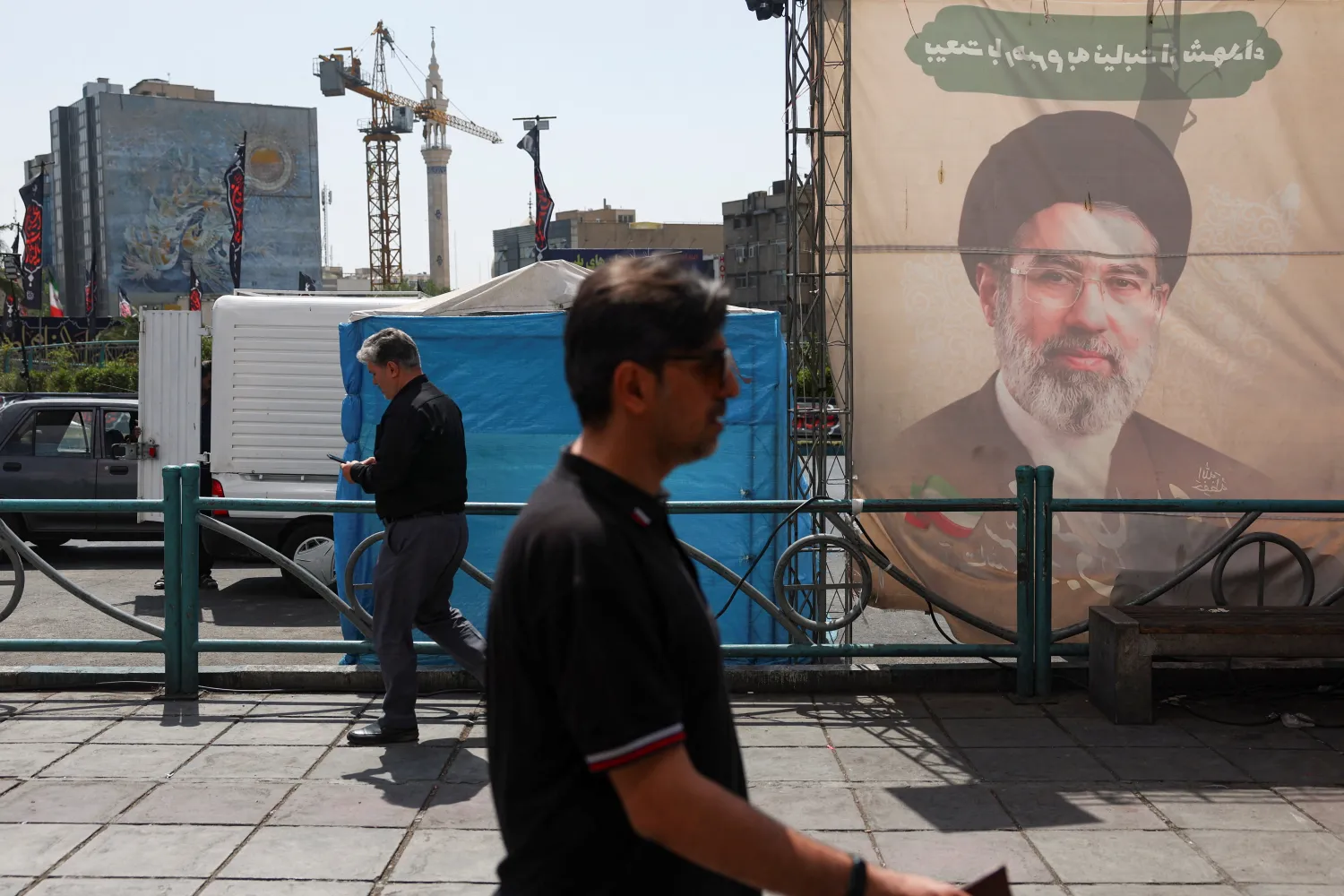
People walk past a banner with a picture of Iran's Supreme Leader, Mojtaba Khamenei, in Tehran, Iran, June 17, 2026. Majid Asgaripour/WANA (West Asia News Agency) via REUTERS
TT

US Push to Get Iran Talks Started Hits an Early Bump Due to Intense Fighting in Lebanon

People walk past a banner with a picture of Iran's Supreme Leader, Mojtaba Khamenei, in Tehran, Iran, June 17, 2026. Majid Asgaripour/WANA (West Asia News Agency) via REUTERS

The American push to quickly begin high-stakes talks with Iran hit a snag Friday, just days after the signing of an agreement that opens a two-month window for negotiations on Tehran's nuclear program and returning oil traffic through the Strait of Hormuz to prewar levels. 

Iranian officials did not travel as planned to Switzerland, insisting that Israeli strikes on Iranian-backed Hezbollah in Lebanon must stop before the talks can take place, according to three regional officials and a person familiar with the matter. They were not authorized to publicly discuss the ongoing mediation to try to get the talks rescheduled and spoke on condition of anonymity. 

The situation was fluid as Israel and Hezbollah agreed on Friday to renew their ceasefire, according to a US official and regional officials. It remains to be seen whether that could help put the US-Iran talks back on track. 

In Washington, President Donald Trump lashed out once again in the midst of the intensified fighting in Lebanon and the stalled nuclear talks. 

“We didn’t meet out of desperation, Iran did,” Trump wrote in a social media post Friday. “They are FINISHED! We’ll play out the 60 days. They get no money, not ten cents!” 

Vance was ready for Swiss talks Trump's vice president, JD Vance, had been prepared to make an overnight flight to meet with his Iranian counterparts at a mountainside resort in the tiny Swiss village of Obbürgen and begin the technical talks. 

Vance's staff and a small group of journalists had gathered at Joint Base Andrews outside Washington in anticipation of the trip. Dozens of White House officials, advance staffers and more media were already in Switzerland. 

Then the trip was called off — abruptly and for the time being. 

A White House statement said Vance, tapped by Trump to lead the negotiations, decided to postpone his travel. It made no mention of the escalating violence in Lebanon. 

“The logistics of these negotiations have never been simple or predictable,” the statement said. 

But, according to officials, the Iranians made clear to the White House that they had balked at starting the talks with Vance because of the Israeli action in Lebanon. 

Fighting in southern Lebanon intensifies  

The fighting had intensified with at least 18 killed by Israeli airstrikes, while four Israeli soldiers were killed in southern Lebanon, officials said. 

Israeli Prime Minister Benjamin Netanyahu said Thursday that Israel’s military would stay in a “security zone” of southern Lebanon as long as “Israel’s security needs require it.” 

Israel and Hezbollah are not parties to the US-Iran agreement. 

Iran insists Israel must withdraw from the large swath of southern Lebanon it is occupying, but the wording of the interim deal does not explicitly require that and only ensures Lebanon’s “territorial integrity.” 

Hours before postponing his trip, Vance gave some indication of the state of flux when he told reporters at a White House briefing that he was uncertain if the talks were going to happen this weekend. 

“We think these technical negotiations start sometime this weekend," Vance said. "That’s still the plan. But that could change.” 

Soon after Vance spoke to reporters, Iran's supreme leader, Mojtaba Khamenei, endorsed direct negotiations with the United States. His terse statement, read by state media, appeared to signal to the Iranian leadership that it could move forward with a first round of talks. 

“It is obvious that the face-to-face negotiations that will be held in the future will not mean accepting the enemy’s opinion,” Khamenei said. 

The messaging seemed to give Khamenei, who was badly wounded in the US strike on Feb. 28 that killed his father, some maneuverability.  

Hard-liners in the Iranian government, including Khamenei’s father, long opposed direct talks with the White House, especially after Trump, during his first term, pulled out of the 2015 nuclear deal negotiated by Democratic President Barack Obama's administration. 

The meeting was initially supposed to be a signing ceremony  

Vance was initially expected to go to Switzerland to sign the agreement at a formal ceremony. Instead, Trump signed the document Wednesday during a glitzy dinner at the Palace of Versailles with French President Emmanuel Macron. Iran's president, Masoud Pezeshkian, separately signed the agreement. 

It says Iran’s stockpile of highly enriched uranium, which is believed to be buried under rubble left by US military strikes last year targeting Tehran’s key nuclear sites, must at minimum be diluted under international supervision. 

It also says Iran shall not procure or develop nuclear weapons — a commitment Tehran has made previously. Other commitments remain to be worked out. 

Iran believes it's in a strong negotiating position Iranians would be going into the talks with a measure of confidence after effectively shutting down the strait, causing global economic reverberations, said Rosemary Kelanic, director of the Middle East Program at Defense Priorities in Washington. 

She said the US is now “essentially trying to negotiate our way back to the prewar status quo." 

Neil Quilliam, an associate fellow with the Middle East and North Africa Program at Chatham House think tank, said the “buoyant” Iranian leadership feels it has the upper hand. The endorsement of the talks by the Iranian supreme leader “sends a very strong signal domestically: ’We’re now on an equal footing with the US.'” 

”‘Trump has gone from calling for regime change on Feb. 28 to this: Now they’re going to sit down with us directly and talk about these big issues,'” Quilliam said of the Iranians' thinking. “So it’s intended more for the domestic audience, and telling them: ‘We are firmly in control of this. There can be no protests, no revolution: We are a new regime and we’re staying put.’” 

Vance has to negotiate through political division  

For Vance, a likely 2028 presidential contender, how the negotiations play out could have enormous ramifications for his political fortunes. 

Vance's skepticism of foreign wars was a core part of his political identity during his political rise, which included election as a US senator. Now he finds himself the chief defender of negotiating an endgame to Trump's conflict that Democrats have largely derided as a foolish gambit.  

Some hawkish Republicans are aghast that Trump is getting behind a settlement that could put billions of dollars into Iran's coffers. 

US Sen. Roger Wicker, chairman of the Senate Armed Services Committee, said aspects of the deal are “completely out of step” with Trump's goals. 

Trump fiercely criticized Obama for the 2015 nuclear agreement, which Trump argued failed to stop Tehran from advancing toward a weapon and funneled billions of dollars to the country. The Republican president exited the US from the deal in 2018. 

Trump has pushed back against comparisons to that earlier agreement, saying he had “negotiated from strength” after a major military campaign while asserting that Obama was paying the Iranians off and not receiving acquiescence. 

Wicker, R-Miss., was particularly concerned about the $300 billion fund for the reconstruction and economic development of Iran mentioned in the 14-point agreement. Trump and Vance have said no US taxpayer money would go to such a fund and it would not come without concessions and reforms by Tehran. 


Iran Says Received US Response to Its Proposal to End War

Vessels in the Strait of Hormuz near the beach of Bandar Abbas, Iran, September 28, 2026. Amirhosein Khorgooi/ISNA/via WANA (West Asia News Agency) via REUTERS
TT

Iran Says Received US Response to Its Proposal to End War

Vessels in the Strait of Hormuz near the beach of Bandar Abbas, Iran, September 28, 2026. Amirhosein Khorgooi/ISNA/via WANA (West Asia News Agency) via REUTERS

Iranian authorities said on Wednesday they received the official US response to their proposal to end the Middle East war, state media reported, days after US President Donald Trump rejected the plan. 

"At today's cabinet meeting, the American side's proposal was presented to President Masoud Pezeshkian by Foreign Minister Abbas Araghchi," government spokeswoman Fatemeh Mohajerani told the official IRNA news agency, without specifying the content of the reply. 

After seven months of conflict, indirect talks between the United States and Iran resumed last week on the sidelines of the UN General Assembly, said AFP. 

Iran said it has put forward seven conditions for ending hostilities and reopening the strategic Strait of Hormuz, a vital route for oil and gas exports. 

The strait lies at the heart of the conflict between the United States and Iran, which began with US-Israeli strikes on Iran in late February. 

Tehran imposed a blockade on Hormuz after the war started, prompting Washington to respond with its own blockade on Iranian ports. 

While not all conditions have been made public, Iran is notably demanding a ceasefire across the Middle East, including in Lebanon, where its ally Hezbollah has been battling Israeli forces. 

It is also demanding the unfreezing of Iranian assets abroad, the lifting of sanctions on its oil sector and an end to the US naval blockade. 

Trump rejected the proposal when speaking to the press on Saturday, but Tehran had been awaiting an official response via Qatari mediators. 

Fighting has subsided in recent weeks, though Tehran has continued to target ships in the strait. 

Iran's Revolutionary Guards, the ideological arm of the country's military, said on Wednesday that they have been striking small vessels that try to pass through the strait. 

"We have been striking ships for quite some time now -- specifically the small vessels I mentioned that attempt to pass. We block their passage, yet the US has not retaliated for a while," Guards spokesperson Hossein Mohebi told state TV. 

The US, meanwhile, has stepped up its economic warfare against Iran, imposing sanctions on Iranian airlines and vowing to take a hard stance against foreign companies that provide them with assistance. 


US Supreme Court Lifts Limits on Third-country Deportations

The United States has deported thousands of migrants to so-called third-countries, including Liberia, as part of US President Donald Trump's immigration crackdown. Matthew Jacobs / AFP
TT

US Supreme Court Lifts Limits on Third-country Deportations

The United States has deported thousands of migrants to so-called third-countries, including Liberia, as part of US President Donald Trump's immigration crackdown. Matthew Jacobs / AFP

The US Supreme Court on Tuesday lifted restrictions on the deportations of immigrants to countries that are not their own, while agreeing to hear the issue on its merits in December.

The conservative-dominated high court granted an emergency request by the Trump administration to suspend a lower court ruling that restricted, but did not outright ban, so-called "third-country removals."

The lower court had said people targeted with deportation must be given effective notice ahead of time about where they are being sent to allow them to raise concerns about potential persecution, said AFP.

The three liberal justices on the nine-member bench said they would not have granted the administration's request.

President Donald Trump campaigned on promises to expel millions of undocumented migrants from the United States and has taken several actions aimed at speeding up deportations since returning to the White House in 2025.

The Trump administration has defended third-country deportations as necessary since the home nations of some of those who are targeted for removal sometimes refuse to accept them.

In a brief to the Supreme Court, opponents of lifting the restrictions argued that the lower court ruling did not fully block all third-country deportations, "it simply requires them to do so lawfully."

Trump's solicitor general, John Sauer, meanwhile told the court that the rapid deportation to third countries was "an essential tool to remove certain aliens, including some of the worst criminal aliens."

The lower court ruling "created substantial logistical problems" with removals, he said.

- 'Indefensible' -

An AFP investigation found that the US has offered multimillion-dollar deals and threatened visa restrictions in a bid to get "third countries," especially in Africa, to take such deportees.

Once in these countries -- and outside US jurisdiction -- deportees have been subject to abuse by local guards, indefinite detention, or quickly re-deported to their home countries.

According to an investigation published last week, the United States has deported more than 25,000 people under secretive agreements with 35 countries to take migrants with no ties to those nations.

The investigation by Forbidden Stories found the administration has earmarked $410 million to be paid directly to the receiving countries, or to United Nations agencies to facilitate the returns.

The vast majority of the deportees -- around 20,000 -- were sent to Mexico, but the rest were dispersed to 27 other countries across Latin America, Africa, and the Pacific, and agreements have been finalized with seven more.

Congress has made it US policy not to deport people to countries where their lives would be in danger or they could be subject to torture.

After the high court's ruling, some Democratic lawmakers were calling for more formalized steps to prevent such deportations and uphold due process.

"Congress must step in. No one should be shipped off to a country that is not their own without basic due process and a meaningful opportunity to raise legitimate fears for their safety," House Democrat Lois Frankel said on X.

Rob Menendez, another congressional Democrat, called the Supreme Court's decision "indefensible."

"Taxpayers shouldn't fund tearing people from the only home they've ever known, nor should our legal system fast-track these unilateral deportations."


US Withdraws from European Anti-Corruption Panel

FILE PHOTO: A general view of a US State Department sign outside the US State Department building in Washington, DC, US, July 11, 2025. REUTERS/Annabelle Gordon/File Photo
TT

US Withdraws from European Anti-Corruption Panel

FILE PHOTO: A general view of a US State Department sign outside the US State Department building in Washington, DC, US, July 11, 2025. REUTERS/Annabelle Gordon/File Photo

The Trump administration has withdrawn the United States from a top European anti-corruption watchdog as it forges ahead with plans to disengage from international and multilateral organizations that it accuses of exceeding their mandates, being inefficient or not adapting to US policies.

The Council of Europe said Tuesday that the US formally notified it a day earlier that it would leave the Group of States against Corruption, or GRECO. Only two other countries have left GRECO before — Russia and Belarus.

The State Department confirmed the move, saying that US participation, which requires an annual monetary contribution, “does not provide tangible benefits to US national security.”

“The era of writing blank checks to international bureaucracies is over,” it said. “The department is instead prioritizing higher-impact tools to combat corruption, such as visa restrictions, sanctions, and targeted foreign assistance to strengthen foreign criminal investigations into corruption directly threatening US security and prosperity.”

The Strasbourg-based Council of Europe said the US had been “a valuable contributor” to GRECO "and to the exchange of experience and good practice in preventing and combating corruption.”

“GRECO remains open to resuming cooperation with the United States in the future in support of shared efforts to prevent corruption, strengthen integrity and uphold the rule of law,” it said in a statement.

The decision was announced a week after the Organization for Security and Cooperation in Europe said the US had declined to invite its members to observe November’s congressional midterm elections, a sharp break from past practice.

The US has already withdrawn from a number of European-based UN and multilateral agencies, including the World Health Organization and the UN Human Rights Council, and is weighing further such steps.

The US withdrew in January from another Council of Europe panel — the Venice Commission, which is an advisory body on constitutional law.

GRECO was created in 1999 by the Council of Europe to monitor compliance with the organization’s anti-corruption standards. Membership is not limited to European Union members, and the United States joined a year after its founding.
