


Iran's Chief Negotiator Says US Talks Bound by Tehran's 'Red Lines'

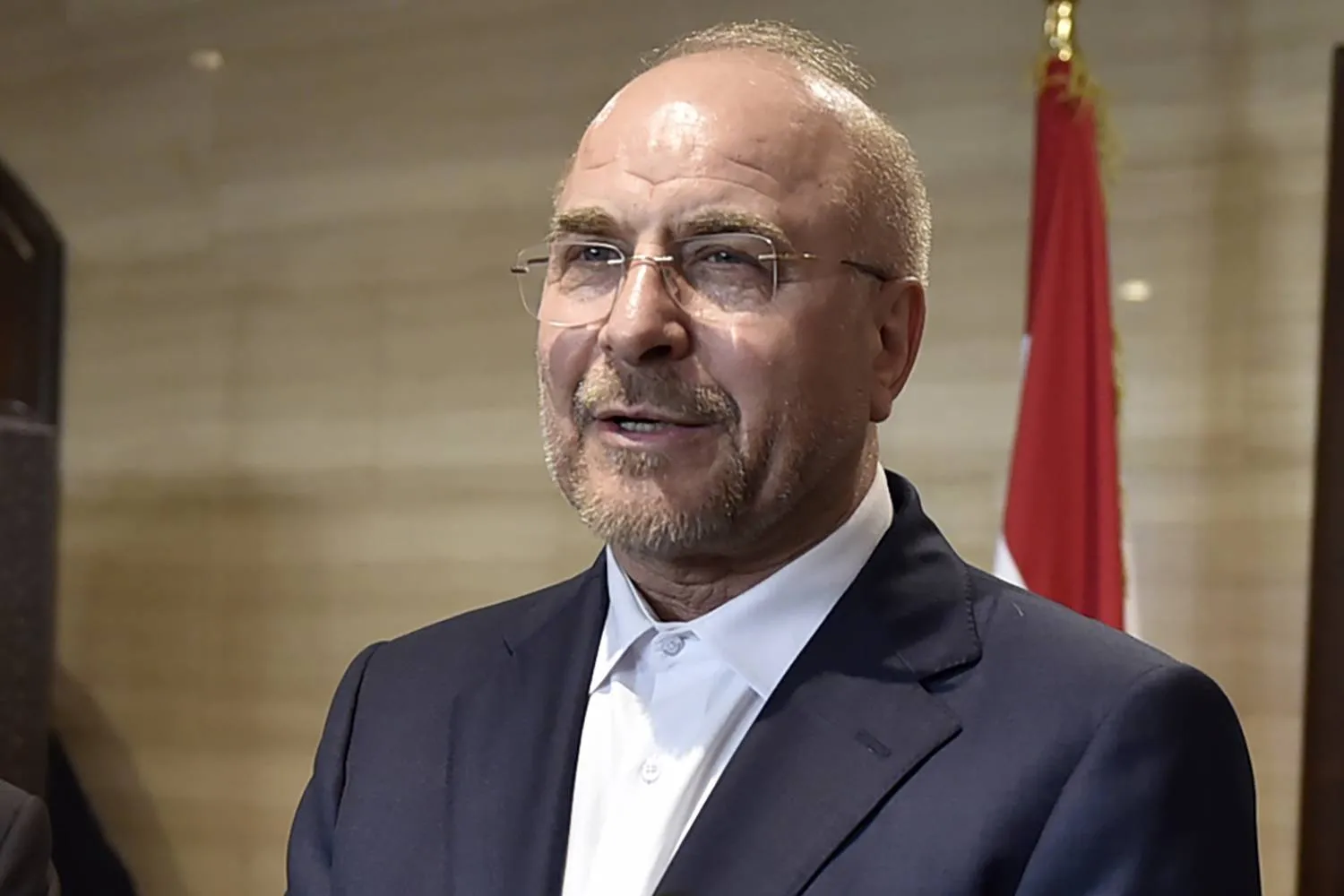
FILED - 12 October 2024, Lebanon, Beirut: Iranian Parliament speaker Mohammad Bagher Ghalibaf speaks during a press conference in Beirut. Photo: Hassan Ibrahim/Lebanese Parliament/dpa
TT

Iran's Chief Negotiator Says US Talks Bound by Tehran's 'Red Lines'

FILED - 12 October 2024, Lebanon, Beirut: Iranian Parliament speaker Mohammad Bagher Ghalibaf speaks during a press conference in Beirut. Photo: Hassan Ibrahim/Lebanese Parliament/dpa

Iran's chief negotiator Mohammad Bagher Ghalibaf said on Friday that talks with the United States would remain bound by Tehran's "red lines".

"As we have shown in the past path of negotiations, we are steadfast in fulfilling the conditions and red lines set, and in achieving the interests of the Iranian nation," Ghalibaf said in remarks published by the official IRNA news agency.

"If the enemy seeks to be excessive, we have proven that our fingers are on the trigger and we have no hesitation in giving a crushing response to the enemy."

Tehran and Washington signed a memorandum of understanding this week ending a regional war that erupted on February 28 with US-Israeli strikes on Iran.

Ghalibaf's remarks came after Iran's supreme leader Mojtaba Khamenei said he had approved the US-Iran deal despite having a "different view" on the matter, without elaborating.

In a message read out on state television, Khamenei said that direct talks with the United States "will not mean accepting the enemy's point of view".

In response to Khamenei's message, Foreign Minister Abbas Araghchi said the country's foreign policy apparatus "will be used to secure the sublime interests of Iran" and "protect the rights of the noble Iranian nation".

President Masoud Pezeshkian, who signed the deal on behalf of his country, issued a similar statement promising to adhere to Iran's red lines and defend its "dignity, honor and authority".

The US-Iran deal, which US President Donald Trump also signed, lays the groundwork for detailed 60-day negotiations on Iran's nuclear program and sanctions relief.

It remains unclear when talks for a final settlement would start after a first meeting in Switzerland slated for Friday was postponed.

The agreement provides for an end to the Middle East war on all fronts, including Lebanon, the lifting of the two-month US naval blockade on Iranian ports, and Tehran's reopening of the Strait of Hormuz "with no charge for 60 days only".

It also includes an Iranian commitment not to procure or develop nuclear weapons -- an ambition Tehran has consistently denied pursuing.

Conservatives in Iran appeared deeply skeptical of the deal and US intentions, with some expressing concern that Tehran could be giving up key sources of leverage before securing compensation and sanctions relief.

"The Americans do not honor to any commitments, they have not been loyal to any agreements, and they will not be," said Hossein Shariatmadari, editor-in-chief of the ultraconservative Kayhan newspaper, in an interview with state television on Thursday.

He added: "The Strait of Hormuz is the way to get compensation."

Ebrahim Rezaei, spokesman for parliament's national security commission, took issue with reports of possible inspections of Iranian nuclear facilities by a UN watchdog.

"I hope the government denies this, but if this claim is true... the parliament will stand up to lawlessness and disobedience," he said in a post on X.



Netanyahu Says ‘Toppling’ Iran Government Only Way to End Threat

Israeli Prime Minister Benjamin Netanyahu and Defence Minister Israel Katz attend a graduation ceremony of new Israeli army officers at a base near Mitzpe Ramon, Israel, October 21, 2026. (Reuters)
TT

Netanyahu Says ‘Toppling’ Iran Government Only Way to End Threat

Israeli Prime Minister Benjamin Netanyahu and Defence Minister Israel Katz attend a graduation ceremony of new Israeli army officers at a base near Mitzpe Ramon, Israel, October 21, 2026. (Reuters)

Israeli Prime Minister Benjamin Netanyahu said on Wednesday that the only way to remove the threat posed by Iran was to topple its government.

"Iran wanted to destroy us; we stopped them. They wanted to produce nuclear bombs; we stopped them... Yet they persist," he said during an election rally in the southern town of Dimona. "Therefore, there is only one way to end this: by toppling this regime."

"This is the directive I have issued to the Israel Defense Forces, to the Mossad, and to all our security branches," he added, without specifying when or how that directive would be executed.

The saber-rattling came as the premier headed into the last week of a tight race for re-election.

Netanyahu had instructed the Israeli military to plan for resumed strikes against Iran earlier this month, according to sources cited by the Financial Times on Wednesday, but US President Donald Trump reportedly objected to the idea.

The US leader has publicly said that he does not intend to restart the war, which Washington started in February alongside Israel, before the US mid-term elections early next month.

This week, Netanyahu thanked Trump in a video for his endorsement in the Israeli election, and said that the two leaders have "a job to finish" in Iran.

Israeli Defense Minister Israel Katz also warned against a potential threat from Iran.

Speaking at an officers' graduation ceremony in southern Israel on Wednesday, he said that "the Iranian regime is at its weakest point ever, and we recognize that this weakness could lead it to take the most extreme steps".

"If Iran attacks Israel, Iran will burn!" he said.

Katz also warned against unspecified attempts by Israel's enemies to disrupt the upcoming vote.

"In recent days, we have identified attempts by our enemies -- led by Iran and its proxies -- to advance attacks that could affect the outcome of Israel's elections," he said.


US Democratic Congressional Candidate Lander Detained by Israeli Authorities in West Bank

 Members of Israeli forces block a road, preventing Palestinians from harvesting olives in their groves in the West Bank village of Deir Jarir, Wednesday, Oct. 21, 2026. (AP)
Members of Israeli forces block a road, preventing Palestinians from harvesting olives in their groves in the West Bank village of Deir Jarir, Wednesday, Oct. 21, 2026. (AP)
TT

US Democratic Congressional Candidate Lander Detained by Israeli Authorities in West Bank

 Members of Israeli forces block a road, preventing Palestinians from harvesting olives in their groves in the West Bank village of Deir Jarir, Wednesday, Oct. 21, 2026. (AP)
Members of Israeli forces block a road, preventing Palestinians from harvesting olives in their groves in the West Bank village of Deir Jarir, Wednesday, Oct. 21, 2026. (AP)

Brad Lander, a US Democratic Party candidate for Congress, was detained by Israeli forces in the occupied West Bank on Wednesday, along with other Americans, Israelis and Palestinians taking part in the annual olive harvest, rights groups said.

The incident took place in Nahalin, a village south of Bethlehem, as Palestinians were gathering olives accompanied by around 80 volunteers, according to Israeli organization Rabbis for Human Rights and Jewish North American organization T'ruah.

Lander, a Jewish American and former New York City comptroller and mayoral candidate, wrote on X that he had been detained along with a group of rabbis and volunteers.

"We were simply harvesting olives in a grove near Nahalin in the West Bank. The occupation is a crime under international law. Harvesting olives isn't a crime under any law I know."

Lander, who is an ally of New York Mayor Zohran Mamdani and has been critical of Israel's conduct in the war in Gaza, was later released, according to Rabbis for ‌Human Rights and T'ruah.

Lander, ‌who is running for New York's 10th Congressional District in the US House of Representatives ‌in ⁠the November 3 midterm ⁠elections, was not immediately available for comment.

Israeli police said it had detained Palestinian olive harvesters and dozens of Israeli and foreign activists gathering olives near the fence of an Israeli settlement, saying it was prohibited. One of the foreign nationals was later released once it became known he was a congressional candidate, police said.

The military said harvesting in that area required prior coordination, which had not happened, and that those present had been detained. It did not say harvesting there was prohibited.

Lander is the only one released so far, while the others are expected to be interrogated, according to Rabbis for Human Rights Acting Director Anton Goodman.

"I would suggest to all activists go out there and get yourself elected," he said.

HARVEST ⁠AREA DECLARED A CLOSED MILITARY ZONE

The volunteers were accompanying local farmers gathering olives who often ‌are faced with the threat of violence from Israeli settlers, as an act of ‌solidarity in what is known as protective presence.

Israeli settler violence against Palestinians is surging, while the Israeli military continues to curb Palestinian freedoms, including access to ‌farmland.

Olives are the backbone of Palestinian agriculture, a sector that accounts for around 8% of GDP and more than 60,000 jobs, according ‌to the Palestinian Authority's agriculture ministry.

Rabbis for Human Rights and T'ruah said Israeli military and police forces arrived around two hours after the Palestinians and volunteers began gathering olives and informed them that they were in a closed military zone and would be detained.

Goodman said they were not aware the area had been declared a closed military zone since it had only been issued that morning, but they told the Israeli forces they would respect ‌the order and leave.

"However, we were told that we cannot leave because we have been disturbing the public order," he said by phone, speaking from a police station in the Israeli Betar Illit ⁠settlement.

"If you would have come ⁠to our harvest earlier today, you would have found a place that was quiet and peaceful and respectful and definitely not harming any of the public order."

Among those detained were over 30 US citizens, as well as UK and Canadian citizens, according to Rabbi Jill Jacobs, chief executive of T'ruah, who is among those who have been detained.

"We were obviously not doing anything violent but just the very act of picking olives together with Palestinian farmers was apparently disturbing for some," Jacobs, a 51-year-old rabbi from Manhattan, told Reuters by phone.

A spokesperson for the US Embassy in Jerusalem said it was aware of reports that US citizens had been detained and was monitoring the situation but declined further comment, citing privacy and other considerations.

"The Trump administration has no higher priority than the safety and security of Americans," he said.

Israeli settler attacks against Palestinians and other civilians in the West Bank over the weekend prompted a call by US Secretary of State Marco Rubio on Saturday for Prime Minister Benjamin Netanyahu's government to crack down on the violence.

An American photojournalist for the Washington Post covering a Palestinian olive harvest on Friday was beaten by Israeli settlers, while European diplomats and a French mayor were attacked at another Palestinian olive harvest by settlers on Saturday.

Palestinians were attacked by settlers in both incidents.

Israeli police announced on Monday it had made 10 arrests in connection with the weekend violence.


Greek Students, Teachers, Civil Servants Plan Protests

Protesters take part in a rally organized by teachers and students demanding improvements to education and measures to address the rising cost of living in Athens, Greece, Wednesday, Oct. 21, 2026. (AP Photo/Thanassis Stavrakis)
TT

Greek Students, Teachers, Civil Servants Plan Protests

Protesters take part in a rally organized by teachers and students demanding improvements to education and measures to address the rising cost of living in Athens, Greece, Wednesday, Oct. 21, 2026. (AP Photo/Thanassis Stavrakis)

Students, teachers and civil servants will rally in Greece on Wednesday to protest against the high cost of living, saying they face the same problems that sparked violent demonstrations in France at the weekend.

Gatherings are expected around midday (0900 GMT) in Athens and Thessaloniki, the country's second-largest city.

"In Greece like in France, we are demanding public, free education," Katia Koubousidou, head of a student union at the Aristotle University of Thessaloniki, told AFP.

"This will not be a one-off protest. We have a plan to continue our demonstrations."

Dozens of students set up tents in Syntagma Square, facing Parliament, in Athens, and on a pedestrian street in Thessaloniki on Tuesday.

The civil servants' union has also called for a work stoppage and a gathering in Athens.

Secondary school pupils and teachers are protesting about a lack of infrastructure, a shortage of staff and increased public spending on education.

The conservative Greek government has sought in recent days to avoid any parallel with the protests and violence in France.

Prime Minister Kyriakos Mitsotakis said on Monday that the country would "never return to the era of great social unrest" during the financial crisis over a decade ago, marked by unpopular austerity measures.

French cities were hit by some of the country's worst rioting in recent years on Saturday, with public buildings torched, hundreds of shops looted and more than 2,000 people arrested.