

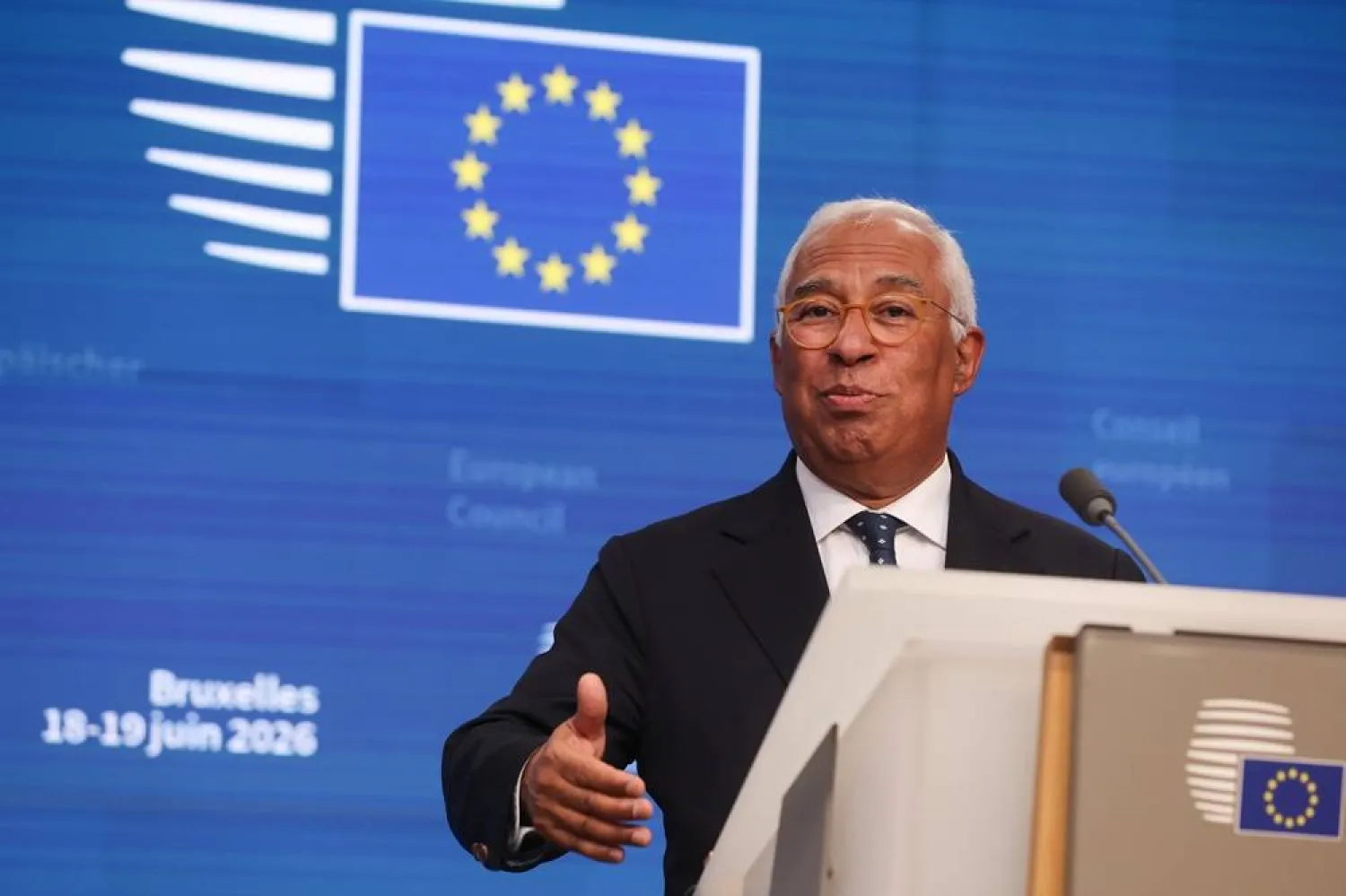

EU Leaders Squabble Over Outreach to Moscow as Ukraine War Rages on

European Council President Antonio Costa speaks during a press conference at the end of European Council summit in Brussels, Belgium, 19 June 2026. (EPA)
TT

EU Leaders Squabble Over Outreach to Moscow as Ukraine War Rages on

European Council President Antonio Costa speaks during a press conference at the end of European Council summit in Brussels, Belgium, 19 June 2026. (EPA)

European Union leaders have been unable to agree on setting up a back-channel with Moscow to ensure that the bloc’s interests are protected should progress be made in negotiations to end Russia’s war on Ukraine, some of them said on Friday.

European Council President Antonio Costa, who chaired their two-day summit, had directed his office to reach out to the Kremlin and proposed a senior official to make contact. Costa said his aim was not to mediate or set up a parallel negotiating track to the one led by the United States, which is making little progress.

Debate has been swirling around Europe in recent months about whether to appoint a mediator for talks with Russia to help get things moving again, but this has been largely rejected as many believe that Russian President Vladimir Putin would be unlikely to negotiate anyway.

Instead, the 27 EU countries have focused on concessions that Russia should make to secure peace.

Speaking to reporters, Czech Prime Minister Andrej Babiš said the leaders had failed to resolve their differences over the approach overnight. “Europe is unable to agree even on whether there will be negotiations or who will lead them,” he said.

Irish Prime Minister Micheál Martin said that “opening up a channel is not a mistake in our view, and I trust António Costa.”

“What was very clear last evening is that any negotiations would have to be first and foremost between Ukraine and Russia, but there are no indications that Russia is coming to the table at all,” he said.

German Chancellor Friedrich Merz stressed that peace negotiations must ultimately be conducted by Ukraine, Russia, Europe and the US.

“Who speaks for the European Union is something we don’t need to decide on today,” he said. “We will decide on that when talks come about.”

He added that Costa has “an important to role to play” as president of the European Council, representing the EU, preparing and organizing summits, and “we don’t need to make decisions going beyond that at the moment.”

Merz highlighted efforts to coordinate diplomacy by the so-called E3 group of countries — Germany, France and Britain — a format that he said came about “at the explicit wish of Ukraine.”

Putin has tried to cut out Europe and Kyiv from negotiations with the US over Ukraine’s future. But the Kremlin said on Friday it was “ready for contact” with Europe, on the condition it abandon its desire to talk to Moscow from the position of force.

At the same time, Russian Foreign Minister Sergei Lavrov argued that the EU can not be an impartial peace broker. He again rejected Western claims that Moscow was harboring plants to attack Europe as “provocation” and “nonsense” while warning that Europe’s military buildup poses growing security threats.

“A direct confrontation between NATO and Russia could rapidly escalate into an exchange of nuclear strikes, with catastrophic consequences,” Lavrov said in an essay released by the Russian Foreign Ministry.

As the leaders left their meeting overnight, Belgian Prime Minister Bart De Wever joked that Costa would be the envoy to Moscow.

“I was just talking about you, António,” De Wever said while laughing and shaking Costa’s hand. “I was full of praise, saying you are the only one who can represent us and that we will send you to Moscow.”

Margus Tsahkna, foreign minister of Estonia — a nation on the EU’s eastern flank that has faced drone incursions and was once occupied by the Soviet Union — said that “Europe must not assume the role of a neutral mediator” and instead buttress Ukraine’s position to “force the Kremlin into serious negotiations.”



Israel Defense Minister Says ‘Mission Not Complete’ on Iran

Then Israeli transportation minister Israel Katz attends the cabinet meeting at the Prime Minister's office in Jerusalem February 17, 2019. (Reuters)
TT

Israel Defense Minister Says ‘Mission Not Complete’ on Iran

Then Israeli transportation minister Israel Katz attends the cabinet meeting at the Prime Minister's office in Jerusalem February 17, 2019. (Reuters)

Israel is not finished with Iran, its defense minister said Sunday, as he renewed charges that Tehran is pursuing nuclear weapons, which the country has long denied.

"With regard to Iran, the mission is still not complete. Iran is trying to renew its efforts to obtain nuclear weapons -- alongside other grave efforts that place the State of Israel in real danger," Defense Minister Israel Katz said at a ceremony.


US Launches Task Force to Disrupt Land Transit Routes into Iran

A banner depicting US President Donald Trump, Israeli Prime Minister Benjamin Netanyahu, US Vice President JD Vance and US Special Envoy Steve Witkoff is displayed on a street in Tehran, Iran, November 4, 2026. Majid Asgaripour/WANA (West Asia News Agency) via REUTERS
TT

US Launches Task Force to Disrupt Land Transit Routes into Iran

A banner depicting US President Donald Trump, Israeli Prime Minister Benjamin Netanyahu, US Vice President JD Vance and US Special Envoy Steve Witkoff is displayed on a street in Tehran, Iran, November 4, 2026. Majid Asgaripour/WANA (West Asia News Agency) via REUTERS

The US military has announced it will create a 20-member task force to find ways to disrupt land routes into Iran that it says are used for shipments of weapons and illicit materials.

The restrictions would expand on a US naval blockade of Iranian ports during the two countries' eight-month war, in which Tehran has also restricted passage through the critical Strait of Hormuz trade route, choking global energy supplies, AFP said.

The task force's work "will further constrain Iran's ability to finance terrorism, rebuild weapons factories, and replenish their military," US Central Command chief Brad Cooper said in a statement posted on X on Saturday.

The team of both civilian and military personnel based in Florida would coordinate with US government agencies on "preventing the movement of advanced weapons systems, dual-use technologies, sanctioned materials, and illegal revenue streams across Iran's land borders and the Caspian Sea," the statement added.

The United States imposed a blockade on Iranian ports early in the war in response to Tehran seeking to limit traffic through the strategic Strait of Hormuz, where around a fifth of global oil trade normally passes.

That blockade has halted around $25 billion in crude oil exports from Iran, according to the US Central Command.


Thick Smoke at Tehran Refinery Caused by Safety Flaring, No Fire Reported

A man uses umbrella while walking under a rain around traditional main bazaar of Tehran, Iran, Saturday, Nov. 7, 2026. (AP)
TT

Thick Smoke at Tehran Refinery Caused by Safety Flaring, No Fire Reported

A man uses umbrella while walking under a rain around traditional main bazaar of Tehran, Iran, Saturday, Nov. 7, 2026. (AP)

Thick smoke and flames seen rising from Tehran's oil refinery on Sunday were caused by activation of its flare systems ‌after electrical ‌and technical problems, ‌the ⁠refinery's public relations ⁠office was reported as saying by the oil ministry's news outlet, Shana.

The ⁠refinery said the ‌systems ‌had been activated ‌to release excess ‌gases in accordance with industrial safety procedures.

It said no ‌fire had broken out in its ⁠processing ⁠units, the situation was under control and teams were working to restore normal operations.

Fuel production and supply continued without interruption, it added.