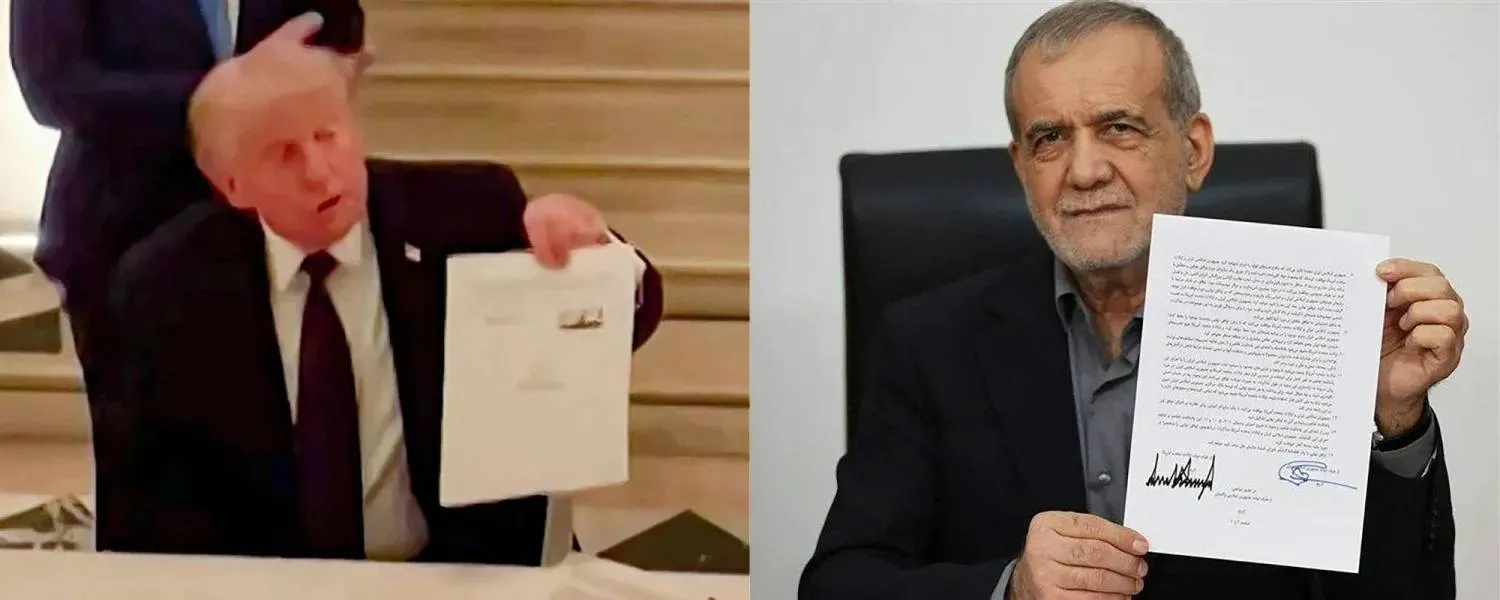
Obama on Iran Deal: We’re Maybe a Little Bit Worse Off

US President Donald Trump and Iranian President Masoud Pezeshkian have signed a memorandum of understanding aimed at ending the conflict that has roiled the Middle East since late February (AFP)
TT

Obama on Iran Deal: We’re Maybe a Little Bit Worse Off

US President Donald Trump and Iranian President Masoud Pezeshkian have signed a memorandum of understanding aimed at ending the conflict that has roiled the Middle East since late February (AFP)

Former US President Barack Obama said while he is happy to see a ceasefire, it seems like the United States is “worse off” now than before President Donald Trump launched the war on Iran in February.

The former president noted that under the Iran nuclear deal negotiated during his administration, “Iran had agreed not to develop nuclear weapons.”

“This administration, or a prior version of this administration, pulled out of it, which caused then Iran to develop more nuclear capacity,” Obama said in an interview with “TODAY” co-host Craig Melvin that aired Friday.

“We’ve now fought a war, spent billions and billions of dollars, you know, put enormous strain on our military. A lot of people have died. And it feels like we’re back where we were before we started the war, except maybe a little bit worse off,” Obama said.

Trump signed a memorandum of understanding during a dinner at the Palace of Versailles on Wednesday night. It sets a 60-day deadline for negotiators to reach a more permanent deal to end the conflict.

Switzerland announced on Friday that planned talks following up on the deal to end the Middle East war had been postponed, hours after US Vice President JD Vance’s departure for the Alpine country was cancelled.

“The planned talks between the US, Iran, Qatar and Pakistan have been postponed,” the Swiss foreign ministry said in a message to AFP.

“Switzerland remains ready to facilitate these talks. The relevant preparatory work at Burgenstock is continuing,” it added, without providing a new date for the talks.

Nothing on Missiles

Trump and his administration sought to defend the memorandum.

On Thursday, Vance defended the “win-win” US-Iran agreement as critics slammed its vague provisions.

Trump said on social media that those who see problems with the memorandum are “fools” and either “jealous, bad people, or stupid.”

But AFP quoted experts as saying that although Iran suffered billions in damages and heavy blows from US and Israeli airstrikes, Tehran emerged from the conflict in a stronger geopolitical position.

They said Iran was already engaged in indirect talks before the war, and has now greater influence over the Strait of Hormuz.

Also, the memorandum mentioned nothing about Iranian conventional military forces (including missiles and drones) or support for proxies such as Hamas, Hezbollah, and the Houthis.

Experts expect Iran to make no concessions on these two files in future talks.

Richard Haass, former president of the Council on Foreign Relations, wrote on Thursday: “Nothing in the MOU prejudices, one way or the other, the future status of the stock of enriched uranium in Iran, new enrichment-related activities, or inspections.”

“It's a much worse situation strategically for the US now than it was back in the 2010 to 2015 time period,” said Alan Eyre, distinguished diplomatic fellow at the Middle East Institute.

“The Iranian nuclear program is a lot more advanced now” -- though its nuclear facilities and enrichment ability were set back by US strikes last year -- and “there's a lot less bilateral trust,” said Eyre, one of the negotiators of the 2015 deal.

By attacking Iran, Washington has already played what would have been a major card: the threat of military force.

“We used it, and they're still standing. So what are we going to threaten them with?” Eyre said. “We have failed strategically, despite our military preeminence. Iran succeeded in that Iran's goal in this war was to survive.”

The memorandum of understanding -- signed by Trump and his Iranian counterpart Masoud Pezeshkian on Wednesday -- says Iran “reaffirms that it shall not procure or develop nuclear weapons,” but provides no mechanism for that to be verified or enforced.


After Fridge Hacks, Home Appliances Could Be Next, Warns EU Cyber Chief

A notice informing customers that refrigerators are temporarily out of service is displayed on an empty refrigerated case at the Delhaize Shop & Go store after an overnight IT incident affected cooling and freezer systems in a number of Delhaize stores in Belgium and Luxembourg, causing temperature spikes in refrigeration units, in Linkebeek near Brussels, Belgium, November 2, 2026. (Reuters)
TT

After Fridge Hacks, Home Appliances Could Be Next, Warns EU Cyber Chief

A notice informing customers that refrigerators are temporarily out of service is displayed on an empty refrigerated case at the Delhaize Shop & Go store after an overnight IT incident affected cooling and freezer systems in a number of Delhaize stores in Belgium and Luxembourg, causing temperature spikes in refrigeration units, in Linkebeek near Brussels, Belgium, November 2, 2026. (Reuters)

After recent attacks on supermarket fridges, home appliances could be next, the EU's cyber chief told AFP on Tuesday, as he urged Europe to invest more to counter growing cyber threats.

Supermarkets in at least 12 European countries were hit by cyberattacks in October and November, with France the worst affected.

"Security should not and cannot be an afterthought," Juhan Lepassaar, executive director of the EU's cybersecurity agency ENISA, said.

"Today it was fridges, tomorrow it could be routers, the day after tomorrow it could be home appliances and so forth."

Lepassaar spoke to AFP in Brussels where he unveiled the Athens-based agency's latest biennial report on the state of the EU's cybersecurity.

"All incidents can be avoided, but the question is, are we ready to invest to make it happen? Cybersecurity is not cheap," he said, calling on manufacturers to make products that are secure "by design".

Cybersecurity is crucial, Lepassaar said, because "every single service that you are depending on as a citizen, as a human being, contains a layer whereby there is a digital element in it, a piece of code which if not protected can be hacked."

A worst-case scenario would mean losing services "you depend upon: the policemen arriving, the fire brigade arriving, the hospital functioning, the transport giving you a ride from point A to B."

"These are the things that we depend on to function well and 24-7," he explained. "And if they don't, we will have an immediate impact."

Hundreds of French supermarkets were hit in cyberattacks on October 11 and 12, which raised the temperatures in their refrigerators and freezers, forcing many to throw away entire inventories of perishable food.

France on Monday said it held Iran's Revolutionary Guard Corps (IRGC) responsible for the cyberattacks on supermarkets.

Lepassaar would not comment directly on France's accusation, but said Iranian and Russian "state-aligned actors" were known to target Europe.

He pointed to "a lot of collaboration" between them.

"China, Iran, People's Republic of North Korea, there are a lot of state-aligned threat actors which do target European companies and European interests," Lepassaar said.

He welcomed EU cyber rules that will fully enter into force next year, and the bloc's plans to "double the size of ENISA and also its resources."

It would "never" be enough, he said, "but it is a first good step".


Lavrov Says Russia Cannot Agree to Immediate Ukraine Ceasefire Without Knowing What Will Happen Next

30 October 2026, US, Atlanta: Russia's Foreign Minister Sergei Lavrov (C) attends the G20 foreign ministers' meeting chaired by US Secretary of State Marco Rubio in Atlanta. Photo: Michael Kappeler/dpa
TT

Lavrov Says Russia Cannot Agree to Immediate Ukraine Ceasefire Without Knowing What Will Happen Next

30 October 2026, US, Atlanta: Russia's Foreign Minister Sergei Lavrov (C) attends the G20 foreign ministers' meeting chaired by US Secretary of State Marco Rubio in Atlanta. Photo: Michael Kappeler/dpa

Russian Foreign Minister Sergei Lavrov said on Tuesday that Russia would not agree ‌to ‌an immediate ceasefire ‌in ⁠Ukraine without knowing ⁠what would happen next.

It would be wiser to ⁠discuss the ‌outlines ‌of the ‌future security architecture ‌in Europe first, and then a ‌ceasefire in Ukraine, Lavrov said, referring ⁠to ⁠the trilateral talks between Russia, Ukraine and the US in Abu Dhabi


Iran Calls on US to Meet Its Demands to End War

A drone view shows vessels in the Strait of Hormuz, as seen from Musandam, Oman, June 15, 2026. (Reuters)
TT

Iran Calls on US to Meet Its Demands to End War

A drone view shows vessels in the Strait of Hormuz, as seen from Musandam, Oman, June 15, 2026. (Reuters)

Iran on Tuesday urged the United States to meet its demands in a plan to reopen the Strait of Hormuz, after President Donald Trump spoke of "positive momentum" to end their eight-month war.

"The conflict with Iran will not be resolved through military means, nor by intensifying sanctions," Foreign Minister Abbas Araghchi told Iran's IRNA news agency.

"The only solution is to adopt a language of respect, engage in diplomacy, and address Iran's demands and conditions -- which were outlined in the two-day proposal and remain on the table."

Tehran has proposed reopening Hormuz, which it has blockaded since the start of the war, within two days in return for Washington meeting a raft of conditions.

These include ending the war on all fronts, unfreezing Iranian assets, lifting oil sanctions and ending the US counter-blockade of Iranian ports.

Trump, whose Republican party last week lost midterm elections in part due to the war, said on Monday that there was "positive momentum" towards ending the conflict after meeting Qatar's prime minister at the White House.

In a post on social media, Trump reiterated that the US was "locked and loaded" but said further strikes were "quite unlikely".

"We are seeing positive momentum toward an end to this conflict, and will ensure that America's interests are at all times protected," Trump said.

Diplomatic efforts, led by Qatar and Pakistan, are underway to find a resolution to the war, which broke out in late February when US-Israeli strikes killed Iran's supreme leader Ali Khamenei.

On Tuesday, Iran's security chief Mohsen Rezaei urged Washington to "surrender" to the Iranian demands.

"The war on Iran has already wrecked the US government. But Washington flails like a desperate gambler. FOLD YOUR HAND. STOP manufacturing FAKE NEWS about imaginary talks," said Rezaei, the head of Iran's Supreme National Security Council, in a post on X.