Russian Strikes Kill Three in Eastern Ukraine

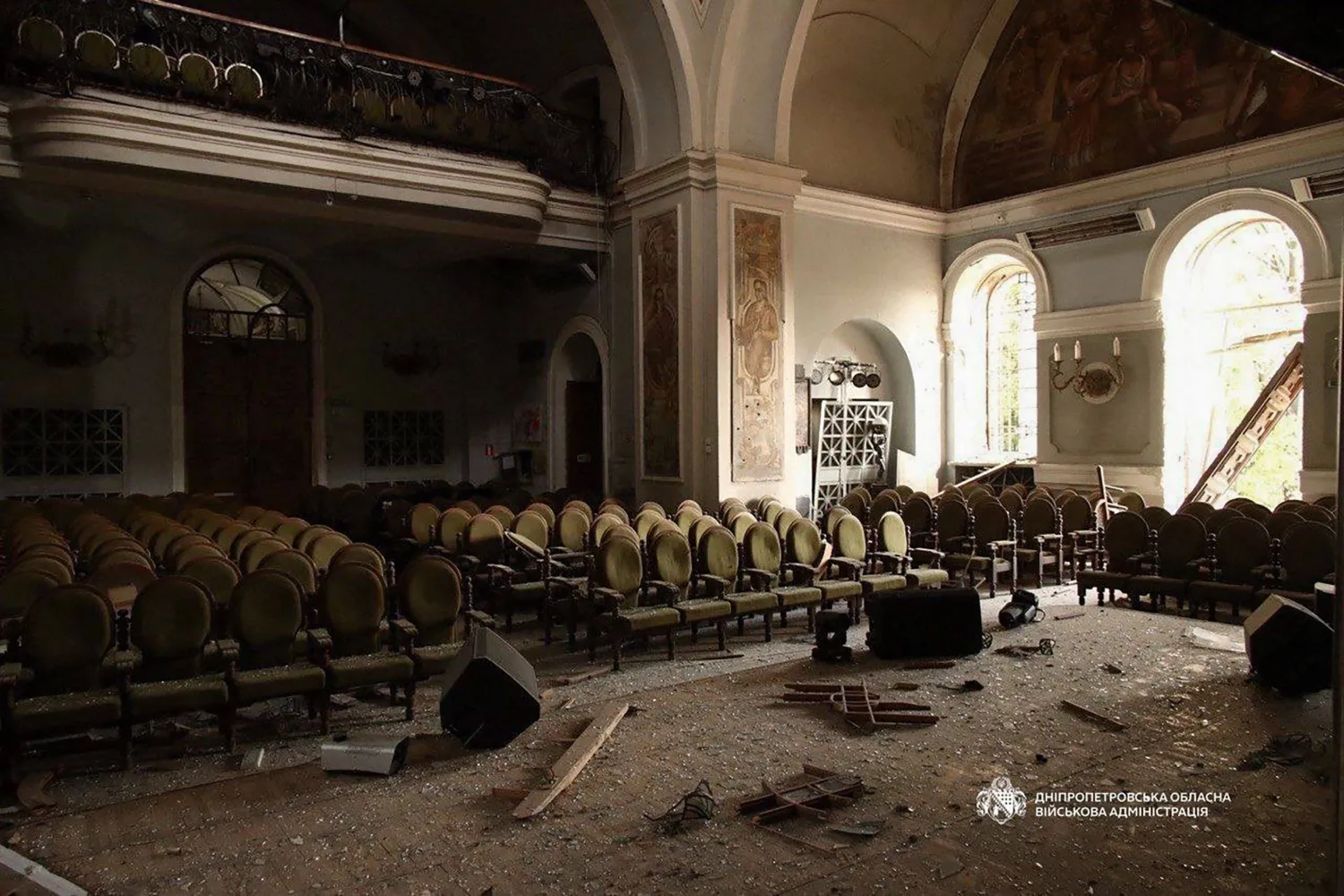
This handout photograph posted on the official Telegram channel of the Head of the Dnipropetrovsk Regional Military Administration on June 15, 2026 shows damage to the House of Organ and Chamber Music in Dnipro, amid the Russian invasion in Ukraine. (Handout / Telegram / @dnipropetrovskaODA / AFP)
TT

Russian Strikes Kill Three in Eastern Ukraine

This handout photograph posted on the official Telegram channel of the Head of the Dnipropetrovsk Regional Military Administration on June 15, 2026 shows damage to the House of Organ and Chamber Music in Dnipro, amid the Russian invasion in Ukraine. (Handout / Telegram / @dnipropetrovskaODA / AFP)

Russian attacks killed three people in the Dnipropetrovsk and Poltava regions in eastern Ukraine, local authorities said on Sunday.

Moscow and Kyiv have escalated attacks on each other in recent weeks, as US-led talks on ending the conflict that began in February 2022 remain effectively frozen.

"One person was killed and nine were wounded" in Russian strikes in three districts of Dnipropetrovsk, head of the regional military administration Oleksandr Ganzha wrote on Telegram.

The fatality was a 70-year-old woman in the Nikopol district, according to Ganzha.

Vitali Dyakivnych, head of the Poltava regional military administration, said a Russian strike on Saturday evening killed two people and wounded 13, including six children.

Russia's defense ministry said it had shot down 239 Ukrainian drones overnight.


Bolivia Declares State of Emergency, Deploys Military to Quell Protests

A member of the Bolivian police patrols the streets during a roadblock clearance operation in Achica Arriba, Bolivia, Saturday, 20 June 2026. (EPA)
TT

Bolivia Declares State of Emergency, Deploys Military to Quell Protests

A member of the Bolivian police patrols the streets during a roadblock clearance operation in Achica Arriba, Bolivia, Saturday, 20 June 2026. (EPA)

Bolivia's president declared a state of emergency on Saturday and deployed soldiers and bulldozers to raze anti-government roadblocks that have paralyzed the Andean nation.

For more than six weeks, unions, Indigenous groups and coca farmers have marched through cities and blocked roads across the country with rubble, logs and debris in protest against the conservative government.

Major cities have suffered acute shortages of fuel, food and medicine, the economy has lost billions of dollars, and the protests have threatened to topple Bolivia's first non-socialist government in two decades.

President Rodrigo Paz appeared in a predawn televised address on Saturday to warn protesters they would face "the full force of the law" as he moved to end the crisis.

He declared a 90-day state of emergency, which curbs the right to protest and allows the military to be deployed domestically.

Hours after his address, AFP reporters in the city of El Alto saw squads of soldiers and armed police moving in a convoy as bulldozers moved in to clear roadblocks.

Some residents clapped as they passed. One man handed a bag of bread to a police officer riding in the back of a pickup truck.

"I'm very happy," Carla Butron, a 39-year-old shopkeeper, told AFP.

"Everything has been difficult here in El Alto during these 50-some days -- work, free movement."

- 'Held hostage by blockades' -

In nearby La Paz, military police and navy personnel guarded the presidential palace and police tactical units were stationed on main squares.

"Bolivians cannot continue to be held hostage by blockades that prevent them from working, studying, receiving medical care, getting supplies and bringing food to their homes," Paz said in a social media post.

"This state of emergency is not intended to take away normalcy, but to restore it."

The protesters want Paz to abandon liberal economic reforms and step down, less than a year after he was elected.

The 58-year-old had signaled he was ready to negotiate and, earlier this week, agreed to a deal with one of the country's major unions to end the crisis.

In exchange for a promise not to privatize state companies and to hold further talks, the Bolivian Workers' Central union agreed to end their protests.

But some Indigenous groups have vowed to fight on, and more than 40 major roadblocks remain.

"We want him gone. We don't want him to be the one governing," Lidia Callisaya, a 42-year-old Aymara leader, told AFP recently.

- Standoff -

But some Bolivians are ready to see an end to the disruption.

On the road to La Paz, truck driver Erland Richard Segovia, 49, was hoping to make it to Santa Cruz, farther east.

"They abandoned us on the road, we have to wait. Now, at least we're seeing that traffic is starting to get back to normal," he said.

Paz has accused "narcoterrorists" -- and in particular former president Evo Morales -- of being behind the road-blocking protests.

Morales, a leftist firebrand, Indigenous leader and former coca farmer, was president from 2006 to 2019.

He is currently in hiding while facing charges of alleged trafficking of a minor, which he denies.

His stronghold is the Chapare region in central Bolivia, which is now a potential flashpoint.

He is protected by thousands of Indigenous supporters who have so far prevented police from arresting him.

On Saturday Interior Minister Marco Antonio Oviedo refused to rule out an operation to capture the former leader.

The security forces "will carry out whatever operations are necessary at the appropriate time," he said, adding that Morales must face the law.

Morales recently told AFP from hiding that Bolivians were rebelling against a conservative government that is "utterly submissive" to the United States.


Vance Arrives in Switzerland for Iran Peace Talks with Hormuz in Spotlight

FILE PHOTO: US Vice President JD Vance speaks during a press briefing at the White House in Washington, D.C., US, June 18, 2026. REUTERS/Eric Lee/File Photo
TT

Vance Arrives in Switzerland for Iran Peace Talks with Hormuz in Spotlight

FILE PHOTO: US Vice President JD Vance speaks during a press briefing at the White House in Washington, D.C., US, June 18, 2026. REUTERS/Eric Lee/File Photo

US Vice President JD Vance arrived in Switzerland on Sunday for peace talks with Iran as both nations seek a durable end to their war while disagreeing over Iran's claims that it had closed the vital Strait of Hormuz.

Although the US and Iran had agreed to a 60-day ceasefire while negotiations take place, Tehran's Revolutionary Guard Corps on Saturday declared the Strait of Hormuz shut, though the US military said commercial vessels had continued operating in the waterway.

Those developments could complicate talks in which both sides want to advance an interim deal brokered by Pakistan and signed on Wednesday by Presidents Donald Trump and Masoud Pezeshkian to end the almost four-month war.

Pointing to what it called Israeli "crimes" in Lebanon that violated US commitments to a ceasefire, the Revolutionary Guards warned ships would be at risk if they approached the Strait, a vital conduit for global oil and gas supplies. But US Central Command said 55 merchant ships transited the strait on Saturday with more than 17 million barrels of oil bound for global markets.

STRAIT OF HORMUZ, LEBANON REMAIN FLASHPOINTS

US forces will ‌ensure commercial traffic ‌continues, Central Command said.

Trump said no toll would be charged for passage through the strait during or after ‌the 60-day ⁠ceasefire — unless the ⁠US imposes one should peace talks fail.

In a social media post, he cited the possibility of a toll levied by the United States "for services rendered as the Guardian Angel to the countries of the Middle East" if a peace deal is not completed. Mohammad Mokhber, an adviser to Iran's supreme leader, Mojtaba Khamenei, accused the US on X of failing to implement the first clause of its 14-point interim deal with Iran, which includes a ceasefire "on all fronts", including Lebanon.

He said that, as long as the agreement was only on paper, the flow of Middle East energy would remain halted.

The Lebanon truce appeared fragile as Israeli forces and the Iran-backed militant group Hezbollah attacked each other.

The Iranian delegation is led by chief negotiator Mohammad Baqer Qalibaf and includes Foreign Minister Abbas Araghchi as well as senior ⁠security, central bank and oil officials, Iranian media said. In addition to Vance, the US negotiating team includes envoys ‌Steve Witkoff and Jared Kushner, Trump's son-in-law.

Iranian Foreign Ministry spokesperson Esmaeil Baghaei said Iran would press in ‌Switzerland for fulfilment of commitments, citing past failures by the other side to honor agreements.

Pakistani Prime Minister Shehbaz Sharif and the army chief, Field Marshal Syed Asim ‌Munir, will attend this weekend's sessions, the country's ministry of foreign affairs said.

Vance, in an interview with Fox News before leaving the US, said he ‌was confident the ceasefire would hold, and that he had seen no evidence that the Strait of Hormuz was closed.

Negotiators will likely have a "couple days of talks", he told reporters at Joint Base Andrews in Maryland. "I think we're going to hopefully make progress on the nuclear issue, make progress on the Lebanon ceasefire issue."

The vice president and second lady Usha Vance arrived at Emmen Air Base in Switzerland at 5:59 a.m. (0359 GMT), a vice presidential spokesperson said.

ISRAEL VOWS TO DEFEND ITS FORCES IN LEBANON

A halt ‌to fighting in Lebanon was one of the conditions for starting US-Iranian talks on Tehran's nuclear program and other issues. But Lebanese Civil Defense said 20 people had been killed by Israeli strikes in Lebanon on ⁠Saturday, hours after a truce took effect ⁠there.

Israel said it was responding to attacks from Hezbollah, while the Iran-backed militant group said it would not allow Israel "freedom of movement" in Lebanon. Israel says it is not party to the Iran-US deal and will keep its forces in the Lebanese territory it occupies.

A military statement said Israel was committed to the ceasefire but would continue to act against any threat to Israel or its forces.

Israeli broadcaster Channel 12 reported that the prime minister and defense minister had instructed the military to hold fire in Lebanon but that it would not withdraw from areas it had captured.

A poll by Israel's Hebrew University, shared with Reuters, found that some 92% of Israelis believe Iran benefited more from the joint Israeli-US military campaign than Israel and only some 8% think Israel emerged victorious. Almost 90% of Israelis said the goals of the war were not met and more than 70% do not believe Prime Minister Benjamin Netanyahu's claims that there were major achievements.

Lebanon's state news agency NNA said Israeli warplanes and drones had struck locations across southern Lebanon and the Bekaa Valley on Saturday, both Hezbollah strongholds.

An Israeli military official said Hezbollah fired more than 50 projectiles at Israeli forces in southern Lebanon overnight, and that Israel had attacked what it described as Hezbollah targets in response.

Lebanon's health ministry says 4,057 people have been killed in Israeli attacks since March 2, including medics, women and children, though it does not specify how many of the dead were combatants.

Israeli authorities say at least 32 soldiers and four civilians have been killed in fighting with Hezbollah.


80 Mines Are Blocking Normal Navigation in Hormuz Strait

 Vessels are anchored in the Strait of Hormuz, as seen from Musandam, Oman, June 19, 2026. (Reuters)
Vessels are anchored in the Strait of Hormuz, as seen from Musandam, Oman, June 19, 2026. (Reuters)
TT

80 Mines Are Blocking Normal Navigation in Hormuz Strait

 Vessels are anchored in the Strait of Hormuz, as seen from Musandam, Oman, June 19, 2026. (Reuters)
Vessels are anchored in the Strait of Hormuz, as seen from Musandam, Oman, June 19, 2026. (Reuters)

The center of the strait of Hormuz is blocked with about 80 mines that will need clearing for normal shipping to resume, the independent tanker owner trade body has said.

Several vessels began to exit the Gulf through the key maritime chokepoint on Thursday after the signing of a memorandum of understanding (MoU) between the US and Iran. However, shipping is not expected to return to normal for some time, even if a ceasefire lasted, because of the mines and other obstacles, underlining the continuing challenges facing global trade, reported the Guardian on Saturday.

“The main route ... through the middle of the strait of Hormuz, that’s closed, that’s dangerous,” said Phil Belcher, the marine director at Intertanko, the tanker owners association.

“The latest figure we had was that there’s 80 mines in the strait of Hormuz. It’s an enormous amount and it’s going to take some time to clear.”

During the conflict Tehran laid mines in the center of the strait in the traffic separation scheme, which has been in place between Iran and Oman since 1968, to restrict the movement of tankers and other vessels.

About 20,000 seafarers were left stuck either side of the channel, although some ships managed to sneak through at night near the Omani coast with their transmitters off and with US assistance. Others paid to travel through Iranian waters in an arrangement nicknamed “Tehran’s tollbooth”.

The shipping industry is keen to see a return to using the standard route, which before the conflict allowed about 130 ships a day to cross the strait, through which about 20% of global oil used to flow.

“This is like a highway where the road in the middle is closed and you are using the hard shoulder,” said Belcher, according to the Guardian

“We need to get the highway open so we can get the volume of traffic through safely. One of the big issues we’ve got at the moment is the navigational risk, the risk of running aground on the rocks. It’s very close to the rocks on the southern route, the Omani route.”

With high numbers of vessels trying to pass through narrow areas of the strait, the shipping industry is warning of the risk of collision. This risk is intensified by the “signal jamming” that Iran has reportedly carried out during the conflict, where electronic interference has prevented ships’ navigating and positioning systems from operating, leaving them effectively sailing blind.

A collision, grounding or sinking could further disrupt global trade. Shipping companies still remember the disruption caused in 2021 when the container ship Ever Given blocked the Suez canal for a week.

Almost 600 vessels are believed to still be in the Gulf, where they have been anchored since February, meaning the backlog will take time to clear.

Richard Meade, editor-in-chief at the maritime data provider Lloyd’s List, said: “We are in uncharted territory. I don’t think [shipping in the strait] is getting back to normal this year.”

The shipping industry is cautiously waiting to see whether the ceasefire in the strait will hold, after Israel and Hezbollah traded deadly strikes on Friday. The industry was already on high alert after the April ceasefire unraveled within hours of being announced.

The MoU signed by the US and Iran this week should be “greeted with realism and extreme caution”, said Peter Sand, the chief analyst at the ocean and air freight analytics firm Xeneta. “Even if the ceasefire holds, around 10% of global container shipping capacity is impacted by the blockade and freight rates are spiraling across major trades. This scale of disruption and market volatility cannot be reversed overnight.”

Further concerns remain over Iran saying it plans to charge a maritime fee to vessels crossing the strait. Such tolls are illegal under international law.

Under the terms of the US-Iran memorandum, Iran is required to ensure toll-free passage for commercial vessels for at least 60 days, with full restoration of traffic within 30 days. Tehran has said it would charge ships fees to cover the cost of managing the waterway after the 60-day period.

The German container shipping company Hapag-Lloyd has said it would be “fundamentally wrong” to charge vessels to pass through international waters. A company spokesperson added: “Tolls for infrastructure such as the Suez or Panama canals are different, as they reflect major infrastructure investments. That’s not the case in the strait of Hormuz.”

The shipping industry is concerned that Iran charging fees could set a precedent for other key maritime channels that are bordered by several states, including the strait of Malacca – a narrow stretch of water between Singapore, Malaysia and Indonesia – or the Taiwan strait separating the island of Taiwan from mainland China.