Vance Meets Top Iranian Officials as US Looks to Get Negotiations Back on Track

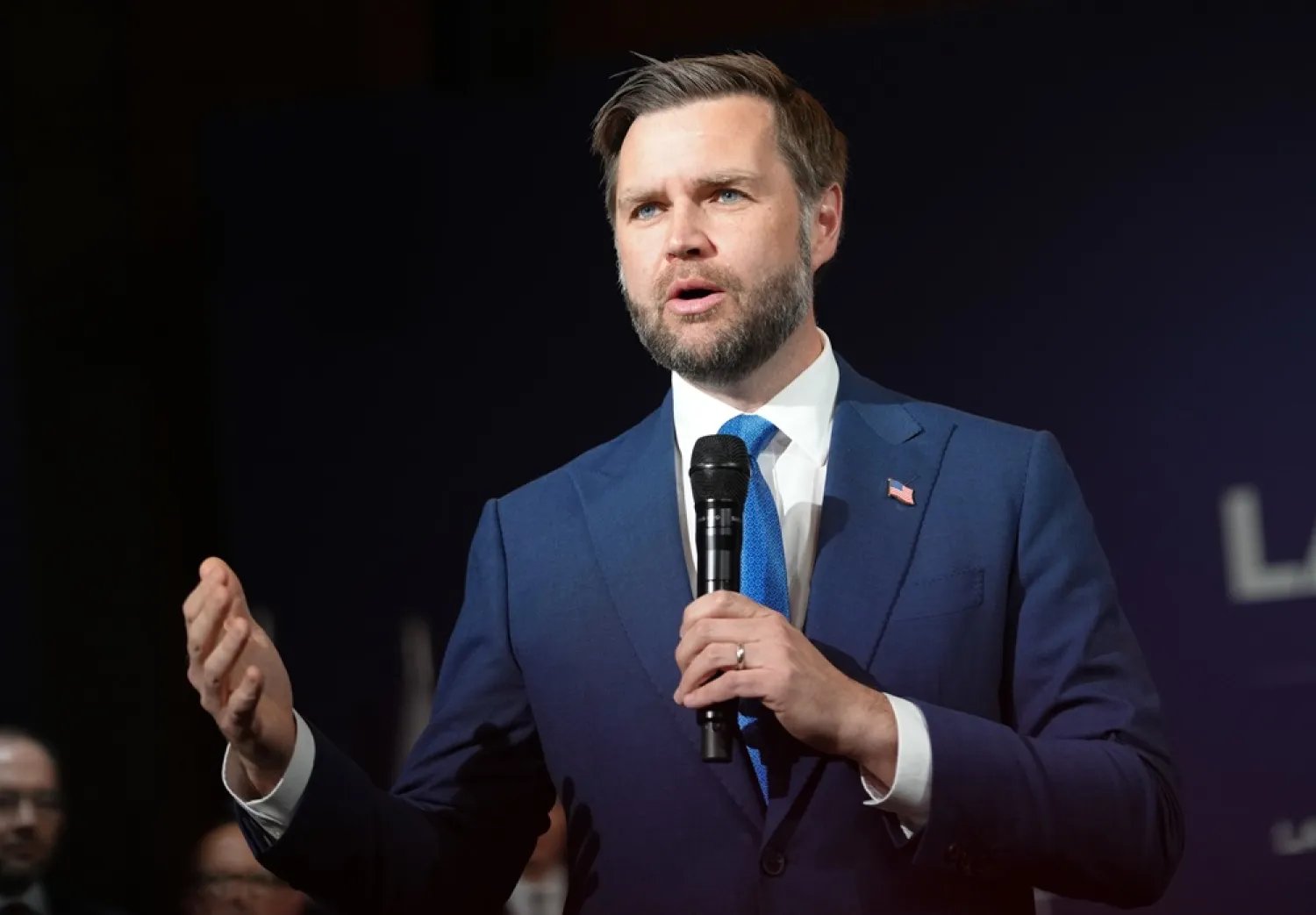
US Vice President JD Vance makes an opening statement at the start of a quadrilateral meeting between the US, Iran, Pakistan, and Qatar at the Bürgenstock Resort Lake Lucerne, near Stansstad, Switzerland, Sunday, June 21, 2026. (AP)
TT

Vance Meets Top Iranian Officials as US Looks to Get Negotiations Back on Track

US Vice President JD Vance makes an opening statement at the start of a quadrilateral meeting between the US, Iran, Pakistan, and Qatar at the Bürgenstock Resort Lake Lucerne, near Stansstad, Switzerland, Sunday, June 21, 2026. (AP)

US Vice President JD Vance said Sunday there was an opportunity to “turn over a new leaf” with Iran as the sides launched talks aimed at building out the interim deal to end the war in Iran reached by the two sides last week. 

Vance is holding talks with Iran's parliamentary speaker, Mohammad Bagher Qalibaf, and Foreign Minister Abbas Araghchi, at a Swiss mountainside resort near Lake Lucerne. Mediators from Pakistan and Qatar were also in the room for the direct engagement. 

The US is looking to get Iran locked into negotiations over its nuclear program amid concerns it may be used for military purposes, which Iran denies. Vance also wants to push Tehran to commit to keeping open the Strait of Hormuz, the critical waterway through which about a fifth of world traded oil passes. 

But the on-again, off-again conflict in Lebanon, between Israel and Iranian-backed Hezbollah, continues to threaten to derail the effort for the US to win concessions from Tehran on its nuclear program and keep the Strait of Hormuz open. 

“The question before us now is how much more can we accomplish together? Can we turn over a new leaf?” Vance said in brief comments as the talks, dubbed the “Lake Lucerne Summit,” got underway. 

“Can we change relations in the Middle East permanently, or do we go back to doing things the old way, which is not our preference, but is certainly very much something that can happen.” 

Iran first wants to focus on Israeli strikes in Lebanon  

Iran’s main focus during negotiations on Sunday would be the ongoing war between Israel and Hezbollah in Lebanon, Iranian Foreign Ministry spokesman Esmail Baghaei told Iran’s state news agency ahead of the meeting with Vance. 

The interim agreement was signed last week, and now top American and Iranian negotiators are in a 60-day sprint to reach an agreement on the technical details that hold massive implications for the world economy and global security. 

Yet only days after signing the agreement, it is being stress-tested after fighting escalated in Lebanon between Israel and Hezbollah — and by the subsequent announcement by Iran’s military that it had again closed the vital waterway that transits one-fifth of the world’s traded oil and natural gas. A renewed ceasefire in Lebanon, brokered on Saturday, appeared to be holding. 

Vance stressed that “great progress” had been made on Lebanon. But minutes after he was finished speaking, President Donald Trump took to social media to threaten Iran if it didn't rein in Hezbollah. 

"If they don’t, we’ll hit Iran very hard again, just like we did last week, only harder!!!” Trump wrote. 

Iran is cautiously approaching the talks given its previous experience with the US negotiations on the nuclear issue, which twice in the past year have been interrupted by massive military strikes against the country.  

“The implementation of any document is more important than its signing,” Baghaei said Sunday. 

Iran’s president added that Iran will maintain its right to a nuclear program. 

“What is certain is that we will never back down from the right to enrich uranium, and the other side is also forced to accept it,” Iranian President Masoud Pezeshkian said Sunday, according to Iran’s state media. 

A delayed meeting is now back on  

Vance had originally been slated to be on the ground at the Bürgenstock resort near Lucerne on Friday, but his departure from the United States was delayed after fighting escalated in Lebanon and Iranian officials canceled plans to attend the talks. 

US Central Command disputed Iran’s claim that it had once again shuttered the strait and said US forces continued to monitor the situation to ensure traffic continues to flow through the waterway. Vance has said that millions of barrels of oil have moved through the strait in recent days. 

Vance departed the US just after Iranian state TV said Iran’s negotiators had arrived in Switzerland. 

The vice president was joined by special envoy Steve Witkoff and Jared Kushner, Trump's son-in-law, for Sunday's talks. Witkoff and Kushner were on the ground in Switzerland ahead of Vance to begin sifting through the technical details of the nuclear talks. 

Vance and his wife, second lady Usha Vance, arrived at Emmen Air Base outside Lucerne just before 6 a.m. local time, according to his office. 

While Vance said he planned to be in Switzerland for just “a day or two,” leaving much of the detailed negotiations to be spearheaded by Witkoff and Kushner, his role in the talks has heightened scrutiny of the vice president at a time when he’s actively considering a 2028 presidential campaign. 

The deal has stirred much controversy  

Trump and Vance have come under searing criticism from parts of their own party for the deal, with Republican hard-liners unfavorably likening it to a nuclear agreement signed by the Obama administration that Trump and the GOP have insisted did nothing to actually terminate Iran’s nuclear program. 

The agreement signed by Trump and Iranian President Pezeshkian immediately allows Tehran to sell its oil freely and paves the way for Iran to tap into billions of dollars in assets that are currently frozen. It also calls for Iran to dilute its stockpile of highly enriched uranium, believed to be buried under nuclear sites that were targeted in US strikes last summer. 

The agreement says commercial vessels can pass through the Strait of Hormuz for 60 days without a charge, but does not preclude future fees imposed by Iran. Trump made his own threat on Saturday to levy US tolls on the strait if there is no deal with Iran in 60 days, insisting in a social media post that the money would be for “services rendered as the Guardian Angel to the countries of the Middle East.” 

The Trump administration has been working to reassure global markets that the Iran war has been merely a blip on oil prices, as Americans complain the conflict resulted in hiking gasoline prices ahead of peak summer travel months. After the White House announced the deal a week ago, oil futures dropped almost 8% — and markets are expected to closely track the progress of talks when they open for trading on Sunday evening. 

Further complicating matters, neither Israel nor Hezbollah is a signatory to the deal between the US and Iran, and Israeli Prime Minister Benjamin Netanyahu has vowed to keep his forces in southern Lebanon until any threat to Israel is eliminated. Hezbollah has refused to halt its attacks unless Israel commits to withdrawing from Lebanon. 


Military Helicopter Crashes in Southern Türkiye, Killing 4

Rescuers and security officers examine the wreckage of an ambulance helicopter after it collided with a hospital building and crashed into the ground, in Mugla, Türkiye, December 22, 2024. REUTERS/Kenan Gurbuz Purchase
TT

Military Helicopter Crashes in Southern Türkiye, Killing 4

Rescuers and security officers examine the wreckage of an ambulance helicopter after it collided with a hospital building and crashed into the ground, in Mugla, Türkiye, December 22, 2024. REUTERS/Kenan Gurbuz Purchase

A military helicopter crashed in southern Türkiye on Thursday, killing four personnel, the Turkish Defense Ministry said.

The aircraft crashed for unknown reasons in Samankoy, a neighborhood on the southern outskirts of the provincial capital Malatya in the early evening.

“As a result of an accident involving our S-70 helicopter in Malatya, for a reason not yet determined, 4 of our heroic comrades-in-arms aboard the helicopter were martyred,” the ministry said in a social media post.

“We pray that God will have mercy on our martyrs and offer our condolences and prayers for strength to their grieving families, our Turkish Armed Forces, and our noble nation.”

According to The Associated Press, TV images showed the wreckage of the helicopter burning near a cluster of buildings in an otherwise open area of land. The Demiroren News Agency reported that flames had spread to a nearby house but reported no casualties on the ground.

Police, firefighters and medical teams were dispatched to the crash.


Trump Says US Does Not Need Iran Deal

US President Donald Trump and Vice President JD Vance look on during a Veterans Day ceremony at Arlington National Cemetery in Arlington, Virginia, US, November 11, 2026. REUTERS/Kylie Cooper
TT

Trump Says US Does Not Need Iran Deal

US President Donald Trump and Vice President JD Vance look on during a Veterans Day ceremony at Arlington National Cemetery in Arlington, Virginia, US, November 11, 2026. REUTERS/Kylie Cooper

President Donald Trump said on Thursday the US does not need a deal with Iran and directed Vice President JD Vance, who has played a role in efforts to resolve the war, to focus "his complete and total attention" on alleged crime and corruption in Democratic-run cities and states.

Trump's directive came a day after the Wall Street Journal reported that Vance was considering face-to-face peace talks with a hard-line Iranian security official and a week after the vice president blamed the costly war with Iran for Republicans' midterm elections drubbing.

Trump's comments marked a shift in tone after he had suggested ⁠in recent weeks ⁠that Iran would be more willing to strike a deal in the eight-month conflict after the US elections.

"We don’t need a deal with Iran. Those days have long since passed. We’ve got their money, Hundreds of Billions of Dollars, and we’ve got their Strait!" Trump wrote on social media, referring to the Strait of Hormuz, the critical ⁠shipping route near Iran where the US military has been working to secure safe passage for international shipping.

Trump said he asked Vance to focus instead on a domestic issue the president previously put in his portfolio: leading an effort targeting alleged fraud in Democratic-run cities and states throughout the US.

"Our Budget could be quickly BALANCED with the correction of this large-scale criminal activity. CORRUPTION is in the Democrat Leadership’s blood!" Trump wrote on Thursday.

Vance's office did not immediately respond to a request for comment.

The Wall Street Journal reported on Wednesday that ⁠Vance was considering ⁠meeting with a senior Iranian security official, a move that would have put Vance at the center of peace negotiations. Reuters has not confirmed the potential talks.

Vance, who is viewed as a leading contender for the 2028 Republican presidential nomination, distanced himself from the war last week after Republicans' midterm election rout by Democrats.

The vice president blamed the costs of the Iran war in part for the party's losses. He also said an earlier recommendation to end the war was "sound advice."

Trump responded to Vance's position by defending the war as necessary to stop Iran from obtaining a nuclear weapon.


Iran: Four Tankers Struck by Explosions in Strait of Hormuz

Iran: Four Tankers Struck by Explosions in Strait of Hormuz
TT

Iran: Four Tankers Struck by Explosions in Strait of Hormuz

Iran: Four Tankers Struck by Explosions in Strait of Hormuz

Four oil tankers were hit by explosions in the Strait of Hormuz, Iran's military said on Thursday, adding that the vessels had ignored warnings and entered what it considers restricted areas of the strategic waterway.

Tankers are still facing attacks across the strait, despite a rebound in traffic and expectations of a de-escalation in the war between the United States and Iran that have been reflected in falling oil prices.

Iran's Revolutionary Guards Navy said two supertankers were disabled by explosions on Wednesday after they ignored ⁠warnings against using what ⁠it said was an "unauthorized route".

Reuters could not immediately verify the Iranian account.

The two vessels "exploded after hitting naval mines", Iranian state media reported, broadcasting what it said was video footage of the incidents.

Iran's army later said two other tankers had hit mines on Thursday afternoon while sailing through the eastern Strait of Hormuz after ignoring ⁠warnings and disabling their radar systems, state TV reported. The tankers entered a restricted area and subsequently caught fire, it reported.

Earlier in the US-Israeli war with Iran, which began in February, the IRGC Navy announced its attacks on tankers. More recently, however, it has instead reported that vessels have caught fire after hitting naval mines while traversing the southern part of the strait, which it has declared an unauthorized route.

In several of those cases, the United Kingdom Maritime Trade Operations agency (UKMTO) has said vessels had been struck by unknown projectiles.

The ⁠UKMTO said ⁠in reports on Thursday that a vessel was hit by an unidentified projectile about 14 nautical miles northwest of the UAE emirate of Ras Al-Khaimah on Wednesday while exiting the strait, causing a fire in its engine room.
Firefighting efforts were under way and all crew had been evacuated, it added.

At least 10 ships were hit in the first 10 days of November, after 37 attacks in October, which was the highest monthly tally since the conflict began in late February, according to data from the Washington Institute for Near East Policy.