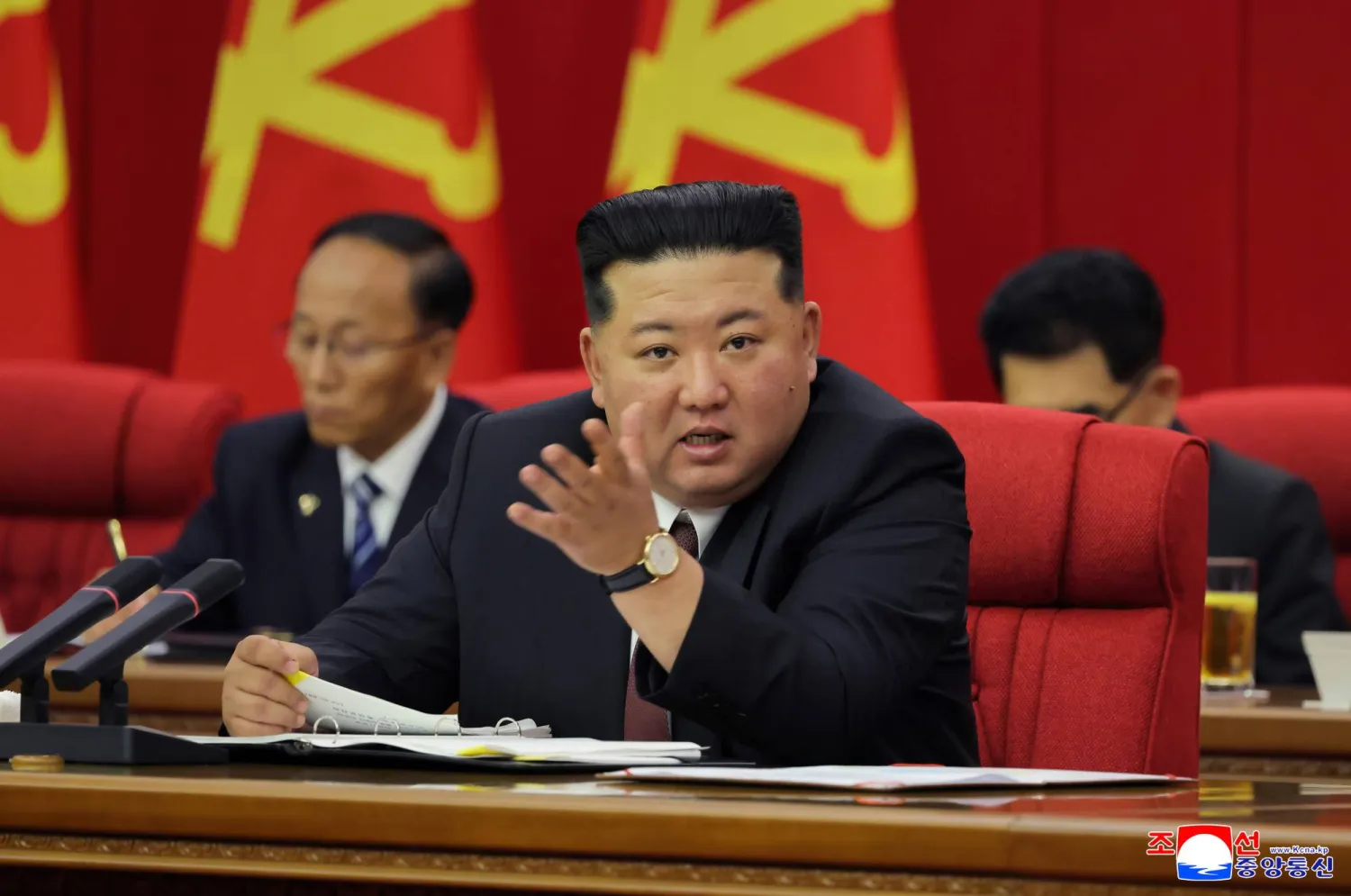
North Korea's Kim Vows to Accelerate Military Buildup

A photo released by the official North Korean Central News Agency (KCNA) shows North Korean leader Kim Jong Un (C) speaking during the Second Plenary Meeting of the Ninth Central Committee of the Workers' Party of Korea (WPK) held from 20-22 June 2026 in Pyongyang, North Korea (issued 23 June 2026). EPA/KCNA
TT

North Korea's Kim Vows to Accelerate Military Buildup

A photo released by the official North Korean Central News Agency (KCNA) shows North Korean leader Kim Jong Un (C) speaking during the Second Plenary Meeting of the Ninth Central Committee of the Workers' Party of Korea (WPK) held from 20-22 June 2026 in Pyongyang, North Korea (issued 23 June 2026). EPA/KCNA

Kim Jong Un vowed to beef up North Korea's defense capabilities, citing military modernization efforts by South Korea and the United States pushing the region "to the brink of a nuclear war", state media reported Tuesday.

Pyongyang is under multiple sets of sanctions over its nuclear program, and the two Koreas remain technically at war because their 1950-53 conflict ended in an armistice rather than a peace treaty, AFP said.

"Comrade Kim Jong Un in his concluding speech reaffirmed the steadfast policy stand of our Party and state to beef up the national defense capabilities faster," the official Korean Central News Agency quoted the leader as saying.

The speech was delivered as Kim presided over a three-day meeting of the Workers' Party of Korea that wrapped up on Monday, during which senior officials reviewed policy initiatives, KCNA said.

It quoted Kim as saying "the US and the ROK are pushing forward with the ROK's possession of a nuclear submarine while getting evermore undisguised in their moves towards the reinforcement and modernization of armed forces in the region", referring to South Korea by the acronym of its official name.

According to KCNA, Kim said such moves were "pushing the situation in the Korean peninsula to the brink of a nuclear war".

In the face of such developments, it was the "steadfast stand" of the North to "further expand and strengthen the powerful and absolutely reliable deterrent for self-defense", Kim said.

- 'Line of no retreat' -

KCNA said the meeting "unanimously recognized that to steadily expand and strengthen the nuclear forces... is the most correct and unique way to actively and confidently cope with the unpredictable international military and political situation".

It added the North's development of a war deterrent "with nuclear technology as a basis" would proceed "at increasing speed".

Pyongyang has repeatedly declared itself an "irreversible" nuclear state since a 2019 summit between Kim and Trump in Hanoi collapsed over the scope of denuclearization and sanctions relief.

Kim's powerful sister, Yo Jong, said this month the North's nuclear policy was a "line of no retreat", reiterating the regime's position that it has no intention of giving up its nuclear arsenal.

South Korean President Lee Jae Myung said last week that US counterpart Donald Trump had told him it was time to "pay attention to the North Korea issue".

He told reporters he had told Trump at a meeting of the G7 in France that sanctions on the North were "ineffective."

"I also said that we can no longer deal with the North Korean nuclear issue in the same way we deal with other countries, and President Trump agreed," Lee added.


Iran Says Supreme Leader Met with Security Chief Over Hormuz

 A cargo ship sails in the Arabian Gulf toward the Strait of Hormuz, as seen from Dubai, United Arab Emirates, Wednesday, Oct. 21, 2026. (AP)
A cargo ship sails in the Arabian Gulf toward the Strait of Hormuz, as seen from Dubai, United Arab Emirates, Wednesday, Oct. 21, 2026. (AP)
TT

Iran Says Supreme Leader Met with Security Chief Over Hormuz

 A cargo ship sails in the Arabian Gulf toward the Strait of Hormuz, as seen from Dubai, United Arab Emirates, Wednesday, Oct. 21, 2026. (AP)
A cargo ship sails in the Arabian Gulf toward the Strait of Hormuz, as seen from Dubai, United Arab Emirates, Wednesday, Oct. 21, 2026. (AP)

Iran's supreme leader Mojtaba Khamenei, who has yet to appear in public since he took office in March, has met with security chief Mohsen Rezaei to discuss regional security and the Strait of Hormuz, his office said Tuesday.

Mojtaba was chosen in March to succeed his father and longtime ruler Ali Khamenei, who was killed in US-Israeli strikes on February 28 in central Tehran alongside senior military commanders, and was said to have been injured in the same attack.

He has only communicated through written messages since his appointment, some of them published in handwriting attributed to him.

During the meeting, the first publicly announced encounter between Rezaei and the leader, they discussed "strengthening bilateral relations with neighboring countries" and "safeguarding national and regional security through the management of the Strait of Hormuz," Khamenei's office said in a statement.

Khamenei "emphasized the need to safeguard the rights and interests of the Iranian nation and the resistance front by adhering to the conditions set by the country's authorities, with the aim of ending the war and the state of neither war nor peace," it added.

Neither the date nor the location of the meeting was disclosed.

Iran claims control over the Hormuz strait and regularly targets vessels that attempt to cross without its authorization, while the United States has imposed a naval counter-blockade on Iranian ports.

Diplomatic efforts to resolve the crisis remain stalled, especially since the collapse of a June deal which laid out a pathway to a permanent settlement.

Several Iranian officials, including Judiciary chief Gholamhossein Mohseni Ejei and parliament speaker Mohammad Bagher Ghalibaf, have in recent days said they held rare meetings with the supreme leader.


In US Swing Districts, High Prices Dominate Minds but Not Always Ballots

 A woman feeds her ballot into a scanning machine at an early voting site in Haverstraw, NY, Monday, Oct. 26, 2026. (AP)
A woman feeds her ballot into a scanning machine at an early voting site in Haverstraw, NY, Monday, Oct. 26, 2026. (AP)
TT

In US Swing Districts, High Prices Dominate Minds but Not Always Ballots

 A woman feeds her ballot into a scanning machine at an early voting site in Haverstraw, NY, Monday, Oct. 26, 2026. (AP)
A woman feeds her ballot into a scanning machine at an early voting site in Haverstraw, NY, Monday, Oct. 26, 2026. (AP)

American consumers say the rising cost of living is a top concern — one that's changed how they shop. But that won't necessarily affect their votes in next week's congressional elections.

More than two dozen voters in three East Coast swing districts overwhelmingly reported that high gas and grocery bills were top of mind. Reuters interviewed the voters, who largely self-described as working- or middle-class, during routine shopping trips.

Their concerns mesh with Reuters/Ipsos polling finding living costs to be the most pressing issue for voters ahead of November 3 elections that will determine control of the US House of Representatives and Senate.

More than half of the people identified as Democratic-leaning, and said they planned to vote against Republican candidates, many with a renewed sense of urgency.

But of the ten who said they had previously voted for incumbent congressional Republicans, eight told Reuters they are sticking by them this year. That is despite inflation being driven up by, among other factors, tariffs introduced by Republican President Donald Trump, and a Iran war-related rise in energy costs.

"It hasn't changed my opinion on anything," Republican-leaning voter John Beers, of Peekskill, New York, told Reuters on October 16, as he ‌decried a "staggering" rise in grocery ‌prices and said he'd "be very disappointed" if prices don't ease soon.

Such responses underscore the challenges facing Democrats as they ‌seek to ⁠flip seats in ⁠a world where economic sentiment is an increasingly unreliable indicator of how people shop and vote, said Katie Thomas, who leads the Kearney Consumer Institute, part of global consulting firm Kearney.

Control of the House will hinge on just a few dozen of the 435 seats being contested — those that feature competitive races, like New York's 17th congressional district, where Beers lives. An Emerson College poll in late September showed incumbent lawmaker Mike Lawler, a Republican ally of Trump, trailing Democratic challenger Cait Conley in this district by 2 points.

The self-employed Beers, 74, lives in a less affluent pocket of Lawler's generally wealthy district north of New York City. Interviewed before a trip to Ahold's Stop & Shop grocery chain, Beers said he has traded down to cheaper coffee amid the pinch, and sacrificed items like avocado oil and sardines.

But he supports the Iran war and is sticking with ⁠Lawler.

Echoing Beers, Fred McDonald, a 71-year-old retired diesel mechanic from Easton, Pennsylvania, said he has backed Republicans for many years ‌and won't abandon them now, despite his economic worries.

Consumers have "decoupled" sentiment and behavior, said Kearney's Thomas — a result, ‌she believes, of anxiety about unknowns like the Middle East conflict and the ascendance of AI. "Without a reliable picture of the future, people fall back on routine, habit, and ‌loyalty," she said.

The effect has shown up in how Americans shop: even as consumer confidence has cratered to nearly a 12-1/2-year low, retail sales for the ‌first 9 months of this year are 4.7% higher than the same period last year, according to US Census data.

Consumers are widely trading down on essentials but Thomas' research has found that they are also still splurging on the luxuries they value.

PINCH FROM BEEF AND GAS PRICES

McDonald and his wife of five decades, Antoinette, are living with their daughter, struggling to find housing in an unaffordable market after a landlord took back their last apartment. They've cut beef from their diets and cringe every time they fill their gas tank.

In Pennsylvania's ‌7th congressional district incumbent Republican Ryan Mackenzie — who earned McDonald's vote in 2024 — is up against Democratic challenger Bob Brooks. Opinion polls indicate a narrow advantage to Brooks.

McDonald is supporting Mackenzie, though, whom he described as "honest." He blames inflation ⁠on generalized greed among political elites rather ⁠than Republicans.

As higher costs bite, 69-year-old Antoinette said she's considering taking a job.

"I can sew, I can clean," she said. Then, she gestured toward the cashier at the fast-food chain where the couple spoke to Reuters. "And there's always McDonald's," she added.

DEMOCRATS' INCREASED URGENCY

Still, national polling by Reuters/Ipsos this month showed Democrats leading Republicans on a generic ballot question without a named candidate, with a majority of voters faulting Trump's handling of the economy.

Several Democratic voters told Reuters they feel increased urgency in this election, which could spur a higher turnout.

In New Jersey's 7th congressional district, 67-year-old Carla Schiller, a retired nurse, is switching sides. She said she's voting for Democrat Rebecca Bennett. In the past, she supported incumbent Republican Tom Kean Jr., partly because she was a fan of his father, former governor Thomas Kean.

"I have to be able to know I can eat," said Schiller as she browsed the pantry aisle at Aldi, a lower-priced grocer she began visiting recently to cut costs.

Back in Pennsylvania, 76-year-old retiree Donna Sook, a self-described conservative Democrat who will vote for Democratic candidate Brooks, said she "just about fainted when I went by (gas station) Wawa and saw $4.65."

Nationwide, US gas prices average $4.29 a gallon, up 40% from a year ago, according to AAA.

After a wallet-punishing trip to BJ's Wholesale Club in New York's 17th, Joanice Patino, 49, fretted about how she would afford gas for the commute to her nursing job, on top of the hundreds of dollars in monthly medical costs for her nonverbal autistic daughter.

“I'm thinking more about prices," said Patino, who plans to vote for Democratic challenger Conley and hopes a change might ease the cost of living.

"Before, we could save something," she said. "Now we cannot save anything."


At Least 62 People Killed in Attack in Northeastern Nigeria

Officials of the Nigeria Center for Disease Control and Prevention (NCDC) prepare an ambulance for deployment for a suspected Ebola case, outside the agency's headquarters in Abuja, Nigeria, October 25, 2026. REUTERS/Sodiq Adelakun
TT

At Least 62 People Killed in Attack in Northeastern Nigeria

Officials of the Nigeria Center for Disease Control and Prevention (NCDC) prepare an ambulance for deployment for a suspected Ebola case, outside the agency's headquarters in Abuja, Nigeria, October 25, 2026. REUTERS/Sodiq Adelakun

At least 62 people have been killed after gunmen attacked a community in northeastern Nigeria, the country’s emergency agency said Tuesday.

The attack, reportedly carried out by criminals known as bandits, happened on Friday in Binnari community located in the Karim-Lamido local government area of Taraba state, and also wounded 52 other people and displaced thousands, according to Ladan Ayuba, the state head of the National Emergency Management Agency.

Attacks by bandits are common across northern Nigeria where armed groups carry out attacks against civilian populations.

Meanwhile, a prominent Muslim cleric known for advocating religious harmony between Muslims and Christians in Nigeria has been shot dead outside his home, police said.

Yahaya Ibrahim Masussuka and his associate Adamu Abubakar were killed in the town of Dutsin-Ma in northern Nigeria's Katsina state Monday evening.

They were killed at around 1830 GMT "when two armed men riding on a motorcycle opened fire, fatally injuring both victims,” police spokesman Abubakar Sadiq Aliyu said in a statement late Monday night.