

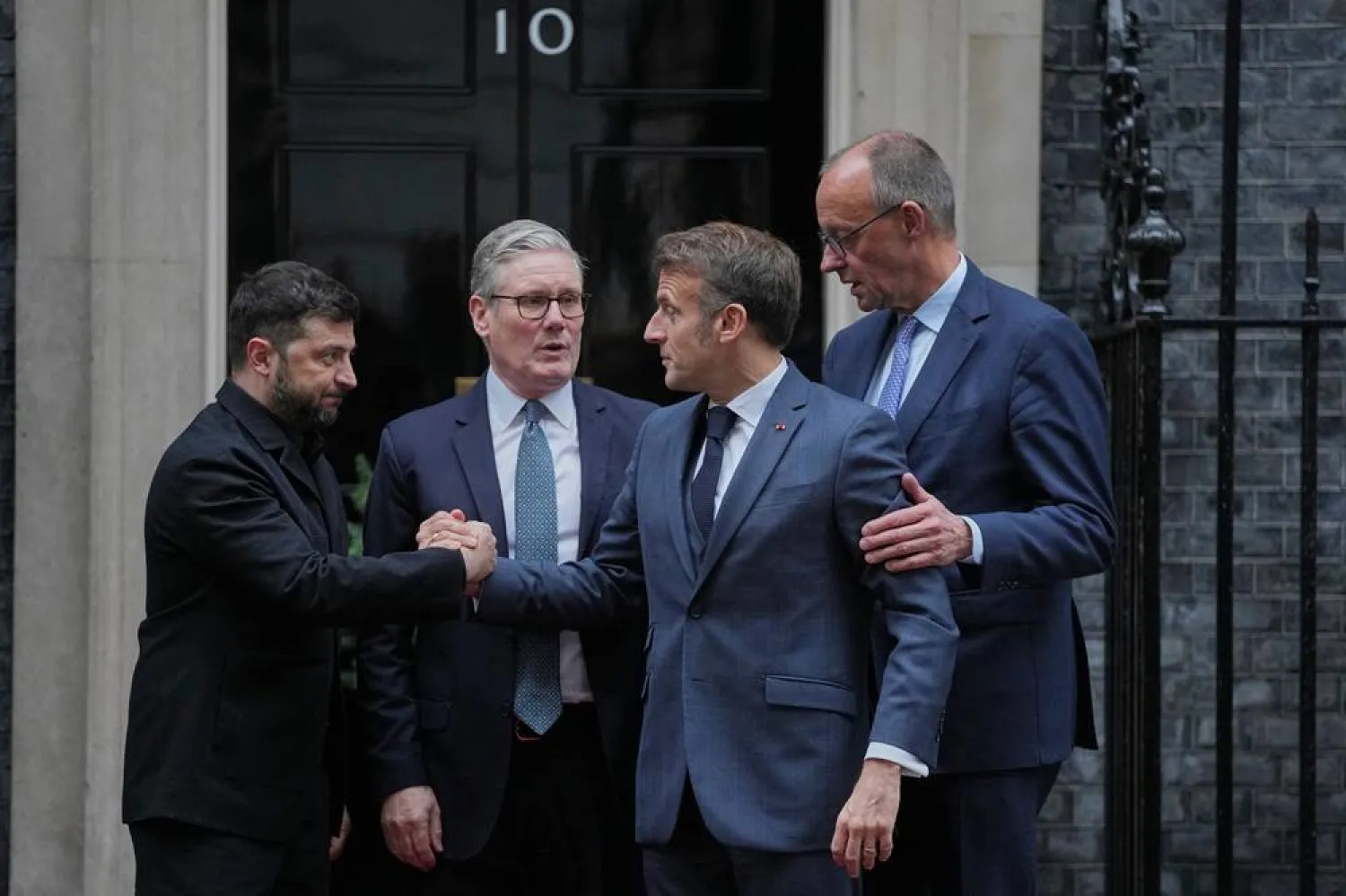

European Leaders Offer Warm Farewell to Britain’s Starmer

Ukraine's President Volodymyr Zelenskiy, left, with, from second left, Britain's Prime Minister Keir Starmer, France's President Emmanuel Macron, and Germany's Chancellor Friedrich Merz pose on the doorstep of 10 Downing Street, London, Dec. 8, 2025, following a meeting of the leaders inside. (AP)
TT

European Leaders Offer Warm Farewell to Britain’s Starmer

Ukraine's President Volodymyr Zelenskiy, left, with, from second left, Britain's Prime Minister Keir Starmer, France's President Emmanuel Macron, and Germany's Chancellor Friedrich Merz pose on the doorstep of 10 Downing Street, London, Dec. 8, 2025, following a meeting of the leaders inside. (AP)

Outgoing British Prime Minister Keir Starmer announced his departure on Monday amid plunging approval ratings, but there were warm words from European leaders who had generally found him easier to work with than his recent predecessors.

Starmer, the first non-Conservative prime minister since Britain voted to leave the European Union, rejected suggestions that it could rejoin the 27-member bloc, but he had pushed to improve relations after the trauma of Brexit.

He also kept up Britain's central role in the region's support for Ukraine, alongside his fellow "E3" leaders, French President Emmanuel Macron and German Chancellor Friedrich Merz.

"It can take many leaders years to grow into the statesman you became in just two years," European Commission President Ursula von der Leyen said on ‌the social ‌media platform X. "European and Ukrainian security is stronger because of ‌you. Thank ⁠you, dear Keir."

STARMER ⁠ONE OF MANY TO SUFFER POPULARITY CRISIS

Starmer came to office in 2024, sweeping aside a deeply unpopular government that presided over a slumping economy and a nation still divided by the bitter Brexit referendum campaign.

But like other European leaders, Starmer struggled to win over voters disillusioned with mainstream parties and increasingly drawn to insurgent anti-establishment parties that promised to shake up politics with bold measures.

Away from home, his perceived lack of charisma appeared to matter less ⁠than it did at home, where he was frequently accused of ‌lacking conviction.

"I want to acknowledge the significant role ‌Keir played in resetting the Irish-British relationship as well as relations between the UK and the European ‌Union during his time as prime minister," Irish Prime Minister Micheál Martin said in ‌a statement.

Starmer's support for Ukraine maintained the line followed by Conservative predecessors such as Boris Johnson who threw London's support behind Ukrainian President Volodymyr Zelenskiy after Russia's assault on Kyiv in 2022.

Zelenskiy thanked Starmer "for always being in touch, always engaged, and always striving to do what is needed" and said their ‌conversations had always been "filled with real substance".

"Keir, you are always a welcome guest in Ukraine," he said on X.

A German government spokesperson ⁠said Starmer had ⁠always been "a reliable and close partner".

However, there was no immediate personal statement from Merz, himself struggling with record-low ratings that have prompted press speculation about his own future.

Across the Atlantic, the farewell was less warm.

US President Donald Trump offered a dismissive send-off, announcing a day before the resignation that Starmer would leave, and saying he had "failed badly" on the key issues of immigration and energy, where Trump disagrees sharply with British government policy.

In Russia, which considers Britain one of its main enemies, not least for supporting Ukraine, President Vladimir Putin's special envoy Kirill Dmitriev claimed some of the credit for Starmer's departure.

"We did this jointly," he wrote in a post on X, "by exposing Starmer's warmongering and consistently wrong policies on immigration, crime, energy and economy."

Post-publication a spokesperson for Dmitriev said his comment was made in a personal capacity and was referring to himself and other social media users who had criticized Starmer.



UN Chief Urges AI Firms 'Come Clean' on Environmental Footprint

United Nations Secretary-General Antonio Guterres speaks during a press conference in the Petion-Ville commune of Port-au-Prince, Haiti, on June 16, 2026. (Photo by Clarens SIFFROY / AFP)
TT

UN Chief Urges AI Firms 'Come Clean' on Environmental Footprint

United Nations Secretary-General Antonio Guterres speaks during a press conference in the Petion-Ville commune of Port-au-Prince, Haiti, on June 16, 2026. (Photo by Clarens SIFFROY / AFP)

UN Secretary-General Antonio Guterres called on artificial intelligence companies on Tuesday to disclose their growing environmental footprint and commit to powering every data center with renewable energy by 2030.

"It is time to come clean. If AI is to help build a better future, it must be honest about what it costs us now," Guterres said at London Climate Action Week, an annual gathering of policymakers, company executives and NGOs.

A UN study earlier this month found that data centers consumed more electricity than all but 10 countries in 2025. By 2030, they could use more power than all but five countries.


Denmark Reopens Embassy in Tehran

People drive on a street in Tehran, Iran, June 18, 2026. Majid Asgaripour/WANA (West Asia News Agency) via Reuters
TT

Denmark Reopens Embassy in Tehran

People drive on a street in Tehran, Iran, June 18, 2026. Majid Asgaripour/WANA (West Asia News Agency) via Reuters

Denmark has reopened its embassy in Tehran more than three months after closing it due to the conflict in the Middle East, the foreign ministry announced on Tuesday.

"In light of the improvement in the security situation in Iran, the embassy in Tehran is reopening its doors," the Danish diplomatic service said in a statement.

"The Danish ambassador to Iran has been working on the embassy premises since June 19," it added.

Italy's embassy in Tehran, which had also been closed for more than three months, reopened its doors on Friday.

Denmark ordered the temporary closure of its embassy in Iran on March 10 because of the security situation in the country.


Iran Says to Oversee Hormuz as Swiss Talks Conclude

Vessels at the Strait of Hormuz, as seen from Musandam, Oman, June 22, 2026. REUTERS/Stringer
TT

Iran Says to Oversee Hormuz as Swiss Talks Conclude

Vessels at the Strait of Hormuz, as seen from Musandam, Oman, June 22, 2026. REUTERS/Stringer

Tehran voiced Tuesday its intent to maintain control over the vital Strait of Hormuz, a crucial question in the Middle East war talks with Washington that just wrapped up in Switzerland.

Vice President JD Vance called the negotiations a "very good foundation" for a final deal to end the conflict, noting on Monday that Washington suspended sanctions on Iranian oil.

But critical questions like Iran's nuclear program and Hormuz, a major conduit for the world's oil supply, have not been resolved despite an initial deal between Washington and Teheran.

Technical talks that followed higher level negotiations in Switzerland have concluded, with working groups to be set up on nuclear issues and sanctions, Iran's state media reported Tuesday.

US President Donald Trump has demanded an unconditional reopening of Hormuz to marine traffic, however Iran again pushed back fiercely.

"The Strait of Hormuz will never return to its pre-war conditions and will be administered by the Islamic Republic of Iran, in accordance with international law," Iran's chief negotiator Mohammad Bagher Ghalibaf said, state media reported Tuesday.

The Strait of Hormuz had reopened last week, after Washington and Tehran reached an agreement, but Tehran announced on Saturday it had closed it again in response to Israeli attacks in Lebanon.

- Frozen funds -

Tehran and Washington have agreed to establish a line of communication "to avoid incidents and miscommunication with the aim of safe passage for commercial vessels" through the waterway, according to Qatari and Pakistani mediators.

As part of their deal, Washington agreed to release $12 billion in frozen funds to Iran, Iranian state media reported on Tuesday, and temporarily suspend sanctions on oil from the Iranian republic.

The US Treasury said the decision involved temporarily lifting sanctions on Iran to allow it to produce, sell and deliver crude and related products through August 21.

Vance said Iranian assets had not yet been unfrozen as part of the deal and that, if they were, they would be used to buy US goods such as soybeans and would not fund terrorism.

Iran has been subject to asset freezes and sweeping sanctions by the United States and other Western countries since its 1979 Iranian revolution that toppled the US-backed Shah, Mohammad Reza Pahlavi.

The round of negotiations launched this weekend in Switzerland raised hopes for a lasting settlement of the conflict and pushed down oil prices.

The negotiations, in which Pakistan and Qatar are playing a mediating role, are aimed at producing a final document within a renewable 60-day deadline.

Diplomacy toward a deal continued Tuesday, with Iranian President Masoud Pezeshkian to travel to Pakistan, state media reported, following the talks in Switzerland.

- Progress on talks -

The developments come after mediators Pakistan and Qatar said the US and Iranian negotiators reached agreement on a "roadmap towards reaching a final deal within 60 days".

"Encouraging progress has been made," they said, including a contact channel set up to "avoid incidents and miscommunication" in the Strait of Hormuz.

Vance said Iran would allow UN nuclear inspectors to return to the country, but Iranian Foreign Ministry spokesman Esmaeil Baqaei said for his part that "a very brief discussion took place regarding the nuclear issue, but there was no discussion of details."

Set up by the 2015 agreement torn up by Trump in 2018, these inspections were suspended by Iran after the Israeli-American bombings of its facilities in June 2025.

Since then, International Atomic Energy Agency inspectors have not been able to visit the sites hit, leaving doubts hanging over the state of the Iranian Republic's stocks of highly enriched uranium, a major point of contention with Washington.

Tehran has always denied seeking to acquire nuclear weapons, while remaining adamant about its right to develop a full civilian nuclear fuel cycle.

On the Lebanese front, which Tehran insisted on including in the discussions, a conflict management cell is to be set up to halt the fighting between Israel and the pro-Iranian Hezbollah movement, which dragged Lebanon into the war in early March.

On Monday, Lebanese President Joseph Aoun said he had received a call from Vance regarding "the issue of consolidating the ceasefire in Lebanon, stopping the Israeli military escalation and steps that should be taken in this regard, including the possibility of forming a cell for this purpose".

The offensive in Lebanon, which Israel says is intended to prevent Hezbollah attacks, has left more than 4,100 dead and over a million displaced, according to the authorities.