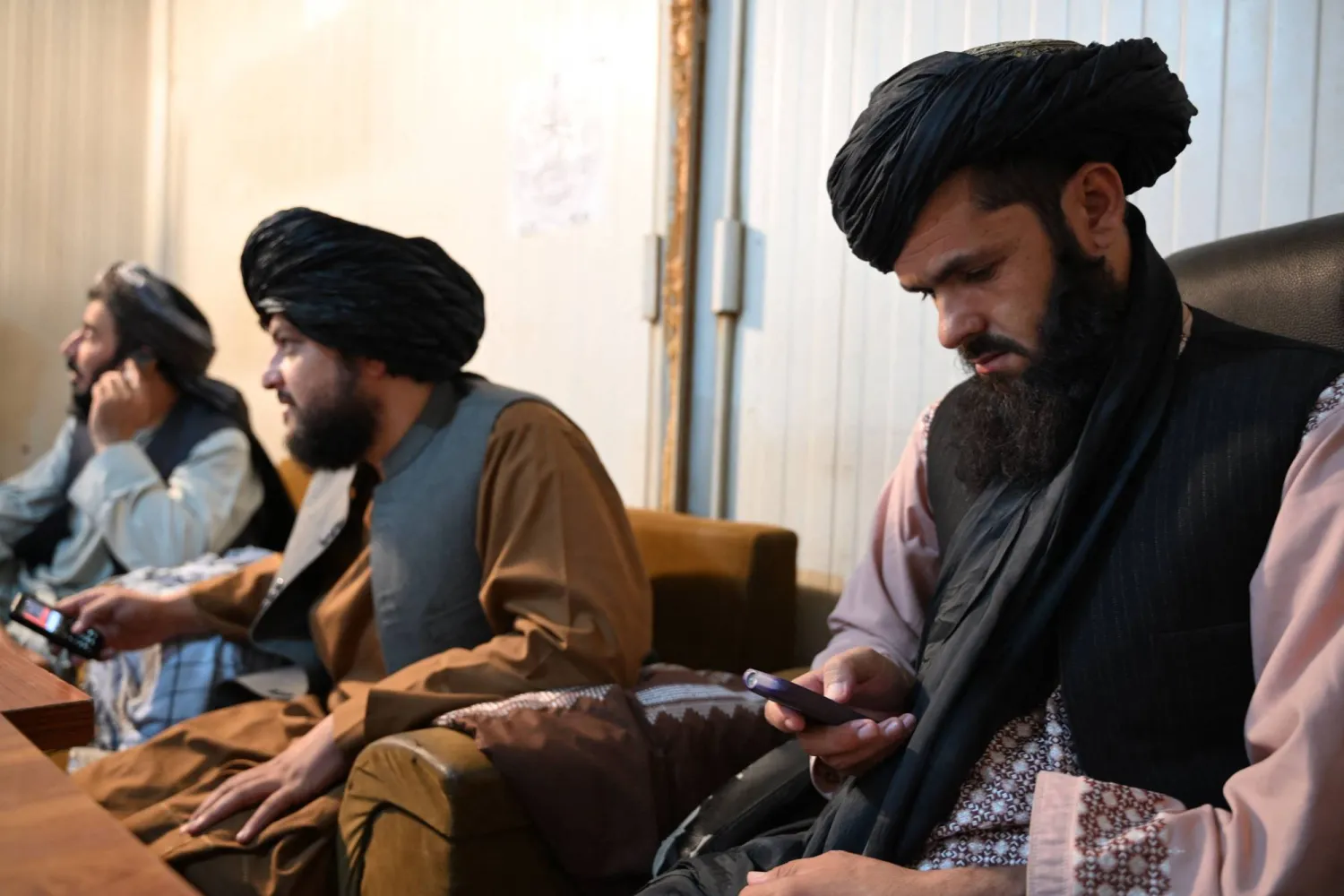
Taliban Officials Hold EU Migration Talks in Brussels

Taliban administrative staff use feature phones at the Department of Information and Culture building in Kandahar on June 22, 2026. (Photo by Sanaullah SEIAM / AFP)
TT

Taliban Officials Hold EU Migration Talks in Brussels

Taliban administrative staff use feature phones at the Department of Information and Culture building in Kandahar on June 22, 2026. (Photo by Sanaullah SEIAM / AFP)

A Taliban delegation held talks with the EU in Brussels on Tuesday on stepping up the return of failed asylum-seekers to Afghanistan, in an unprecedented visit fiercely criticized by rights activists. 

The European Commission invited a five-person delegation for discussions under a push to crack down on irregular migration and boost deportations -- although the EU does not formally recognize the Taliban administration. 

"The meetings were constructive, and there is hope that they will lead to positive developments," an Afghan official with direct knowledge of the talks, who requested anonymity due to their sensitivity, told AFP. 

A spokesman for the European Commission said 15 EU member states participated in the "technical level meeting" co-chaired by Sweden. 

The Afghan official said discussions -- the first by Taliban officials with EU representatives in Brussels -- focused on resuming consular services for Afghans in Europe, on "confidence-building measures" and "a dignified return process". 

The commission said "the identification of returnees" and "the issuance of travel documents" for them to be returned to Afghanistan, were on the agenda. 

"The focus was on persons who have committed serious crimes and who pose a security threat," the commission spokesman said. 

The European Union's outreach to Taliban authorities has drawn strong pushback from rights campaigners who say it flies in the face of the bloc's values. 

"The Taliban have erased women and girls from public life," said Nobel Peace Prize laureate Malala Yousafzai -- who was shot by Pakistani Taliban militants aged 15 and said she was "shaken and deeply disturbed" by the EU's invitation. 

The Taliban delegation in Brussels was led by foreign ministry spokesman Abdul Qahar Balkhi, and included representatives of the Afghan interior ministry. 

Brussels said the meeting was arranged upon the request of 20 EU countries and aimed at providing them the opportunity to "establish contacts" with Taliban authorities. 

It followed a January visit by EU officials to Afghanistan to explore the feasibility of organizing migrant returns. 

EU countries are responsible for arranging repatriations, although the commission can play a coordinating role. 

As host country to the European institutions, Belgium confirmed Monday it had issued the Taliban delegation five one-day visas "after a security assessment" -- valid just for Belgium and not the broader free-movement Schengen area. 

EU nations and the commission deny that hosting Taliban officials is tantamount to recognizing the government in Kabul, but critics say it reneges on the bloc's values. 

"EU countries are undermining their credibility by condemning Taliban abuses and pursuing accountability on one hand, while cooperating with the Taliban to forcibly return Afghans on the other," said Fereshta Abbasi of Human Rights Watch. 

European governments shut their embassies in Kabul when the Taliban authorities returned to power in 2021. 

This month, the European Union's migration chief Magnus Brunner defended the outreach, saying Brussels had no other option than to talk to the Taliban government about returning irregular migrants from Afghanistan. 

European governments have sought a tougher stance on migration as public opinion has hardened, fueling far-right electoral gains across the continent. 

EU countries received about a million asylum applications filed by Afghans between 2013 and 2024, according to the bloc's data agency. About half as many were approved over the period. 

Around 20 of the EU's 27 member states have expressed interest in returning some migrants without a right to stay to Afghanistan. 

Some countries have pushed ahead, with Germany deporting more than 100 Afghans with criminal convictions since 2024, via charter flights, and Austria following suit. 

Rights groups have questioned the legality and ethics of returning migrants to a country that is in the midst of a severe humanitarian crisis, with millions facing hunger and economic hardship, according to the United Nations. 

"The desperate scenes of people -- including EU staff -- fleeing Afghanistan are a recent memory," said Eve Geddie, director of Amnesty International's European Institutions Office. 

"It is unconscionable that the EU would now try and deport people to Afghanistan, which has only become more dangerous in the meantime." 


Iran Army: Any New War with US Could be 'Longer Than Previous Conflict'

Iranians motorists drive past a poster of Iran's supreme leader Mojtaba Khamenei in central Tehran on November 1, 2026. (Photo by ATTA KENARE / AFP) /
TT

Iran Army: Any New War with US Could be 'Longer Than Previous Conflict'

Iranians motorists drive past a poster of Iran's supreme leader Mojtaba Khamenei in central Tehran on November 1, 2026. (Photo by ATTA KENARE / AFP) /

Iran warned on Sunday that any new war with the United States could last longer than the previous conflict and that US President Donald Trump would not be the one to determine its duration.

"A potential future war could last longer than previous conflict, and the American president would not be in a position to dictate the timing or the conditions of its conclusion," said army spokesman Mohammad Akraminia, according to Iranian state television.

He was referring to the most intense phase of the fighting in the war that began on February 28 with US-Israeli strikes on Iran, killing supreme leader Ali Khamenei.

Iran responded by launching missiles and drones across the region, while the militant groups it backs also entered the fray in Lebanon and Yemen.

Iran's Defense Minister Mehrdad Akhlaghi on Sunday warned of a "proportionate, decisive, and impactful response" to any attack on the country, according to state TV.

"Those who pose threats will not dictate the scope, timing, or consequences of Iran's defensive response," he added, according to AFP.

Also on Sunday, Hossein Mohebbi, the spokesperson of the Revolutionary Guard Corps echoed the remarks made by the country's new supreme leader Mojtaba Khamenei in a written message the day before.

"In a conflict with America, there are no geographical limitations; a vast theatre has been defined for inflicting damage upon the enemy," Mohebbi said, according to state TV.

US President Donald Trump said on Saturday that the United States has knocked out much of Iran's military but still has to "take care of" one or two targets.

"We've knocked out their nuclear. We still have to take care of, I would say one or two sites, but we can do that in 10 minutes," Trump said.


Trump Says US Still Has 'One or Two Targets' in Iran

PALM BEACH, FLORIDA - OCTOBER 31: US President Donald Trump shakes hands with members of the media during a Halloween party at his Mar-a-Lago club on October 31, 2026 in Palm Beach, Florida. Andrew Harnik/Getty Images/AFP
TT

Trump Says US Still Has 'One or Two Targets' in Iran

PALM BEACH, FLORIDA - OCTOBER 31: US President Donald Trump shakes hands with members of the media during a Halloween party at his Mar-a-Lago club on October 31, 2026 in Palm Beach, Florida. Andrew Harnik/Getty Images/AFP

President Donald Trump said on Saturday that the United States has knocked out much of Iran's military but still has to "take care of" one or two targets, as Tehran warned of reprisals if attacked.

Trump maintained that negotiations with Iran to end the war, which was started by the United States and Israel in February, were "going fine but you know they're not very reliable."

According to AFP, the Republican president said the United States is not in a hurry to take offensive action because it had already decimated Iran's military and nuclear program.

"We've knocked out their nuclear. We still have to take care of, I would say one or two sites, but we can do that in 10 minutes," Trump told reporters at his Florida residence.

"You probably could look at Pickaxe Mountain, and you have to take care of that. We can do that all very quickly," he added, referring to a suspected underground nuclear complex.

The Iranian government denied any nuclear work is carried out there.

Earlier Saturday, US Secretary of State Marco Rubio said Trump has not made a decision about fresh strikes on Iran and that the United States would be open to a diplomatic solution.

Iran's supreme leader on Saturday warned the United States and Israel against launching a new offensive, following threats they could resume strikes after crucial elections in both countries.

Trump had previously warned an attack could come after the US midterms this week, while Israeli Prime Minister Benjamin Netanyahu spoke of a "historic, one-time opportunity" to topple the Iranian government.

The elections in both countries could determine the direction of the conflict, with Israel having voted in a general election on Tuesday but yet to form a new government.

"Any level or type of threat must be met with an immediate, impactful and geographically unrestricted response," Iran's supreme leader Mojtaba Khamenei told top military commanders, according to a statement.

Khamenei also ordered commanders to update Iran's target list to include "all types of tangible and intangible assets belonging to the American-Zionist enemy".

This was the first reported meeting between Khamenei and military top brass.

The supreme leader has not been seen publicly since before he took the helm in March, after the killing of his father Ali Khamenei in US-Israeli strikes.

Rubio warned that "we can achieve military objectives if we seek to", adding that Trump had not made a decision on any fresh strikes.

Since the recent outbreak of the war, Tehran has restricted shipping through the Strait of Hormuz, which normally carries around one-fifth of global oil consumption.

Iran has previously warned it would also consider severing undersea cables in the Strait of Hormuz.

Fresh diplomatic efforts are underway to avert any resumption of fighting.

Qatari mediators landed in Tehran on Friday, and US Vice President JD Vance sent a letter to Iran's security chief Mohsen Rezaei.

"I read the letter," said Rezaei, head of Iran's supreme national security council, in a video broadcast on Iranian television.

"I haven't yet responded. Their tone has completely changed," he added, describing that as "a good sign" without going into more detail.

Iranian Foreign Minister Abbas Araghchi said there were currently no plans for meetings with US officials.

Rezaei insisted Iran would continue to blockade the Strait of Hormuz until its conditions, including releasing frozen assets, were met.

Qatar and Pakistan have been mediating between the warring parties, but the talks have yet to produce a lasting agreement.

Iranian army spokesman Mohammad Akraminia said any resumption of hostilities would only expand the scope of the war.

"The flames of war will undoubtedly engulf a much wider geographical area," he said on social media.

Araghchi warned on X that there would no longer be any "red lines".


FBI Accuses NKorea of Standing Behind $6 Billion Crypto Theft from Binance

A smartphone with displayed Binance logo and representation of cryptocurrencies are placed on a keyboard in this illustration (Reuters)
TT

FBI Accuses NKorea of Standing Behind $6 Billion Crypto Theft from Binance

A smartphone with displayed Binance logo and representation of cryptocurrencies are placed on a keyboard in this illustration (Reuters)

The FBI on Saturday accused North Korea of stealing more than $6 billion in virtual assets from the cryptocurrency exchange Binance in what is thought to be the biggest-ever crypto heist.

Malicious actors from North Korea were observed laundering the stolen assets by ⁠converting them into ethereum, said the FBI, adding that ⁠it expects “further laundering stages” for the stolen ⁠digital assets.

The US law enforcement agency's statement came as Binance offered reassurances it was covering the losses from the hacking attack, saying it has used company funds to buy tokens to replenish 90% of what was stolen.

Binance is the world's largest crypto exchange by daily trading volumes.

News of the cyberattack caused the prices of most major cryptocurrencies to fall sharply on Friday.

The FBI confirmed earlier suspicions from private investigators and analysts that a North Korea-affiliated group called TraderTraitor was behind the hack.

TraderTraitor is the same group blamed for a $1.5 billion theft from the Bybit platform in February last year.

“The Federal Bureau of Investigation (FBI) is releasing information advising the Democratic People's Republic of Korea (North Korea) was responsible for the theft of more than $6 billion USD in virtual assets from cryptocurrency exchange Binance, on or about October 29, 2026,” the statement said.

The FBI added that it had observed “TraderTraitor actors” converting stolen assets into Ethereum, and expected those assets to be laundered further by converting them using decentralized finance and instant swap services.

It said it was urging private sector entities “to block transactions with or derived from addresses TraderTraitor actors are using to launder these stolen assets.”

US President Donald Trump, however, cast doubt on the North Korea's involvement in the hack.

“I'm not concerned. We're learning about it. We don't know if it's North Korea,” Trump told reporters at his residence in Florida late Saturday.

The president often reflects with pride on summits he held with North Korean leader Kim Jong Un during his first term.

Binance said Saturday it has set aside more than $6.34 billion in company funds to cover losses in the hack.

“Our commitment remains the same: Binance will fully cover the financial impact of the funds stolen in this incident,” the company said on X.

It said it has used company money to buy tokens to replenish 90 percent of the stolen funds, while the remaining 10% of tokens are “less liquid, which means they may take longer to source in the required amounts.”

Binance suspended user withdrawals after the hack, but said in its latest update they were on track to resume Sunday.

The attack on Binance came as many observers express worries that the ever-expanding capabilities of artificial intelligence models could compromise cryptography and IT security protocols.

Bitcoin plunged nearly 5% after the news of the hack, while Ethereum dropped nearly six percent and BNB, native to Binance, tumbled nearly 10%.

Binance said Friday it was working to resolve what it called a “complex attack” with several “points of breach.”

The sheer scale of the hack has put a spotlight on the capacity of North Korea -- which faces extensive international sanctions over its nuclear and missile programs -- to find illicit means to capture revenue.

TraderTraitor is believed to be part of the Lazarus Group, which gained notoriety in 2014 when it was accused of hacking into Sony Pictures as revenge for “The Interview,” a film that mocked North Korean leader Kim.