


Rubio: US Will Immediately Send Search Teams and Medical and Humanitarian Aid to Venezuela

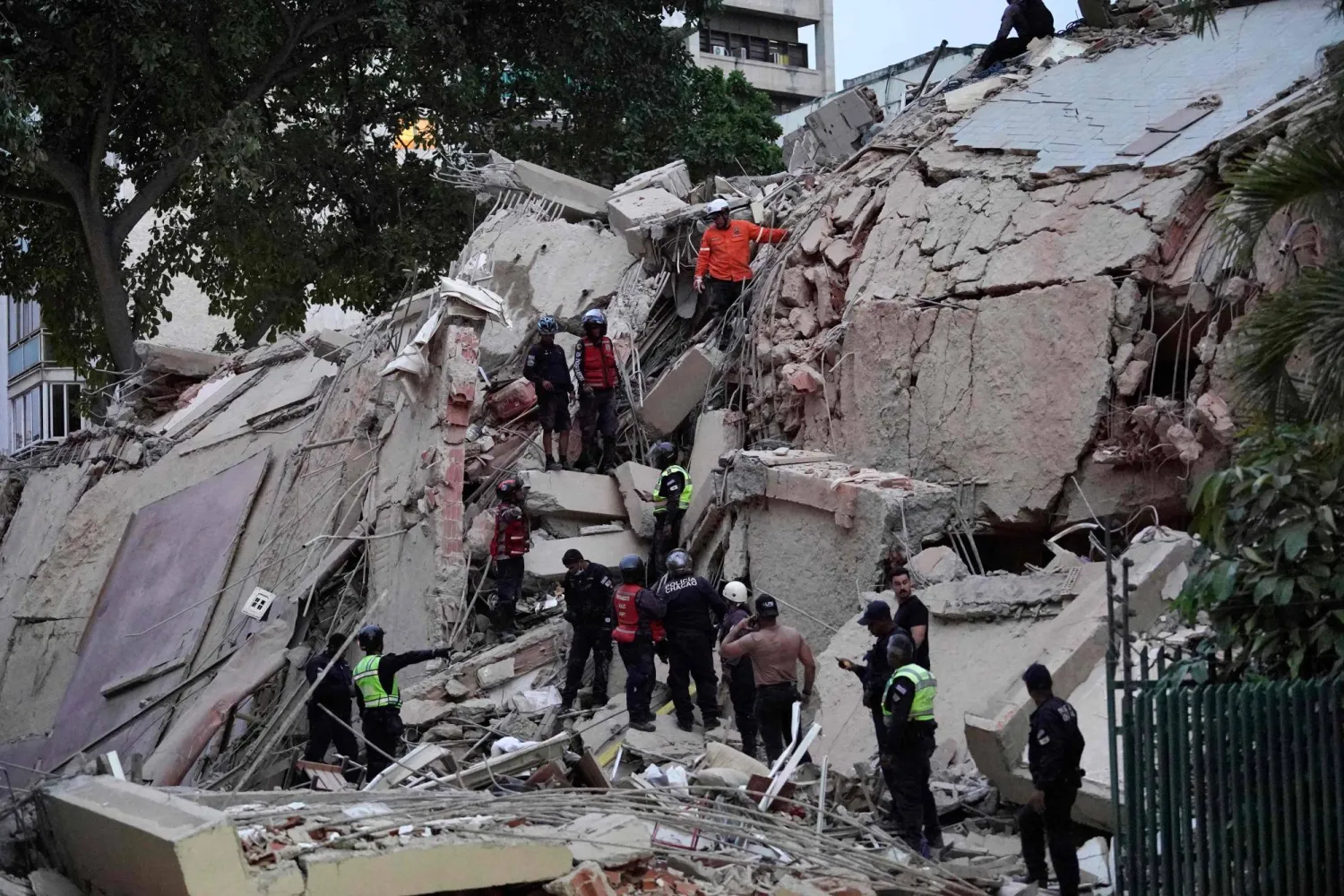
TOPSHOT - Rescuers search for victims in a collapsed building following an earthquake in Caracas on June 24, 2026. (Photo by Manaure Quintero / AFP)
TT

Rubio: US Will Immediately Send Search Teams and Medical and Humanitarian Aid to Venezuela

TOPSHOT - Rescuers search for victims in a collapsed building following an earthquake in Caracas on June 24, 2026. (Photo by Manaure Quintero / AFP)

Powerful back-to-back earthquakes that struck Venezuela on Wednesday evening killed at least 32 people and injured at least 700, the nation's acting president said, as communities across the South American country sustained damage.

Acting President Delcy Rodríguez warned the toll was expected to rise as rescuers search collapsed buildings and emergency crews reach devastated areas after the 7.2 and 7.5 magnitude earthquakes that struck shortly after 6 p.m, The Associated Press said.

Rodríguez declared a state of emergency in an address to the nation late Wednesday and said the quakes caused damage in several states. The casualty figures released early Thursday excluded the state of La Guaira, which Rodríguez described as a “disaster zone” and the area hardest hit.

“Dozens of buildings have collapsed there, about 30 kilometers (19 miles) north of Caracas, and we are currently carrying out intensive rescue operations to save lives,” she said.

The earthquakes, among the strongest to strike Venezuela in more than a century, roiled the region, with buildings evacuated in cities and areas impacted as far as Brazil’s Amazon about 1,700 kilometers (1,050 miles) from Venezuela's capital Caracas.

The earthquakes damaged and closed Simón Bolívar International Airport near Caracas, the country’s main airport, Rodríguez said, adding that subway and natural gas services in Caracas were canceled. She urged Venezuelans to report any damages through a government app.

Rodríguez said school classes would be canceled for several days. The Ministry of Education said some school buildings would be used as shelters and donation centers.

“We urge our population to remain calm,” said Rodríguez, who asked health care professionals to report to hospitals to assist the injured. “We urge unity.”

Country hit twice by large quakes The US Geological Survey initially said the first earthquake had a magnitude of 7.1, later revising that to 7.2. Its epicenter was west of Morón on the country’s Caribbean coast about 168 kilometers (104 miles) west of Caracas. The quake had a depth of 22 kilometers (13.6 miles).

The USGS reported an even larger 7.5-magnitude earthquake just a minute later. The second quake had a depth of 10 kilometers (6.2 miles) with an epicenter 16 kilometers (10 miles) southwest of Morón.

In the coastal state of Falcon, Gov. Víctor Clark said 32 people had been hospitalized and there were 15 people trapped in the hours after the earthquake.

International assistance offered

Offers of help were made by various governments including the United States, Argentina, Bolivia, Brazil, Chile, Ecuador, El Salvador, Mexico, Panama and Uruguay.

Jeremy P. Lewin, the US undersecretary of state for foreign assistance, said the State Department had mobilized a disaster assistance team and task force to coordinate aid including search-and-rescue teams, medical and humanitarian supplies and other resources in coordination with the interim Venezuelan government.

El Salvador President Nayib Bukele, once diametrically opposed to Venezuela’s government, said in a post on X Wednesday night that he had offered aid.

“We send you all our solidarity and our prayers. Stay strong, Venezuela,” Bukele wrote.

Ecuadorian President Daniel Noboa said he had ordered the immediate delivery of humanitarian aid to help respond to the emergency.

“Ecuador will respond with the speed and commitment this moment demands because, despite our enormous differences, humanity must always guide the actions of a leader,” Noboa wrote.

Bolivian President Rodrigo Paz, who less than a week ago declared a state of emergency in his country following weeks of anti-government protests, said his country stood ready to provide any needed assistance.

The administration of Brazil President Luiz Inácio da Silva expressed solidarity and said no Brazilians reported being injured

‘We all had to leave our houses' Television broadcasts Thursday showed images of rescue workers using power tools on collapsed structures.

During the quakes, people evacuated swaying buildings in Caracas, many visibly shocked as they saw collapsed walls that left furniture visible from the street. Dust columns could be seen in two capital neighborhoods with typically busy restaurants and other businesses.

People remained on the streets for hours, some sitting on the ground hugging pets as dust gathered around them. Collapsed buildings, toppled electric poles and debris blocked streets. Parts of the capital lost power and cellphone signal.

“It started off gently and then gradually grew, and in the end, we all had to leave our houses, go outside and gather together,” Caracas resident Hector Ricci said.

Roberto Gamas, another Caracas resident, said the building he was in “really shook from side to side. Unreal. The force was incredibly strong.”

The lack of cellphone signal in parts of Venezuela deepened the distress of many families, particularly those among the more than 7.7 million people who have left the country during its protracted crisis.

Venezuela opposition leader María Corina Machado, in exile after leaving Venezuela in December, took to X to send prayers and wish strength to Venezuelans.

“May strength, serenity, and solidarity prevail among us in the face of this difficult time,” she said on X.

Impact felt throughout Venezuela Venezuela Interior Minister Diosdado Cabello said the quake could be felt in several states and asked motorists to give way to ambulances and other emergency vehicles.

“We understand that some people may be desperate, but we are acting according to protocols to activate aid and rescue efforts to help those who need it most,” Cabello said, urging people to remain outside as aftershocks could further damage structures. “Be very careful with children and the elderly. Call each other and check that no one has been harmed.”

Earthquakes impact the region Buildings in Manaus, Belem and Macapá in Brazil's Amazon were evacuated, according to reports on TV Globo. The quakes also were felt in Colombia’s Caribbean and northeast regions, but there were no reports of damages or injuries.

The US Pacific Tsunami Warning Center issued several tsumani alerts in the wake of the earthquakes that were quickly lifted.

Strong earthquakes are unusual in Venezuela. While the country sits near multiple fault lines, its position straddling the South American and Caribbean plates make earthquakes much less common than in other parts of Latin America.

Earthquakes are frequent along the Pacific coast, including in Mexico and Chile, which both sit along the seismically active tectonic belt known as the Ring of Fire, an area that the USGS said is responsible for 90% of earthquakes.



Iran's President Delivers Defiant UN Speech

Iran's President Masoud Pezeshkian speaks during the 81st United Nations General Assembly at the United Nations Headquarters in New York, on September 23, 2026. (Photo by TIMOTHY A. CLARY / AFP)
TT

Iran's President Delivers Defiant UN Speech

Iran's President Masoud Pezeshkian speaks during the 81st United Nations General Assembly at the United Nations Headquarters in New York, on September 23, 2026. (Photo by TIMOTHY A. CLARY / AFP)

Iranian President Masoud Pezeshkian delivered a defiant speech at the United Nations on Wednesday as Tehran downplayed talks with the United States.

He said his country's people had been the “victims of terrorism” by the United States.

Delivering the rare wartime speech at the UN General Assembly, Pezeshkian displayed images of the late Supreme Leader Ali Khamenei and more than 150 schoolchildren killed in the opening days of the conflict.

“We have only defended ourselves. We are not terrorists,” he said. “Our innocent people have been the targets of cowardly attacks and aggressions imposed upon our country.”

Turning to the United States, Pezeshkian added: “Yes, they did hit us, but we did not bend the knee.”

On Wednesday, US Secretary of State Marco Rubio told reporters that President Donald Trump remained open to an agreement “that allows Iran to be what it should be, which is a great and prosperous country.”

Rubio said the prospects for such a deal were hindered by Iran’s nuclear ambitions and “their support of terrorism.” If those policies continued, he said, Trump could exercise “a number of options,” including further military action.

“It must be understood by Mr. Trump and those who seek to bully us that we are ready for dialogue and diplomacy and negotiations without accepting the language of force,” Pezeshkian said in his speech.


WHO: Congo is Running Short of Health Workers as Ebola Remains Out of Control

Ebola response teams organize a public demonstration to raise awareness about the Ebola virus disease in Beni, North Kivu province, eastern Congo, Tuesday, Sept. 22, 2026. (AP Photo/Sebastien Kitsa Musayi)
TT

WHO: Congo is Running Short of Health Workers as Ebola Remains Out of Control

Ebola response teams organize a public demonstration to raise awareness about the Ebola virus disease in Beni, North Kivu province, eastern Congo, Tuesday, Sept. 22, 2026. (AP Photo/Sebastien Kitsa Musayi)

Congo is running short of health workers to staff treatment centers for history's fastest-growing Ebola outbreak, particularly in the eastern province of North Kivu where cases have surged 73% over three weeks, the World Health Organization said Wednesday.

The warning came despite signs of improvement in other provinces, including Ituri, the outbreak’s epicenter. The outbreak has spread to seven provinces, with 7,773 confirmed cases and 3,759 deaths, according to the latest government figures.

Between Aug. 31 and Sept. 20, cases fell 26% in Ituri province and 15% in Haut-Uele, said Marie Roseline Belizaire, the WHO’s regional emergency director for Africa. But transmission patterns vary widely and the outbreak remains uncontrolled, she said.

“While cases and deaths are declining in some provinces, they continue to rise in others,” The Associated Press quoted Belizaire as saying. “The outbreak is still not under control and remains spread across a wide geographic area.”

The outbreak is spreading under extremely difficult conditions, fueled by insecurity, displacement, a health workers’ strike and intense population movements. The World Health Organization has said it is on track to surpass the 2014-2016 West Africa Ebola outbreak, the deadliest on record, which killed more than 11,000 people, primarily in Guinea, Liberia and Sierra Leone.

Catherine Smallwood, the WHO’s Ebola incident manager, said cases and deaths had begun declining in North Kivu after several weeks of increases. But although treatment beds are being added daily, facilities still lack enough staff and partners to operate them.

“The human resources gap is one of the biggest gaps,” Smallwood said.

WHO representative in Congo Anne Ancia said one Ebola treatment center requires about 300 health professionals, including anesthetists, hygienists, nurses and general practitioners.

“We are building Ebola treatment centers but do not always have the human resources needed to operate them,” Ancia said. “Those health workers must be paid.”

Frontline workers in Ituri previously went on strike over unpaid wages, worsening access to care.

Health Minister Roger Kamba said in July that the government was verifying payroll lists after the names of people not involved in the response were added. Frontline workers said officials promised to pay the arrears, but some workers received nothing and others only part of what they were owed.

Another major challenge in the response is the fatality rate among children, according to the WHO. Children under five have the highest case fatality rate, more than 60% compared with approximately 40% among adults, Belizaire said.

WHO Ebola Incident Manager Smallwood said detecting cases among children under five is also very difficult because the children can’t necessarily explain their symptoms, and the presentation of symptoms can be confusing.


Pakistani Officials Say Afghan Taliban Shelled Pakistani Border. Kabul Denies the Attack

Pakistani soldiers near a security fence at the border post in Torkham, Pakistan, in December. Credit Salahuddin/Reuters
TT

Pakistani Officials Say Afghan Taliban Shelled Pakistani Border. Kabul Denies the Attack

Pakistani soldiers near a security fence at the border post in Torkham, Pakistan, in December. Credit Salahuddin/Reuters

Afghanistan's Taliban forces shelled Pakistani border posts overnight after Pakistani troops foiled what they described as a cross-border infiltration attempt by militants, local Pakistani officials said Wednesday.

The spokesman for Afghanistan’s Taliban government, Zabiullah Mujahid, denied any attacks by the Afghan Taliban forces, The Associated Press said.

The conflicting statements came just days after Pakistani fighter jets struck sites in eastern Afghanistan that Islamabad said were militant hideouts, an escalation between Kabul and Islamabad that threatens mediation efforts by regional powers.

Pakistani security forces neutralized two rudimentary drones, which the officials said were launched by the Afghan Taliban, before they could enter the northwestern city of Kohat, the officials said. They said the action underscored Pakistan's round-the-clock vigilance and air-defense systems' readiness to counter emerging aerial threats from Afghanistan.

The airstrikes ended several weeks of relative calm following months of cross-border hostilities. Also, earlier this month, Pakistani security forces killed 15 militants attempting to cross into the country from Afghanistan.

Four local Pakistani officials said Wednesday that militants attempted to infiltrate Pakistan from areas near Afghan border posts in Paktia and Nangarhar provinces, allegedly with support from the Afghan Taliban forces.

The officials referred to the militants as Fitna-ul-Khawarij, a term Islamabad uses for the Pakistani Taliban, a group that is separate but allied with the Afghan Taliban. Pakistan has repeatedly accused Afghanistan’s Taliban government of allowing militants to operate from its territory and carry out attacks across the border, an accusation that Kabul denies.

After Pakistani troops thwarted the infiltration attempt, Afghan Taliban forces allegedly fired mortars and other heavy weapons at Pakistani border posts, the four officials said. Pakistani forces responded with artillery fire, targeting Taliban border posts, mortar sites, and defensive positions.

The officials said Afghan Taliban forces subsequently abandoned several positions and suffered casualties. The four officials spoke on condition of anonymity as they were not authorized to talk to the media about the latest flare-up.

The accounts could not be independently verified. The latest escalations threaten mediation efforts by China, Türkiye, Qatar and Saudi Arabia to broker a lasting peace between Kabul and Islamabad.

In Monday's airstrikes, Pakistan’s Information Ministry said 28 militants were killed, while Afghan authorities said at least three civilians died and four others were wounded. The U.N. mission in Afghanistan confirmed the civilian casualties and Kabul formally protested the attack.

On the sidelines of the UN General Assembly in New York, Pakistani Foreign Minister Ishaq Dar expressed concern about what he said was the presence of more than two dozen anti-Pakistani militant groups in Afghanistan.

Monday’s Pakistani airstrikes followed a shootout with militants in Hangu, a district in northwestern Khyber Pakhtunkhwa province near the Afghan border, that killed six Pakistani security personnel. Days earlier, a suicide bomber struck a mosque inside a police compound in the nearby city of Kohat.

Eight gunmen then stormed the compound, triggering a 20-hour gunbattle that killed at least 21 people, most of them police officers. No group had claimed responsibility for the attacks.

Pakistani authorities blamed the violence on the Pakistani Taliban and allied militant groups. The Pakistani Taliban, formally known as Tehrik-e-Taliban Pakistan, have stepped up their attacks on Pakistani security forces, boosted by the Afghan Taliban's return to power in Afghanistan in 2021.