


IAEA Head: 'Very Strong' Nuclear Verification Needed in Iran after War

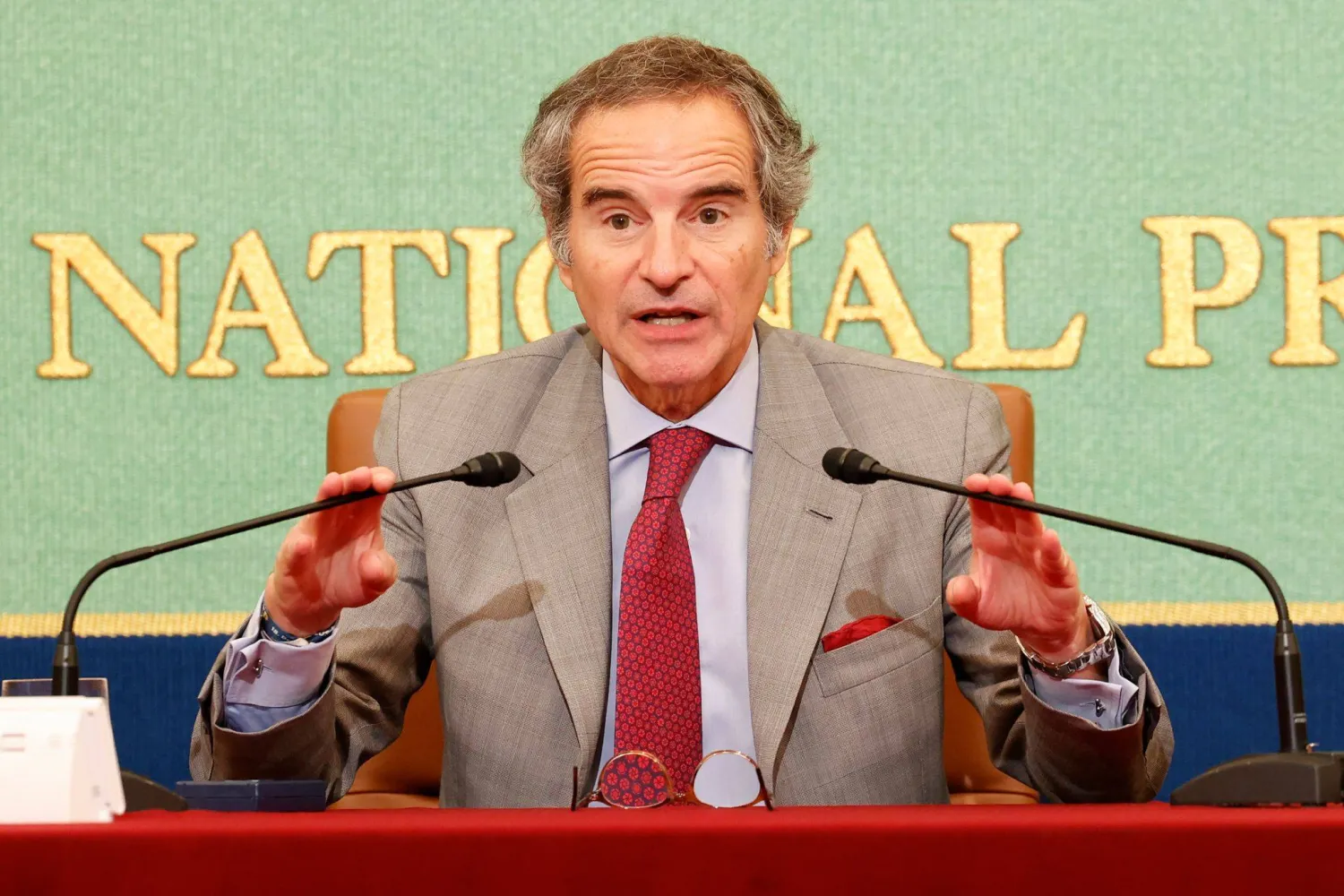
26 June 2026, Japan, Tokio: International Atomic Energy Agency (IAEA) Director General Rafael Mariano Grossi addresses the media during a press conference at the Japan National Press Club. Photo: Rodrigo Reyes Marin/ZUMA Press Wire/dpa
TT

IAEA Head: 'Very Strong' Nuclear Verification Needed in Iran after War

26 June 2026, Japan, Tokio: International Atomic Energy Agency (IAEA) Director General Rafael Mariano Grossi addresses the media during a press conference at the Japan National Press Club. Photo: Rodrigo Reyes Marin/ZUMA Press Wire/dpa

"Very strong" verification is needed in Iran following the Middle East conflict to ensure that it does not develop nuclear weapons, the UN atomic watchdog chief said on Friday.

International Atomic Energy Agency (IAEA) head Rafael Grossi's remarks come as the United States and Iran negotiate a broader agreement to end the war, with Tehran's nuclear program a key sticking point.

"I think the objective of this (recent US-Iran preliminary) agreement is to ensure that there is no development of nuclear weapons in Iran. The government of Iran has declared quite clearly that this is not their intention," Grossi told reporters in Japan.

"But of course intentions are not enough. We have to have a very strong verification system in place... as soon as is practicable," AFP quoted the IAEA chief as saying.

Grossi said the watchdog had also "barely initiated" talks with Iran following its preliminary agreement with the United States about what to do with Tehran's uranium stockpile.

"Initial conversations have taken place... We expect this work to pick up soon," Grossi said.

Before the conflict, the IAEA estimated that Iran had 440 kilograms (970 pounds) of uranium enriched to 60 percent.

That is close to the 90 percent needed to make a bomb and well above the 3.67-percent limit set by a now-defunct 2015 agreement with Iran.

Iran suspended cooperation with the IAEA after Israel and the United States launched a previous wave of attacks in June 2025, and its inspectors have not seen the material since.

Under the terms of the preliminary agreement between Tehran and Washington, this stockpile is meant to be "downblended" under IAEA supervision.

Grossi said the "widespread impression" was that the stockpile remains where it was before June 2025 near Iran's Isfahan facility.

However, that facility was bombed and Iran said that it does not plan to allow the IAEA to inspect sites that were attacked.

Grossi also said on Friday that an alternative to diluting could be shipping the enriched uranium out of Iran.

"The memorandum of understanding, as you may have noted, includes the possibility of downblending as one alternative," Grossi said.

"It could also be shipped out directly. It would perhaps be more complicated, but there are a few technical alternatives to deal with the material," he said.

Iran has consistently denied seeking to acquire an atomic bomb, while remaining adamant about its right to operate a full-scale civilian nuclear program.

Before the 12-day war in 2025, Iran as a signatory to the nuclear non-proliferation treaty -- unlike Israel, which is widely assumed to have atomic weapons -- allowed the IAEA to inspect its nuclear sites under its safeguards deal with the Vienna-based body.

Iran agreed a landmark nuclear deal with six big powers in 2015 limiting its nuclear program in exchange for sanctions relief, but US President Donald Trump walked away from the agreement during his first term.



Iran Says Strait of Hormuz is Under Its Control

An Iranian woman walks next to an anti-US billboard at the Enghelab square in central Tehran, Iran, 13 August 2026. Tensions between Iran and the US remain high as opposing claims persist over shipping control in the Strait of Hormuz.  EPA/ABEDIN TAHERKENAREH
An Iranian woman walks next to an anti-US billboard at the Enghelab square in central Tehran, Iran, 13 August 2026. Tensions between Iran and the US remain high as opposing claims persist over shipping control in the Strait of Hormuz. EPA/ABEDIN TAHERKENAREH
TT

Iran Says Strait of Hormuz is Under Its Control

An Iranian woman walks next to an anti-US billboard at the Enghelab square in central Tehran, Iran, 13 August 2026. Tensions between Iran and the US remain high as opposing claims persist over shipping control in the Strait of Hormuz.  EPA/ABEDIN TAHERKENAREH
An Iranian woman walks next to an anti-US billboard at the Enghelab square in central Tehran, Iran, 13 August 2026. Tensions between Iran and the US remain high as opposing claims persist over shipping control in the Strait of Hormuz. EPA/ABEDIN TAHERKENAREH

The Strait of Hormuz is "under Iran's control and management", the head of Iran's Basij paramilitary unit, Hossein Taeb, said on Thursday, according to the semi-official Fars news ‌agency.

The remarks ‌came a day ‌after ⁠US President Donald ⁠Trump wrote on his Truth Social platform that the US had "total control" of the strategic waterway.

Taeb said the United States ⁠had sought to ‌disrupt ‌what he described as Iran’s popularity in the ‌region by launching another war in the Strait of Hormuz, but had once ‌more been defeated despite claiming Iran had neither an ⁠air ⁠force nor a navy.

"Today you see that the Strait of Hormuz is under the management and control of the Islamic Republic," Taeb said, adding that Iran was continuing on its course in complete security.


Colombia Enters ‘Final Phase’ of Quake Search as Toll Hits 265

This aerial view shows heavy machinery used by rescuers in the search for survivors amid the rubble of a collapsed building after an earthquake in Pereira, Colombia on August 12, 2026. (AFP)
TT

Colombia Enters ‘Final Phase’ of Quake Search as Toll Hits 265

This aerial view shows heavy machinery used by rescuers in the search for survivors amid the rubble of a collapsed building after an earthquake in Pereira, Colombia on August 12, 2026. (AFP)

Rescuers in Colombia were making last-ditch efforts to locate earthquake survivors early Thursday, as the critical 72-hour window for rescue operations neared its end.

The magnitude 7.4 quake, the strongest to hit Colombia this century, has killed 265 people, injured more than 3,500 and left almost 500 missing, according to local authorities.

In cities such as Cali and Pereira, emergency crews worked through a third night with their bare hands, cranes and sniffer dogs, stopping not to rest but to listen for signs of life.

Thursday morning will mark 72 hours since the quake, a period when survivors are considered most likely to be found alive beneath collapsed buildings.

Cali resident Martha Perez said she felt "helpless" as two relatives were thought to still be trapped under rubble.

"We will hold on to (hope) until the very end," Perez told AFP on Wednesday night.

"As you can see, all of us here -- the entire city of Cali -- are hoping to find more survivors," volunteer rescuer Fernando Loaiza said.

Cali Mayor Alejandro Eder said Wednesday that rescue efforts were "entering the final phase."

Colombia's newly installed president Abelardo de la Espriella has declared the disaster an "economic emergency" and announced three days of national mourning.

"We will do what is necessary," he said in a statement, vowing to "emerge again as a country and as a society."

More than 11,000 dwellings have been destroyed and thousands of families have been rendered homeless, according to official figures.

- Holding onto 'hope' -

In Pereira, crews focused on a collapsed bakery where they believe a street vendor trapped since Monday's earthquake may still be alive beneath the rubble.

Rescuers using equipment that detects vibrations said they had picked up possible signs of life from Pablo Loaiza, prompting anxious relatives to gather near the wreckage.

"They tell us it could be him," said his 16-year-old niece, Sara Loaiza. "My heart is about to burst out of my chest."

Relatives said the trapped man appeared to respond when rescuers asked him to knock twice, then three times from beneath the rubble, drawing applause from those gathered at the scene.

"Every half hour we make everyone be quiet to see if we can find people alive," volunteer rescuer Johana Sanchez told AFP.

"So far, three people have been pulled out alive and three dead."

Many have already spent consecutive nights outdoors, either because their homes were damaged or because they feared aftershocks.

In the town of Roldanillo, Yuliana Mendez picked through the wreckage of the beauty products store where she worked, one of many businesses damaged in the disaster.

"It's like starting over from scratch," she said.

In Pereira's Providencia neighborhood, residents hauled furniture and household items from damaged buildings. Among them was lawyer Ana Paulina Crosthwaite, whose apartment block was left unsafe by the quake.

"We're in a state of shock," she told AFP. "We're not prepared to tell our children that we have to pack whatever we can and start a new life."

Many Colombians have mobilized to help, bringing water, food and supplies to affected neighborhoods, while long lines formed outside blood donation centers.

"It's about wanting to help your community, your city and your country," said blood donor Ferney Cabrera.

The United States announced $15.5 million in emergency aid to Colombia, and the European Union pledged two million euros ($2.3 million).


US Floats Prospect of Joint Strikes on Colombian Armed Groups

 US Defense Secretary Pete Hegseth speaks during a forum of the Americas Counter Cartel Coalition in Panama City on August 12, 2026. (AFP)
US Defense Secretary Pete Hegseth speaks during a forum of the Americas Counter Cartel Coalition in Panama City on August 12, 2026. (AFP)
TT

US Floats Prospect of Joint Strikes on Colombian Armed Groups

 US Defense Secretary Pete Hegseth speaks during a forum of the Americas Counter Cartel Coalition in Panama City on August 12, 2026. (AFP)
US Defense Secretary Pete Hegseth speaks during a forum of the Americas Counter Cartel Coalition in Panama City on August 12, 2026. (AFP)

US Defense Secretary Pete Hegseth floated on Wednesday the possibility of joint strikes on Colombian armed groups, as he welcomed the nation into a military-led counter-narcotics coalition after its conservative president took over last week.

Colombia had authorized "joint military operations to destroy terrorists and terror networks," Hegseth told a gathering of the US-led Americas Counter-Cartel Coalition in Panama.

"Yes," he replied when asked if he had discussed with his Colombian counterpart joint strikes against armed groups such as the National Liberation Army (ELN), which the US designates as a terrorist group, and remnants of the Revolutionary Armed Forces of Colombia.

"Designated terrorist organizations, with partnered governments, will be legitimate targets of the United States government," to include Colombia, Hegseth said when asked if such operations were expected.

President Donald Trump's Latin American policy has expanded dramatically beyond its early focus on the Panama ‌Canal.

More than 200 ‌people have been killed since the launch of US military strikes on suspected drug ‌boats ⁠last September, while a ⁠US-led commando raid in January deposed Nicolas Maduro, the president of Venezuela.

Critics say the US strikes amount to war crimes worthy of the International Criminal Court, but Hegseth blasted the organization and encouraged coalition allies attending the meeting in Panama to withdraw from it.

He compared drug traffickers to al-Qaeda or ISIS terrorists.

Speaking at a hotel in Panama City, Hegseth invoked a revamped Monroe Doctrine, the 19th-century policy asserting US primacy across the Americas that critics associate with decades of US intervention.

He has called it the "Donroe Doctrine" — a play on Trump's name.

"We will defend our hemisphere from external threats," including from ⁠narco-traffickers and foreign malign influence, Hegseth said.

COLOMBIAN CRACKDOWN

Colombian President Abelardo De La Espriella's ‌vows of a security crackdown have been embraced by the Trump administration, which ‌announced plans on Friday to provide $1 billion in US security assistance to his government.

During his swearing-in remarks on Friday, De ‌La Espriella vowed to "definitively eradicate the scourge of illicit crops" and committed to also joining the Shield of the ‌Americas program founded by Trump.

De La Espriella has blamed his predecessor, leftist Gustavo Petro, for an expansion of armed groups.

Speaking alongside Hegseth at the event, Colombia's new Defense Minister Jorge Eduardo Mora, a retired major general, said Colombia could take a critical role in combating narco-traffickers on both its Pacific and Caribbean coasts.

"I think the time has arrived for the narco-terrorist cartels to confront ‌the power and the capabilities of the entire hemisphere, led by the United States," Mora said.

One US official, speaking on condition of anonymity, said the new security ⁠partnership was expected to ⁠surpass the level of cooperation under Plan Colombia, a US-Colombia anti-narcotics initiative launched in the early 2000s.

De La Espriella's election was part of a rightward shift rippling across Latin America.

In Argentina, Bolivia, Chile, Ecuador, Panama and Peru, weak economies and rising crime have reshaped voter priorities, allowing once-fringe hard-right candidates to gain traction by promising crackdowns amid a global rise of right-wing nationalism.

In Panama, Trump's administration won a major victory from the country's Supreme Court in January after voicing concerns about encroachment by China. Hong Kong-based CK Hutchison, through local unit Panama Ports Company, lost the port concessions it had held for nearly three decades.

The Panama Canal handles 5% of global maritime trade, making control of its entrance ports a flashpoint for tension between Washington and Beijing.

Addressing the meeting, Panama President Jose Raul Mulino called drug trafficking the biggest threat facing the region and dismissed concerns that the US-led coalition could infringe on members' sovereignty. He made no mention of China.

Instead, he said the transnational crime groups that traffic drugs and people are the real threats to sovereignty.

"There's never going to be a sustainable peace if this enemy (advances)," Mulino said.