

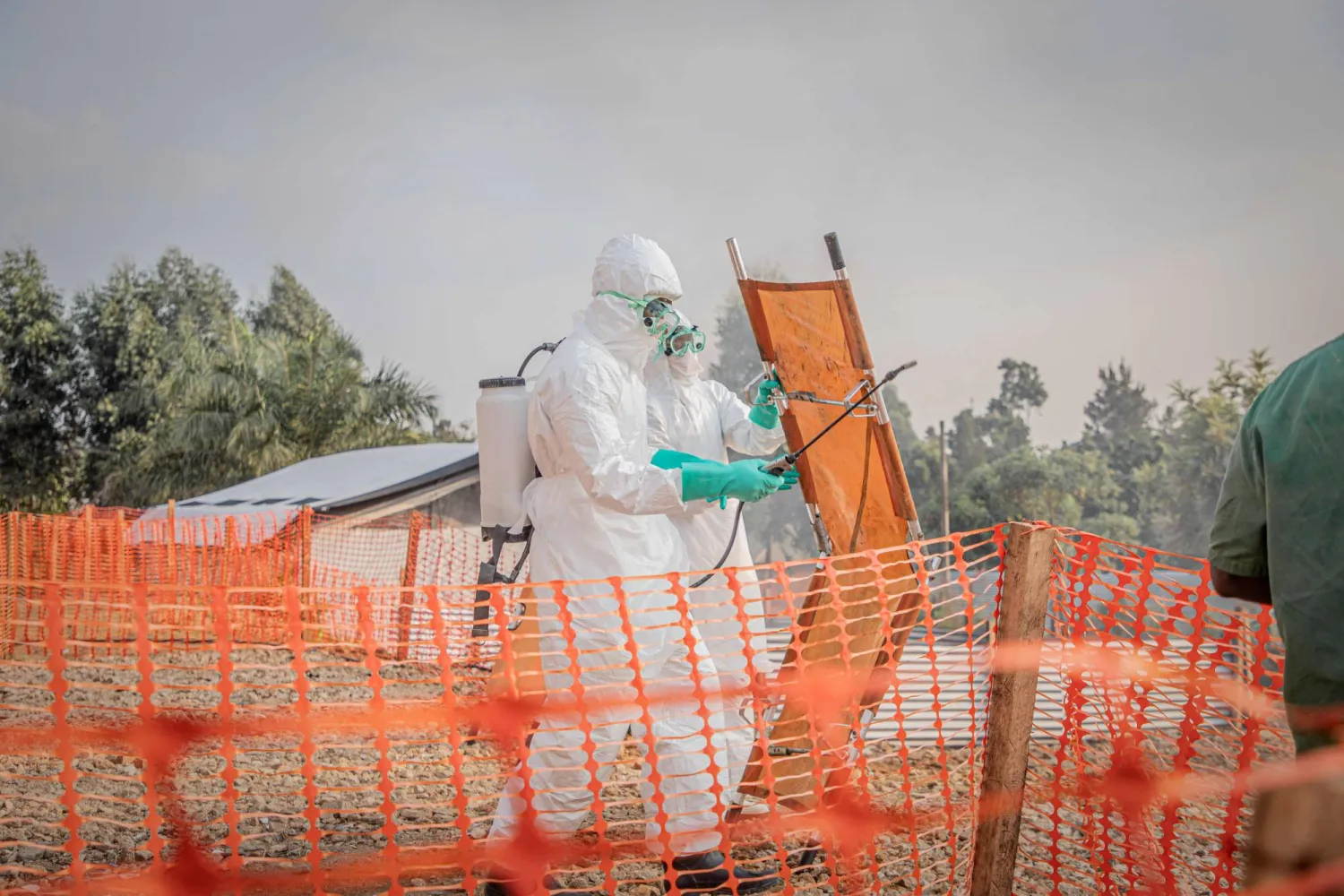

Ebola Deaths Exceed 300 in DR Congo, Say Heath Authorities

 Healthcare workers disinfect a stretcher after transporting a patient suffering from the Ebola virus disease from an ambulance at the Ebola Treatment Center (ETC) in Bunia, Ituri, in the east of the Democratic Republic of Congo on June 23, 2026. (AFP)
Healthcare workers disinfect a stretcher after transporting a patient suffering from the Ebola virus disease from an ambulance at the Ebola Treatment Center (ETC) in Bunia, Ituri, in the east of the Democratic Republic of Congo on June 23, 2026. (AFP)
TT

Ebola Deaths Exceed 300 in DR Congo, Say Heath Authorities

 Healthcare workers disinfect a stretcher after transporting a patient suffering from the Ebola virus disease from an ambulance at the Ebola Treatment Center (ETC) in Bunia, Ituri, in the east of the Democratic Republic of Congo on June 23, 2026. (AFP)
Healthcare workers disinfect a stretcher after transporting a patient suffering from the Ebola virus disease from an ambulance at the Ebola Treatment Center (ETC) in Bunia, Ituri, in the east of the Democratic Republic of Congo on June 23, 2026. (AFP)

The Ebola epidemic has claimed more than 300 lives in the Democratic Republic of Congo (DRC), a little over one month after it was declared, health authorities said on Friday.

The deadly viral disease, which spreads through direct contact with bodily fluids, can cause severe bleeding and organ failure.

A total of 304 people in the DRC have now died of the virus, from 1,115 confirmed infections since the outbreak was detected on May 15, giving a mortality rate of 26.3 percent, the National Public Health Institute (INSP) said.

This is a jump from the 202 deaths confirmed on June 18 by the African Union's health agency, from 875 confirmed infections -- a mortality rate of 23 percent.

The Red Cross warned last week that the outbreak of the haemorrhagic fever has yet to peak and could take up to a year to contain.

In some rare good news, the DRC authorities announced in early June that several Ebola patients had been treated and cured.

Responders to the epidemic, the 17th to hit the vast, unstable central African country, face towering challenges.

No approved vaccines or treatments exist for the Bundibugyo strain of the virus responsible for the latest outbreak to hit the DRC, which is one of the world's poorest countries.

The three affected provinces in eastern DRC -- Ituri, North Kivu and South Kivu -- have been plagued for three decades by conflict and mass displacement, complicating the response.

The outbreak has spread to neighboring Uganda, where containment measures have been effective.

Kampala has reported 20 confirmed cases nationwide, including two deaths since May 15. Most of those infected are Congolese nationals who have travelled to Uganda.

On Wednesday, France reported the outbreak's first confirmed case of Ebola outside Africa -- a Congolese doctor who was working in the DRC for the international medical aid NGO ALIMA.

The World Health Organization says there is minimal risk of the virus spreading in Europe and there is no need for travel restrictions.

Air France, on which the doctor flew back to France, has nevertheless suspended all flights to Kinshasa for several days.

- Ituri -

The vast majority of cases in the DRC have been detected in Ituri.

The mineral-rich province is plagued with unrest from a string of rival armed groups, and frequent population movements favour the spread of the disease.

More than 91 percent of all infections have been registered in the provincial capital, Bunia, and more than 82 percent of all deaths.

Efforts to contain the virus have been ratcheted up in Ituri.

But healthcare facilities -- which often operate with limited resources -- still lack basic equipment and supplies, such as personal protective equipment and chlorine.

Many clinics set up by the WHO and aid agencies are close to full, the country's public health agency said.

At least 78 healthcare workers have been infected with the virus, and 18 have died, it added.

Medical and aid workers also have to contend with deep mistrust from some local communities.

Some families have demanded that hospitals hand over the bodies of the deceased, not realizing that touching the body puts them at risk of contamination.

The reluctance of some families to allow post-mortem examinations on the victims is also leading to an underestimation of the number of cases, officials said.



115 Vessels, 2,500 Seafarers Evacuated from Strait of Hormuz Since Tuesday, Says UN Maritime Head

Vessels at the Strait of Hormuz, as seen from Musandam, Oman, June 24, 2026. (Reuters)
TT

115 Vessels, 2,500 Seafarers Evacuated from Strait of Hormuz Since Tuesday, Says UN Maritime Head

Vessels at the Strait of Hormuz, as seen from Musandam, Oman, June 24, 2026. (Reuters)

A total of about 115 vessels and 2,500 seafarers have been evacuated from the Strait of Hormuz since Tuesday, the head of the UN maritime body said Friday.

International Maritime Organization secretary-general Arsenio Dominguez gave the update after the IMO on Thursday suspended its efforts to evacuate some 600 ships and 11,000 sailors, following an attack on a vessel in the Gulf of Oman.

Dominguez told an online press conference that "115 (vessels) have evacuated in the last three and a half days, representing around 2,500 seafarers that have now safely left the Strait of Hormuz" since the UN began its safe-passage program Tuesday.

Dominguez said that following "consultations with some countries, particularly in the region", he took the decision to pause evacuations of those trapped because of the US-Iran war.

Yet vessels continued to use a non-Iranian-approved passage, tracking platforms showed Friday.

Formal evacuation of crews is being carried out via two routes -- one close to the Omani coast and the other near to the Iranian coast.

Neither is the traditional passage established by the IMO in 1968 as part of the Traffic Separation Scheme aimed at reducing collision risks in the Strait of Hormuz.

This is because of mines located in the usual traffic route.

In the memorandum of understanding signed by Iran and the United States last week aimed at ending the war, Tehran committed to clearing the mines from the area within 30 days.


Trump Says Iran Attacks on Ships a ‘Foolish Violation’ of the Ceasefire

 Vessels at the Strait of Hormuz, as seen from Musandam, Oman, June 26, 2026. (Reuters)
Vessels at the Strait of Hormuz, as seen from Musandam, Oman, June 26, 2026. (Reuters)
TT

Trump Says Iran Attacks on Ships a ‘Foolish Violation’ of the Ceasefire

 Vessels at the Strait of Hormuz, as seen from Musandam, Oman, June 26, 2026. (Reuters)
Vessels at the Strait of Hormuz, as seen from Musandam, Oman, June 26, 2026. (Reuters)

US President Donald Trump on Friday blamed Iran for carrying out a drone strike on a cargo ship in the Strait of Hormuz, calling it a “foolish violation” of the ceasefire agreement with the US. 

Trump said one drone hit the upper deck of the ship and “damage was done,” but the ship was able to proceed. He added that the US shot down three other drones. 

His post on social media did not identify the ship or the time of the strike, but on Thursday the British military said a vessel was hit by a projectile off the coast of Oman. 

It comes during a fragile time for the US and Iran as they work to negotiate a permanent end to the war. 


World Must Stop Venezuela Quakes Triggering ‘Larger Human Tragedy’, Say UN, Aid Agencies

 People search through the rubble two days after an earthquake struck La Guaira, Venezuela, Friday, June 26, 2026. (AP)
People search through the rubble two days after an earthquake struck La Guaira, Venezuela, Friday, June 26, 2026. (AP)
TT

World Must Stop Venezuela Quakes Triggering ‘Larger Human Tragedy’, Say UN, Aid Agencies

 People search through the rubble two days after an earthquake struck La Guaira, Venezuela, Friday, June 26, 2026. (AP)
People search through the rubble two days after an earthquake struck La Guaira, Venezuela, Friday, June 26, 2026. (AP)

UN and other humanitarian agencies issued a joint call Friday for "solidarity" after deadly twin quakes rocked Venezuela, insisting that "the international community must not allow this emergency to deepen into a larger human tragedy".

"The people of Venezuela need solidarity now," the heads of the Inter-Agency Standing Committee -- a forum of United Nations and non-UN humanitarian organizations -- said in a statement, urging "rapid and unimpeded humanitarian access" to those affected.

The death toll from twin earthquakes in Venezuela more than doubled Friday to 589, interim president Delcy Rodriguez said, as rescuers boosted by international teams raced to find survivors beneath collapsed buildings.

Rescuers used heavy machinery but also their bare hands in a race to pluck out people caught under rubble in the earthquake zone west of the capital Caracas.

"This disaster comes on top of an already challenging humanitarian context" in Venezuela, the humanitarian chiefs said.

"Even before the earthquakes, millions of people across Venezuela were facing food insecurity, collapsing health services, protection risks, and limited access to basic services," they said.

"For many communities already living in vulnerability, this latest shock is catastrophic."

The statement highlighted that humanitarian organizations were helping assess needs and deliver life-saving assistance.

"At this critical time, rapid and unimpeded humanitarian access, safe operational conditions, and transparent information sharing are essential to ensure assistance reaches those most affected," it said.

The humanitarian chiefs also called on the broader international community to "act swiftly and decisively by providing flexible and timely funding to scale up emergency relief, including shelter, food, health care, protection, water and sanitation, and psychosocial support".