


Tanker Struck in Hormuz as Iran, US Trade Attacks in Worst Escalation Since Peace Deal

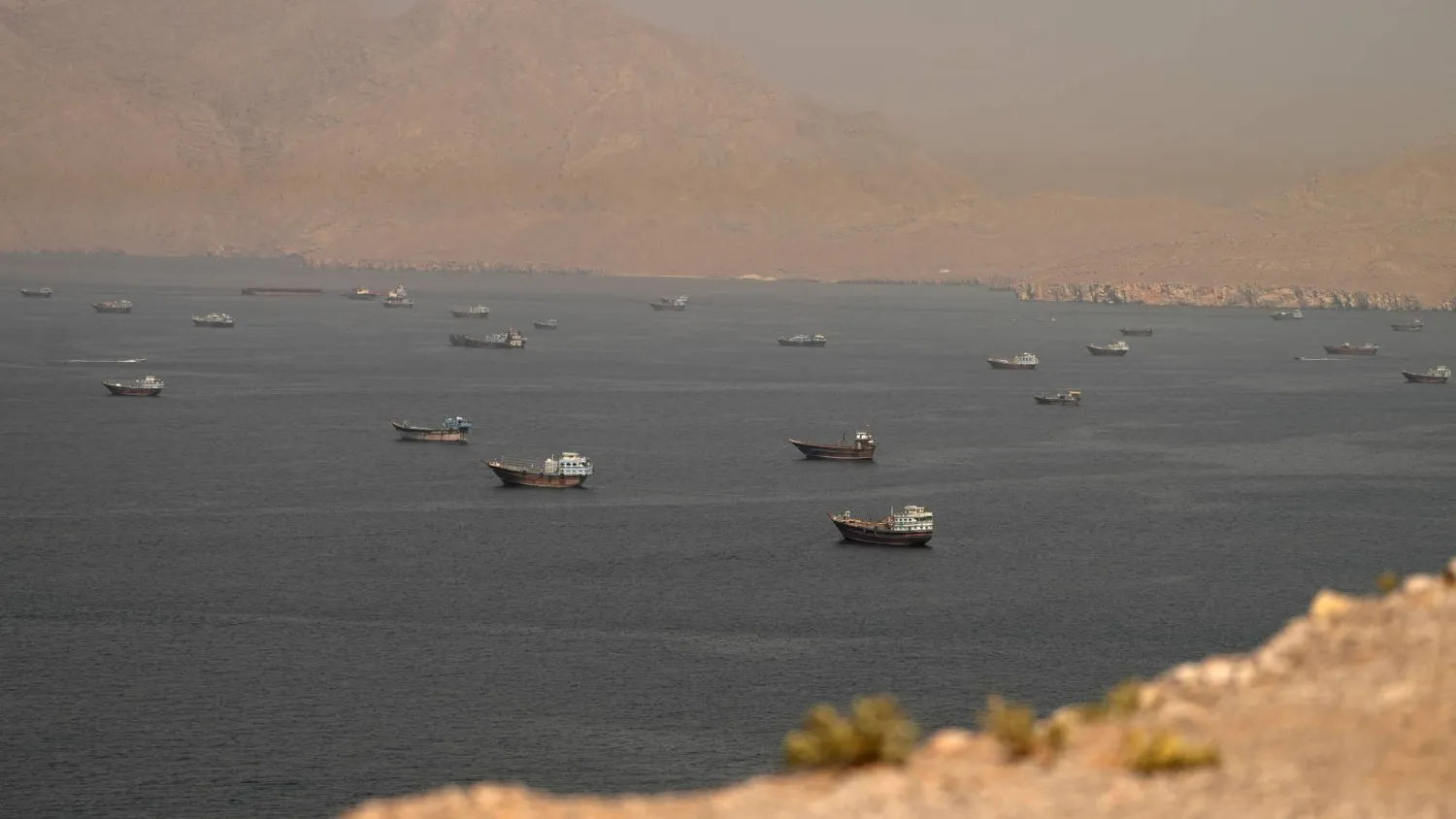
Vessels at the Strait of Hormuz, as seen from Musandam, Oman, June 18, 2026. (Reuters)
TT

Tanker Struck in Hormuz as Iran, US Trade Attacks in Worst Escalation Since Peace Deal

Vessels at the Strait of Hormuz, as seen from Musandam, Oman, June 18, 2026. (Reuters)

A tanker reported being struck by a projectile in the Strait of Hormuz on Saturday, Britain's maritime security agency said, after the United States and Iran each launched strikes in the worst escalation since they signed an interim peace deal.

The warring sides each accused the other of violating the agreement reached two weeks ago to end the four-month-old conflict.

Washington said it hit Iranian targets overnight, while Iran said it had struck targets linked to US forces on Saturday in response.

Saturday's attack on a tanker in the strait followed another on a cargo ship on Thursday that triggered the latest escalation.

Iran has made a fresh bid to assert control over the world's most important energy shipping route, which has begun to reopen over the past two weeks after months of disruption.

Britain's UKMTO maritime security agency said the tanker hit on Saturday had sustained damage to its bridge, with all crew reported safe. The Joint Maritime Information Center, run by a coalition of navies protecting shipping, said it had raised its security ‌threat level as ‌a result of recent incidents.

Iran has not directly commented on reports of specific attacks on ships. But Iranian ‌state ⁠television reported that ⁠the Revolutionary Guards had fired "warning shots" towards unspecified vessels attempting to pass through channels not approved by Iran, and that this was now prompting other ships to seek Iranian permits before attempting to cross the strait.

Bahrain reported an Iranian drone attack. The US military did not immediately respond to the reports.

IRAN ASSERTS CONTROL OVER VITAL STRAIT

Iran has accused the United States of failing to uphold the interim agreement, in particular by failing to sustain a promised ceasefire in Lebanon, which US ally Israel invaded in March in pursuit of the Iran-backed group Hezbollah.

Israel and Lebanon have repeatedly agreed US-brokered ceasefires, the latest of which was announced on Friday. But these have so far had only limited overall impact, with ⁠Israel insisting it will not withdraw from a swathe of territory it has seized and Hezbollah repeatedly rejecting calls ‌to give up its arms as long as Israeli troops remain in place.

Lebanese state television reported ‌an Israeli drone strike on Saturday in the Nabatieh area in the south, which has seen Israeli strikes throughout the conflict.

The Israeli military said it had targeted a ‌person who posed a threat to its forces.

Hezbollah leader Naim Qassem rejected the day-old Israel-Lebanon agreement as surrender, and said it was "null and void".

Mohsen ‌Rezaei, an adviser to Iran's supreme leader, said Washington had violated the war-ending memorandum of understanding by supporting what he called proxy forces in the region and creating tensions in the Strait of Hormuz.

Iranian state television said the Revolutionary Guards had delivered "a decisive response" after US forces hit a communications tower in the port city of Sirik. Iran's Mehr news agency said the Iranian port was operating normally with ‌no damage reported to facilities or equipment.

Bahrain said Iran's latest attacks violated the memorandum of understanding.

Hundreds of ships, including tankers laden with oil, have been blockaded inside the Gulf since war broke out. As they began leaving ⁠through the strait over the past ⁠two weeks, oil prices have tumbled close to pre-war levels on the resulting surge in supply.

But fully resolving the global energy crisis would require sustaining two-way traffic through the strait at pre-war levels, likely to be possible only if shippers accept it as safe.

Washington has been promoting a southern lane along the coast of Oman, while Tehran, which ultimately aims to charge fees for use of the strait, wants ships to use a northern route through its waters and under its control.

Ebrahim Azizi, head of the Iranian parliament's national security committee, said on Saturday that any violation of Iran's shipping instructions would be met decisively.

'VIOLENCE WILL BE MET WITH VIOLENCE,' VANCE SAYS

US Vice President JD Vance, President Donald Trump's chief negotiator on the conflict, said the Americans had adhered to the ceasefire deal, and Iran was to blame for any return to conflict that might result from its actions.

"Iran signed a ceasefire agreement. We have honored it. If they have disagreements about how the MOU is being applied, they can pick up the phone. But violence will be met with violence," Vance said on X.

As has regularly been the case throughout the war, the escalation unfolded over the weekend while markets were closed, giving the sides two days to stake out tough positions and exchange fire without causing any immediate oil price impact.

Previously, including the last two weekends, bitter words on Friday and Saturday were followed by more ameliorative positions from both sides in time for markets to reopen on Monday. Before the renewed outbreak of violence, oil prices fell about 3% on Friday, on course for a steep weekly fall.



22 Killed in Kenya Bus Crash Near the Site of a Previous Fatal Accident

 People walk on a street near the site of a building that collapsed the previous day in Eastleigh, Nairobi, Kenya, October 24, 2026. (Reuters)
People walk on a street near the site of a building that collapsed the previous day in Eastleigh, Nairobi, Kenya, October 24, 2026. (Reuters)
TT

22 Killed in Kenya Bus Crash Near the Site of a Previous Fatal Accident

 People walk on a street near the site of a building that collapsed the previous day in Eastleigh, Nairobi, Kenya, October 24, 2026. (Reuters)
People walk on a street near the site of a building that collapsed the previous day in Eastleigh, Nairobi, Kenya, October 24, 2026. (Reuters)

A bus collided with a truck on Kenya's main highway on Sunday, killing at least 22 people, police said.

The crash came three weeks after 17 people died in another accident along the same highway linking the capital, Nairobi, with the coastal city of Mombasa.

Several others were injured in the Sunday morning crash and were receiving treatment, police said. The passengers were reportedly returning from a funeral when the accident occurred.

Makueni County Commissioner Abdullahi Khalif said that the death toll could rise.

The circumstances surrounding the crash remain unclear. Speeding and poor road conditions have previously been cited as contributing factors in road accidents in Kenya.

Kenya’s National Transport and Safety Authority said the stretch of the highway where the crash occurred is a designated “accident black spot” and that recommendations had been made to address safety concerns.


Iran President to Visit Moscow Next Week for Talks with Putin

Russian President Vladimir Putin meets with Iranian President Masoud Pezeshkian in Turkmenbashi earlier in October. (Reuters)
TT

Iran President to Visit Moscow Next Week for Talks with Putin

Russian President Vladimir Putin meets with Iranian President Masoud Pezeshkian in Turkmenbashi earlier in October. (Reuters)

Iranian Foreign Minister Abbas Araghchi stated that President Masoud Pezeshkian will travel to Moscow next week to meet his Russian counterpart, Vladimir Putin, as part of ongoing consultations between the two countries regarding bilateral cooperation and regional developments.

Araghchi noted, in a message addressing the recent visit of Russian Foreign Minister Sergei Lavrov to Tehran, that the talks focused on developing political and economic cooperation, implementing joint agreements, and strengthening the comprehensive strategic partnership between Iran and Russia.

The state-run Mehr News Agency quoted Araghchi as saying: "During this visit, we stressed the importance of continuing consultations to protect mutual interests and enhance regional peace and stability. This dialogue and these consultations will continue next week in Moscow in the presence of the presidents of both countries."

Lavrov visited Tehran on Monday, marking his first visit to Iran since the eruption of the war on February 28, where he met with Pezeshkian and Araghchi.

In a joint press conference with Araghchi, he said that Pezeshkian might visit Moscow "in the coming days," without specifying a date.

Lavrov called for a return to the pre-war status quo in the Strait of Hormuz, including the "restoration of freedom of navigation and guarantees against a recurrence of aggression," adding that Russia was ready to search for a way to resolve the crisis.

Russia "has no intention of abandoning the implementation of economic and investment agreements with Iran" despite the "difficult situation," he said, revealing that Russian experts are "gradually returning to the Bushehr nuclear plant".

Trade exchange between Moscow and Tehran grew by 21 percent last year, he added.

Pezeshkian and Putin recently met in Turkmenistan. Putin had informed Pezeshkian in early October of Moscow's readiness to contribute to mediation efforts.


Iran Judiciary Says Chief Holds Rare Meeting with Supreme Leader

 A police officer monitors traffic as he stands under portraits of Iran's supreme leader Mojtaba Khamenei in Tehran on October 21, 2026. (AFP)
A police officer monitors traffic as he stands under portraits of Iran's supreme leader Mojtaba Khamenei in Tehran on October 21, 2026. (AFP)
TT

Iran Judiciary Says Chief Holds Rare Meeting with Supreme Leader

 A police officer monitors traffic as he stands under portraits of Iran's supreme leader Mojtaba Khamenei in Tehran on October 21, 2026. (AFP)
A police officer monitors traffic as he stands under portraits of Iran's supreme leader Mojtaba Khamenei in Tehran on October 21, 2026. (AFP)

Iran's judiciary said on Saturday that its chief held a rare meeting with the country's supreme leader Mojtaba Khamenei, who has yet to appear in public since being appointed.

Mojtaba was chosen in March to succeed his father and longtime ruler Ali Khamenei, who was killed in US-Israeli strikes in central Tehran alongside senior military commanders at the start of the Middle East war, and was said to have been injured in the same attack.

Judiciary chief Gholamhossein Mohseni Ejei and the supreme leader discussed issues including "securing public rights, and effectively combating corruption and its bottlenecks", the judiciary's Mizan Online website reported.

They held talks on "pursuing the recovery of rights and compensation for material and moral damages arising from the crimes of American-Zionist criminals", it said.

The younger Khamenei has only communicated through written messages since his appointment, some of them published in handwriting attributed to him.

No video message from him has been released, and the time and location of his meeting with Ejei were not disclosed, as has been the case with previously reported meetings.

Earlier this week, Iran's chief negotiator Mohammad Bagher Ghalibaf also reportedly met with the supreme leader to discuss "the latest developments" in the war.

President Masoud Pezeshkian was reported to have met Mojtaba Khamenei in May, in what was among the first publicly reported meetings with the new leader.

Ali Abdollahi, then head of the Khatam al-Anbiya command center overseeing Iran's military operations, also met him later.

Abdollahi was subsequently appointed chief of the staff of Iranian armed forces while retaining his previous position.