


Trump's Iran Deal Faces Wide Criticism and Some Fear it Could Cost Republicans the Midterm

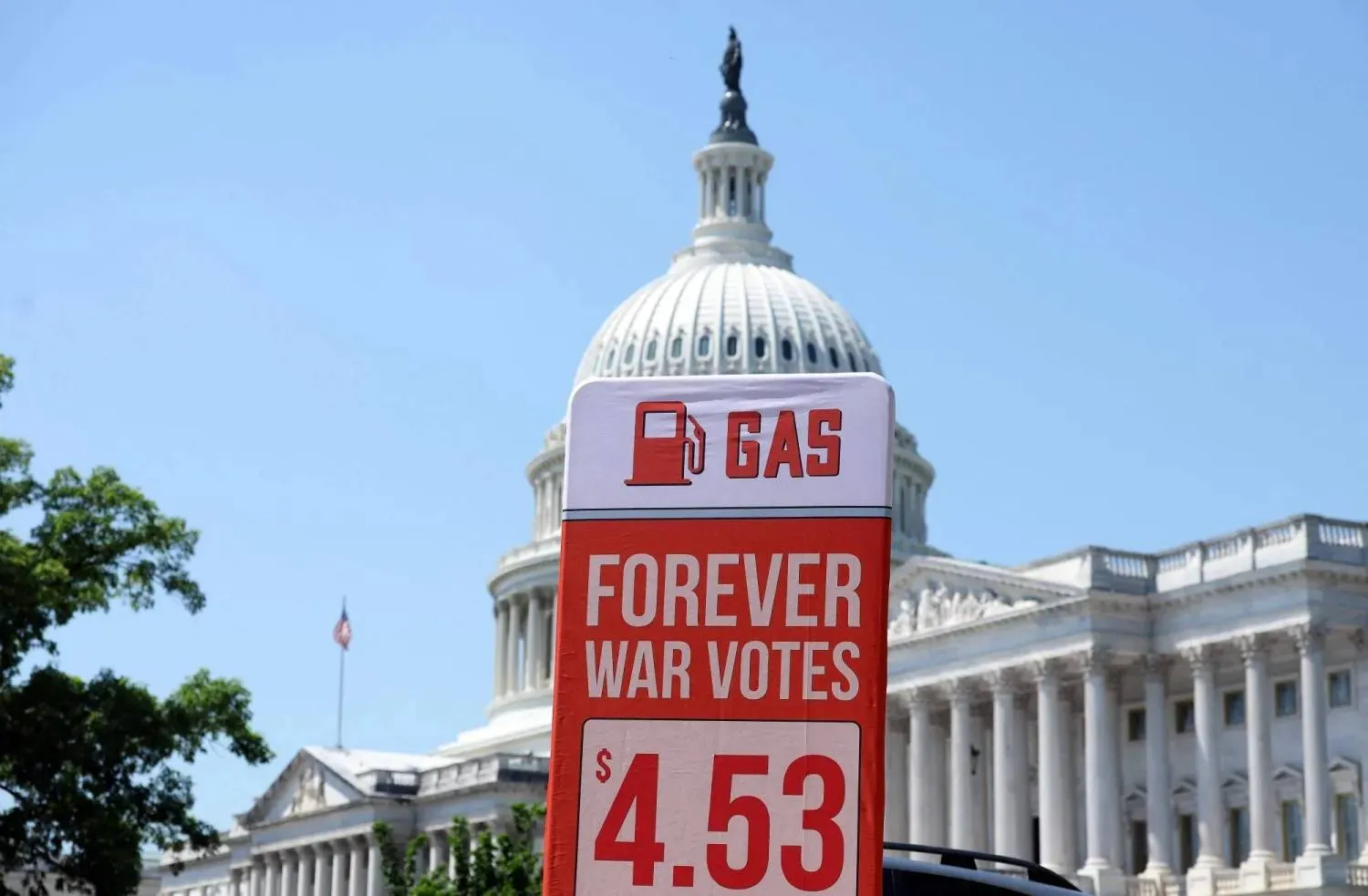
A sign protesting the Iran war and its impact on gas prices is seen during a protest outside of the US Capitol (AFP)
TT

Trump's Iran Deal Faces Wide Criticism and Some Fear it Could Cost Republicans the Midterm

A sign protesting the Iran war and its impact on gas prices is seen during a protest outside of the US Capitol (AFP)

US President Donald Trump’s interim agreement to end the war with Iran has dragged down his approval rating and garnered criticism across the political spectrum — even from his own supporters.

Recent interviews with 18 Americans who voted for Trump in 2024, a group that Reuters has interviewed monthly since he returned to office, show that most have doubts about the deal, which has reopened the Strait of Hormuz while temporarily lifting US oil sanctions on Iran and authorizing a $300 billion fund for its reconstruction.

“We need to truly weaken the Iranian regime instead of this, ‘beat them up a little bit and then step back and let them rebuild’,” said Terry Alberta, 65, a pilot in Michigan.

Overall, only a quarter of Americans believe the war with Iran was worth the costs, and a majority worry that the truce with Tehran is unlikely to last, according to the latest Reuters/Ipsos poll.

Many of the Trump voters feared his unpopular concessions to Iran would make it harder for Republicans to retain control of Congress in November's midterm elections, although those most critical of the deal had already begun to lose faith in the president before the war.

Six in the group believed he still had plans to bring down the Iranian government.

The group largely supported the war during its early days, believing US strikes were necessary to deplete Iran's stockpile of long-range missiles and cripple its nuclear program.

Lack of Trust in Tehran

Nearly four months later, with Iran politically emboldened and many of its military capabilities still intact, 14 of the voters criticized some aspects of the memorandum of understanding announced on June 14.

Most were skeptical that Tehran could be trusted to honor any agreement and dismayed by the prospect of granting it billions of dollars to rebuild.

The $300 billion fund will be a private investment vehicle rather than a government-funded plan, though exact details have not been released.

Juan Rivera, 26, said Trump “criticized his predecessors about negotiating with terrorists, and he’s basically done the same exact thing.”

Trump’s Midterm Endorsement now ‘Kiss of Death?’

Rivera still plans to support mostly Republican candidates in the midterms. But he said that when he volunteered recently to canvass Latino voters in his community near San Diego, many fellow Trump supporters were so disappointed by the president's handling of the war, among other issues, that they felt unmotivated to back his party in November.

“A lot of people say: ‘Why should I vote when the president's not doing what he promised?’” Rivera recalled.

Asked for comment, a White House spokesperson told Reuters that Trump's achievement “on the battlefield and at the negotiating table is nothing short of remarkable and will strengthen American security for many years.”

Steve Egan, 65, a promotional product distributor in Tampa, soured on Trump in early 2025 after tariff-triggered price hikes hurt his business. From the outset, Egan was skeptical of the president's rationale for the war and upset that it further jacked up the price of gas and other goods.

“Right now it doesn't seem like it's been worth it to go through all that,” he said, noting that the stated goal of regime change “didn't happen.”

His opinion of the president is now so low, Egan said, that Trump's endorsement would be “the kiss of death” for him when deciding which candidates to vote for in the midterms.

Brandon Neumeister, 37, a Pennsylvania state corrections worker and former National Guardsman, said the conflict seemed only to have benefited oil companies. Even before the war, though, Neumeister said he was unlikely to vote in November because he was disgusted with politics.

Robert Billups, 35, of ⁠Washington state, was cautiously optimistic the peace deal would hold. But he believed the war had spawned more hostility toward the United States rather than making the country safer.

Vice President JD Vance, tasked with leading US negotiations with Iran, has fallen in his esteem, and Billups said he no longer feels preferential toward Republican candidates. Come November, “whoever has a better strategy this time, I'm gonna vote for them regardless of their party,” he said.

‘A Bigger Plan’

Though Trump has been adamant about wanting to end the war, six ⁠of his more loyal voters expressed hope that he still had secret plans to bring Iran to heel.

Kate Mottl, 63, a secretary at a municipal office in the Chicago suburbs, said that “destroying” the regime in Tehran seemed like the only way to avert future conflict.

It would be “very disappointing” if Trump refrained from further military intervention, Mottl said, adding that she believed “there’s a bigger plan here.”

Rich Somora, 62, an engineer in North Carolina, agreed that Trump probably had more aggressive ⁠plans up his sleeve. “I can't imagine that he would have gone through all this and not found out a way to get rid of those mullahs,” he said.

According to diplomats and analysts, however, the war has only strengthened the grip of Iran’s clerical rulers. If they remain in power for another month, Somora said, he'll start to worry.

In Prescott, Arizona, 74-year-old retiree Joyce Kenney said she supported lifting sanctions and believed restoring Iran's ability to trade with other countries would ensure its leaders honored the truce.

But the reconstruction fund was a bridge too far: “That's not our responsibility,” she said.


Putin Threatens Retaliatory Seizures of European Ships

Russian President Vladimir Putin holds a meeting aboard the Guards missile cruiser Varyag during the final stage of the Pacific Fleet's exercises off the coast of Sakhalin region, Russia, 12 August 2026. (EPA/Gavriil Grigorov Kremlin / Pool)
TT

Putin Threatens Retaliatory Seizures of European Ships

Russian President Vladimir Putin holds a meeting aboard the Guards missile cruiser Varyag during the final stage of the Pacific Fleet's exercises off the coast of Sakhalin region, Russia, 12 August 2026. (EPA/Gavriil Grigorov Kremlin / Pool)

Russian President Vladimir Putin on Wednesday threatened to seize ships belonging to European countries in retaliation for plans to sell off cargo seized from Russian "shadow fleet" vessels.

Several European companies have intercepted ships carrying Russian oil in contravention of European sanctions targeting the vital revenue source.

New sanctions passed last month permit EU members to sell the oil or any other cargo seized from the ships.

Moscow has bristled at the moves, with Putin calling it "piracy and banditry".

"We will be forced to respond in kind," the Kremlin chief said while overseeing naval drills in Russia's Far East.

Moscow would act "wherever we ourselves deem necessary and appropriate -- anywhere," he added.

Swedish court documents obtained by AFP earlier in August showed Stockholm will transfer to Kyiv a seized Russian ship suspected of transporting grain from occupied Ukraine.

Putin was speaking aboard the Russian cruiser Varyag off the island of Sakhalin, where Russia's navy was conducting drills.

The exercises come a week before joint US-South Korean war games, designed to simulate a possible invasion from North Korea.

Tensions are high in the region amid accusations from Kyiv and Seoul that Pyongyang and Moscow are further intensifying their military cooperation.


Pakistan Interior Minister in Iran to Discuss Regional Security

A handout photo made available by the Iranian Foreign Ministry Office shows Iranian Foreign Minister Abbas Araghchi (R) meeting with Pakistan's Minister of Interior Mohsin Naqvi in Tehran on August 11, 2026. (Iran Foreign Ministry / AFP)
TT

Pakistan Interior Minister in Iran to Discuss Regional Security

A handout photo made available by the Iranian Foreign Ministry Office shows Iranian Foreign Minister Abbas Araghchi (R) meeting with Pakistan's Minister of Interior Mohsin Naqvi in Tehran on August 11, 2026. (Iran Foreign Ministry / AFP)

Pakistan's interior minister is visiting Iran to discuss regional security, stability and other developments, the Pakistani foreign office said Wednesday, as Islamabad tries to mediate a resolution to the Middle East war.

Mohsin Naqvi, previously involved in mediation efforts between Iran and the US, is known to be close to the powerful head of the Pakistani army, Asim Munir.

Iranian state news agency IRNA reported late Tuesday that Naqvi met with Iranian President Masoud Pezeshkian, Foreign Minister Abbas Araghchi and Interior Minister Eskandar Momeni.

"He is discussing bilateral relations, security, regional security and stability, and constructive engagement amongst the parties in the region and regional developments," Pakistani foreign ministry spokesman Tahir Andrabi told reporters in Islamabad.

The Iranian government's website said Naqvi conveyed to Pezeshkian "a message from the Pakistani prime minister and the chief of the army", without specifying its content.

Tehran insists on retaining control of the Strait of Hormuz after the war and wants to charge fees for passage, repeatedly striking ships it accuses of attempting to circumvent its preferred route. The US has imposed a rival blockade on Iranian ports.

Attacks in the waterway, which was free to transit before the war, led to the collapse of an April ceasefire, and mediators have urged both sides to return to the terms of a subsequent June memorandum that set out a path for peace talks.

Last week Iran said it had agreed a route with neighboring Oman for ships transiting the strait and was finalizing arrangements for jointly managing the strategic waterway.

On Tuesday the US military announced that it had fired on a Panama-flagged cargo ship that attempted to break the American blockade of Iran's ports.


North Korea Fires Missile Ahead of Major US-South Korea Drills

People watch a news broadcast on a television screen showing a report on a missile launch, at a railway station in Seoul, South Korea, 12 August 2026. (EPA)
TT

North Korea Fires Missile Ahead of Major US-South Korea Drills

People watch a news broadcast on a television screen showing a report on a missile launch, at a railway station in Seoul, South Korea, 12 August 2026. (EPA)

North Korea fired a ballistic missile on Wednesday toward the sea off the Korean peninsula's east coast, South Korean and Japanese authorities said, days ahead of major joint military exercises by Seoul and Washington long denounced by Pyongyang.

The missile was launched from the North's Wonsan area at about 6 a.m. (2100 GMT Tuesday), South Korea's Joint Chiefs of Staff (JCS) said, six days after North Korea fired another ballistic missile from the same area.

The launch came ahead of South Korean and US military drills, dubbed Ulchi Freedom Shield, set to run from August 17 to August 27, aimed at countering Pyongyang's evolving nuclear and weapons capabilities.

Hong Min, a senior researcher at the Korea Institute for National Unification in Seoul, said the launch ‌was likely part of ‌North Korea's existing weapons development schedule, but the timing could also have been ‌selected ⁠to send a ⁠message ahead of the exercises.

"Even if it was a test of a weapon under development, choosing when to conduct it requires a political decision," Hong said.

There was no immediate statement from North Korea on the Wonsan launch, but Pyongyang on Wednesday afternoon criticized the nuclear ambitions of South Korea and Japan.

South Korea said North Korea also fired a ballistic missile from Wonsan on August 6, but Pyongyang did not report that launch in state media. Hong said that test may have failed to achieve its intended objective.

North Korea's series of tests this year has featured short-range ballistic missiles, artillery rockets and other tactical weapons.

Wednesday's ⁠launch was its 11th suspected ballistic missile test in 2026, according to South Korean ‌assessments.

South Korean and Japanese defense authorities said the missile flew about 700 ‌km (435 miles).

Seoul's Joint Chiefs of Staff did not identify it as a short-range ballistic missile, saying authorities would conduct a detailed ‌analysis.

The omission leaves open the question of what type of missile it was, analysts said. Ballistic missiles with ‌ranges of 300 km to 1,000 km (186 miles to 620 miles) are generally classified as short-range.

Hong said the range, trajectory and launch site suggested it may have been a type of hypersonic missile, though a submarine-launched missile was also possible.

CONDEMNATION AND HEIGHTENED TENSIONS

South Korea and Japan both condemned the launch.

"Japan lodged a strong protest with North Korea through diplomatic channels at the Japanese Embassy ‌in Beijing and strongly condemned the action," Japanese Defense Minister Shinjiro Koizumi told reporters.

South Korea's Office of National Security convened an emergency meeting and expressed concern over North Korea's continued ⁠ballistic-missile launches following the ⁠August 6 firing. It urged Pyongyang to halt provocations that violate UN Security Council resolutions.

South Korea's military said it was maintaining readiness to respond "overwhelmingly" to any provocation under its combined defense posture with the United States.

The US Indo-Pacific Command said it was consulting closely with allies and partners, adding that its initial assessment was that the launch posed no immediate threat to US personnel or territory, or to its allies.

On Tuesday, Ukrainian President Volodymyr Zelenskiy said Moscow used North Korean ballistic missiles during a Russian attack that killed seven workers at a steel plant in the southeastern city of Zaporizhzhia.

In a statement, a North Korean Foreign Ministry official responsible for South Korean affairs said Seoul's plans to develop nuclear-powered submarines would heighten instability in the region, for a "serious challenge" to the North's security.

Pyongyang needed the capability to counter its adversaries' military moves with retaliatory strikes that would make their "survival and recovery impossible", the statement added.

In a separate commentary state news agency KCNA accused Japan of seeking nuclear weapons under the guise of peaceful use of atomic energy, citing its nuclear power program and debate among Japanese politicians over nuclear armament.
