


Türkiye Must Be ‘Included’ in Europe Security Structures, Says Erdogan

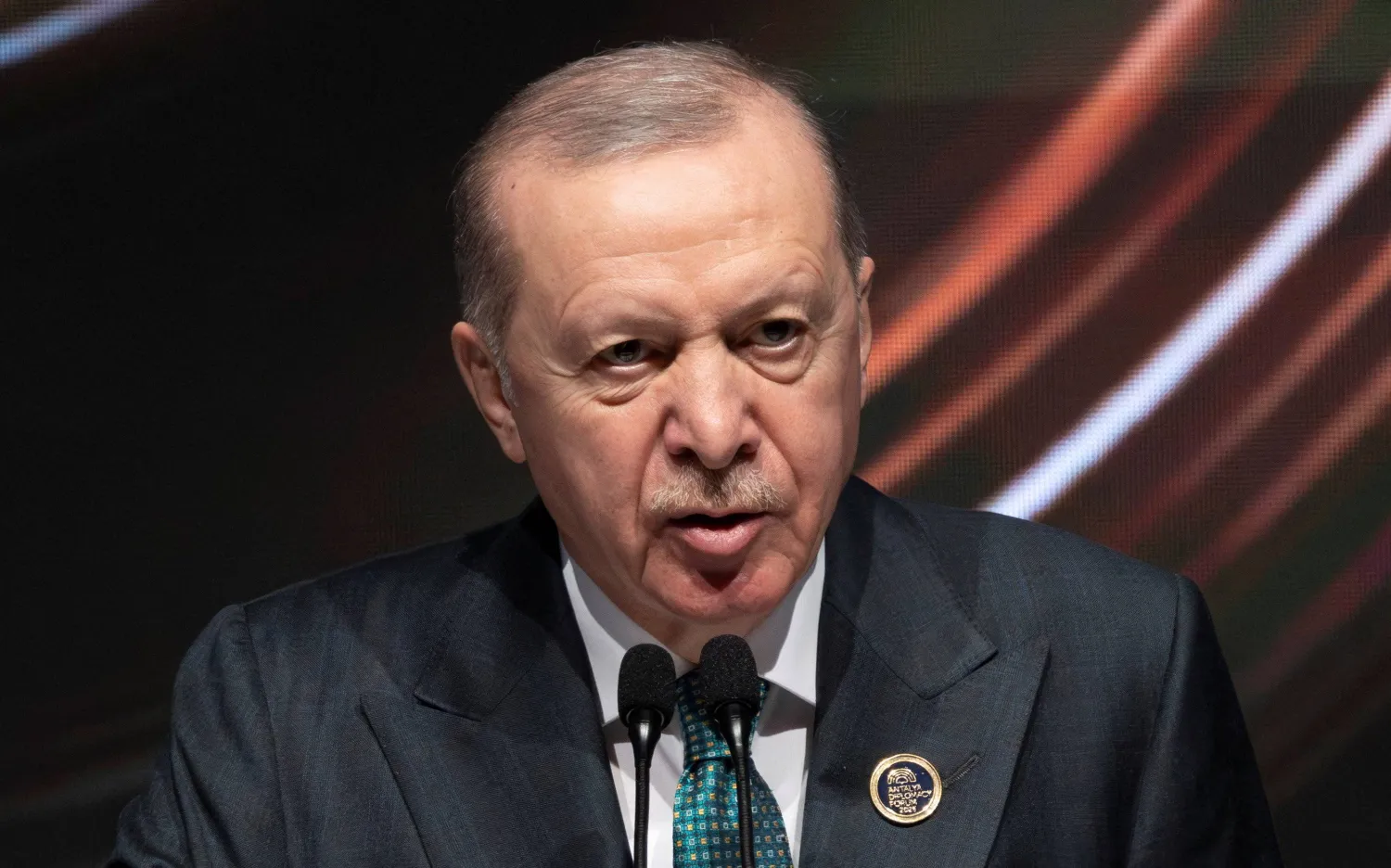
Turkish President Recep Tayyip Erdogan speaks during the opening ceremony of Antalya Diplomacy Forum in Antalya, Türkiye, April 17, 2026. (Reuters)
TT

Türkiye Must Be ‘Included’ in Europe Security Structures, Says Erdogan

Turkish President Recep Tayyip Erdogan speaks during the opening ceremony of Antalya Diplomacy Forum in Antalya, Türkiye, April 17, 2026. (Reuters)

Türkiye must be included in all of Europe's defense structures and defence trade restrictions between NATO members must be removed, President Recep Tayyip Erdogan said Monday ahead of a key NATO summit.

His remarks come as Europe revamps its defenses to counter Russia and the risk of a US pullback from NATO, which is to hold a summit in the Turkish capital Ankara on July 7-8.

"Türkiye's indispensable contributions to European security are sometimes overlooked," Erdogan told parliamentary delegates from all 32 NATO member states in Istanbul. He said Türkiye wanted "to participate in all defense and security initiatives" on the continent.

At issue is Türkiye's access to the European Union's 150-billion-euro ($176-billion) Security Action for Europe (SAFE) initiative, intended to strengthen European defense capabilities.

"We expect your support, lawmakers, for Türkiye's inclusion in the defense and security initiatives announced by the European Union," Erdogan told them.

Within SAFE, firms from non-EU countries such as Türkiye, Britain and the United States can only supply up to 35 percent of the component costs of weaponry funded by the scheme.

If Türkiye wants its companies to be able to tap a bigger part of the funds Ankara needs to sign a security partnership with the EU and then negotiate special access with Brussels -- a process that would require approval from all 27 EU members. Greece has threatened to block such a move.

"Under SAFE, any third country can participate in a defense project up to a level of 35 percent. Any negotiations with a view to potentially increasing or lifting this 35 per cent cap ... would require a bilateral agreement," said Thomas Regnier, a European Commission spokesperson.

"For now, this is not an agreement we have concluded with Türkiye."

- 'Remove the obstacles' -

Erdogan also urged NATO to remove all barriers blocking defense industry trade between alliance members.

"If we want to overcome the challenges we face, we need to remove obstacles to defense industry trade while ensuring a balanced and fair burden-sharing among allies," he said.

Türkiye has the second-biggest army of the alliance after the United States and a burgeoning defense industry which has gone from strength to strength fueled by bilateral defense deals.

But its defense industry has been hit by US sanctions imposed over Ankara's purchase of an S-400 Russian surface-to-air missile defense system. Washington also booted Türkiye out of its F-35 program, in a move that has soured relations between the NATO allies.

Although Washington has expressed a desire to draw a line under the dispute, lifting the sanctions requires Congressional approval. Observers say there is little chance the showdown would be resolved before the summit.

US President Donald Trump has however pledged to give Erdogan something that would make him "very happy" when he flies in next week for the NATO gathering.

Analysts said it was likely to be a delivery of several dozen US-made F110 engines Türkiye needs for its fifth-generation KAAN fighter jets that are under development. Delivery of the engines had been blocked since the imposition of the US sanctions.



Carney Says Cause of Fire at Alberta Military Base Still Unknown

 Canadian Prime Minister Mark Carney speaks about the incident at CFB Wainwright as he rises in the House of Commons in Ottawa, Monday, Oct. 19, 2026. (Adrian Wyld/The Canadian Press via AP)
Canadian Prime Minister Mark Carney speaks about the incident at CFB Wainwright as he rises in the House of Commons in Ottawa, Monday, Oct. 19, 2026. (Adrian Wyld/The Canadian Press via AP)
TT

Carney Says Cause of Fire at Alberta Military Base Still Unknown

 Canadian Prime Minister Mark Carney speaks about the incident at CFB Wainwright as he rises in the House of Commons in Ottawa, Monday, Oct. 19, 2026. (Adrian Wyld/The Canadian Press via AP)
Canadian Prime Minister Mark Carney speaks about the incident at CFB Wainwright as he rises in the House of Commons in Ottawa, Monday, Oct. 19, 2026. (Adrian Wyld/The Canadian Press via AP)

Canada’s ‌Prime Minister Mark Carney said Monday the cause of a fire that killed at least four military members and injured dozens of others in Alberta on Saturday is still not known.

In an address to Parliament, Carney said soldiers and reserve members ‌were conducting ‌live-fire exercises at ‌an ⁠army base in Wainwright ⁠while a fire was burning in the training area.

“Driven by ferocious winds, the fire jumped nearly a kilometer in less than a minute to ⁠where soldiers were gathered,” Carney ‌said.

He ‌added 50 investigators are currently on the ‌ground, from the army and ‌the Royal Canadian Mounted Police, to determine how the disaster happened.

"This loss touches every corner of ‌the nation," Carney said.

Officials said 39 people remain hospitalized, with ⁠19 ⁠people in critical condition. The soldiers and reserve members were preparing to deploy to Latvia, where Canadian forces have their largest international military operation.

The incident comes as Albertans vote Monday in a referendum about whether residents want to pursue a legally binding vote on seceding from Canada.


France Wants Curfews in Some Areas after Weekend of Riots

A protester waving a French national flag walks past a fire during clashes prior to the start of a demonstration to protest against the "high cost of living", in Marseille, southern France, on October 17, 2026  (Photo by Thibaud MORITZ / AFP)
A protester waving a French national flag walks past a fire during clashes prior to the start of a demonstration to protest against the "high cost of living", in Marseille, southern France, on October 17, 2026 (Photo by Thibaud MORITZ / AFP)
TT

France Wants Curfews in Some Areas after Weekend of Riots

A protester waving a French national flag walks past a fire during clashes prior to the start of a demonstration to protest against the "high cost of living", in Marseille, southern France, on October 17, 2026  (Photo by Thibaud MORITZ / AFP)
A protester waving a French national flag walks past a fire during clashes prior to the start of a demonstration to protest against the "high cost of living", in Marseille, southern France, on October 17, 2026 (Photo by Thibaud MORITZ / AFP)

France's central government asked some local authorities to impose curfews and faced pressure over security failings on Monday after a weekend of riots and looting borne out of nationwide anti-government protests.

Prime Minister Sebastien Lecornu did not rule out declaring a state of emergency but said it was more appropriate for now to apply partial and localized curfews, without providing details of which cities would be affected.

"My determination to restore order is absolute," he said in a press conference, ruling out, however, a blanket curfew in Paris, Reuters reported.

The weekend of looting and violence between some protesters and police followed weeks of student demonstrations, rocking France six months ahead of its next presidential election and highlighting pressures from a weak economy and surging debt.

Lecornu blamed far-left groups for some of France's worst unrest in years. "There is, after all, a far-left movement that wants to cause — we can’t put it any more strongly — profound unrest in the country in the run-up to the presidential election," he said.

Hard-left presidential candidate Jean-Luc Melenchon urged him to provide evidence. "Otherwise, he should apologise, keep quiet and stop fanning the flames of unrest," he said on X.

The Federation of Trade and Retail said almost 3,000 shops had been affected over the weekend.

"Once again, the retail sector finds itself on the front line, at a time when it is already weakened by a succession of crises," it said.

"Behind every ransacked shop are business owners, employees and families who have seen years of work and effort wiped out in a matter of hours," it added, calling for relief from social security contributions and tax for those businesses affected.

Lecornu said the government would provide furlough measures from Tuesday.

Some 2,400 people were arrested and one protester died from a cardiac arrest on Saturday while nearly 1,000 officers were injured.

French assets were underperforming broader European markets on Monday, though moves were more contained than at some other moments of recent political friction.

Tensions in President Emmanuel Macron's fragile government over apparent security shortcomings — coming just as the government needs to pass a much-needed budget bill to rein in its finances — could further unsettle investors.

Macron's office said on Monday he had turned down his Interior Minister Laurent Nunez's offer to resign, telling him instead to put an end to barricades and looting and be transparent over what Macron called "intelligence and foresight failings".

Nunez told reporters that Tuesday evening's Champions League soccer match between Paris Saint-Germain and Barcelona would go ahead as planned, even though the capital was one of the worst-hit areas.

The mayors of Paris, Marseille and Lyon said in a joint op-ed published by the newspaper Liberation that they were used to demonstrations and protests.

"But on Saturday ... for the first time, we had the feeling that whole sections of our cities had been left without protection," the mayors — all from the centre-left — said. "We now need to patch the wounds of our cities and face up to the anger of our residents, aghast at this level of violence."

The start of school holidays on Monday may give the government some relief, but students were staging more gatherings and blockades in some places, including the Louvre gallery and Sciences Po university in central Paris.

Marseille, another city badly hit by the riots, banned gatherings and demonstrations. French unions meanwhile called for a new round of strikes and rallies on November 5.

INTELLIGENCE FAILURES

At the weekend, hundreds of thousands took to the streets to protest over what many say are declining and dysfunctional public services that leave citizens to fend for themselves amid cost-of-living pressures.

In Paris, at least 300 to 400 businesses were vandalised at the weekend, Dominique Restino, the head of the Paris chamber of commerce, told BFM television.

At the Place Vendome, home to luxury hotels and boutiques, most shops were shuttered and surrounded by security guards. The front door of a Dior boutique was smashed, while the windows were damaged in the stores of other luxury brands in central Paris, including Rolex, Louis Vuitton, Ralph Lauren and Gucci.

In Marseille, Ligue 1 club Olympique de Marseille said its official store on the city's historic main avenue had been looted, while a town hall in central France was torched.

France deployed 60,000 police and other security forces on Saturday, Nunez told France Inter radio, but he acknowledged that was not enough to control violent crowds.

European governments have advised citizens travelling to France to avoid large crowds and exercise caution.


Louvre Blocked as France Grapples with Unrest

TOPSHOT - A protester waving a French national flag walks past a fire during clashes prior to the start of a demonstration to protest against the "high cost of living", in Marseille, southern France, on October 17, 2026 as part of a nationwide call for mobilization bringing together various groups expressing their anger: former "Yellow Vests", secondary school and university students, climate activists and even farmers. (Photo by Thibaud MORITZ / AFP)
TT

Louvre Blocked as France Grapples with Unrest

TOPSHOT - A protester waving a French national flag walks past a fire during clashes prior to the start of a demonstration to protest against the "high cost of living", in Marseille, southern France, on October 17, 2026 as part of a nationwide call for mobilization bringing together various groups expressing their anger: former "Yellow Vests", secondary school and university students, climate activists and even farmers. (Photo by Thibaud MORITZ / AFP)

Protesters blocked the entrance to the Louvre in Paris on Monday, as French authorities scrambled to stem public discontent fueling mass cost-of-living demonstrations that over the weekend spilled over into some of the worst street violence in recent years.

President Emmanuel Macron ordered a security review as the country's interior minister admitted that the police "had lost control" during the weekend's unrest.

Undeterred, the Yellow Vests movement which organized the weekend's rallies called for a new round of protests Saturday, said AFP.

Italy, Spain and Portugal, where anger over rising prices has also led to protests, were keeping a nervous eye on the developments after smaller clashes broke out in Milan over the weekend and protests about housing costs persisted in Spanish cities.

Some half a million people turned out across France to protest the surging cost of living, a culmination of four weeks of protests that began with high school students demanding better conditions at their schools.

What started as peaceful demonstrations morphed into violence in some places, as masked groups on the sidelines of the protests attacked law enforcement, broke into town halls and other public buildings, setting many of them ablaze, looted shops, and set fire to cars, bicycles and scooters on the streets.

Interior Minister Laurent Nunez offered to resign on Monday after more than 2,500 people were arrested and nearly 1,000 members of the security forces injured. Protesters were also hurt, with one demonstrator's hand blown off by a police crowd-control grenade.

"On Saturday, in some major cities, you couldn't look shopkeepers in the eye after hundreds of shops had been looted and tell them we hadn't lost control," Nunez said.

Macron refused Nunez's resignation, even as he acknowledged security and intelligence failures in the government response, despite the some 60,000 law enforcement personnel deployed across the country on Saturday.

Nationwide, more than 2,330 people were taken into police custody over the weekend, 70 percent of whom were adults, Justice Minister Gerald Darmanin said Monday.

More than 2,000 shops were expected to have been affected by the weekend's violence across France, with damage running into "hundreds of millions of euros", according to chamber of commerce president Alain Di Crescenzo.

In an address to the nation Sunday evening, Macron slammed the "unbridled" violence and said local authorities would be able to ban -- "if necessary" -- certain rallies in coming days.

But he stopped short of announcing drastic measures, such as a state of emergency or curfew.

City authorities in Marseille said on Monday that public gatherings would be banned from noon to 08:00 pm (1000-1800 GMT).

- Louvre blocked -

The public discontent showed no signs of subsiding on Monday, with demonstrators blocking the entrance to Paris's iconic Louvre Museum, the most visited in the world.

"We are proud to announce that we are blocking the world's largest museum," read a leaflet posted outside the museum, as management and unions said the protest was led by students from Ecole du Louvre.

Rising prices have fueled anger in France, where diesel prices have jumped nearly 40 percent and petrol by 25 percent since March and where food prices have risen by 25 percent since 2021.

- Elections -

The unrest in France has flared just months before a key presidential election where centrist Macron cannot stand again and Marine Le Pen, the far-right presidential candidate for the National Rally party, is riding high in the polls.

Ministers have blamed "ultra-left" groups for the violence, while Le Pen claimed that the party of her far-left rival for the presidency, Jean-Luc Melenchon, had "legitimized the violence".

The left has accused Macron of ignoring protesters' demands, while the right is calling on him to take a firmer line.

- Europe -

With costs of living rising across Europe, smaller demonstrations have broken out in other countries.

During the weekend, clashes broke out on the sidelines of a cost-of-living demonstration in Milan, with Mayor Giuseppe Sala warning: "I'm very worried because it's a new phenomenon, which also originates from an international scenario and therefore feeds itself."

In Spain, hundreds of tents have occupied Madrid's central Puerta del Sol square since September, when the eviction of an 87-year-old woman from her lifelong flat sparked nationwide protests in a country with soaring housing costs.

Dozens of tents have also sprung up in Portugal's main cities of Lisbon and Porto, with protesters demanding action over rising costs of housing.