France Sets Presidential Election Dates

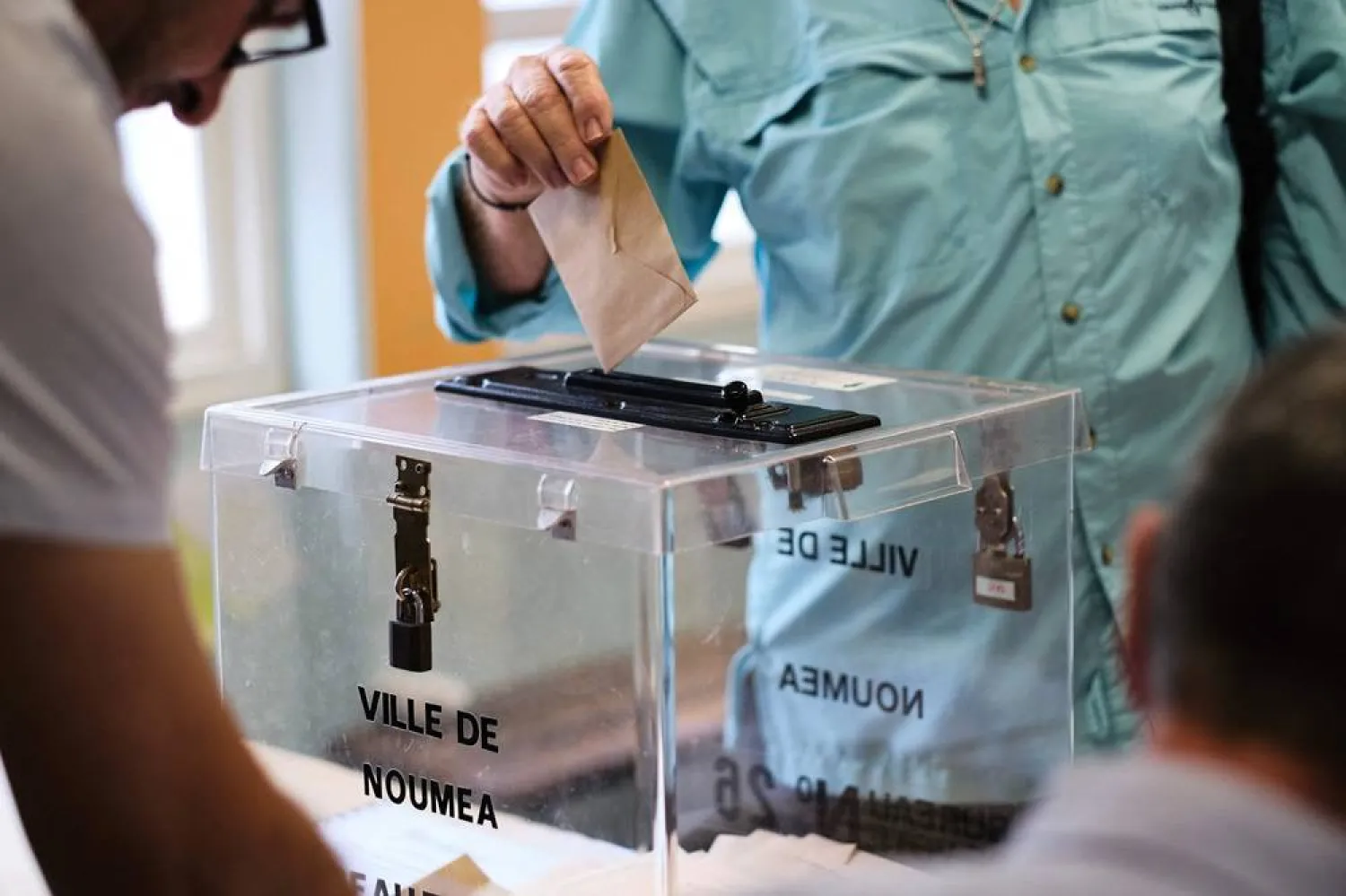
File photo: A person casts their vote at a polling station in the Magenta district during the first round of France's crunch legislative elections in Noumea in the first constituency of the French Pacific territory of New Caledonia, on June 30, 2024. (AFP)
TT

France Sets Presidential Election Dates

File photo: A person casts their vote at a polling station in the Magenta district during the first round of France's crunch legislative elections in Noumea in the first constituency of the French Pacific territory of New Caledonia, on June 30, 2024. (AFP)

France will hold the first round of its next presidential election on April 18, 2027, with a run-off set ‌for May ‌2, the ‌government ⁠spokeswoman, Maud Bregeon, said ⁠on Wednesday following a cabinet meeting to officially approve the dates.

The race to ‌succeed ‌President Emmanuel Macron — ‌who cannot run ‌again after two terms — is shaping up as a ‌fragmented contest, with polls placing the ⁠far-right ⁠National Rally in a leading position, and a crowded field raising the prospect of a run-off dominated by political extremes, Reuters said.


US, Iran to Hold Indirect Talks After Exchanges of Fire

 A general view of the Doha skyline, Qatar, June 29, 2026. (Reuters)
A general view of the Doha skyline, Qatar, June 29, 2026. (Reuters)
TT

US, Iran to Hold Indirect Talks After Exchanges of Fire

 A general view of the Doha skyline, Qatar, June 29, 2026. (Reuters)
A general view of the Doha skyline, Qatar, June 29, 2026. (Reuters)

Iran and the United States are to hold indirect talks with mediators in Doha on Wednesday in a push to advance negotiations and quell tensions following exchanges of fire between the two sides.

Both have said they will send officials to discuss their memorandum of understanding aimed at ending the Middle East war, but Iran has insisted direct negotiations will not take place.

The foes would take part in "indirect technical talks on Wednesday in Doha with Qatari and Pakistani mediators", a diplomat with knowledge of the talks told AFP on condition of anonymity.

The discussions, being held at a lower level and focused on the details of the MOU, will "build on the progress made at the Lake Lucerne summit", the diplomat added.

The memorandum of understanding, brokered by Qatar and Pakistan, culminated in a summit last month in Lucerne, Switzerland.

It includes a 60-day ceasefire pausing the war that broke out with US-Israeli strikes in late February, as well as the reopening of the blockaded Strait of Hormuz and a timeframe for a final deal to permanently end the conflict and reach an agreement on Iran's nuclear program.

Iranian officials were set to travel to Doha on Wednesday but Tehran denied an earlier claim by US President Donald Trump that there would be direct talks.

- 'Implementation challenges' -

Iranian foreign ministry spokesman Esmaeil Baqaei said the Iranian delegation would be led by Deputy Foreign Minister Kazem Gharibabadi, but said the officials "have no plans for negotiations with the American side at any level over the coming days".

US envoys Jared Kushner and Steve Witkoff will not be taking part in the technical talks, the anonymous diplomat told AFP, after they met with Qatar's Prime Minister Sheikh Mohammed bin Abdulrahman Al Thani on Tuesday.

In a statement, Qatar's foreign ministry said the trio discussed "the ongoing talks between the United States of America and Iran within the framework of the memorandum of understanding", as well as developments in Lebanon.

Since the signing of the US-Iran deal on June 17, both sides have exchanged fire in the Gulf, with Tehran targeting a commercial ship it said had deviated from its approved route through the Strait of Hormuz.

US Central Command responded by saying it had attacked 10 Iranian military targets over the weekend.

Iran then hit back with strikes against Kuwait and Bahrain, which both condemned Tehran for the attacks.

Iran's chief negotiator Mohammad Bagher Ghalibaf said Tuesday in a televised interview that "when a war of this magnitude comes to an end... it is inevitable that there will be implementation challenges, incidents, and differences of opinion, especially where parties such as the Israeli regime are concerned".

- Relative quiet -

He said the Iranian delegation in Doha would be focused on the implementation of clauses in the deal related to the Strait of Hormuz and fighting in Lebanon.

"Naturally, Iran is committed to ensuring that the agreement is implemented, and the enemy, the United States and its ally -- must also fulfil their commitments," he said.

The exchanges of fire appear to have calmed in the days leading up to the talks in Qatar.

On the Lebanon front, fighting between Israel and Hezbollah has been relatively quiet.

Tehran has insisted any deal should include an end to the parallel conflict in Lebanon and a withdrawal of Israeli troops from its south, part of which they have occupied.

Ghalibaf also said Iran's oil exports had surged since the end of the US blockade on its ports, which Washington imposed in retaliation for Iran blocking shipping through Hormuz.

"From the day the blockade was lifted until today, we have exported more than 40 million barrels of oil," he told state television.

"By contrast, during the previous 50 to nearly 60 days, we were genuinely unable to export even a single barrel of oil."


Powerful Storm Hits Romania, One Person Killed

An uprooted tree following heavy gusts of wind during a strong storm in northern Bucharest, Romania, July 1, 2026. (Inquam Photos/Octav Ganea via Reuters)
TT

Powerful Storm Hits Romania, One Person Killed

An uprooted tree following heavy gusts of wind during a strong storm in northern Bucharest, Romania, July 1, 2026. (Inquam Photos/Octav Ganea via Reuters)

A powerful storm tore through the Romanian capital Bucharest and 20 counties on Wednesday, killing one person and damaging dozens of homes and vehicles, emergency services officials ‌said.

In Bucharest ‌alone, nearly ‌2,000 ⁠calls for help were reported, ⁠emergency services told broadcaster Digi24. Several metro stations were flooded.

Outside the capital, the storm wrought ⁠damage in 60 ‌towns and ‌villages.

One person was ‌killed when a ‌tree fell on their vehicle.

Police and firefighters were deployed across several counties, evacuating ‌flooded homes and clearing debris.

The storm ⁠was ⁠preceded by a heatwave, with temperatures exceeding 40 degrees Celsius in parts of the country on Monday and Tuesday, boosting power consumption and raising electricity prices.


Erdogan Seeks to Bolster Türkiye’s Clout at NATO Summit

Turkish President Recep Tayyip Erdogan speaks during the opening ceremony of Antalya Diplomacy Forum in Antalya, Türkiye, April 17, 2026. (Reuters)
TT

Erdogan Seeks to Bolster Türkiye’s Clout at NATO Summit

Turkish President Recep Tayyip Erdogan speaks during the opening ceremony of Antalya Diplomacy Forum in Antalya, Türkiye, April 17, 2026. (Reuters)

Turkish President Recep Tayyip Erdogan will seek to leverage the NATO summit to burnish his international credentials, analysts say, despite mounting scrutiny over a domestic crackdown on political opponents ahead of a presidential election.

Hosting the July 7-8 summit offers Ankara a chance to underscore Türkiye’s role as a pivotal regional power and an intermediary between the United States and Europe, as geopolitical tensions rise.

Analysts say Erdogan is seeking to capitalize on Türkiye’s elevated profile since the start of the Russia-Ukraine war, as conflict in the Middle East and tensions within the transatlantic alliance reshape Western security priorities.

His goal is to position Türkiye as "an indispensable actor in security and geopolitical processes in Europe and beyond," foreign policy expert Serkan Demirtas told AFP.

NATO unity has been tested in recent months, particularly since the United States and Israel began attacking Iran on February 28, sparking war.

But European governments declined to participate in the military campaign, which Türkiye also opposed, angering US President Donald Trump, who has lashed out at the NATO alliance.

Despite the standoff, Trump will attend the summit in Ankara alongside more than 30 other world leaders.

A key member of the alliance, Türkiye occupies a strategic crossroads between Europe and the Middle East, and fields NATO's second-largest army.

"Holding the summit in Türkiye will serve as a reminder to the rest of the alliance of the important role Ankara has played since joining NATO in 1952 -- not only inside the alliance but also across the broader region," said Luke Coffey, a senior fellow at the Hudson Institute.

- 'In the right direction' -

According to a Turkish security source, hosting the summit is a "diplomatic success" that reaffirms Türkiye as a balancing power while highlighting its growing importance to European defenses.

Demirtas said Türkiye provides substantial military capacity, pointing to its participation in major NATO exercises and its prominent role in missions, particularly in the Baltic region.

Still, the relationship is far from seamless.

"There have been challenges in the US- Türkiye bilateral relationship in recent years, and at times these tensions have spilt over into NATO's internal dynamics," Coffey said.

In 2022, Türkiye initially blocked Sweden and Finland's bids to join NATO following Russia's invasion of Ukraine, although both were eventually admitted.

Ankara also drew US ire by purchasing the Russian S-400 missile systems, prompting its removal from the F-35 fighter jet program, and NATO voicing compatibility concerns.

Even so, Trump's good rapport with Erdogan has helped preserve dialogue between the two sides.

"On balance, the relationship is trending in the right direction. It is in everyone's interest that next month's summit goes smoothly," Coffey said.

- Muted concerns -

Aaron Stein, head of the Foreign Policy Research Institute, said NATO membership remains " Türkiye’s ultimate deterrent", allowing Ankara to compartmentalize its complex ties with Russia.

It means Türkiye does not have to face Russia alone, giving it greater flexibility to engage Moscow, he said.

Analysts say keeping Türkiye aligned with NATO is critical, given its ability to engage in multiple theatres from Ukraine to the Middle East and across a range of regional crises.

Ankara has pursued a delicate balancing act since the start of the Ukraine war, hosting several rounds of talks between the warring sides in Istanbul and beyond.

"Türkiye has supported Kyiv, sometimes quietly, with key munitions and equipment, while also maintaining channels with both sides in an effort to pursue a diplomatic solution," Coffey said.

- Pragmatism -

The summit coincides with a wave of domestic turmoil after a court ruling ousted Türkiye’s main opposition leader -- in what critics say is the latest judicial maneuver by Erdogan to quash rivals ahead of a presidential race in 2028.

But European governments have kept their concerns muted, treading carefully to avoid damaging ties with Ankara, Demirtas said.

With Türkiye’s EU accession bid largely stalled, cooperation has shifted towards pragmatic areas such as defense, where Ankara has expanded its industrial capacity and secured deals with European partners.

The Turkish security source said Ankara expects allies to ease restrictions on its defense sector and deepen industrial cooperation.

For Erdogan, the summit also offers a domestic political boost -- a chance to reinforce his image as "the leader who defends Türkiye’s interests most forcefully on the international stage", Demirtas said.

As for Western tolerance of Ankara's increasingly authoritarian drift, Stein suggested it was largely compartmentalized.

"NATO isn't a club exclusively for democracies," he said.