


‘Thought They’d Never Be Caught’: The Strike That Killed Iran’s Ali Khamenei

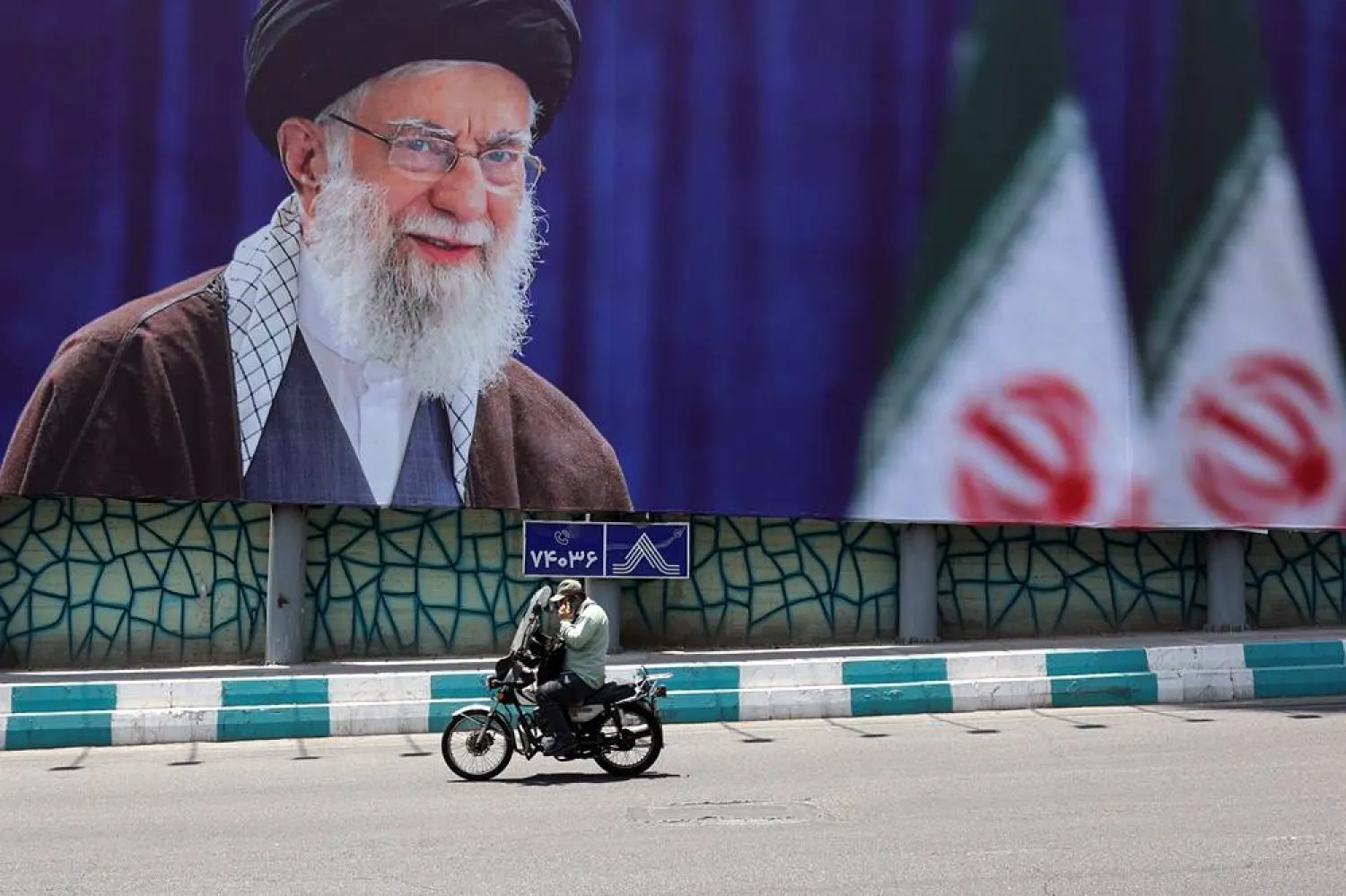
An Iranian man rides a motorbike past a large-scale poster of late Iranian Supreme Leader Ali Khamenei displayed along a highway, in Tehran, Iran, 01 July 2026. (Reuters)
TT

‘Thought They’d Never Be Caught’: The Strike That Killed Iran’s Ali Khamenei

An Iranian man rides a motorbike past a large-scale poster of late Iranian Supreme Leader Ali Khamenei displayed along a highway, in Tehran, Iran, 01 July 2026. (Reuters)

On Saturday, February 28, Tehran residents were embarking on the working week during the Islamic holy month of Ramadan, nervously anticipating celebrations for the Iranian New Year against the background of diplomatic efforts to stave off war with the US and Israel.

That morning, there was also activity around and inside the main government complex in Tehran just off Pasteur Street in the heart of the capital, which housed the residence and offices of then supreme leader Ali Khamenei.

The morning rush was rocked as several explosions shook the area, with smoke seen rising from around the government complex, known locally as the beit-e rahbari (house of the leader).

"The State of Israel has launched a preemptive strike against Iran," the Israeli defense ministry announced.

For hours, uncertainty surrounded the fate of the man aged 86 who had ruled Iran for more than three and a half decades and had maintained a position of zero compromise with the United States as well as crushing dissent.

"Khamenei, one of the most evil people in History, is dead," US President Donald Trump wrote that night on Truth Social, saying he "was unable to avoid our Intelligence and Highly Sophisticated Tracking Systems".

Iranian officials initially insisted that Khamenei had survived. But on the morning of March 1 a state television announcer, his voice breaking with emotion, declared that the leader had been martyred during the holy month of Ramadan.

- 'Path of sacrifice' -

The New York Times subsequently reported that the CIA had been tracking Khamenei for months and had learned that a meeting of top Iranian officials would take place that Saturday morning at the leadership compound, with the leader present.

The intelligence was passed to Israel and, two hours and five minutes after the Israeli jets took off, at around 9:40 am Tehran time, the long-range missiles struck the compound, it said.

The attack took place in broad daylight, which is highly unusual for such a strike.

"They thought they would never be caught, because we never bomb during breakfast. But we bombed," Trump said during the G7 summit in France last month.

Khamenei was not the only top official killed, with a whole echelon of senior figures wiped out including Revolutionary Guards chief Mohammad Pakpour, Khamenei's military advisor Ali Shamkhani and defense minister Aziz Nasirzadeh.

His family was also not spared with a daughter, daughter-in-law, son-in-law and infant granddaughter also killed.

While his son Mojtaba Khamenei, a key figure for years in his father's office, lost his wife Zahra Haddad-Adel, he survived albeit with wounds according to Iranian officials. One week later he was named the new supreme leader but has yet to be seen in public.

Ali Khamenei had always taken major security precautions. He never left Iran as supreme leader and his speeches were rarely carried live on television or announced in advance. During Israel's 12-day war against Iran in June 2025, he had reportedly retreated to a bunker.

But in an apparent act of defiance, he had never disappeared totally from public view and on February 17 gave his final public speech in the northern city of Tabriz, saying the US wanted to "devour" Iran.

He urged people to stay calm and go about their business "without any worries".

Observers were startled that, given the risks, Ali Khamenei was present in the very center of Tehran on February 28 rather than in hiding elsewhere in the vast country.

- 'You wouldn't believe' -

But the attack also further revealed the startling US and Israeli intelligence penetration of Iran, a strategic weakness exposed in the 2025 war when Israel killed a succession of key figures in targeted strikes.

According to the Financial Times, road-surveillance cameras in Tehran including around the leadership compound had been hacked years ago by Israel, enabling the identification of guards, their routines and movements.

Trump said at the G7 that satellite surveillance meant that "if somebody walks in and he has got a badge with his name on it... they can tell the name, they can give you the serial number".

"We can see things, you wouldn't believe the quality of the stuff that we have. That's why we have been so successful."



Pentagon Picks Boeing for New US Navy Contract for Fighter Jets

26 October 2022, Schleswig-Holstein, Henstedt-Ulzburg: Boeing logo is pictured on a hall of the US aircraft manufacturer Boeing distribution center in Schleswig-Holstein. (dpa)
TT

Pentagon Picks Boeing for New US Navy Contract for Fighter Jets

26 October 2022, Schleswig-Holstein, Henstedt-Ulzburg: Boeing logo is pictured on a hall of the US aircraft manufacturer Boeing distribution center in Schleswig-Holstein. (dpa)

The Pentagon has chosen Boeing to build the Navy's next-generation fighter jets in a contract valued at $20 billion, US officials announced Tuesday.

The contract is to produce F/A-XX aircraft or "strike fighters" under the "Next Generation Air Dominance Program," a Pentagon statement said, adding that the new jets would replace the legacy "Super Hornets" fleet beginning in the 2030s.

The announcement marks the second time Boeing has been selected by the Pentagon during the second Trump administration for a sixth-generation weapons system. In March 2025, Trump announced that the Air Force chose Boeing to build a new stealth fighter.

"Delivering two advanced fighters in parallel was always our plan, and we invested accordingly. We are ready and able to build multiple concurrent future combat aircraft franchise programs," said Steve Parker, head of Boeing Defense, Space & Security.

"The F/A-XX platform represents a crucial, non-negotiable investment in America's national security and long-term air combat capabilities," said Pentagon undersecretary Michael Duffey. "We are joining forces with Boeing to field these capabilities."

Boeing said construction was continuing at the company's "secure manufacturing" facility in St. Louis, which the company said is the largest of its kind in the United States.

"The technical and programmatic details of F/A-XX remain classified under US national security and export laws," Boeing said.

Boeing was competing for the contract with Northrop Grumman.

"For F/A-XX, Northrop Grumman offered a highly survivable, digitally advanced sixth-generation fighter to the US Navy," Northrop said Tuesday. "We look forward to receiving additional information about their selection."

At a May 2026 hearing, Admiral Daryl Caudle, chief of naval operations, told a Senate panel that the next-generation system needed to "extend the reach, survivability and lethality," expected to work with unmanned systems.

"Failure to field next-generation carrier aviation capability on schedule will introduce risk to air superiority, strike reach and the long-term viability of carrier-based operations in contested environments," Caudle said.

Shares of Boeing rose 2.4 percent in after-hours trading, while Northrop Grumman dropped 3.6 percent.


Qatari Mediators Press Peace Deal between US and Iran

This photo shows a general view of Milad Tower in Tehran on September 27, 2026. (AFP)
TT

Qatari Mediators Press Peace Deal between US and Iran

This photo shows a general view of Milad Tower in Tehran on September 27, 2026. (AFP)

Qatar said on Tuesday it hopes that shuttle diplomacy between Iran and the US can lead to a breakthrough despite US President Donald Trump's denial of media reports that he was willing to ease sanctions and release frozen funds in exchange for Iranian concessions on its nuclear program.

"We are exchanging messages between the parties, and we're working towards establishing a common ground in order to get into a deal that would save all of us from the repercussions of the conflict," Qatari Foreign Ministry spokesperson Majed al-Ansari told reporters.

The US and Iran have failed to find an off-ramp from their war, now in its eighth month. Negotiations appeared to intensify during last week's UN General Assembly meeting in New York, but have so far not yielded any agreement ‌to reopen the Strait ‌of Hormuz.

US and Iranian officials spoke separately with Qatari mediators on Monday. It was unclear if another exchange took place on Tuesday.

Trump repeated his position that Iran must not obtain a nuclear weapon and that the war would be over soon.

The conflict has degraded Iran's conventional forces and damaged its already ailing economy, but Tehran has fought back with missile and drone strikes on US allies in the Gulf and by restricting oil tanker traffic in the strategic Strait of Hormuz, which has pushed up world energy prices.

"I don't know if they are going to give up yet but they'll give up," Trump told ⁠reporters on Tuesday.

"They are doing very poorly," he added.

On Monday night, Trump took to ‌social media to deny reports by Axios and CNN, citing unidentified US ‌officials, that Trump was willing to give Iran sanctions relief and release frozen Iranian funds as part of a final deal on the condition ‌that Iran showed "concrete progress" on the nuclear issue.

"This is untrue. I offered them NOTHING," Trump wrote on Truth Social.

Trump has cited ‌preventing Tehran from acquiring a nuclear bomb as a central goal of the war, along with ending its ability to attack its neighbors and creating conditions for Iranians to topple their leadership.

Iran does not have nuclear weapons and denies it wants to develop them, but argues it has the right to a nuclear program for civilian purposes.

Iranian President Masoud Pezeshkian, in an interview with the CBS show "Face the Nation" that ‌aired on Sunday, said Tehran was ready for talks on its nuclear program and other issues, but would not accept "bullying or coercion."

IRANIAN PEACE PROPOSAL

At the United Nations General Assembly ⁠last week, Iran floated a peace ⁠proposal that would trigger a seven-day countdown to reopening the strait and a pause in fighting.

Trump on Saturday rejected the plan although Iranian Foreign Minister Abbas Araghchi said on Sunday that Washington had not officially relayed a US rejection through mediators.

The war has killed thousands of people and severely disrupted global energy supplies, fueling inflation.

Oil prices settled 2.5% lower on Tuesday as investors focused on signs of recovering crude exports from the Middle East, but prices were still on track for monthly gains on lingering concern about supply disruptions.

The US government on Tuesday offered to loan energy companies up to 40 million barrels of oil from the Strategic Petroleum Reserve, the last US batch of crude from a global deal to unleash reserves in the wake of the Iran war.

The United States also stepped up its economic pressure on Iran, sanctioning 10 individuals and entities, including some based in China, Hong Kong and Pakistan, saying they helped Iran procure weapons and components.


Iran’s Currency Hits a New Record Low as War Erodes the Country’s Economic Stability

A display shows currency exchange information, in Tehran, Iran, September 27, 2026. Majid Asgaripour/WANA (West Asia News Agency) via Reuters
TT

Iran’s Currency Hits a New Record Low as War Erodes the Country’s Economic Stability

A display shows currency exchange information, in Tehran, Iran, September 27, 2026. Majid Asgaripour/WANA (West Asia News Agency) via Reuters

Iran’s currency fell to a new record low on Tuesday, with traders in Tehran exchanging more than 2.5 million rials to the US dollar in a stark reflection of how the war in the Middle East has steadily eroded the Iranian economy.

The latest decline came just 27 days after the rial hit its previous record low of 2.2 million to the dollar on Sept. 2. The currency has repeatedly reached new lows since the war began in February.

The Iranian economy has been under duress for years in the face of international sanctions. But a US naval blockade on Iranian oil and new sanctions imposed since the start of the war have sent it into free fall.

Meanwhile, Iran’s top diplomat said indirect negotiations with the United States aimed at reopening the critical Strait of Hormuz have become “more serious,” while the Iranian Revolutionary Guard Corps’ chief spokesman Gen. Hossein Mohebbi on Tuesday called on Americans to take to the streets and protest the conflict.

Iran's top diplomat raises the prospect of new talks

Foreign Minister Abbas Araghchi told Iranian media late on Monday that the “current focus is solely on the Strait of Hormuz,” the chokepoint of the war.

Araghchi made the comments shortly before departing New York, where he attended last week’s gathering of world leaders at the UN General Assembly, and after meeting with Pakistani and Qatari mediators.

Araghchi said the Qatari intermediaries were expected to soon engage with the US side.

“They are set to raise the matter with the American side once more, after which the final US response will be conveyed to us,” Araghchi said. “If there is a response, the Qataris will convey it to us and a decision will be made in Tehran on that basis.”

Officials, including from the US, have confirmed to The Associated Press that mediators are working with Iran and the US on trying to broker a deal to end the fighting and open the strait.

The mediation efforts continue even after US President Donald Trump earlier this week spurned an Iranian proposal to reopen the strait in seven days if the US agreed to lift its blockade of Iranian ports, release frozen Iranian assets and waive sanctions on Iranian oil sales, among other conditions.

Tensions in the Strait of Hormuz were underscored by a report Tuesday that a cargo vessel was struck by an “unknown projectile” while moving through the strait on Monday. The United Kingdom Maritime Trade Operations said it had received a delayed report from a third party.

The strike caused a fire on board that was extinguished, UKMTO said, and all crew members were reported safe, UKMTO said. The vessel, which wasn't identified, continued on its way, the report said. There was no immediate claim of responsibility for the attack.

US targets Iran’s military supply chain with new sanctions

The Trump administration said Tuesday that 10 individuals and entities based in Iran, Hong Kong and Pakistan now face sanctions over accusations of procuring weapons and weapon components for Iran’s defense ministry as it fights its now seven-month war against the US

The United States is targeting people and companies around the globe that it accuses of being financial facilitators or enablers of Iran’s military supply chain, pushing ahead with economic warfare against Tehran at a time when renewed diplomacy between the two countries remains uncertain.

The latest action by the Treasury Department is part of the administration’s “Operation Economic Outcast” campaign, aimed at severing “critical financial lifelines” for the already heavily sanctioned Iranian government.

“Treasury will not tolerate any support to the regime and will continue to identify, expose, and isolate Iran’s enablers,” Treasury Secretary Scott Bessent said in a statement.

Iran sends a provocative message to the US public

The Iranian Revolutionary Guard Corps on Tuesday made an appeal to everyday Americans to push their government to end the US war against Iran, a provocative message that comes just weeks before critical midterm elections in the United States.

Mohebbi, the Guard spokesman, read a letter during a news conference in Iran's capital, Tehran, appealing to Americans to pressure their government and claiming that the only way for the war to end is for Washington to admit defeat and leave the Middle East.

Mohebbi’s remarks come as Trump’s Republican Party faces fierce headwinds as it looks to maintain control of Congress. But polling shows the war has darkened the American electorate’s mood ahead of the Nov. 3 election in which elevated gasoline prices, a byproduct of the conflict, loom large.

Trump and his top aides are insistent that Iran’s economy cannot sustain a conflict much longer and have expressed confidence that Tehran will be forced to capitulate.

The US president predicted soon after launching the war that the conflict would last a matter of weeks. More recently, he’s said that the war will likely end after the November elections in the US

US Secretary of State Marco Rubio in a Monday appearance on Fox News said Iran was heading toward an economic “cataclysm.”

Administration officials say that a combination of new sanctions and a US naval blockade aimed at preventing Iranian oil from going to market are having the intended effect.

“And so when you’re denying them money through oil sales and sanctions, you’re not just punishing them,” Rubio said. “You are preventing them from getting access to money that they will use to try and kill Americans and others around the world and their own people and build weapons and threaten the world and ultimately break out to a nuclear weapon program."