Netanyahu, Trump Agree to Meet Soon after Phone Call

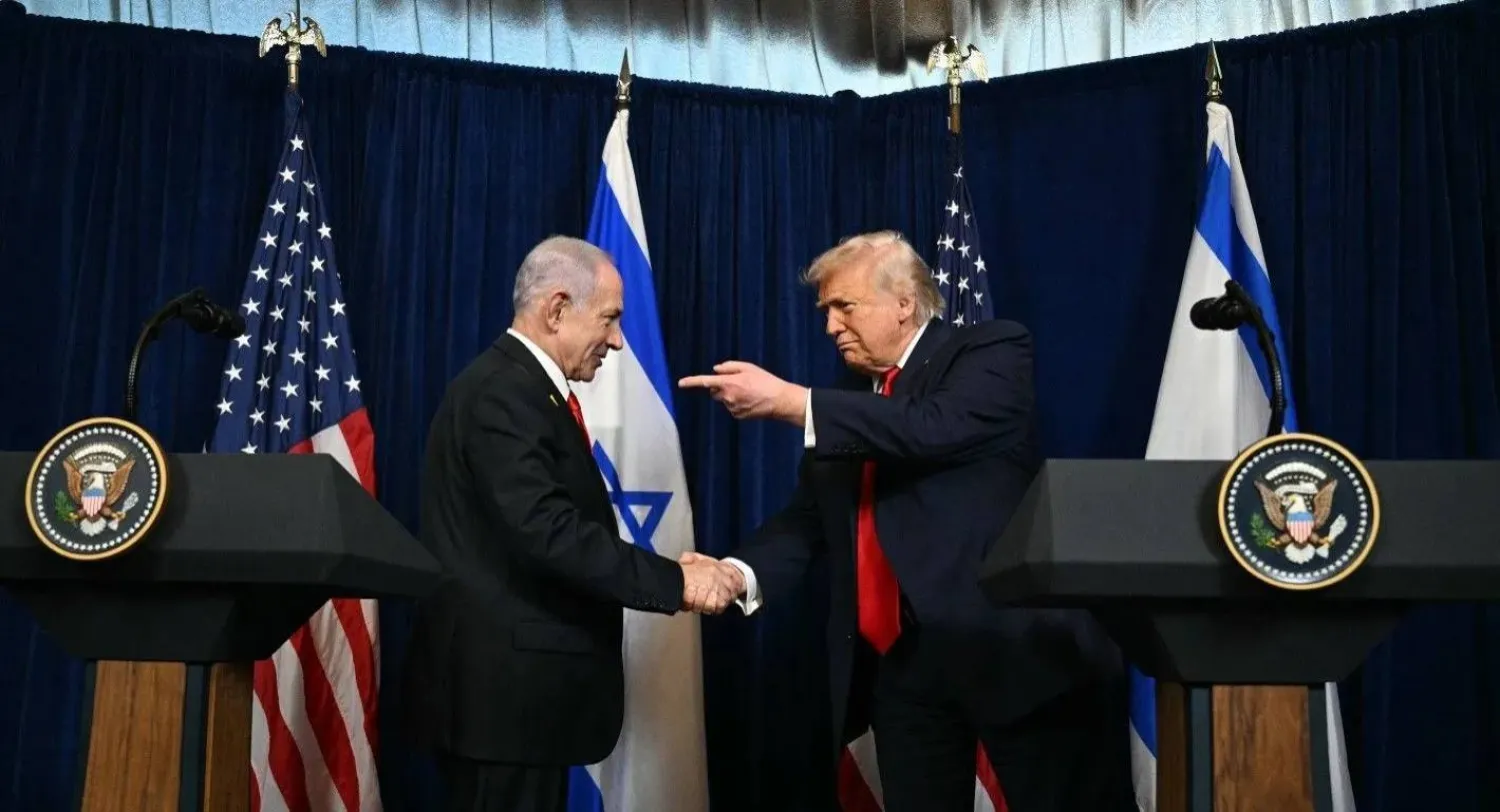
Trump and Netanyahu at Mar-a-Lago on December 29, 2025. (AFP via Getty Images)
TT

Netanyahu, Trump Agree to Meet Soon after Phone Call

Trump and Netanyahu at Mar-a-Lago on December 29, 2025. (AFP via Getty Images)

Israeli Prime Minister Benjamin Netanyahu spoke with ‌US ‌President Donald ‌Trump ⁠on Friday and the ⁠two leaders agreed ⁠to ‌meet soon ‌in the ‌United States, ‌Netanyahu's office said.

The ‌statement did not specify ⁠when ⁠the meeting would take place.


Erdogan Urges Trump to Pursue Talks with Iran, Offers Support

Turkish President Recep Tayyip Erdogan and Palestinian President Mahmoud Abbas (not pictured) attend a press conference following their meeting in Ankara, Türkiye, 12 August 2026. (EPA)
TT

Erdogan Urges Trump to Pursue Talks with Iran, Offers Support

Turkish President Recep Tayyip Erdogan and Palestinian President Mahmoud Abbas (not pictured) attend a press conference following their meeting in Ankara, Türkiye, 12 August 2026. (EPA)

Turkish President Recep Tayyip Erdogan urged US President Donald Trump in a phone call to pursue talks with Iran to de-escalate tensions between the two countries, and offered Ankara's support for peace efforts, the Turkish presidency said on Tuesday.

Türkiye, which has NATO's second-largest army and borders Iran, has repeatedly called for an end to the war. It has maintained close contact with the United States, Iran, and mediators such as Pakistan and Qatar, while also acting as an ‌intermediary between the parties.

"Erdogan ‌stated that it is of great ‌importance ⁠to make the utmost ⁠of diplomacy regarding the tensions between Iran and the United States, that we hope the talks will continue, and that Türkiye will continue to support peace efforts," the presidency said in a statement.

The call comes after a senior Iranian official told Reuters earlier on Monday that Iran would shift ⁠to a "fully offensive" military posture because efforts ‌to negotiate a permanent end ‌to the war have stalled, as Washington ruled out extending a temporary ‌ceasefire agreement.

Progress towards a resumption of oil tanker ‌traffic through the Strait of Hormuz has also stalled. Türkiye has criticized the US and Israeli assault on Iran, while also condemning the Iranian attacks on Gulf states and calling for the re-opening of ‌the strategic strait.

On Monday, Türkiye’s foreign minister discussed the strait's re-opening and the continuation of ⁠the ⁠ceasefire with his Iranian counterpart.

The presidency added that Erdogan and Trump also discussed bilateral ties, the war in Gaza, and a defense pact signed between Türkiye, Saudi Arabia, and Pakistan, adding that the Turkish leader praised the accord as a sign of a "strong stance" for regional stability and security.

It said Erdogan told Trump that Israel's attacks on Palestinians had increased at a time when the second phase of Trump's Gaza Peace Plan was supposed to come into effect.

The White House did not immediately respond to a request for comment on the call.


Hormuz Crossings Rise Slightly from Weekend, Remain in Single Digits

Archive photo of ships crossing the Strait of Hormuz (AFP)
TT

Hormuz Crossings Rise Slightly from Weekend, Remain in Single Digits

Archive photo of ships crossing the Strait of Hormuz (AFP)

Ship ‌crossings via the Strait of Hormuz were still in single digits on Monday, despite rising slightly from the weekend, according to preliminary shipping data on Tuesday, amid a stalemate in US and Iranian peace talks.

Six commodity ships transited the strait on Monday, of ‌which three were exiting ‌the Gulf and ‌three ⁠were entering, Kpler shiptracking ⁠data showed, compared with the 10-day average of 11 ships. Three ships transited on Saturday while two moved through the waterway on Sunday.

There were no very ⁠large crude carriers or tankers ‌carrying liquefied ‌natural gas passing through, reported Reuters.

Some vessels could be ‌passing through the strait ‌with their transponders switched off and they are not considered in the tally.

The very large gas carrier (VLGC) Xavia entered ‌the strait via the Iranian route under ballast, meaning empty ⁠of ⁠a cargo, according to the data. VLGCs are typically used to ship liquefied petroleum gases such as propane and butane.

A medium-range fuel tanker and an intermediate-range tanker also entered the Gulf, the data showed, while a medium-sized LPG carrier, a Panamax bulk carrier and a Panamax-sized fuel tanker exited the Gulf.


Pentagon Inks Tomahawk Deal Amid Reports of Missile Shortfall

A visitor walks past Raytheon stand at the 53rd International Paris Air Show at Le Bourget Airport near Paris, France June 21, 2019. (Reuters)
TT

Pentagon Inks Tomahawk Deal Amid Reports of Missile Shortfall

A visitor walks past Raytheon stand at the 53rd International Paris Air Show at Le Bourget Airport near Paris, France June 21, 2019. (Reuters)

The Pentagon announced a $22.9 billion contract with Raytheon on Monday for Tomahawk missiles amid reports of a shortfall due to the war with Iran.

Acting US Navy Secretary Hung Cao said the contract will "accelerate Tomahawk missile delivery to our warfighters at unprecedented speed."

"Guaranteeing our naval and joint forces have the lethal firepower they need to deter aggression and protect the homeland is paramount," Cao said in a statement. "The Department is utilizing every available tool to meet the demands of our current operations."

An analysis by the Center for Strategic and International Studies (CSIS) think tank released last month found that US stocks of Patriot and THAAD air defense missiles have been slashed by the conflict with Iran.

Before it began in late February, the United States had more than 2,300 Patriot and more than 450 THAAD interceptors -- figures that CSIS estimated have been roughly halved or more in the subsequent months of war.

The Washington Post reported this month that President Donald Trump had demanded answers from Pentagon chief Pete Hegseth about munitions shortages at a recent cabinet meeting.

Trump and Hegseth both later denied that the United States was faced with dwindling missile stocks.

Tomahawk missiles are mainly launched from submarines and warships and can travel more than 1,600 kilometers (1,000 miles).