


North Korea’s Kim Oversees Latest Naval Weapons Tests

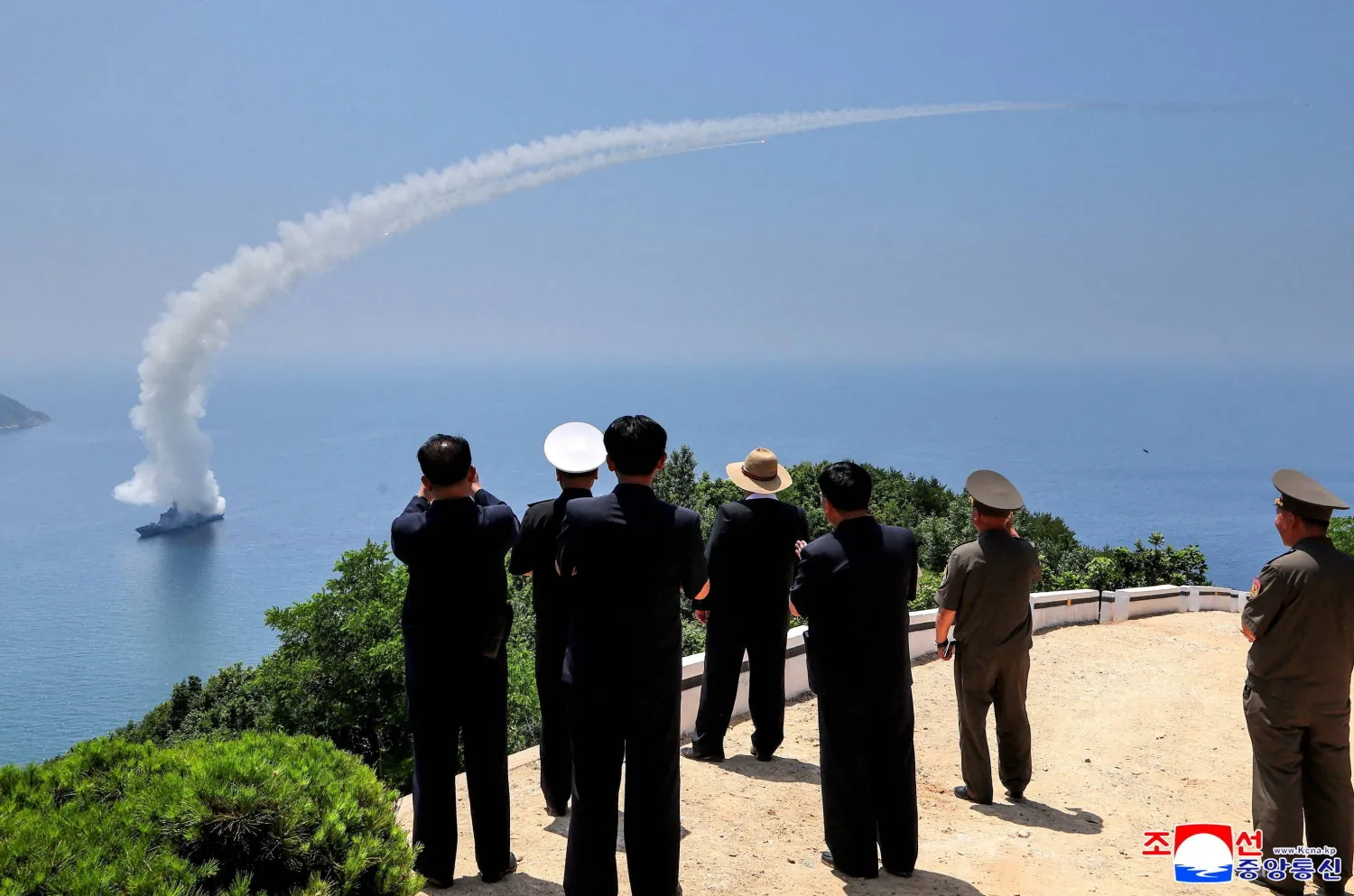
North Korean leader Kim Jong Un observes an assessment of the newly built naval destroyer Kang Kon's combat systems, including the test firing of a strategic cruise missile, at an unknown location in North Korea, July 3, 2026, in this picture released July 5, 2026 by North Korea's official Korean Central News Agency. (KCNA via Reuters)
TT

North Korea’s Kim Oversees Latest Naval Weapons Tests

North Korean leader Kim Jong Un observes an assessment of the newly built naval destroyer Kang Kon's combat systems, including the test firing of a strategic cruise missile, at an unknown location in North Korea, July 3, 2026, in this picture released July 5, 2026 by North Korea's official Korean Central News Agency. (KCNA via Reuters)

North Korean leader Kim Jong Un oversaw weapons tests this week of the 5,000-ton destroyer Kang Kon, including cruise missile launches and "electronic warfare means", state media reported Sunday.

The naval vessel was notably the one that tipped over last year during its launch ceremony, but later repaired.

The tests took place on Friday, the state-run Korean Central News Agency (KCNA) said, less than two weeks after another 5,000-ton destroyer, the Choe Hyon entered military service.

During that commissioning ceremony, Kim vowed to equip his navy with nuclear weapons and develop new 10,000-ton warships.

After the weapons test on Friday, Kim "gave an instruction to complete the trial process of the destroyer in a responsible manner and commission it for the Navy within two months," KCNA said.

A photo released by KCNA shows Kim, wearing a yellow hat, watching a weapons test from a coastal observation point, flanked by officials.

Another photo shows Kang Kon firing a missile at sea, with a plume of smoke rising from the launch.

While reiterating the need to strengthen the country's "war deterrent", Kim also pledged to demonstrate North Korea's determination to possess "absolute power", KCNA said.

The Kang Kon suffered a setback in May last year when it partially capsized after tipping into the water during its launch, damaging the vessel in full view of Kim.

He blamed the accident on "absolute carelessness" and "irresponsibility", ordering that those responsible be held accountable.

- Naval ambitions -

Analysts said Kim's instruction to commission the vessel within two months could be linked to a major political anniversary.

"Given North Korea's political calendar, the most likely scenario is that the vessel will be commissioned to coincide with the 78th anniversary of the country's founding on September 9," Hong Min of the Korea Institute for National Unification in Seoul told AFP.

Once deployed, the warship is likely to operate off the Korean peninsula's eastern coast, he said.

"For the time being, the focus is likely to be on building proficiency in low-threat, nearshore operations."

Pyongyang has repeatedly declared itself an "irreversible" nuclear state since a 2019 summit between Kim and US counterpart Donald Trump in Hanoi collapsed over the scope of denuclearization and sanctions relief.

North Korea remains technically at war with the South because the neighbors' 1950-53 conflict ended in an armistice rather than a peace treaty.

The South Korean navy runs more than 10 ships over 5,000 tons compared to the North's two.


EU to Host Talks on Ukraine with United States and Others on Wednesday

 Ukrainian rescuers clear rubble from a destroyed residential building following an air attack in Dnipro on November 3, 2026, amid the Russian invasion of Ukraine. (AFP)
Ukrainian rescuers clear rubble from a destroyed residential building following an air attack in Dnipro on November 3, 2026, amid the Russian invasion of Ukraine. (AFP)
TT

EU to Host Talks on Ukraine with United States and Others on Wednesday

 Ukrainian rescuers clear rubble from a destroyed residential building following an air attack in Dnipro on November 3, 2026, amid the Russian invasion of Ukraine. (AFP)
Ukrainian rescuers clear rubble from a destroyed residential building following an air attack in Dnipro on November 3, 2026, amid the Russian invasion of Ukraine. (AFP)

The European Commission will host a meeting on Ukraine on Wednesday with representatives of the United States, Ukraine, NATO and European allies, the European Union's executive body said on Tuesday.

"So tomorrow the European Commission will host a meeting with representatives from Ukraine, from the United ‌States, France, Germany, the ‌UK, NATO and the ‌World ⁠Bank and this meeting ⁠will build on earlier talks that took place in Miami," Commission spokeswoman Paula Pinho told reporters in Brussels.

The delegations will discuss a "prosperity plan" and security guarantees for Ukraine, a ⁠source familiar with the plans told ‌Reuters.

US envoy ‌Steve Witkoff had said earlier that the ‌meeting would take place in Brussels.

NATO ‌will host further talks on Thursday, according to Allison Hart, a spokesperson for the military alliance.

She said representatives from France, ‌Germany, Britain and the United States would "discuss the way forward on ⁠bringing about ⁠a just and sustainable end to the war in Ukraine".

The United States will then bring together delegations from Ukraine and Russia in Abu Dhabi on November 10-11 to discuss ending Moscow's war in Ukraine, post-war security agreements and de-escalation, Witkoff said earlier in a post on social media platform X.


Israeli Opposition Bloc Gathers to See How to Oust Netanyahu

Former military chief Gadi Eisenkot, leader of the Yashar party, speaks following the exit poll at his party headquarters, on the evening of Israel's national election, in Tel Aviv, Israel October 28, 2026. (Reuters)
TT

Israeli Opposition Bloc Gathers to See How to Oust Netanyahu

Former military chief Gadi Eisenkot, leader of the Yashar party, speaks following the exit poll at his party headquarters, on the evening of Israel's national election, in Tel Aviv, Israel October 28, 2026. (Reuters)

The Israeli opposition bloc led by Gadi Eisenkot gathered on Tuesday for the first time since elections as they strategize how to oust Prime Minister Benjamin Netanyahu, with divisions on whether to ally with Arab lawmakers.

Opposition party heads gathered in Herzliya, the tech industry hub north of Tel Aviv where former military chief Eisenkot lives, a week after the election produced an inconclusive result.

Yair Lapid, a centrist former prime minister who headed the opposition in the outgoing parliament, said as he entered that Netanyahu was backing an "extreme and dangerous attempt to invalidate the elections".

"What we need to do now is go and form a government, because the conduct of recent days is just a reminder that we must remove Netanyahu and his people from the Prime Minister's Office," Lapid told reporters.

"They have already caused enough damage to the State of Israel and to the people of Israel," he said.

Netanyahu and his allies have repeatedly alleged major fraud or malfeasance by Arab-majority parties which made historic gains last week, winning 19 seats in the 120-member parliament on the back of anger over the hard-right government's rhetoric towards Arab citizens of Israel.

No side won a majority. Eisenkot's diverse opposition bloc won 48 seats while Netanyahu's camp secured 53, of which 27 are from his Likud party.

The Arab parties could bring Eisenkot to a majority but the opposition is divided on whether to ally with them, and Arab politicians did not join the talks in Herzliya.

Despite their diverging views on various issues, including the role of Arab lawmakers, all the party leaders in Eisenkot's bloc have said they would back him to form the next government.

Public opinion polls conducted before the election showed that Jewish Israeli opposition supporters are divided over including Arab parties in government while right-wing Israelis are adamantly opposed.

- 'Political reality' -

Yousef Jabareen, the head of the largest Arab-majority party in the next parliament, told AFP that the opposition needed to accept "political reality" and team up to remove Netanyahu.

Arab-Israelis are descendants of Palestinians who remained after Israel's creation in 1948 and account for around 20 percent of the population today.

On the campaign trail, most of the main Jewish opposition parties rejected partnering with the Arab-majority lists citing a lack of common values, particularly around security and national identity.

The notable exception was Yair Golan, head of the left-wing party The Democrats, who said it was racist to exclude working with the Arab minority.

Netanyahu spent the campaign painting Arab parties as untrustworthy and stoking fears of a Palestinian state.

Avigdor Liberman, a right-wing member of Eisenkot's bloc who heads the Yisrael Beiteinu party, on Tuesday stressed that another election must be avoided but said that the Arab lists should not be included in the government.

"Given the political situation that has emerged, there is enough room to maneuver, and with proper navigation it is possible to quickly establish a functioning and stable government without Raam and the Joint List," he wrote on X, referring to the two Arab-majority lists.

On Monday, Netanyahu called for a "broad national government" without the Arab parties and said that as his Likud was the largest single party, he should lead the next coalition.

No opposition leader has voiced any openness to a unity government with Netanyahu, Israel's longest-serving prime minister, pointing to his divisiveness, the corruption charges against him and his failure to prevent the October 7, 2023 attack by Hamas.

"We seek to establish a broad government with our partners and with any party that wishes to join and does not support terrorism," Netanyahu said in a Telegram post.

He ruled out a coalition with Arab-majority lists, alleging that the parties "support terrorism and deny the existence of the Jewish state".

Leaders of Arab-Israeli parties have unanimously condemned the October 7 attack by Hamas without describing the Palestinian movement as a terror group.

Although the leader of the Raam party has recognized Israel as a "Jewish state", other leaders have rejected that definition.


Qatar Says Remains ‘Hopeful’ of a US-Iran Deal

Vessels at the Strait of Hormuz, as seen from Musandam, Oman, November 3, 2026. (Reuters)
TT

Qatar Says Remains ‘Hopeful’ of a US-Iran Deal

Vessels at the Strait of Hormuz, as seen from Musandam, Oman, November 3, 2026. (Reuters)

Qatar said on Tuesday it remained hopeful that an interim deal could be reached between the United States and Iran as both sides review proposals put forward by mediators including Doha.

In recent days, diplomatic efforts have been underway to prevent renewed fighting after the United States threatened major new strikes -- though US President Donald Trump signaled diplomatic progress with Iran.

Early on Tuesday, US media reported that Washington had launched limited strikes on an Iranian island in the Strait of Hormuz as Iranian media reported five explosions in quick succession.

"Both parties remain committed to the negotiation process; as we mentioned, we are facilitating the real-time exchange of proposals between them," foreign ministry spokesman Majed Al Ansari told reporters.

Both sides "are currently reviewing the ideas and proposals we have presented," he added.

"We remain hopeful that there is still a chance for a deal to take place," he said, adding Doha was working "towards an interim deal".

On Monday, Iranian Foreign Minister Abbas Araghchi said that "very intensive" talks were underway with the United States via mediators.

That same day Qatari negotiators returned to Doha after a meeting in Tehran that lasted more than three hours, Al Ansari said.

He warned that any escalation could complicate the talks.

The US and Israel increased their threats towards Iran in the run-up to the midterms and last week's general elections in Israel, where Prime Minister Benjamin Netanyahu failed to secure a majority.
