


Türkiye Eyes F110 Fighter Jet Engines as Trump Comes to Town

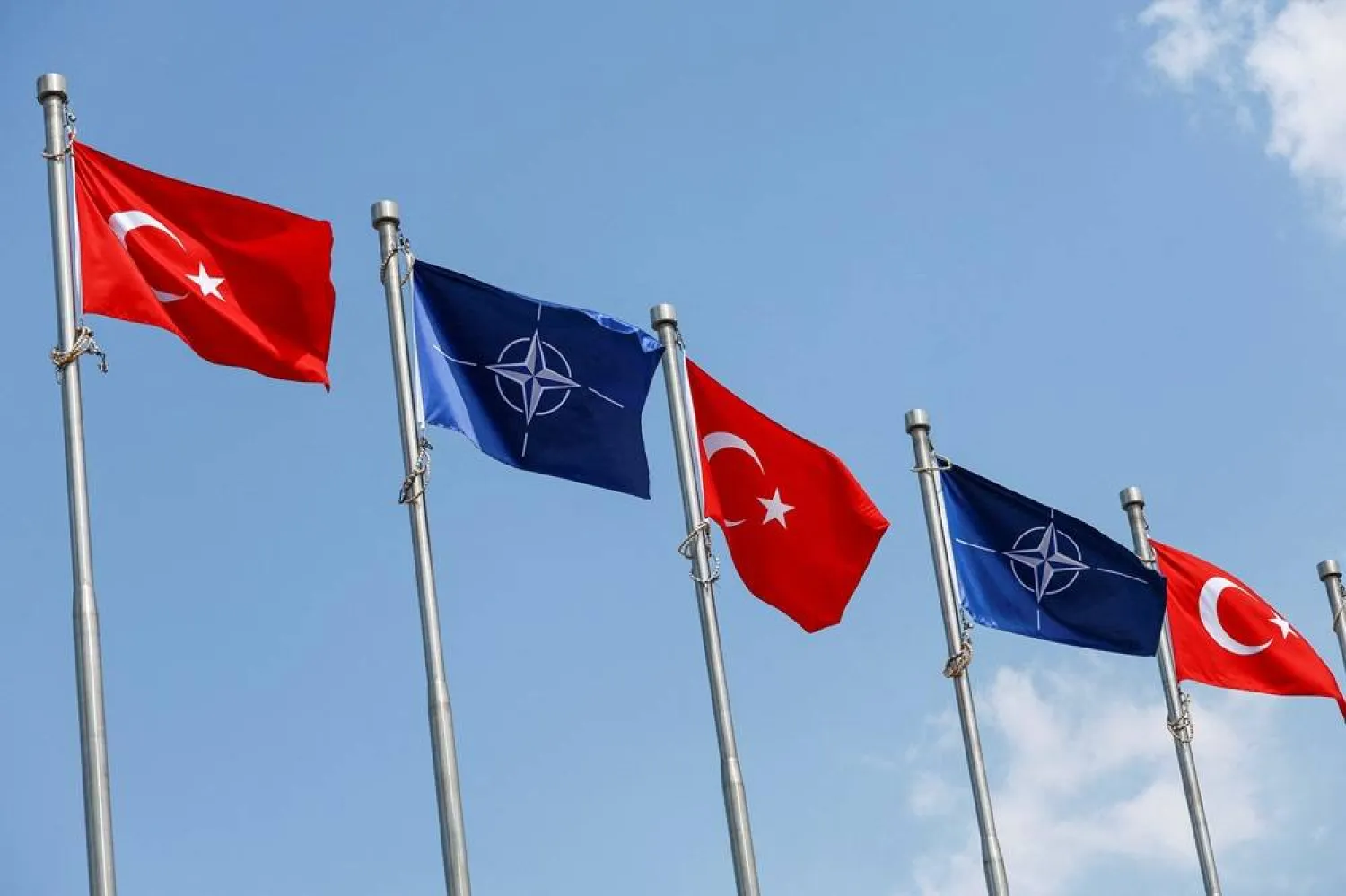
 Turkey and NATO flags wave ahead of the NATO summit, in Ankara, Türkiye, July 4, 2026. (Reuters)
Turkey and NATO flags wave ahead of the NATO summit, in Ankara, Türkiye, July 4, 2026. (Reuters)
TT

Türkiye Eyes F110 Fighter Jet Engines as Trump Comes to Town

 Turkey and NATO flags wave ahead of the NATO summit, in Ankara, Türkiye, July 4, 2026. (Reuters)
Turkey and NATO flags wave ahead of the NATO summit, in Ankara, Türkiye, July 4, 2026. (Reuters)

US President Donald Trump's visit to Ankara for the NATO summit could help secure Türkiye's acquisition of dozens of fighter jet engines, but won't resolve the F-35 dispute that has soured ties, analysts say.

The July 7-8 summit, which is being hosted by President Recep Tayyip Erdogan, will bring together leaders from the military alliance's 32 member states.

Last month, Trump promised to make Erdogan "very happy" when asked about Türkiye looking to secure F110 jet engines and being readmitted to the F-35 fighter jet program.

Analysts said it would likely mean freeing up fighter jet engines Türkiye wants to use in its flagship KAAN stealth fighter project.

"It's likely to be the green light for the F110 GE engines for the KAAN fighter plane, about 40 of them. There had been obstacles to that supply and very possibly those are now being removed," Sinan Ulgen, director of the Istanbul-based Edam think tank, told AFP.

"Türkiye has produced a couple of prototypes which are flying with the F110 engine, but it has been waiting for the supply of additional engines to increase the number of KAAN platforms," he said.

KAAN is a twin-engine stealth fighter being developed by Turkish Aerospace Industries (TAI) to replace the Turkish Air Force's fleet of F-16s as Ankara seeks to join the exclusive club of nations producing fifth-generation combat aircraft, notably the US, China and Russia.

Although Türkiye will eventually fit the fighter with its own domestically-produced engine -- the F110s lacking stealth capability -- that project is still in the preliminary design phase, Defense Minister Yasar Guler said in September.

Türkiye received a first batch of 10 F110s in September, and talks with the US government to acquire 80 more were "ongoing", he said.

- Indigenous defense systems -

But that's been held up by a lack of political clearance linked to Türkiye's 2017 acquisition of a Russian S-400 missile defense system, Foreign Minister Hakan Fidan said in September.

Infuriated, Washington expelled Türkiye from its F-35 fighter jet programe in 2019 and imposed CAATSA sanctions a year later, hampering Turkish defense projects and souring ties.

"The CAATSA issue must be resolved. The US needs to take steps both regarding the F-35 and the engines for KAAN. KAAN's engines are currently awaiting approval in the US Congress," Fidan said, his remarks raising eyebrows back home as Türkiye had said the KAAN would be entirely domestically produced.

Ankara's F-35 exclusion has forced it to refocus on self-sufficiency.

"Some argue we should not buy F-35s and invest that money into our own fifth-generation fighter jet program. And that's exactly what's happening with President Trump's decision to export jet engines," Ozgur Unluhisarcikli, head of the German Marshall Fund in Ankara said.

"Without those engines, Türkiye cannot produce the KAAN jet."

- F-35 deadlock drags on -

With a KAAN delivery date many years away, only Indonesia has placed an order, signing a $10 billion contract to buy 48 fighters, although the NATO summit could generate further interest, Ulgen said.

"Looking at the failure of the German-French FCAS initiative, there may be some interest. Spain could potentially become a partner... But there are more obstacles to be overcome for it to become a credible offer on the international stage," he said.

Experts expected little progress on the lingering F-35 dispute: for Congress to lift the CAATSA sanctions, Ankara would have to get rid of the S-400 -- but selling it to a third country would require Moscow's approval, and returning it to the Russians was not on the cards.

"The US administration might wish to... put this issue behind it and sell Türkiye some F-35, but that will go to Congress and changing the congressional decision won't be easy," said Professor Mustafa Aydin, an international relations expert at Istanbul's Kadir Has University.

But Matthew Bryza, a retired US envoy and former senior White House and State Department official, said Trump could move to resolve the matter as the F-35 was an executive decision which he could easily reverse.

"President Trump can certainly declare that the S-400/F-35 dispute is finished. It's the CAATSA sanctions that require congressional action. Whether he can persuade Congress to do that, depends on how much political capital he's willing to expend," he told AFP of a move that could be "politically costly in the lead up to the midterm elections" due to Türkiye's opponents in the Greek and Armenian diaspora.



Iran's Top Negotiator Threatens 'Faster, More Intense' Response to US Attacks

People walk past a large anti-US banner with reference to the dropping of the atomic bomb on the Japanese city of Hiroshima, in Tehran on September 2, 2026. (Photo by Atta KENARE / AFP) /
TT

Iran's Top Negotiator Threatens 'Faster, More Intense' Response to US Attacks

People walk past a large anti-US banner with reference to the dropping of the atomic bomb on the Japanese city of Hiroshima, in Tehran on September 2, 2026. (Photo by Atta KENARE / AFP) /

Iran's top negotiator Mohammad Bagher Ghalibaf threatened on Sunday to launch swifter and more forceful responses to US attacks, after Tehran targeted American warships in retaliation for US attacks on tankers.

"The Americans must have understood that the era of proportionate responses has come to an end," said Ghalibaf in a speech carried by state media, adding that "any aggression against Iran's interests and security will receive a faster, more intense and more painful response.”

Iran said Sunday that it struck an unmanned US military boat in the Strait of Hormuz.

US Central Command, which oversees the US military operations in the Middle East, did not confirm the claim or respond to request for comment. It comes one day after the US said it struck Iranian oil tankers in retaliation for Iran launching ballistic missiles at Navy warships.


A Fuel Tanker Explosion in West Iran Kills 11 and Injures 7

A fuel tanker exploded in western Iran, killing 11 people and injuring seven others, according to the state media.(AP)
TT

A Fuel Tanker Explosion in West Iran Kills 11 and Injures 7

A fuel tanker exploded in western Iran, killing 11 people and injuring seven others, according to the state media.(AP)

A fuel tanker exploded in western Iran, killing 11 people and injuring seven others, state media said.

IRNA reported late Saturday that the tanker hit other cars before bursting into flames near a traffic police station close to the Kurdish city of Sanandaj, some 400 kilometers (248 miles) west of the capital, Tehran. The report cited a faulty brake system, The Associated Press said.

The injured were transferred to hospitals.

In 2018, a similar road accident between a fuel tanker and an intercity passenger bus near Sanandaj killed 15 people and injured four.

Road and traffic accidents annually leave more than 17,000 dead in Iran. Experts blame the high fatality rate on unsafe vehicles, disregard for traffic rules, and inadequate emergency services.


Nepali Rescuers Buoyed by Miracle Finds but Tough Conditions Persist

Nepal Army personnel work to build an iron bridge across Tadi Khola river following the deadly flash floods and mudslide, in Devighat, Nuwakot district, Nepal, September 4, 2026. REUTERS/Adnan Abidi
TT

Nepali Rescuers Buoyed by Miracle Finds but Tough Conditions Persist

Nepal Army personnel work to build an iron bridge across Tadi Khola river following the deadly flash floods and mudslide, in Devighat, Nuwakot district, Nepal, September 4, 2026. REUTERS/Adnan Abidi

Nepali rescuers faced challenging conditions on Sunday as search operations after catastrophic floods entered their 12th day, buoyed by the extraordinary rescues of four survivors.

The glacial and mountain collapse on the China-Nepal border has killed at least 1,372 people and left more than 5,500 missing across the two countries, AFP said.

Rescuers found two more people alive on Saturday, joining two saved the day before in what have been described as miraculous tales of survival.

Three of those have been found in hydropower tunnels where the government initially said it believed more than 100 workers could be alive.

"Search and rescue is going on at the tunnels despite geography, adverse weather and lack of connectivity," Energy Minister Biraj Bhakta Shrestha told AFP.

Rescue workers were experiencing "multiple challenges", he said.

The wall of icy water and debris tore through mountain districts on August 26, destroying roads, bridges and other infrastructure.

On Saturday, rescuers pulled a Chinese man alive from deep inside a hydropower tunnel, and a 64-year-old Nepali woman, Chandrika Shrestha, from her mud-covered home.

Prime Minister Balendra Shah said the latter rescue had "given hope to the entire nation".

A day earlier, two Nepali hydropower workers were rescued at the Trishuli 3A tunnel, where searches continue alongside multiple other sites, with at least 12 hydropower projects affected.

Biraj Bhakta Shrestha said work was continuing to restore electricity in several areas.

"Places that have unreachable, we've tried to restore power with solar," he told AFP.

Foreign Minister Shisir Khanal has called the disaster a "Himalayan tsunami" and has warned reconstruction costs could run into the billions of dollars.

The United Nations has said the magnitude of the destruction makes delivering aid an immense challenge, and has launched a $50 million appeal to help more than 84,000 people.

With mortuaries overflowing, Nepal has buried hundreds of bodies in mass graves, after taking DNA samples for future identification, according to the police.

Only around 100 bodies have been identified and handed over to families.

Nepal will hold a national day of mourning on Monday, the 13th day since the disaster, in line with a traditional period of mourning in Hindu rituals.

While the exact cause of the glacial collapse is unclear, climate change is accelerating glacial melting worldwide, increasing the risk of such disasters.

In Nepal, rescuers have retrieved 1,341 bodies, while around 4,996 people remain missing, according to the disaster agency.

Chinese state media report that 31 people have been killed and 531 are missing in Tibet.

The combined toll is 1,372 dead and more than 5,500 missing, including around 800 foreigners, among them tourists and pilgrims.