


Australia Signs Defense Alliance with Fiji to Outmaneuver China

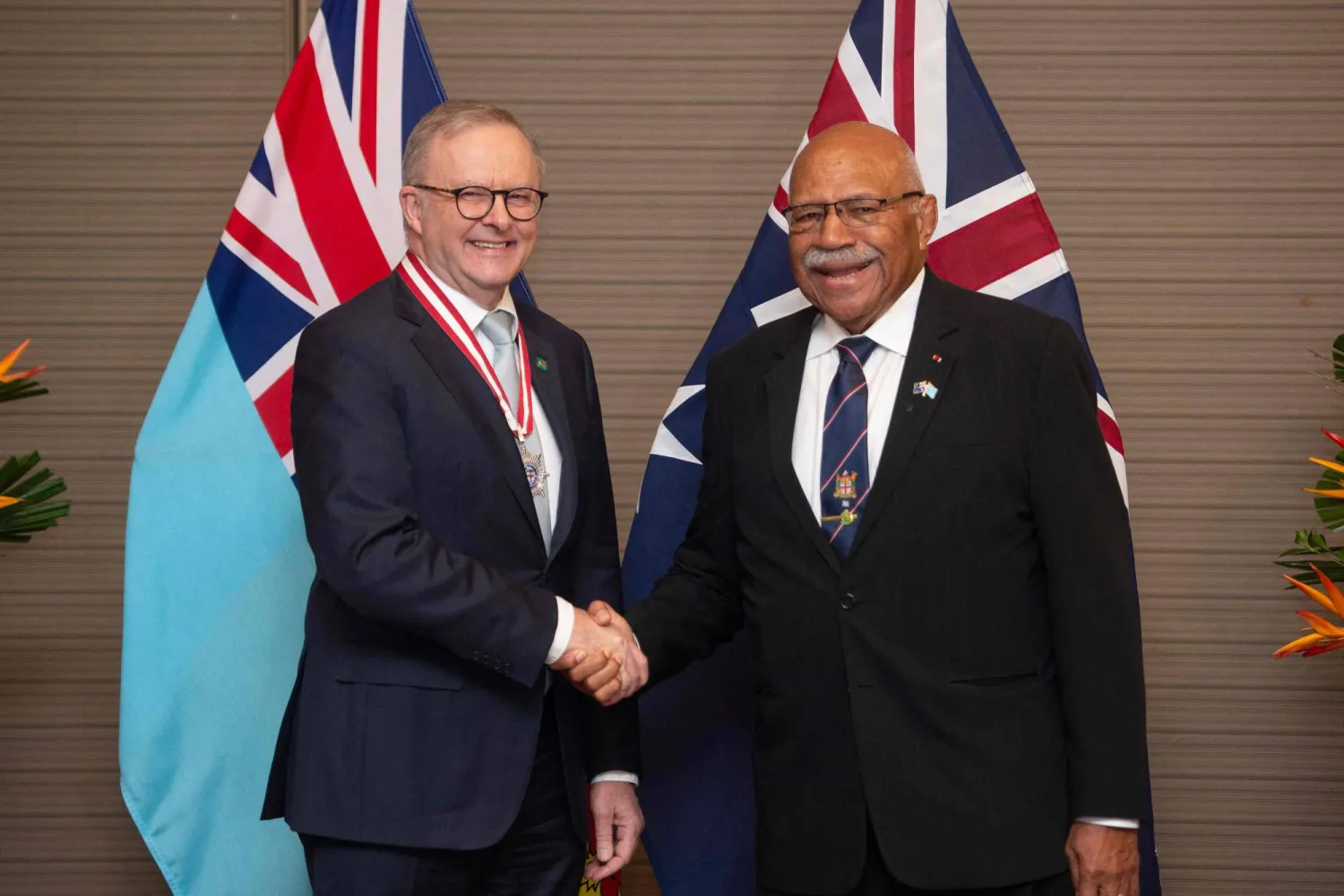
Australian Prime Minister Anthony Albanese (L) shakes hands with Fiji's Prime Minister Sitiveni Rabuka (R) before a bilateral meeting at the Grand Pacific Hotel in Suva on July 6, 2026. (Photo by Leon LORD / AFP)
TT

Australia Signs Defense Alliance with Fiji to Outmaneuver China

Australian Prime Minister Anthony Albanese (L) shakes hands with Fiji's Prime Minister Sitiveni Rabuka (R) before a bilateral meeting at the Grand Pacific Hotel in Suva on July 6, 2026. (Photo by Leon LORD / AFP)

Australia and Fiji signed a major defense treaty on Monday, bolstering ties as Canberra seeks to outmaneuver China in the South Pacific.

The Ocean of Peace pact elevates Fiji to one of Australia's few treaty allies and binds each nation to come to the other's "mutual defense".

China sent waves through the region in 2022 when it signed a secretive security pact with the Solomon Islands, stoking fears it could one day lead to a permanent military presence.

Australia has greatly upped its diplomatic efforts in response, securing deals with the likes of Papua New Guinea, Vanuatu and Tuvalu.

Prime Minister Anthony Albanese signed the pact with his Fijian counterpart Sitiveni Rabuka during a trip to capital Suva.

The pair also signed a second comprehensive treaty covering everything from climate action to economic cooperation.

"When it comes to security issues the Pacific family need to look after our own security," Albanese told reporters.

"The significance of these agreements cannot be underestimated."

Fiji joins the United States, New Zealand and Papua New Guinea as Australia's fourth treaty-bound ally.

Under the deal, the two nations agree to consult each other over any "security-related development" that threatens their sovereignty, AFP reported.

Rabuka tried to quell concerns that China could see the treaty as a snub.

"I do not expect China to have any severe pushback," he told reporters.

"I believe that they will welcome the understanding that it is between Australia and Fiji.
"It does not threaten Fiji's relationship with China."

Fiji grew closer to China under former prime minister Frank Bainimarama, who seized power in a coup in 2006.

Bainimarama turned to Beijing for economic support after his coup resulted in damaging trade sanctions against Fiji.

But China's influence has waned since Rabuka entered office in 2022, favouring Fiji's traditional partnerships with Australia and New Zealand.

Rabuka condemned suggestions in 2025 that South Pacific nations such as Fiji might one day host a permanent Chinese military presence.

"If they want to come, who would welcome them? Not Fiji," he said at the time.

"And I think that China understands that well."

The treaty between Fiji and Australia included a clause that allowed other Pacific nations to join up later.

Pacific affairs expert Tess Newton Cain said this was clearly aimed at Pacific nations with standing militaries such as Papua New Guinea and Tonga.

"It's significant because it's very much focused on the countries that have military capacity," she said.

"It provides a very clear point of entry to have further security conversations down the track."

Albanese will visit the Solomon Islands before returning home later this week for bilateral talks with leaders from Papua New Guinea and Tonga.

Australia's alliance with Fiji mirrors the sweeping Pukpuk Treaty with Papua New Guinea, which is due to come into effect on Wednesday.

Australia and Vanuatu signed a security and economic agreement in June that bars the establishment of any foreign military base in the Pacific nation.

China in response warned Australia against playing "geopolitical games".

Beijing has spent hundreds of millions of dollars building sports stadiums, presidential palaces, hospitals and roads in Pacific island nations.

Kiribati, Solomon Islands and Nauru have in recent years severed longstanding diplomatic links with Taiwan in favor of China.



Türkiye Condemns Closing of 8 Turkish Schools in Greece

View of the island of Halki from a ferry sailing to the island of Rhodes, off the island of Halki, Greece, April 13, 2021. (Reuters)
TT

Türkiye Condemns Closing of 8 Turkish Schools in Greece

View of the island of Halki from a ferry sailing to the island of Rhodes, off the island of Halki, Greece, April 13, 2021. (Reuters)

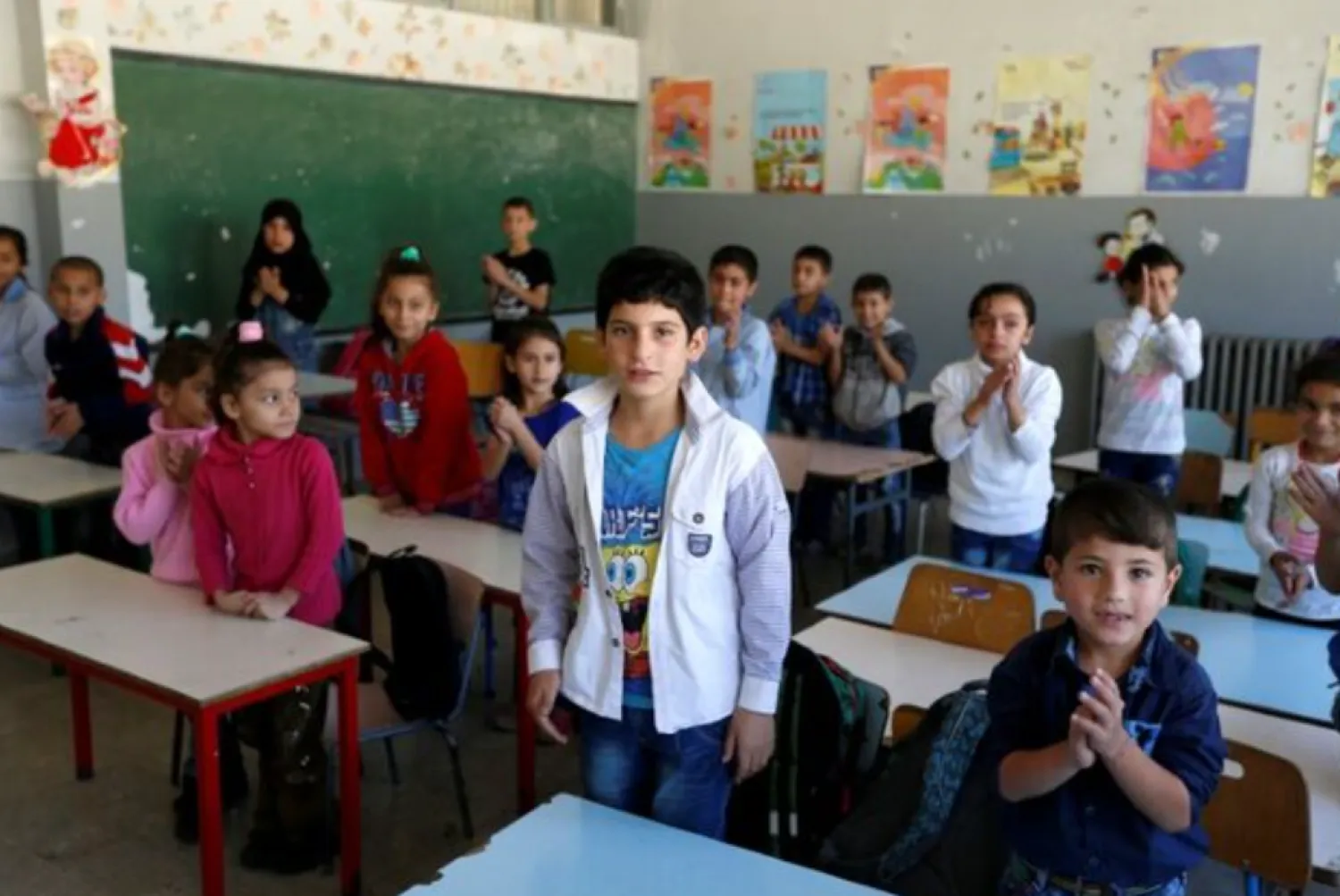
Türkiye's foreign ministry on Sunday condemned a decision by Greece to close eight schools catering to the country's Turkish-speaking minority, accusing its neighbor of discrimination.

In a communique, the ministry condemned "systematic practices aimed at undermining the right to education of the Turkish minority in Western Thrace".

"We once again call on Greece to act in accordance with its contractual obligations regarding minority rights and fundamental rights," it added.

The number of Turkish-language schools left in the north-east region of Thrace -- near the border between the two countries -- is now 76.

Greek authorities have said they were closing schools, and not solely in Turkish-speaking areas, because of declining numbers of pupils.

According to 2021 statistics, some 120,000 Muslims of Turkish origin live in Thrace, where they enjoy specific rights in regards to religion and education under the Treaty of Lausanne, signed after the First World War.


5.5 Magnitude Earthquake Hits Peru’s Andes Region, Killing at Least 5 People

This handout picture released by Peru's Defense Ministry shows a collapsed house on the outskirts of Huancayo, about 300 km east of Lima, on July 19, 2026, following a 5.5 magnitude quake. (Handout / Peruvian Ministry of Defense / AFP)
TT

5.5 Magnitude Earthquake Hits Peru’s Andes Region, Killing at Least 5 People

This handout picture released by Peru's Defense Ministry shows a collapsed house on the outskirts of Huancayo, about 300 km east of Lima, on July 19, 2026, following a 5.5 magnitude quake. (Handout / Peruvian Ministry of Defense / AFP)

A 5.5 magnitude earthquake shook the Andes region of Peru, killing at least five people, local authorities said on Sunday.

More than 20 people were injured, and 300 have been displaced so far.

The US Geological Survey (USGS) reported the quake struck on Saturday at 9:24 p.m. local time, with its epicenter located 2 kilometers (1.24 miles) west-southwest of the city of Sicaya, in Huancayo province. The incident took place at a depth of 10 kilometers (6.21 miles).

Peru’s National Civil Defense Institute said in a statement the total number of people missing is still unknown.

Several buildings collapsed or suffered structural damage, including the local church and convent.

Images broadcast by local media captured the anguish of victims’ relatives in one of the hardest-hit areas, the agricultural region of Chongo Bajo, where residents huddled under blankets outside severely damaged homes. Animals were also seen under the rubble.

In 2007, a magnitude 7.9 earthquake struck the province of Pisco in the Ica region, leaving nearly 600 people dead.

Earthquakes are frequent in Peru, as the country is located in the so-called Pacific “Ring of Fire.”


UN Watchdog Calls for Restraint as Iran Says US Attacked Unfinished

Iranians walk past an anti-US banner in Tehran on July 19, 2026. (AFP)
TT

UN Watchdog Calls for Restraint as Iran Says US Attacked Unfinished

Iranians walk past an anti-US banner in Tehran on July 19, 2026. (AFP)

The UN's nuclear watchdog called for restraint on Sunday after Iran's Atomic Energy Organization said the United States had attacked an under-construction nuclear power plant in the country's southwest.

The US and Iran have been trading escalating attacks for days, and Washington carried out fresh airstrikes on Sunday to "punish" Iran for the deaths of two US service members in Jordan on Friday -- its first reported losses since the return to open hostilities in the Middle East war.

Tehran's Atomic Energy Organization said US forces "in an aggressive and brutal act contrary to international law, attacked the under-construction Darkhovin nuclear power plant... with a number of projectiles on Sunday", according to a statement carried by state TV.

The UN's International Atomic Energy Agency said it was looking into the reports, noting the plant "is in the very early stages of construction and contained no nuclear material when last visited by the IAEA".

While the incident "is not believed to pose any radiological risk", IAEA director Rafael Grossi reiterated his "call for military restraint in the vicinity of all nuclear-related sites", the agency said, in a post on X.

Iran's nuclear program has long been a major point of contention between it and the West, including in negotiations aimed at ending the current war.

While foreign powers including the US and Israel suspect it of seeking a bomb, Tehran has always maintained its program is peaceful, though it insists on its right to enrich uranium for civilian purposes.