


Iran Issues Security Directives to Control Narrative Around Khamenei Funeral

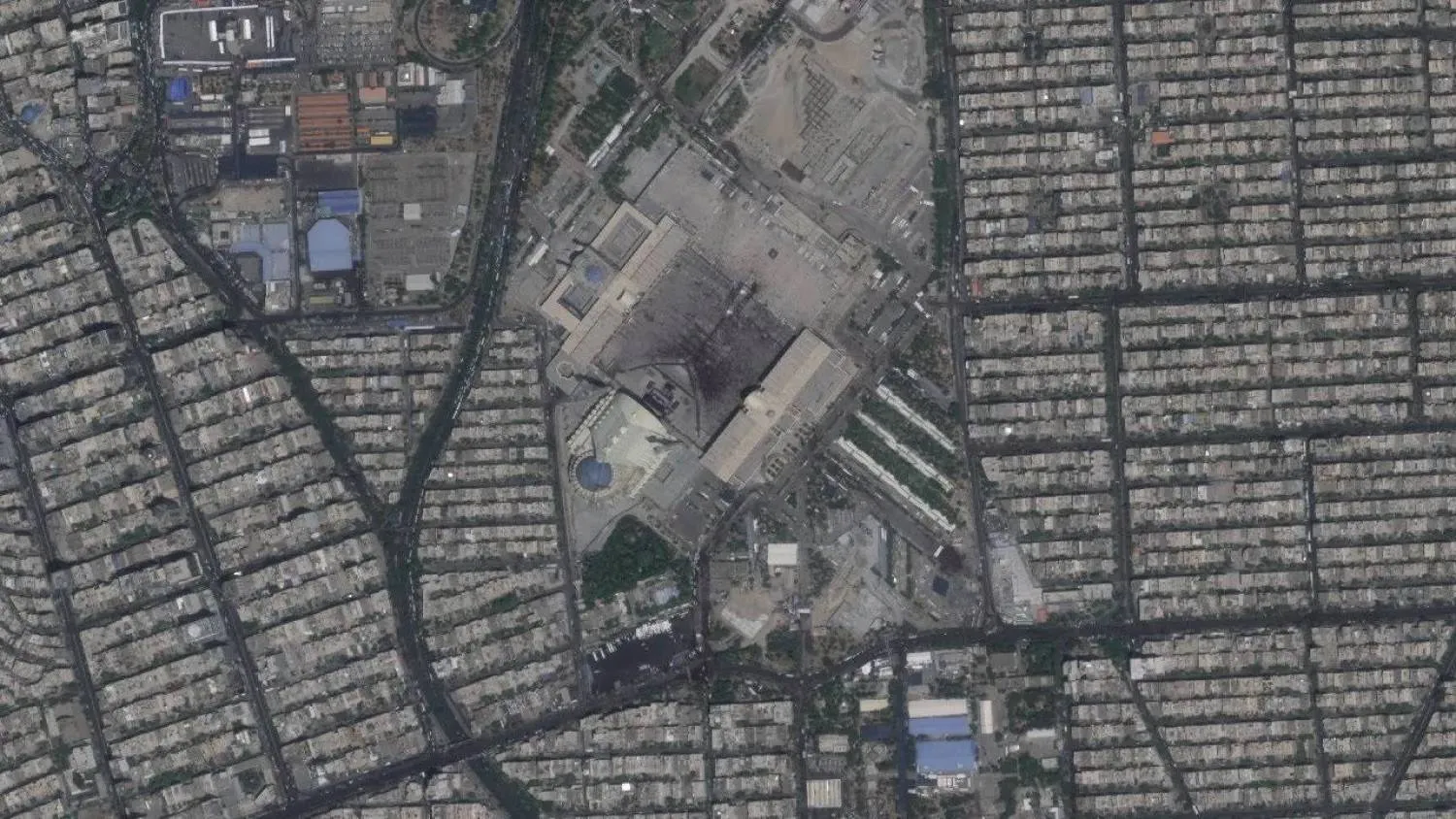
Satellite image of Tehran’s Grand Mosalla during the funeral ceremony for former Iranian Supreme Leader Ali Khamenei in Tehran, July 5, 2026. (Planet Labs/Reuters) 
TT

Iran Issues Security Directives to Control Narrative Around Khamenei Funeral

Satellite image of Tehran’s Grand Mosalla during the funeral ceremony for former Iranian Supreme Leader Ali Khamenei in Tehran, July 5, 2026. (Planet Labs/Reuters) 

Iran’s security agencies have ordered media outlets and public relations departments at state institutions to adhere to a unified framework when covering news and analysis related to the funeral of former Supreme Leader Ali Khamenei, in an effort to tightly manage the public narrative during one of the country’s most sensitive political moments since the leadership transition.

The directives, obtained by Asharq Al-Awsat, instruct media organizations to reinforce specific messaging, remove accounts that deviate from the official narrative, and portray the funeral as proof of the continuity of the leadership and the resilience of the political system in the face of what the document describes as the enemy’s “cognitive warfare.”

The document treats the funeral as a political, security, and media event simultaneously. It instructs outlets to depict public attendance as a unique “human shield” and as a “strategic declaration of loyalty” to Khamenei’s legacy and the Iranian Revolution’s “strategic depth.”

Media observers in Tehran said the directives reflect an effort to shape public opinion and curb media pluralism during a delicate transitional period.

The guidance requires coverage to revolve around three themes: “continuity of leadership,” “continuity of resistance,” and “a bright future.” It warns that inconsistent messaging would create space for competing narratives and urges all media to adopt a unified account on behalf of what it calls the “Front of the Revolution.”

The document also calls for highlighting the attendance of foreign delegations and republishing favorable analyses from Western media in domestic outlets as evidence of the success of Iran’s public diplomacy and the failure of efforts to isolate the country despite sanctions.

It instructs media to counter arguments by supporters of the former Pahlavi monarchy while avoiding defensive responses, instead emphasizing what it describes as the regime’s achievements in the nuclear, missile, and regional arenas.

Emphasis is placed on rebutting narratives of a “succession vacuum” and an “uncertain future.” The directives call for calm, well-documented explanations of Iran’s constitutional succession process to prevent what they describe as a cascading collapse in public confidence.

The guidance also bans coverage that could inflame political or sectarian divisions, urging media to stress national unity and consensus.

Media are further instructed to portray the funeral crowds as a historic display comparable to the 1979 Iranian Revolution and a decisive rebuttal to predictions of state collapse. They are encouraged to use statistics, photographs, and field reports to project national strength and cohesion, while incorporating deterrent messages emphasizing Iran’s military readiness and continued commitment to the “path of resistance.”

Finally, the directives warn against what they describe as pessimistic analyses or forecasts rooted in fear and uncertainty, urging media instead to promote an image of “a proud and advancing Iran” through what the document calls the “engineering of hope,” while affirming that “Iran’s future is bright and remains connected to the path of the Imam and the leadership.”


Teen Pleads Guilty over Arson Attack on Iran International Offices in London

A shopper walks in Oxford Street, in London, Wednesday, Aug.19, 2026. (AP Photo/Kirsty Wigglesworth)
TT

Teen Pleads Guilty over Arson Attack on Iran International Offices in London

A shopper walks in Oxford Street, in London, Wednesday, Aug.19, 2026. (AP Photo/Kirsty Wigglesworth)

A British teenager pleaded guilty on Friday over an arson attack at offices linked to television station Iran International in northwest London earlier this year.

Nathan Dunn, 19, pleaded guilty to a charge of "arson being reckless as to whether life is ⁠endangered" at London's ⁠Old Bailey over the incident in April in which an ignited container was thrown towards premises belonging to Volant ⁠Media, the parent company of the London-based broadcaster.

The device landed in a car park and the fire extinguished itself, causing no damage or injuries, Reuters reported.

Dunn had originally been charged alongside a 21-year-old man and a 16-year-old boy, ⁠who ⁠cannot be identified because of his age.

Iran International, a broadcaster critical of Iran's government, said at the time that a suspicious vehicle had been denied entry to its London site shortly before the incendiary device was thrown.


US-sanctioned ICC Head Warns Against 'Demise of International Rule of Law'

(FILES) Judge Tomoko Akane arrives prior to the announcement of an International Criminal Court (ICC) verdict. (Photo by Eva Plevier / ANP / AFP)
TT

US-sanctioned ICC Head Warns Against 'Demise of International Rule of Law'

(FILES) Judge Tomoko Akane arrives prior to the announcement of an International Criminal Court (ICC) verdict. (Photo by Eva Plevier / ANP / AFP)

International Criminal Court President Tomoko Akane of Japan warned on Friday against "the demise of international rule of law" after the United States targeted her with sanctions.

Washington sanctioned Akane and trial lawyer Abdoulaye Seye of Senegal on Tuesday as part of the Trump administration's campaign against what it calls a "corrupt and fatally politicized" body.

"The sanction against me this time was something I had anticipated to an extent, so I'm not surprised," Akane said in a statement released on X by her publisher Bungei Shunju.

"The important thing is not to let this be the beginning of the demise of international rule of law,” AFP quoted her as saying.

The measures bar Akane and Seye from entering the United States and from carrying out transactions in the US financial system.

Akane's statement -- her first public comments since the sanctions -- comes after the ICC on Wednesday called the US measures a "flagrant attack" on the court's independence.

The United Nations rights chief Volker Turk and top EU officials threw their support behind Akane and her institution.

Washington's latest move follows sanctions it imposed on several ICC officials, seen as largely in response to the court's investigations involving Israel, a US ally.

Japan has also objected to the sanctions on Akane, with the foreign ministry saying it "consistently supported the ICC... in its efforts to prosecute and punish the most serious crimes of concern to the international community and to uphold the rule of law.”

Japan is the biggest funder of the ICC and a close US ally.

Established in 2002, the ICC prosecutes individuals accused of the gravest atrocities and acts as a last resort when countries do not have adequate legal systems to ensure accountability.

US Secretary of State Marco Rubio earlier said in a statement, without providing examples, that the sanctioned "individuals have directly engaged in efforts by the ICC to investigate, arrest, detain, or prosecute officials whose government has not consented to ICC jurisdiction.”

The United States signed the Rome Statute establishing the ICC but never ratified the treaty. Israel, Russia and China are not ICC members either.

In 2023, the ICC issued an arrest warrant for Russian President Vladimir Putin over the war in Ukraine, prompting Moscow to issue its own arrest warrants for senior court officials.

These included Akane, 70, an ICC judge since 2018 who was elected as the court's president in March 2024.

"Even if one judge were to die, we are easily replaceable, so there is really no value in targeting us," she said after the Russian announcement.


Thousands of Migrants in Ceuta Wait in Limbo While Spain Figures Out What to Do with Them

Moroccan migrant Wafae Atid sits on her inflatable mattress as men walk along the road near the Temporary Immigrant Reception Center (CETI) in Ceuta, Spain, August 16, 2026. REUTERS/Maria Alejandra Cardona
TT

Thousands of Migrants in Ceuta Wait in Limbo While Spain Figures Out What to Do with Them

Moroccan migrant Wafae Atid sits on her inflatable mattress as men walk along the road near the Temporary Immigrant Reception Center (CETI) in Ceuta, Spain, August 16, 2026. REUTERS/Maria Alejandra Cardona

For weeks, migrants in the Spanish territory of Ceuta had gathered on a beach away from the city center, sleeping on cardboard sheets, under reed huts and guarding their few possessions in tattered plastic bags.

They were gone by Thursday morning after Spanish police escorted them to makeshift shelters. But an hour later, other migrants were combing through the trash they had left behind for anything useful: an abandoned mattress, plastic chairs, sheets, a scrap of tarp, The Associated Press said.

The scene exemplified the ongoing humanitarian crisis in Ceuta, where up to 10,000 migrants remain in the city weeks after more than 72,000 people poured into the small Spanish territory neighboring Morocco. Three weeks later, Spanish authorities were struggling to shelter and attend to those who refused to leave — or even determine how many migrants were still in the city of 84,000.

Within days of the initial border rush, in which at least 90 people died, most migrants went back to Morocco, realizing the difficulties of staying in Ceuta and their slim chances of reaching mainland Europe. But thousands remained, hiding in the woods, on beaches and outside a migrant reception center.

City officials estimate that 9,000 to 10,000 migrants — including about 2,000 minors — could still be in the city, based on the number of daily food rations handed out by aid groups. Spain’s interior ministry puts the figure at roughly 5,000 people.

Shelter for some migrants while others roam the streets

The US refugee agency highlighted large humanitarian and operational challenges in Ceuta in an interview with The Associated Press, specifically around access to shelter, basic services and food. While most of those who crossed in late July are from Morocco, people from war-torn Sudan, Mali and Yemen also reached the Spanish exclave.

The UN refugee agency urged Spanish authorities to start processing their asylum claims as soon as possible, estimating that about 1,200 migrants in Ceuta could be eligible for international protection, according to Paula Barrachina, a spokesperson for the agency in Spain.

The Spanish government says it is working to house the remaining migrants in the city, and return a sense of normalcy to Ceuta. On Thursday, Spain’s Minister of Inclusion, Social Security and Migration Elma Saiz said the government had secured space to accommodate 1,800 migrants in a parking lot and a military facility sometimes used for religious events. It is looking for more space.

Even so, an Associated Press photographer on Thursday saw migrants still roaming the streets. Elsewhere, hundreds of women and minors were sheltering in makeshift centers run by locals.

Khadija Rifai, a 20-year-old woman from Morocco, acknowledged that some people were receiving help, but didn't know what Spain planned to do with adults like her.

“They help the minors and the youngsters, but they haven’t found any solutions for us,” she said Wednesday.

Rifai said her life in Morocco was “normal” but in late July, she and her husband swam to the Spanish territory in search of better opportunities and healthcare. Rifai's husband was sent back to Morocco, but she hid from authorities and stayed on. She now hopes to reunite with him and eventually move to mainland Spain, where she wants to have children.

“Even though we suffered here in Ceuta, we hope that once we reach the mainland, life will be good and we will have a house, a car, and everything we dreamed of," Rifai said.

Discontent grows in Ceuta

Ceuta Mayor Juan Jesús Vivas accused the national government, led by Socialist Prime Minister Pedro Sánchez, of not doing enough to control the situation.

On Thursday, Spanish police escorted several hundred people, mostly men, through the city’s streets to a shelter. Hours later, Vivas, a member of the center-right Popular Party, said the government’s decision to move migrants from the beach to other locations in the city did not demonstrate "a will to fix the problem.”

Spain's migration ministry said the government has allocated 6.5 million euros ($7.6 million) in emergency funds to help the city cope with the new arrivals. Speaking in Ceuta this week, Migration Minister Saiz praised the work of local organizations in Ceuta and said 4,000 meals had been distributed every day since Aug. 3.

A ministry spokesperson said the Spanish government has to process every case on an individual basis. Before that can happen, police must identify those who entered the city illegally, verify every migrant's nationality and background, determine who qualifies for international protection and establish who must leave, either voluntarily or by force, he said.

Those who crossed await a path forward

Migrants in Ceuta say they are willing to wait out the uncertainty. Hundreds had gathered earlier in the week in protest on a beach in Ceuta, carrying signs reading “Asylum” alongside Spanish flags.

Mohamed Yaqoub, 18, a migrant from Chad hid for days in the woods after Spanish soldiers chased him in late July, he said. He managed to stay and wishes to someday study in France.

Getting there will not be easy. Travelers leaving Ceuta and Melilla, Spain’s other territory in North Africa, are subject to exit checks at ports and airports, an obstacle for those who enter the territories illegally and hope to reach the European continent.

“We ask them to allow us entry and give us the necessary papers and documents,” Yaqoub told an AP photographer in a cellphone note. “The most important thing for us is to get the papers.”
