

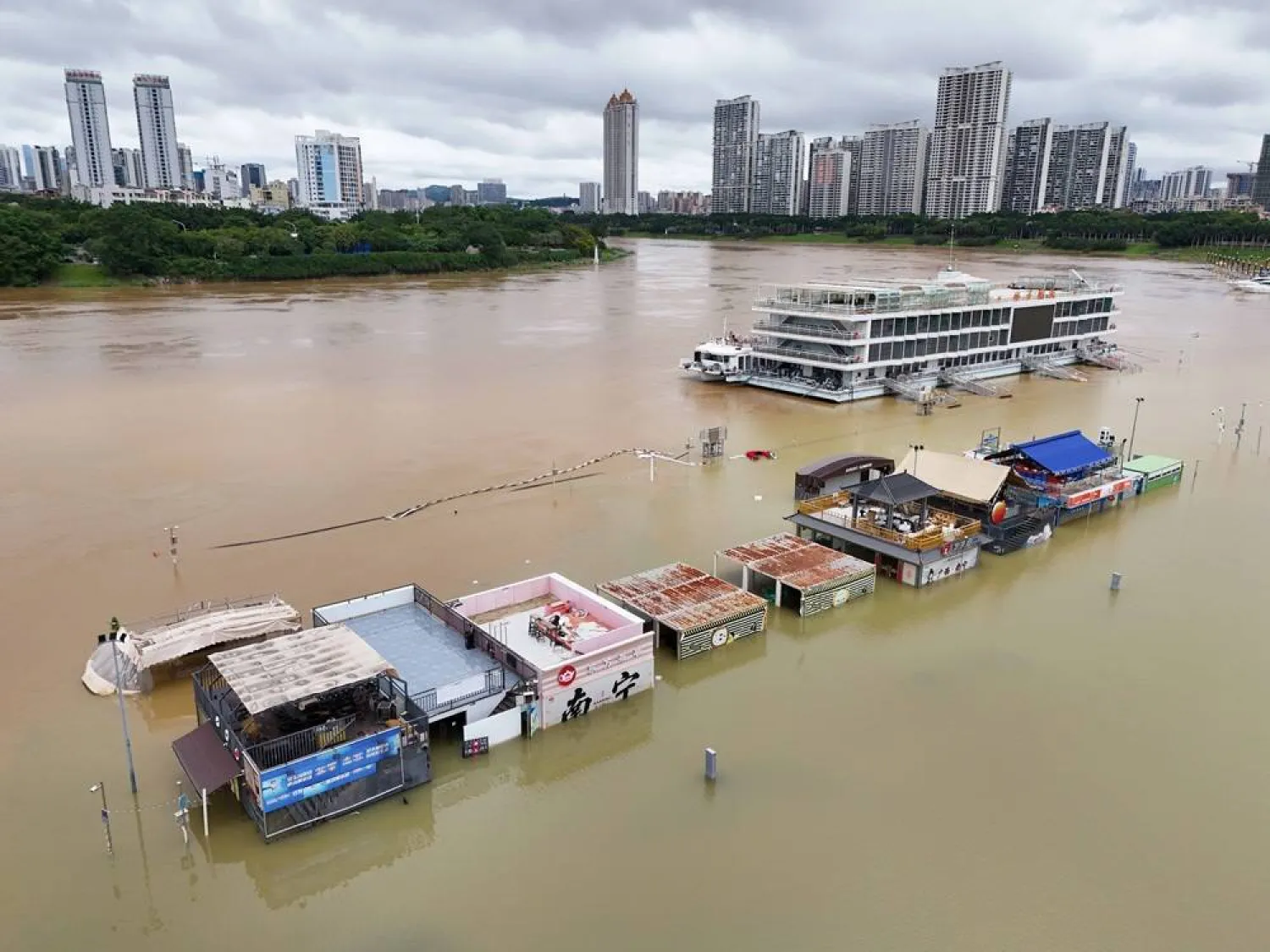

Rescuers Search for Missing in China Storms After 100,000 Evacuated

A riverside park is seen inundated by the surging flood brought by Typhoon Maysak in Nanning in southern China's Guangxi Zhuang Autonomous Region, 07 July 2026. (EPA)
TT

Rescuers Search for Missing in China Storms After 100,000 Evacuated

A riverside park is seen inundated by the surging flood brought by Typhoon Maysak in Nanning in southern China's Guangxi Zhuang Autonomous Region, 07 July 2026. (EPA)

Rescuers scoured flooded parts of China for survivors after devastating storms killed 17 people, caused dozens of rivers to overflow and a reservoir dam to burst, with officials warning rain will persist on Wednesday.

Six people died and at least 130,000 people were evacuated in the southern region of Guangxi after torrential rain and severe flooding from Typhoon Maysak, regional officials said, warning rain would persist there and in neighboring Guangdong province on Wednesday.

Fast-flowing muddy water burst the banks of 40 rivers and waterways in Guangxi, damaging nearly 13,000 acres of agricultural land, state media reported.

Videos published by state broadcaster CCTV showed torrents of water rushing past the crumbled concrete walls of a reservoir dam that had burst in Guangxi, while rescue workers wearing life vests were deployed on inflatable boats.

Chinese authorities were sending additional disaster relief like food, raincoats, and rubber boats to the region, state news agency Xinhua reported on Wednesday.

- 'Severe test' -

Authorities maintained the second-highest level for flood-control emergency response in Guangxi, according to the State Flood Control and Drought Relief Headquarters.

Flood peaks "exceeding the warning water level" by more than six meters (20 feet) are expected at the Wuzhou Hydrological Station in Guangxi early Thursday, Minister of Water Resources Li Guoying said.

"Due to the impact of persistent heavy rainfall and the prolonged passage of floodwaters at high levels, the safety of reservoirs and embankments in the affected areas faces a severe test," he added.

Thunderstorms and gale-force winds killed another 11 people and injured 331 in the central province of Hubei, and tornadoes were reported elsewhere late on Monday, Xinhua said.

One person is missing in Hubei, Xinhua said, adding that 4,800 houses were damaged and 22 more had collapsed.

Natural disasters are common across China, particularly in the summer when some regions experience intense rainfall while others bake in scorching heat.

Xi said on Tuesday that rescuers should "go all out" in organizing emergency operations, CCTV reported.

- Landslide -

Separately in northwestern China's Gansu province, the death toll from a landslide rose to 21, state media reported Wednesday, a day after it buried 33 people.

Rescue teams had rushed to the site of the landslide, which occurred at around 6:56 am on Tuesday (2256 GMT Monday) at Rencang village in Dangchang County, Xinhua said.

"Search and rescue operations at the site of the landslide in Dangchang County have concluded; the landslide resulted in 21 fatalities," Xinhua said on Wednesday, citing local authorities.

The cause of the landslide was still under investigation, according to local media.

Authorities have set aside 30 million yuan ($4.4 million) in reconstruction funds following the landslide.



North Korea Says Record-High Japan Defense Budget Would Risk ‘Turmoil’

North Korean leader Kim Jong Un, accompanied by his daughter Kim Ju Ae and his wife Ri Sol Ju, visits the Revolutionary Martyrs Cemetery on National Liberation Day, in Pyongyang, North Korea, August 14, 2026, in this photo released by North Korea's official Korean Central News Agency (KCNA) on August 15, 2026. (KCNA via Reuters)
TT

North Korea Says Record-High Japan Defense Budget Would Risk ‘Turmoil’

North Korean leader Kim Jong Un, accompanied by his daughter Kim Ju Ae and his wife Ri Sol Ju, visits the Revolutionary Martyrs Cemetery on National Liberation Day, in Pyongyang, North Korea, August 14, 2026, in this photo released by North Korea's official Korean Central News Agency (KCNA) on August 15, 2026. (KCNA via Reuters)

North Korea slammed Japan's reported plans to increase its defense budget, accusing Tokyo on Saturday of preparing for a "war of aggression" as its US ally pursues talks with Pyongyang.

Japan has been gradually moving away from its post-World War II pacifist stance, increasing military spending, ramping up defense pacts and deploying missile launchers to its outer islands.

The Japanese defense ministry is now seeking a "record-high" budget for the upcoming fiscal year, broadcaster NHK and other media outlets reported this week, putting the sum at 8.9 trillion yen ($56 billion).

The budget request "will once again break all-time records", a commentary carried by Pyongyang's official Korean Central News Agency (KCNA) said.

While not yet finalized, the move "clearly signifies a dangerous expansion of the war budget that will bring new turmoil to the region and the world", KCNA said.

"This massive increase in military spending will lead to a buildup of military power to complete preparations for a war of aggression".

The United States, an old Japanese and South Korean ally, meanwhile seeks its own engagement with Pyongyang, with President Donald Trump scaling back annual military drills with Seoul aimed at countering potential threats from the nuclear-armed North.

Trump's order has alarmed allies concerned about US commitments to security in East Asia. Japan this week underlined the "critical" importance of security cooperation with the United States and South Korea.

Trump also said he would meet with North Korean leader Kim Jong Un this year.

Japan occupied all of Korea before its 1945 surrender in World War II, after which the peninsula was divided into separate states along the 38th parallel.

The legacy of the violent colonial period continues to weigh on the foreign policies of both North and South Korea.

China, a key ally of North Korea, has recently expressed alarm at what it sees as "new militarism" by Japan.

Prime Minister Sanae Takaichi's administration is undertaking a major update of the national defense strategy this year in the face of China's expanding military ambitions.

Tokyo has already lifted Japan's self-imposed ban on weapons exports and expanded defense spending, while pushing to amend the pacifist constitution.

Still, Defense Minister Shinjiro Koizumi last week reaffirmed the government's "determination to continue fulfilling our responsibility to uphold Japan's postwar path as a peaceful nation", he said during a visit to a shrine honoring the country's war dead.


US Judge Strikes Down Policy Suspending Immigrant Visa Processing for 75 Nations

Trump pursued a strict immigration policy, which he says aimed to improve national security. (Reuters)
TT

US Judge Strikes Down Policy Suspending Immigrant Visa Processing for 75 Nations

Trump pursued a strict immigration policy, which he says aimed to improve national security. (Reuters)

A US judge on Friday struck down a Trump administration policy suspending the issuance of immigrant visas to applicants from 75 countries, saying that the policy exceeded Secretary of State Marco Rubio's statutory authority.

US District Judge Jeannette Vargas in Manhattan said the policy that the State Department announced in January was "patently unlawful" and ran afoul of federal immigration law, which explicitly stripped the secretary of state of authority over ‌consular officers' ‌processing of immigrant visas.

"The Policy, which ‌categorically ⁠prohibits the issuance ⁠of immigrant visas based upon the nationality of the applicant, represents a direct abrogation of this statutory scheme," she wrote.

The State Department's suspension that also took effect in January impacted applicants from Latin American countries including Brazil, Colombia, and Uruguay; Balkan nations such as Bosnia ⁠and Albania; South Asian countries Pakistan and Bangladesh; ‌and those from ‌many nations in Africa, the Middle East, and the Caribbean.

The State ‌Department said applicants from those countries were "at a ‌high risk for becoming a public charge and recourse to local, state and federal government resources in the United States." The department did not immediately respond to a request for ‌comment on the ruling.

Vargas, an appointee of Democratic former President Joe Biden, issued ⁠the ruling ⁠in a lawsuit filed by immigrant rights groups Catholic Legal Immigration Network and African Communities Together along with applicants for immigrant visas and US citizens who are sponsoring family members from the designated countries for immigrant visas.

President Donald Trump has pursued an aggressive immigration crackdown that he says is aimed at improving domestic security. Rights groups say the crackdown has violated free speech and due process rights and has created an unsafe environment, particularly for ethnic minorities, who have raised concerns about racial profiling


US Navy Aircraft Transits Taiwan Strait Before Planned Xi-Trump Meeting

 US and Taiwan flags fly outside the National Chung-Shan Institute of Science and Technology (NCSIST) in Taoyuan on March 30, 2026. (AFP via Getty Images)
US and Taiwan flags fly outside the National Chung-Shan Institute of Science and Technology (NCSIST) in Taoyuan on March 30, 2026. (AFP via Getty Images)
TT

US Navy Aircraft Transits Taiwan Strait Before Planned Xi-Trump Meeting

 US and Taiwan flags fly outside the National Chung-Shan Institute of Science and Technology (NCSIST) in Taoyuan on March 30, 2026. (AFP via Getty Images)
US and Taiwan flags fly outside the National Chung-Shan Institute of Science and Technology (NCSIST) in Taoyuan on March 30, 2026. (AFP via Getty Images)

A US Navy P-8A Poseidon aircraft transited the Taiwan Strait in international airspace on Friday, in a move the US 7th Fleet said "demonstrates the United States' commitment to a free and open Indo-Pacific".

The Chinese military tracked and monitored the patrol and reconnaissance aircraft throughout the transit, the state-backed Global Times newspaper reported, citing a military source, saying the "situation was under ‌control".

US military ‌ships or aircraft every few ‌months ⁠pass through or above ⁠the waterway that separates democratically governed Taiwan from China — missions that anger Beijing.

Chinese President Xi Jinping is expected to visit the United States next month to meet President Donald Trump as Washington and Beijing look to stabilize ⁠ties marred by issues including Taiwan, trade ‌disputes and technology ‌curbs.

"By operating within the Taiwan Strait in accordance ‌with international law, the United States upholds the ‌navigational rights and freedoms of all nations," the 7th Fleet said in a statement.

"The aircraft's transit of the Taiwan Strait demonstrates the United States' commitment to ‌a free and open Indo-Pacific. The United States military flies, sails, and ⁠operates ⁠anywhere international law allows."

China claims democratically governed Taiwan as its own territory and says it has jurisdiction over the strait. Taiwan and the US say the strait is an international waterway.

Beijing has repeatedly said the Taiwan issue is its internal affair and at the core of Beijing's interests — a red line that must not be crossed or trampled on.

Taiwan's government rejects China's sovereignty claims, saying that only Taiwan's people can decide their future.