

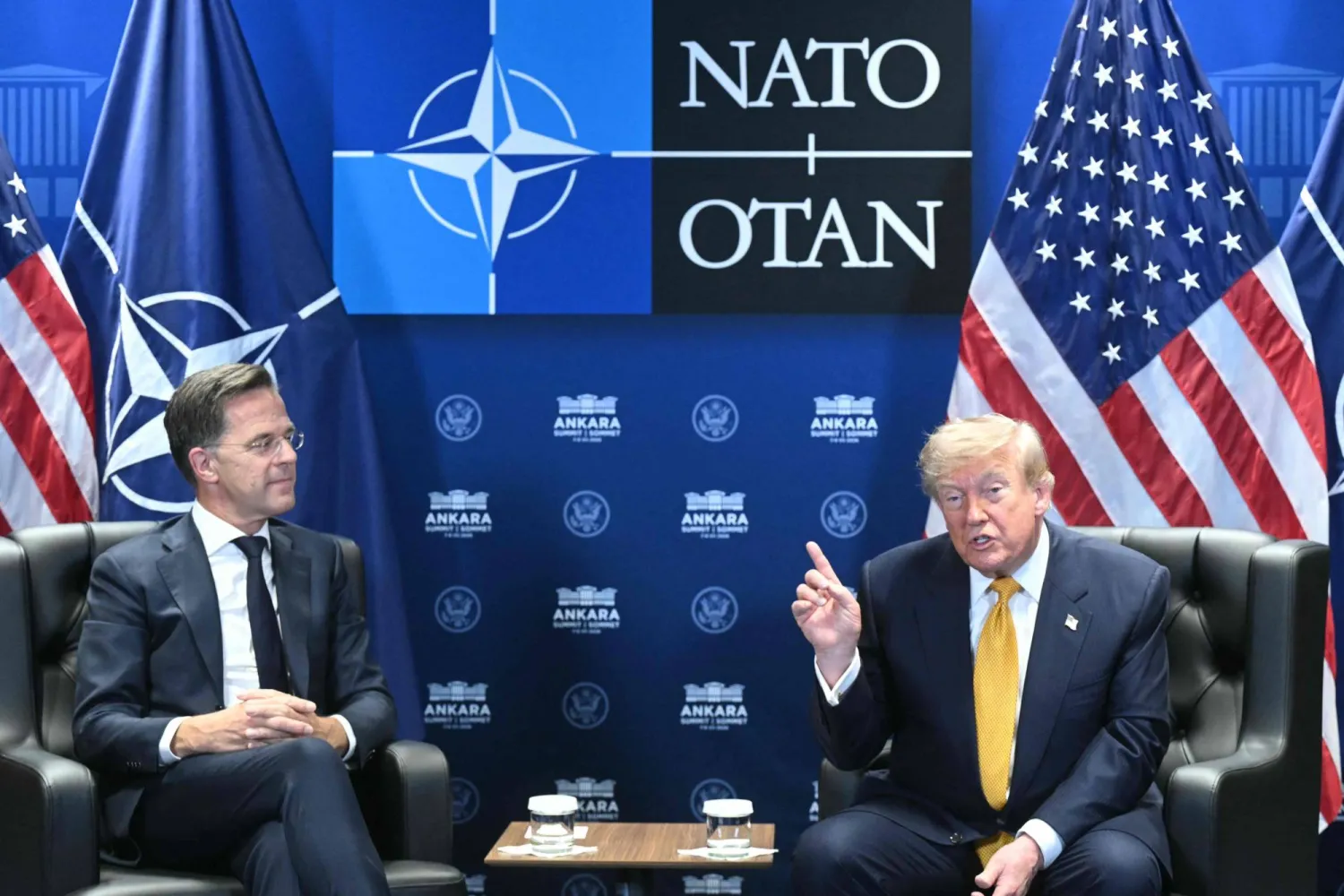

Trump Warns Iran That US Is Preparing for More Strikes After Saying Ceasefire Is Over

NATO Secretary General Mark Rutte (L) and US President Donald Trump meet on the sidelines of the NATO summit in Ankara, on July 8, 2026. (Photo by SAUL LOEB / AFP)
TT

Trump Warns Iran That US Is Preparing for More Strikes After Saying Ceasefire Is Over

NATO Secretary General Mark Rutte (L) and US President Donald Trump meet on the sidelines of the NATO summit in Ankara, on July 8, 2026. (Photo by SAUL LOEB / AFP)

President Donald Trump warned Iran on Wednesday that the US was preparing for another night of strikes, just hours after he said the ceasefire was over because of Iranian attacks. 

A day after assaults on commercial shipping escalated into an exchange of fire on Iranian and US military targets, Trump renewed his past threats to strike Iran’s civilian infrastructure, including electric plants and desalinization plants, and to seize the oil-production hub of Kharg Island. 

“We hit them very hard last night,” Trump said when asked about a possible return to hostilities. “We’ll probably hit them hard again tonight.” 

Speaking on the sidelines of a NATO summit in Ankara, Türkiye, Trump said the strikes are continued retaliation for Iranian attacks on commercial ships in the Strait of Hormuz. 

“They are behaving very badly,” he said of Iran, accusing the country of launching drones and a missile at ships. After three tankers were hit Tuesday, the US launched strikes on Iran, and Iranian forces retaliated by attacking countries sites in the Gulf. 

Strikes raise fears that war could resume 

The latest exchange of fire raised fears that the war in Iran could reignite, and Trump fueled those concerns by saying the interim agreement to pause fighting was “over,” although he added that he would allow negotiations to continue. 

Attacks have repeatedly threatened the shaky ceasefire, but Trump's comments added new uncertainty, and oil prices shot up after he spoke. A renewed conflict could engulf the wider Middle East and would likely again halt energy shipments through the strait that are crucial to the global economy. 

“For me, I think it’s over,” Trump said when asked about the status of the ceasefire. He added that US representatives can continue negotiations, but he cast doubt on the outcome.  

“They can talk, but I think they’re wasting their time,” he said. 

Trump has threatened to seize Kharg Island at previous points in the war, including last month, when he also questioned whether the US “has the stomach for it.” Some 90% of Iranian oil exports pass through the island. 

The renewed attacks on ships in the strait, despite the negotiations, could reflect a divide among Iran's leadership. Hard-liners seek lasting control over the waterway, which is a globally important conduit for fuel shipments and has become a critical lever in confronting the West. Pragmatists, meanwhile, want a permanent peace deal to lift international sanctions and provide desperately needed economic relief. 

Negotiations to reach a final deal had been due to start after the dayslong funeral for Iran’s Supreme Leader Ali Khamenei, who was killed Feb. 28 in the war’s first moments. The funeral, which ends Thursday, was supposed to be a period of lower tensions. 

The talks are meant to focus on the toughest matters, including fully reopening the strait and rolling back Tehran’s disputed nuclear program. 

“The era of bullying and extortion is over,” Iranian Parliament Speaker Mohammad Bagher Qalibaf wrote on X. “It leads nowhere. We don’t fold.” 

US military says it hit air defenses and small boats  

The US military’s Central Command said American forces launched strikes “to impose heavy costs for targeting and attacking commercial shipping crewed by innocent civilians in an international waterway.” 

It said it hit Iranian targets including air-defense systems, radars and over 60 small boats used by Iran’s paramilitary Revolutionary Guard. 

Those boats have been key to threatening ships in the strait, through which a fifth of the world’s traded oil and natural gas passed before the war. Iran’s ability to bring shipping in the waterway to a near halt during the war proved its greatest strategic advantage. 

Rising prices for energy supplies, fertilizer and food put pressure on the US to make a deal. On Wednesday, the price of Brent crude, the international standard, spiked over 5% after Trump’s comments. 

Iranian state media reported explosions in several locations, including in Bandar Mahshahr, where a Revolutionary Guard member was killed. It also reported attacks on Bushehr, home to Iran’s nuclear power plant complex. 

On Wednesday morning, both Bahrain and Kuwait sounded missile alerts. The Revolutionary Guard issued a statement acknowledging targeting US military installations in both countries. 

Kuwait said it intercepted two ballistic missiles and 13 drones launched by Iran. The Kuwaiti Electricity Ministry said a number of lines were out of service after shrapnel fell on them. 

A similar spate of Iranian attacks on shipping and US retaliatory strikes occurred late last month, which drew Iranian attacks on Bahrain and Kuwait.  

US revokes license allowing the sale of Iranian oil  

After the Iranian strikes on shipping, the US revoked a license that — for the first time in years — had allowed Iran to conduct oil sales openly in US dollars, as part of the interim deal. Iran long had been suspected of selling sanctioned crude at below-market prices to China. 

Iran and the United States agreed as part of the interim deal to allow ships to pass through the strait without paying charges for 60 days. But Tehran has insisted it must control the vessels’ routes and vowed to later charge fees for passage. That would upend decades of practice in the waterway. The ships attacked Tuesday all appeared to be using a route close to Oman’s shore, rather than one ordered by Tehran. 


Serbia Crosses ‘Red Line’ as War Criminal Funeral Sparks Outrage

A photograph taken on September 7, 2026 shows a monument reading the figure "8372...", representing the minimum recorded number of victims of the July 1995 Srebrenica massacre at the Srebrenica-Potocari Genocide Memorial and Cemetery in Potocari, near Srebrenica, Bosnia and Herzegovina. (AFP)
TT

Serbia Crosses ‘Red Line’ as War Criminal Funeral Sparks Outrage

A photograph taken on September 7, 2026 shows a monument reading the figure "8372...", representing the minimum recorded number of victims of the July 1995 Srebrenica massacre at the Srebrenica-Potocari Genocide Memorial and Cemetery in Potocari, near Srebrenica, Bosnia and Herzegovina. (AFP)

Bosnia's foreign minister on Tuesday expelled two Serbian diplomats and accused Belgrade of crossing "every red line" after several of its officials attended a funeral for war criminal Ratko Mladic.

At least six Serbian ministers were among thousands that attended Monday's funeral service which openly praised Mladic, who died last month in The Hague while serving a life sentence for war crimes committed during the Bosnian war.

The scenes in the capital of a European Union candidate country also drew condemnation from outside the Balkans, with EU chiefs Ursula von der Leyen and Antonio Costa labelling the attendance of Serbian officials "deeply regrettable".

"Serbia's path into the European Union requires an unequivocal commitment to fundamental European values and historical truth," EU foreign policy chief Kaja Kallas said on X.

Bosnia's foreign minister Elmedin Konakovic said he had ordered the defense envoy and an adviser of Serbia's intelligence service to leave the country.

Earlier he said he would recall Sarajevo's embassy staff from Serbia in an attempt to cut diplomatic ties to the "lowest possible level".

"They crossed every red line with what they did yesterday, the day before, and in the days leading up to the reception," Konakovic told a press conference in Sarajevo.

- 'Lip service' -

Despite Mladic's convictions, Serb nationalists and pro-government media still embrace him as a hero. Mourners wore shirts emblazoned with his face and held banners praising the former general during Monday's event.

Serbian President Aleksandar Vucic, who did not attend the funeral, has rejected allegations of glorifying Mladic and insisted that the service was organized by the family, not the state.

But the attendance of ministers, alongside the use of soldiers and a government plane to bring Mladic's body to Belgrade has sparked outrage.

"If this is not state involvement, what is?" Emir Suljagic, the director of the Srebrenica memorial center, said on X.

Mladic was sentenced for genocide, war crimes and crimes against humanity committed during Bosnia's 1990s war -- including his role in the killing of some 8,000 people in Srebrenica.

Suljagic said the statements from Brussels were not enough.

"We have had enough of people paying lip service to the victims while proceeding to shake hands with politicians dreaming of future genocides," he said.


UK Publishes Legislation for Tougher Sanctions on Iran

People walk along a market street in Tehran on September 7, 2026. (AFP)
TT

UK Publishes Legislation for Tougher Sanctions on Iran

People walk along a market street in Tehran on September 7, 2026. (AFP)

Britain on Tuesday published legislation to introduce tougher sanctions on Iran, expanding trade restrictions and powers to target ships ‌as part ‌of what it described ‌as ⁠wider effort to ⁠curb Tehran's nuclear program and other hostile activities.

The government said the measures would restrict Iran's access to the British financial ⁠system, expand trade ‌bans to additional ‌goods, technology and services, ‌and prohibit Iranian aircraft from ‌landing in Britain unless exemptions apply.

Stephen Doughty, a foreign office minister, said in ‌a written statement that the legislation "doubles down on our action ⁠to ⁠constrain Iran's nuclear ambitions" and would help ensure Iran was never able to acquire a nuclear weapon.

Iran's embassy in London did not immediately respond to a request for comment.


Nicaragua Maintains German Arms Exports to Israel Violate International Law

 Carlos Jose Arguello Gomez, agent for Nicaragua, listens during public hearings on the preliminary objections raised by Germany in the case brought by Nicaragua, at the International Court of Justice (ICJ) at the Peace Palace in The Hague, Netherlands, Monday, Sept. 7, 2026. (AP)
Carlos Jose Arguello Gomez, agent for Nicaragua, listens during public hearings on the preliminary objections raised by Germany in the case brought by Nicaragua, at the International Court of Justice (ICJ) at the Peace Palace in The Hague, Netherlands, Monday, Sept. 7, 2026. (AP)
TT

Nicaragua Maintains German Arms Exports to Israel Violate International Law

 Carlos Jose Arguello Gomez, agent for Nicaragua, listens during public hearings on the preliminary objections raised by Germany in the case brought by Nicaragua, at the International Court of Justice (ICJ) at the Peace Palace in The Hague, Netherlands, Monday, Sept. 7, 2026. (AP)
Carlos Jose Arguello Gomez, agent for Nicaragua, listens during public hearings on the preliminary objections raised by Germany in the case brought by Nicaragua, at the International Court of Justice (ICJ) at the Peace Palace in The Hague, Netherlands, Monday, Sept. 7, 2026. (AP)

Nicaragua told the International ‌Court of Justice on Tuesday that Germany's arms exports to Israel violates the 1948 Genocide Convention and humanitarian law and urged the court to allow its case against Berlin to continue.

Germany suspended weapons exports to Israel for a few months in 2025, but they have since resumed. It is Israel's second biggest weapons supplier after the US and has long been one of its staunchest supporters, principally because of historical guilt for the Nazi Holocaust.

A US-backed ceasefire since October 2025 halted large-scale fighting that had devastated Gaza ‌but has not ‌ended Israeli strikes.

Speaking on behalf of Nicaragua, Ambassador ‌Carlos ⁠Jose Arguello Gomez said ⁠Berlin should have been aware there was a "serious risk that acts that could amount to genocide were being committed by Israel" and should have used all reasonable measures to prevent genocide according to the Genocide Convention.

Nicaragua and Germany are both signatories of the Genocide Convention which includes an obligation on states to act ⁠to prevent possible genocide - but it is unusual ‌for the court to hear cases where ‌neither party is directly involved in the conflict at the heart ‌of it.

Israel rejects genocide allegations as politically motivated and ‌says its military campaign has targeted the Hamas group, whose attack on Israel triggered the war in October 2023.

On Monday, Germany asked the ICJ, also known as the World Court, to throw out ‌the case because they argued the court lacked jurisdiction on various procedural grounds.

Nicaragua on Tuesday dismissed ⁠Berlin's arguments ⁠that it was unclear that a dispute existed when the case was filed, pointing to communication with the foreign ministry and press statements.

Nicaragua's case builds on the one South Africa brought against Israel for alleged genocide. In an interim ruling in 2024, the ICJ said it was plausible Israel violated some rights guaranteed under the Genocide Convention during its assault on Gaza. However, that case is not expected to be heard in full until late 2029.

A ruling on Germany's objection to jurisdiction is expected later this year. Even if the case can continue, it is expected to take years before a final ruling on the merits.
