North Korea Vows Boost to Nuclear Buildup, Military Intelligence

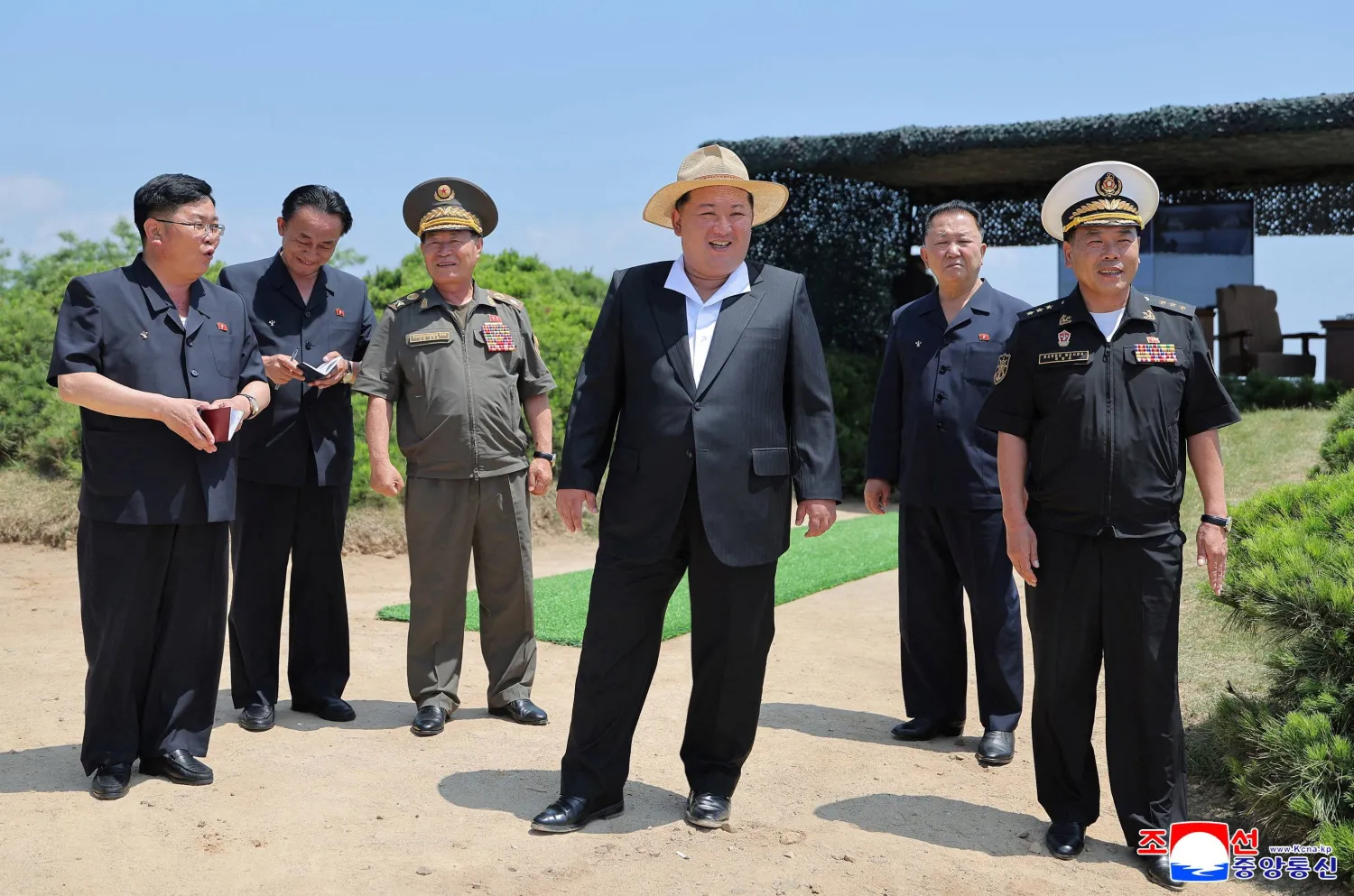
North Korean leader Kim Jong Un reacts on the day of a cruise missile launch at an unknown location in North Korea, July 3, 2026, in this picture released July 5, 2026 by North Korea's official Korean Central News Agency. KCNA via REUTERS
TT

North Korea Vows Boost to Nuclear Buildup, Military Intelligence

North Korean leader Kim Jong Un reacts on the day of a cruise missile launch at an unknown location in North Korea, July 3, 2026, in this picture released July 5, 2026 by North Korea's official Korean Central News Agency. KCNA via REUTERS

North Korea will strengthen its nuclear force "both in quality and quantity" and expand the role of its military intelligence agency focused on South Korea, state media said Friday.

Pyongyang is under widespread sanctions over its nuclear programme, and the two Koreas remain technically at war as their 1950-53 conflict ended without a peace treaty.

The announcement comes after North Korea has repeatedly spurned South Korean President Lee Jae Myung's dovish overtures, labelling Seoul its "most hostile" enemy and declaring itself an "irreversible" nuclear state.

The issues were discussed during an enlarged meeting of the ruling party's central military commission on Thursday, Pyongyang's official Korean Central News Agency said.

The meeting decided on measures such as "bolstering up the nuclear force both in quality and quantity", the report said.

It also called for broadly expanding the functions and missions of the General Reconnaissance and Intelligence Bureau, Pyongyang's military intelligence agency tasked with operations involving South Korea.

The unit "plays a pivotal role in controlling the potential enemies' threats and gathering key information", KCNA said.

The meeting discussed ways to enhance the unit's "capability of military reconnaissance and intelligence activities in a radical way", it added.

Hong Min, a senior researcher at the Korea Institute for National Unification, said North Korea's latest move reflects Pyongyang's shift to treating the two Koreas as "two hostile states", potentially replacing the previous armistice-based framework.

"Military reconnaissance takes on a different meaning under a state-to-state approach, as intelligence activities targeting another sovereign state can carry diplomatic implications," he told AFP.

Experts have said that North Korea is likely aiming to acquire military technology, including surveillance satellites, in return for the troops it sent to aid Russia's war against Ukraine.

In 2023, the country successfully put a military spy satellite into orbit and claimed it was capturing images of major US and South Korean military sites.

South Korea's Unification Ministry told AFP it was "closely monitoring" any developments related to the North Korean unit's reported expansion.


US Withdraws from European Anti-Corruption Panel

FILE PHOTO: A general view of a US State Department sign outside the US State Department building in Washington, DC, US, July 11, 2025. REUTERS/Annabelle Gordon/File Photo
TT

US Withdraws from European Anti-Corruption Panel

FILE PHOTO: A general view of a US State Department sign outside the US State Department building in Washington, DC, US, July 11, 2025. REUTERS/Annabelle Gordon/File Photo

The Trump administration has withdrawn the United States from a top European anti-corruption watchdog as it forges ahead with plans to disengage from international and multilateral organizations that it accuses of exceeding their mandates, being inefficient or not adapting to US policies.

The Council of Europe said Tuesday that the US formally notified it a day earlier that it would leave the Group of States against Corruption, or GRECO. Only two other countries have left GRECO before — Russia and Belarus.

The State Department confirmed the move, saying that US participation, which requires an annual monetary contribution, “does not provide tangible benefits to US national security.”

“The era of writing blank checks to international bureaucracies is over,” it said. “The department is instead prioritizing higher-impact tools to combat corruption, such as visa restrictions, sanctions, and targeted foreign assistance to strengthen foreign criminal investigations into corruption directly threatening US security and prosperity.”

The Strasbourg-based Council of Europe said the US had been “a valuable contributor” to GRECO "and to the exchange of experience and good practice in preventing and combating corruption.”

“GRECO remains open to resuming cooperation with the United States in the future in support of shared efforts to prevent corruption, strengthen integrity and uphold the rule of law,” it said in a statement.

The decision was announced a week after the Organization for Security and Cooperation in Europe said the US had declined to invite its members to observe November’s congressional midterm elections, a sharp break from past practice.

The US has already withdrawn from a number of European-based UN and multilateral agencies, including the World Health Organization and the UN Human Rights Council, and is weighing further such steps.

The US withdrew in January from another Council of Europe panel — the Venice Commission, which is an advisory body on constitutional law.

GRECO was created in 1999 by the Council of Europe to monitor compliance with the organization’s anti-corruption standards. Membership is not limited to European Union members, and the United States joined a year after its founding.


Iran Hangs Two Anti-government Protesters

The Iranian flag waves in front of the International Atomic Energy Agency (IAEA) headquarters, amid the coronavirus disease (COVID-19) pandemic, in Vienna, Austria May 23, 2021. (Reuters)
TT

Iran Hangs Two Anti-government Protesters

The Iranian flag waves in front of the International Atomic Energy Agency (IAEA) headquarters, amid the coronavirus disease (COVID-19) pandemic, in Vienna, Austria May 23, 2021. (Reuters)

Iran's judiciary announced that two men were hanged on Wednesday over charges relating to anti-government protests that peaked in January, having begun a month earlier over economic grievances.

The two, Ali Hemmati and Majid Nik-Andish, were found guilty of involvement "in the riots of January that resulted in the martyrdom of four security personnel" in the northeastern city of Mashhad, said the judiciary's Mizan Online website.

It added that they also "inflicted extensive damage on public property by setting fire to shops, banks, buses, etc, and even torching trees".

They "were executed by hanging early Wednesday, following the Supreme Court's confirmation of their sentences".

In late December, a protest movement initially sparked by the high cost of living rapidly evolved into widespread anti-government demonstrations that peaked on January 8 and 9.

Iranian authorities reported more than 3,000 deaths, attributing the violence to "terrorist acts" orchestrated by the United States and Israel, while foreign-based NGOs maintain that security forces fired on protesters, said AFP.

US President Donald Trump had threatened at the time to intervene militarily in Iran, before the United States and Israel launched a joint attack on Iran on February 28, triggering the Middle East war.

Since then, arrests and executions have multiplied in the country, linked both to the conflict and to the protests that took place earlier in the year.

In 2025, Iran executed at least 1,639 people, the largest number for any year since 1989, according to the NGOs Iran Human Rights and Together Against the Death Penalty.

According to Amnesty International, Iran is responsible for the second most executions of any country, after China.


Russia Opposes Iran Leaving Nuclear Non-Proliferation Treaty

Iranian Foreign Minister Abbas Araghchi meets his Russian counterpart, Sergei Lavrov, on the sidelines of the UN General Assembly in New York last week (Iranian Foreign Ministry) 
TT

Russia Opposes Iran Leaving Nuclear Non-Proliferation Treaty

Iranian Foreign Minister Abbas Araghchi meets his Russian counterpart, Sergei Lavrov, on the sidelines of the UN General Assembly in New York last week (Iranian Foreign Ministry) 

Russia does not want Iran to quit the nuclear Non-Proliferation Treaty (NPT) and counts on it remaining a party to the agreement, the Kremlin said on Tuesday.

Kremlin spokesman Dmitry Peskov responded to recent comments from Iranian officials about a possible exit from the treaty, which requires signatories not to develop or acquire nuclear weapons.

“This statement requires further clarification. We would not want Iran to withdraw from the NPT,” Peskov said.

The remarks came after Iranian First Deputy Parliament Speaker Ali Nikzad indicated that lawmakers are considering a “triple-urgency” bill on withdrawal.

Nikzad said the draft is under review, including its international implications, and could be brought to a plenary session for same-day consideration once registered.

The First Deputy Speaker also said that Tehran, which became a party to the treaty in March 1970, has no trust in the International Atomic Energy Agency (IAEA), or IAEA chief Rafael Grossi, because he conducts “merely superficial inspections and submits negative reports against Iran.”

Why Shouldn’t We Develop a Nuclear Weapon?

In an interview with state television in August, Mohsen Rezaei, secretary of Iran’s Supreme National Security Council, asked, “Why shouldn’t we develop a nuclear weapon so that nobody can attack us?”

Rezaei argued that Iran had subjected itself to extensive international monitoring, joined the Nuclear Non-Proliferation Treaty, yet its nuclear facilities were ultimately attacked.

He did not announce any change in Iran’s nuclear doctrine or a decision to build a bomb. The secretary of Iran’s NSC later said in a press interview that the issue of withdrawal was under consideration within Iran, and that US and Israeli attacks could push Tehran to withdraw from the NPT.

On Monday, more than 30 former Iranian officials had issued an open letter calling for withdrawal from the NPT, arguing that continued membership no longer served national interests and urging relevant bodies to begin legal steps promptly.

The petition includes former Intelligence Minister Heydar Moslehi, former Justice Minister Gholam-Hossein Elham, and former First Vice President Mohammad-Reza Rahimi from the Mahmoud Ahmadinejad administration.

Committed Member

On the sidelines of the UN General Assembly in New York, Iranian Foreign Minister Abbas Araghchi told NBC on Sunday that Iran is a “committed member” of the NPT treaty.

In response to a question about his country’s need for 60% enriched uranium, he said: “We enrich uranium to 60% for peaceful purposes, and this is in line with our obligations under the NPT. We are not violating the NPT.”

Araghchi also said that Iran is ready to discuss with the US a possible deal on uranium enriched to 60%, but for this it is necessary to restore trust between the parties.

He noted that Tehran has already offered Washington to agree on the available reserves of such material in 2025 and 2026.

The UN agency remains unable to verify the status, size, or whereabouts of Iran's enriched uranium stockpile or determine if enrichment activities have been suspended following the June 2025 military strikes. Iran possessed 440.9 kilograms of uranium enriched up to 60% before the start of the Israel-Iran War on June 12.

Option on Table

On September 20, the chairman of the Iranian Parliament's National Security and Foreign Policy Commission, Ebrahim Azizi, told the Mehr news agency that the option of Iran’s withdrawal from the NPT is on the table.

“Legislative proposals titled ‘Plan for Withdrawal from the NPT’—backed by the signatures of numerous MPs—have been drafted and submitted to both the Parliament's National Security and Foreign Policy Commission and the Office of the Deputy for Legislation,” he said.

However, Azizi added, withdrawing from NPT requires “taking effective measures and coordinating with all pillars of the government as well as adoption of a unified decision within the Islamic Establishment.”

On the same day, Iranian MP Hossein Ali Haji Deligani said given the country's current circumstances and recent attacks against it, remaining in the NPT offers Iran nothing but harm.

He noted that a bill proposing Iran's withdrawal from the NPT has been submitted to parliament's presiding board and is awaiting the speaker's approval to be put to an open session.

Hassan Qashqavi, a spokesman for the National Security Committee, said last Wednesday that Iran “will not stand idly by,” regardless of whether the US threats are carried out or not.

Last week, Javan newspaper, a newspaper affiliated with Iran’s Revolutionary Guard Corps (IRGC), wrote that the question of remaining party to the treaty had become tied to the relationship between “commitment” and “security,” citing attacks on Iran’s nuclear facilities and the subsequent suspension of field verification operations.