

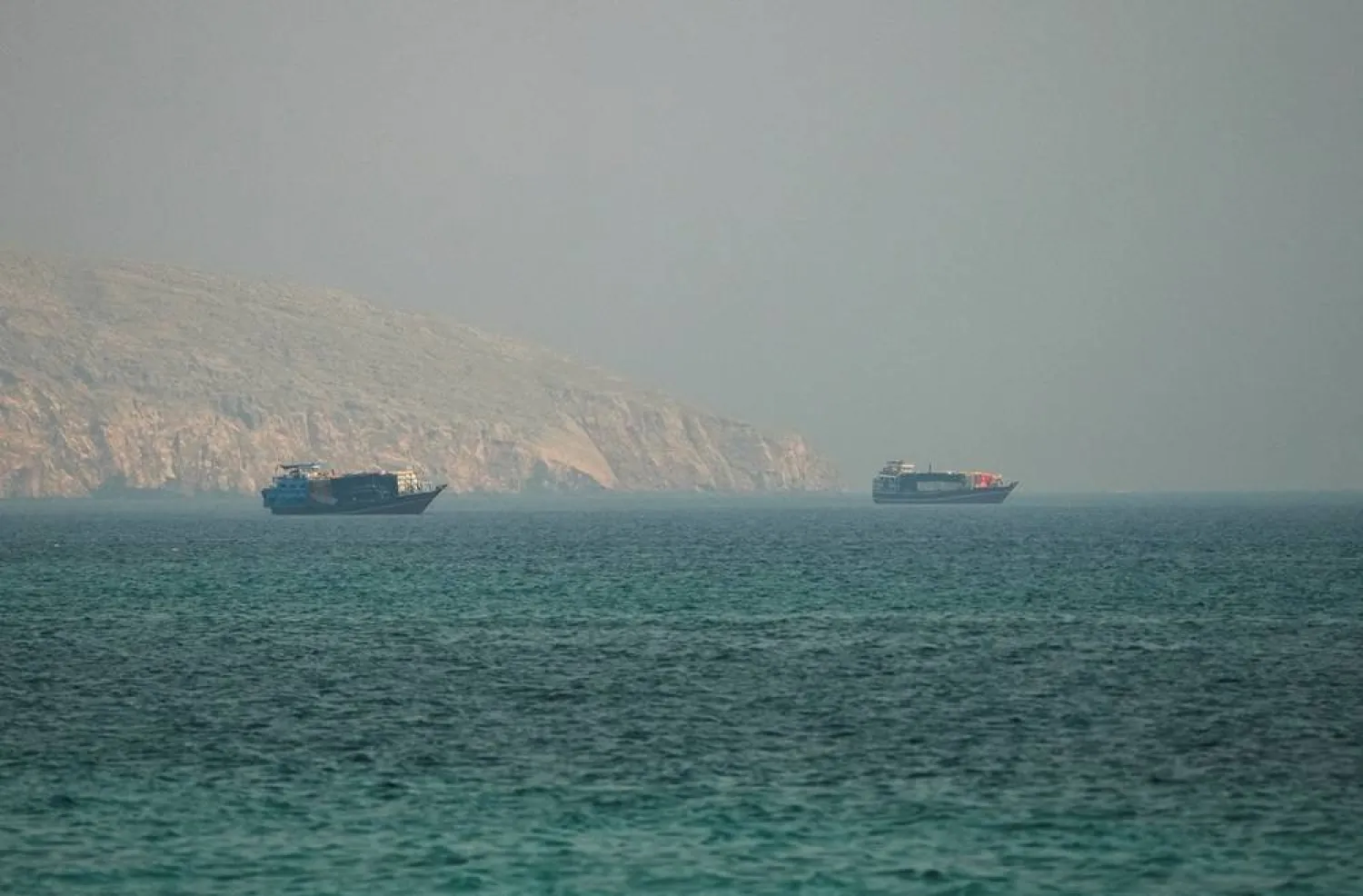

Iran Supreme Leader Vows Revenge for Father’s Killing

Vessels at the Strait of Hormuz, as seen from Musandam, Oman, July 9, 2026. (Reuters)
TT

Iran Supreme Leader Vows Revenge for Father’s Killing

Vessels at the Strait of Hormuz, as seen from Musandam, Oman, July 9, 2026. (Reuters)

Iran's supreme leader on Saturday vowed revenge for the US-Israeli killing of his father and predecessor, hours after President Donald Trump warned against any attempt to assassinate him. 

Both sides dialed up the rhetoric after exchanges of fire this week rocked an interim agreement aimed at ending their war, which broke out in late February with massive US-Israeli strikes. 

Trump has declared their ceasefire over, while mediators have been trying to salvage diplomacy, with Iranian media reporting that a delegation from Qatar travelled to Iran on Friday. 

"Vengeance is the will of our nation and must inevitably be carried out," Mojtaba Khamenei said in a written message. 

He became Iran's supreme leader after his father Ali Khamenei's killing in late February by US-Israeli strikes, but has not been in public since before the war. 

"This matter depends neither on my personal existence nor on that of other officials. Whether we are present or not, it will come to pass," he wrote in his first message since his father's funeral this week. 

He said Iran had compiled a list of individuals to be targeted. 

Hours earlier Trump had posted on his Truth Social platform that any attempt to assassinate him would lead the United States to "completely decimate" Iran. 

"1000 Missiles are Locked and Loaded and aimed at the Islamic Republic of Iran, with thousands of more to immediately follow, should the Iranian Government act on its threat, pronounced in many corners of the Globe, to assassinate, or attempt to assassinate, the sitting President of the United States of America, in this case, ME!" Trump wrote. 

"Orders have already been given, and the US Military is ready, willing, and able, for a one-year period of time, subject to extension, to completely decimate and destroy all areas of Iran." 

With both nations stepping up their threats, mediators have been working to bring diplomacy back on track. Iran's Tasnim news agency reported on Friday that a Qatari delegation was visiting Iran to "try to reinforce Qatar's role as a mediator". 

Trump has said talks with Iran will continue but has labelled them "a waste of time". 

Iran's Foreign Minister Abbas Araghchi meanwhile insisted Tehran had stuck to its end of the bargain after the two sides signed a memorandum of understanding last month. 

Tehran "has so far kept its word", he said. "Reality check: There can only be mutual compliance." 

- Hormuz deadline - 

US and Iranian delegations have held one round of direct talks in Switzerland since the signing of their memorandum of understanding, as well as indirect negotiations in Qatar, but there has been no sign of diplomatic progress since. 

A key roadblock to a final deal is the future of the Strait of Hormuz, which Iran closed to commercial shipping during the war in retaliation for US-Israeli strikes. 

The waterway is a key conduit for oil and gas exports out of Gulf countries, and its closure has heavily impacted the world economy. 

Iran insists on controlling the passage of ships and has announced plans to charge fees, saying there will be no return to the free navigation of the pre-war era, which Washington has rejected. 

Under customary international law, states are not generally permitted to charge tolls on straits used for international navigation. 

Araghchi on Saturday arrived in Oman, which sits on the other side of Hormuz, for talks on administering the strait. 

News outlets Axios and Politico reported that Washington has given Tehran until Saturday to stop firing on commercial ships transiting Hormuz and acknowledge the waterway is open. 

This week's exchange of strikes was sparked after Iran was accused of targeting three vessels it said had deviated from its approved route. 

The attacks prompted Washington to launch a heavy round of bombing in Iran, hitting around 90 targets across the country, according to the US military. 

The US strikes killed 17 people, Tehran's health ministry said Saturday, and injured 115 more. They also triggered a wave of reprisals by Iran against countries in the Gulf that host American military bases. 

- 'Hard-earned peace' - 

Despite being one of the Gulf nations targeted during the war, Qatar has spearheaded efforts to get diplomacy back on track. 

Aside from the Qatari delegation visiting Iran, Qatar's emir on Friday held a call with Prime Minister Shehbaz Sharif of Pakistan, which has also been mediating, according to Sharif's office. 

The Pakistani leader said he had also spoken with Iran's President Masoud Pezeshkian, urging him to safeguard the "hard-earned peace" in the region. 

But Iran's chief negotiator in talks with Washington, Mohammad Bagher Ghalibaf, struck a defiant tone. 

"Ending the war is a priority for the countries of the world, but everyone must know that this confrontation will never end with Iran's surrender," Iran's ISNA news agency quoted him as saying. 

Iranians, he said, were "fully prepared to defend ourselves". 


US Lawmaker Says He Was ‘Detained’ by Israeli Settlers in West Bank

US Representative Ro Khanna (D-CA) speaks with a Palestinian resident of Turmus Ayya, near Ramallah, during a visit in the Israeli-occupied West Bank, July 9, 2026. (Reuters)
TT

US Lawmaker Says He Was ‘Detained’ by Israeli Settlers in West Bank

US Representative Ro Khanna (D-CA) speaks with a Palestinian resident of Turmus Ayya, near Ramallah, during a visit in the Israeli-occupied West Bank, July 9, 2026. (Reuters)

A prominent Democratic US lawmaker from California, Ro Khanna, said Saturday he was "detained" by armed Israeli settlers along with other Americans during a visit to the Israeli-occupied West Bank and said the military was complicit in the incident.

"Israeli settlers, brandishing American made M4s, detained me & other Americans on my trip to Palestine," Khanna said in a post on X.

When the Israeli military arrived at the scene, he added, "they sided with the settlers & continued our detention. They made a huge mistake."

Footage and accounts provided to The New York Times by Khanna and his team shows a group of armed men blocking the road outside a small village in the southern West Bank and swearing at them in Hebrew and Arabic.

Khanna told the Times that when the Israeli troops arrived at the scene, the soldiers spoke to the settlers and subsequently blocked the road themselves when the settlers left.

After calls to the US embassy and Israeli police, Khanna said he was allowed to pass.

The Israeli army did not immediately respond to an AFP request for comment.

The United States is a staunch ally of Israel, but some lawmakers, especially Democrats, have vehemently criticized Israel's military offensive in Gaza, and more generally the treatment of Palestinians in the occupied territories.


Floods in Bangladesh Kill 44, Leave Over a Million Stranded

11 July 2026, Bangladesh, Dhaka: People wade through floodwaters in Dhaka, after torrential rain caused severe flooding and waterlogging across parts of the country. (dpa)
TT

Floods in Bangladesh Kill 44, Leave Over a Million Stranded

11 July 2026, Bangladesh, Dhaka: People wade through floodwaters in Dhaka, after torrential rain caused severe flooding and waterlogging across parts of the country. (dpa)

Floods and landslides triggered by days of torrential monsoon rain have killed at least 44 people in southeastern Bangladesh and left over a million stranded as authorities raced on Saturday to deliver aid to devastated communities.

The disaster management ministry said on Saturday that flooding across seven districts — Chattogram, Cox’s Bazar, Bandarban, Rangamati, Khagrachhari, Moulvibazar and Habiganj — has disrupted daily life, isolated thousands of families, and stranded 267,918 households.

Power outages, damaged roads and broken communication ‌links have slowed ‌rescue and relief efforts. Many residents have been unable ‌to ⁠cook for days ⁠as flood waters submerged their homes, while others are struggling after thick layers of mud covered kitchens and living spaces.

“There is still water inside our home and we have no way to cook. The dry food we had has run out, and we spend the nights in the dark with our children because there is no ⁠electricity,” said Nurul Islam, a resident of a flood-hit ‌area in Chattogram.

Thousands of families are ‌relying on dry food — flattened rice, puffed rice or biscuits that do ‌not require cooking — and emergency relief. Washed-out roads and damaged bridges, ‌however, have made it difficult for aid workers to reach some of the hardest-hit communities.

Army and navy personnel are ferrying food, drinking water, medicines and other essential supplies by boat to isolated communities, as authorities step up relief ‌efforts.

"The government is doing everything possible to support flood victims. Relief, safe drinking water and medical supplies are ⁠being distributed, ⁠and we urge people whose homes have been inundated to move to the nearest shelter," Disaster Management and Relief Minister Iqbal Hossain said during a visit to affected areas in Chattogram.

The heavy rain also triggered landslides in Rohingya refugee camps in Cox’s Bazar earlier this week, killing 16 refugees, including women and children. More than one million Rohingya refugees live in the camps, where makeshift shelters on steep, deforested hillsides are especially vulnerable during the monsoon season.

Bangladesh is one of the world’s most disaster-prone countries, with seasonal monsoon rains regularly causing floods, river erosion and landslides. Scientists say climate change is making extreme rainfall more frequent and intense, increasing the scale and severity of such disasters.


Iran Warns It Will Not Be Bound by Deal with US if Violations Continue

An Iranian woman walks near an anti-US mural in a street in Tehran, Iran, 09 July 2026. (EPA)
TT

Iran Warns It Will Not Be Bound by Deal with US if Violations Continue

An Iranian woman walks near an anti-US mural in a street in Tehran, Iran, 09 July 2026. (EPA)

Iran warned that it would no longer be bound by a deal with the US aimed at ending the Middle East war if Washington's violations of the agreement continued, state TV reported on Saturday.

Referring to the deal struck with the help of Pakistani mediation, Tehran's UN ambassador said in remarks in New York on Friday "that if the United States continues to violate its obligations under the Islamabad Understanding, Iran will no longer consider itself bound by its commitments under that understanding", according to a statement carried by state broadcaster IRIB.

The Iran-US deal was preceded by an April ceasefire, but the two sides have exchanged significant fire in recent days over the Strait of Hormuz, threatening talks laid out under the deal aimed at finding a permanent resolution to the war.

Following the exchanges, US President Donald Trump declared the ceasefire over, but said talks with Iran would continue.

In his remarks to reporters on Friday, Iranian UN representative Amir Saeid Iravani said Washington had "violated its obligation by launching and continuing large-scale military attacks against Iran's sovereignty and territorial integrity".

"Iran remains committed to the faithful implementation of (the) Memorandum of Understanding provided that the United States fully and faithfully complies with its own obligations," he added.
