


Ukraine, EU Aim for Weapons Production Partnership as War with Russia Grinds on

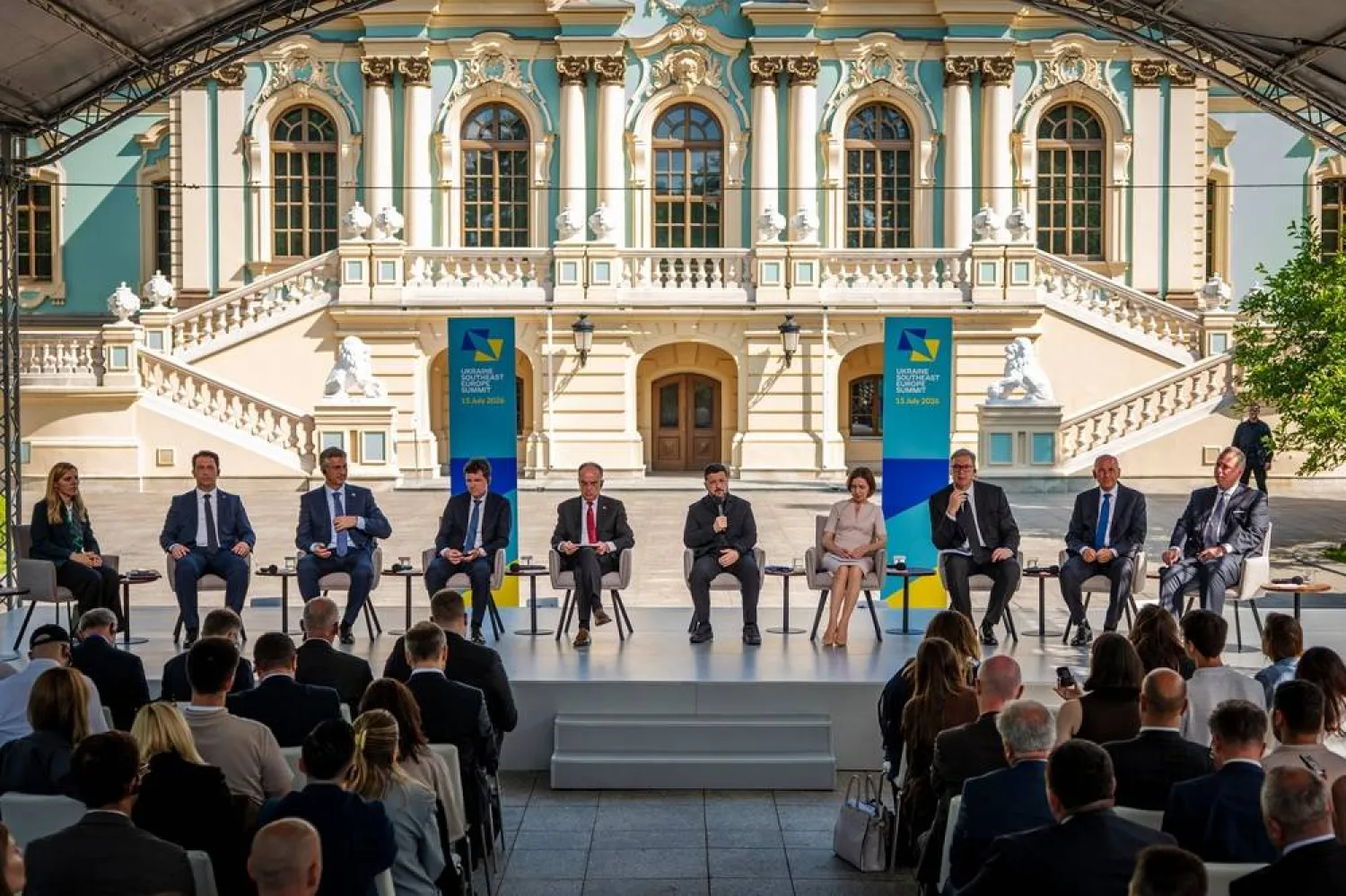
 Ukrainian President Volodymyr Zelenskyy and EU officials attend a summit in Kyiv, Ukraine, Wednesday, July 15, 2026. (AP)
Ukrainian President Volodymyr Zelenskyy and EU officials attend a summit in Kyiv, Ukraine, Wednesday, July 15, 2026. (AP)
TT

Ukraine, EU Aim for Weapons Production Partnership as War with Russia Grinds on

 Ukrainian President Volodymyr Zelenskyy and EU officials attend a summit in Kyiv, Ukraine, Wednesday, July 15, 2026. (AP)
Ukrainian President Volodymyr Zelenskyy and EU officials attend a summit in Kyiv, Ukraine, Wednesday, July 15, 2026. (AP)

The European Union’s top official signed an agreement Wednesday to move forward on joint weapons production with Ukraine, saying Kyiv's fight against Russia’s four-year-old invasion is a key part of the continent’s defense.

Over the course of the war, Ukraine has gone from pleading for foreign military support to providing its cutting-edge and battle-tested weapons know-how to Europe, the United States and Middle East countries. But it still needs help expanding its domestic production, especially sophisticated air defenses that can stop Russia’s ballistic missiles.

European Commission President Ursula von der Leyen, attending ceremonies marking Ukraine’s Statehood Day, and President Volodymyr Zelenskyy launched a new EU-Ukraine Defense Industrial Partnership.

The move reflects European worries about Russia’s broader intentions on the continent.

“Today, Ukraine’s fight is not only a fight for your own freedom. It is an existential fight for Europe’s freedoms — for its values, its self-determination,” Von der Leyen said in a speech in Kyiv's St. Michaels’ Square, where she received Ukraine's Order of Europe, a state honor.

“You are not only fighting for your own future but for the security of our entire continent,” she told a crowd.

The EU and Ukraine signed a letter of intent that aims to establish joint drone and anti-drone production by the end of this year and joint anti-ballistic missile production by 2028, as well as broader support for defense manufacturing.

Ukraine wants to bolster its security by joining the EU. It has started that process, which could take years to complete.

US President Donald Trump said at the NATO summit last week that the US will give Ukraine a license to build its own Patriot air defense systems, essential to countering ballistic missiles.

Zelenskyy said Wednesday he expects Ukraine will have the technical capability to produce the sophisticated missiles by the end of the year, even though experts say it could take years.

Ukraine celebrates its sovereignty amid Russia war

Von der Leyen and other dignitaries, including the presidents of Moldova and Romania, marked Ukraine’s Statehood Day, which celebrates the country’s sovereignty and is a public holiday.

Ukraine has been under threat since Russian forces illegally annexed the Crimean Peninsula in 2014, followed eight years later by the all-out invasion in 2022. Statehood Day, celebrating the country’s self-determination, is a public holiday in Ukraine.

The war has killed thousands of soldiers and civilians, forced millions to flee their homes, reduced some Ukrainian cities to rubble, and has fueled fears the confrontation could slide into an open conflict between Russia and NATO, whose member nations have supported Kyiv. No peace settlement is in sight.

Senior officials from southeastern European countries also were in Kyiv for a gathering focused on Black Sea and regional security. Last year’s meeting in the southern city of Odesa reaffirmed their support for Ukraine’s sovereignty and territorial integrity.

Zelenskyy has recently won important pledges of further support, including from the Group of Seven leading industrialized nations and the so-called Coalition of the Willing countries.

EU official says the ‘tide is turning’ in the war

Von der Leyen said her trip to the Ukrainian capital was her 11th in wartime. The EU has provided billions of euros to Ukraine as well as diplomatic support.

She promised EU help in preparing Ukraine's air defenses for the colder months. That's when Russia, often launching ballistic missiles, usually tries to knock out essential services like electricity and heat in what Kyiv officials call “weaponizing winter.”

"Energy remains an unwavering priority,” Zelenskyy said.

Western officials and analysts say Ukraine’s drone and missile attacks are hitting high-profile targets deep inside Russia, severely disrupting Moscow's supply lines and causing civilian fuel shortages.

“It’s a special moment,” Von der Leyen said on social media. “Ukraine has built a strong military momentum. The tide is turning.”

Washington appeared poised to increase economic pressure on Moscow as a proposed Russia sanctions bill was unveiled in the US Senate following Saturday’s death of Sen. Lindsey Graham, one of its chief backers.

The bill, which its authors had hoped to pass last summer but was held up by White House reservations, would impose steep tariffs on goods from countries that continue to buy Russian oil, gas and other exports.

Wednesday's official ceremonies came at a delicate political moment for Zelenskyy as he manages a major government reshuffle.

Meanwhile, Serbia’s Moscow-friendly president, Aleksandar Vucic, was taking part in the Southeast Europe Summit in Kyiv. Serbia, which relies almost fully on Russia for its energy supplies, has refused to join Western sanctions on Moscow, although it officially supports Ukraine’s territorial integrity.

Russian attacks kill 9 Ukrainian civilians

Ukrainian officials said Wednesday that at least nine civilians were killed and 13 others were injured in Russian aerial attacks.

Russian forces dropped six glide bombs mostly targeting infrastructure in the Sumy region of northern Ukraine, killing three people and wounding seven, said Oleh Hryhorov, head of the regional military administration.

Three people were killed and three others wounded in a Russian attack on Odesa, according to Serhii Lysak, the head of the city’s military administration.

In the Chernihiv region of northern Ukraine, Russian drones killed two people and seriously wounded an 18-year-old, while one person was killed and two injured in the southern Zaporizhzhia region, officials said.

The Russian Defense Ministry said its air defenses overnight intercepted 93 Ukrainian drones over several Russian regions, as well as over Crimea and the Sea of Azov and the Black Sea.



Iran’s Currency Hits New Record Low as US Prepares to Announce More Sanctions

People walk in the Grand Bazaar in Tehran, Iran, August 23, 2026. Majid Asgaripour/WANA (West Asia News Agency) via Reuters
TT

Iran’s Currency Hits New Record Low as US Prepares to Announce More Sanctions

People walk in the Grand Bazaar in Tehran, Iran, August 23, 2026. Majid Asgaripour/WANA (West Asia News Agency) via Reuters

Iran’s currency hit a new record low Monday as Washington prepared to announce new sanctions it said would be an “economic D-Day” and would add further pressure on an economy already battered by previous sanctions and a US naval blockade.

The rial dropped to 2.02 million to the US dollar as trading opened on informal currency markets. Iran’s official Central Bank rate stood at around 1.5 million rial to the dollar, but the informal rate is what most Iranians pay.

The currency had already been under pressure before the US and Israel attacked Iran on Feb. 28, with double-digit inflation and negative growth, but has been hitting new record lows as nearly six months of war have taken an even greater toll.

Still, US President Donald Trump has been unable to win concessions from Iran, which continues to keep a firm grip on shipping through the Strait of Hormuz, the key waterway through which a fifth of the world’s traded oil transited freely before the war began.

Iranian attacks and threats have severely hampered that traffic during the war.


Iran Dismisses US Threat of 'Economic D-day'

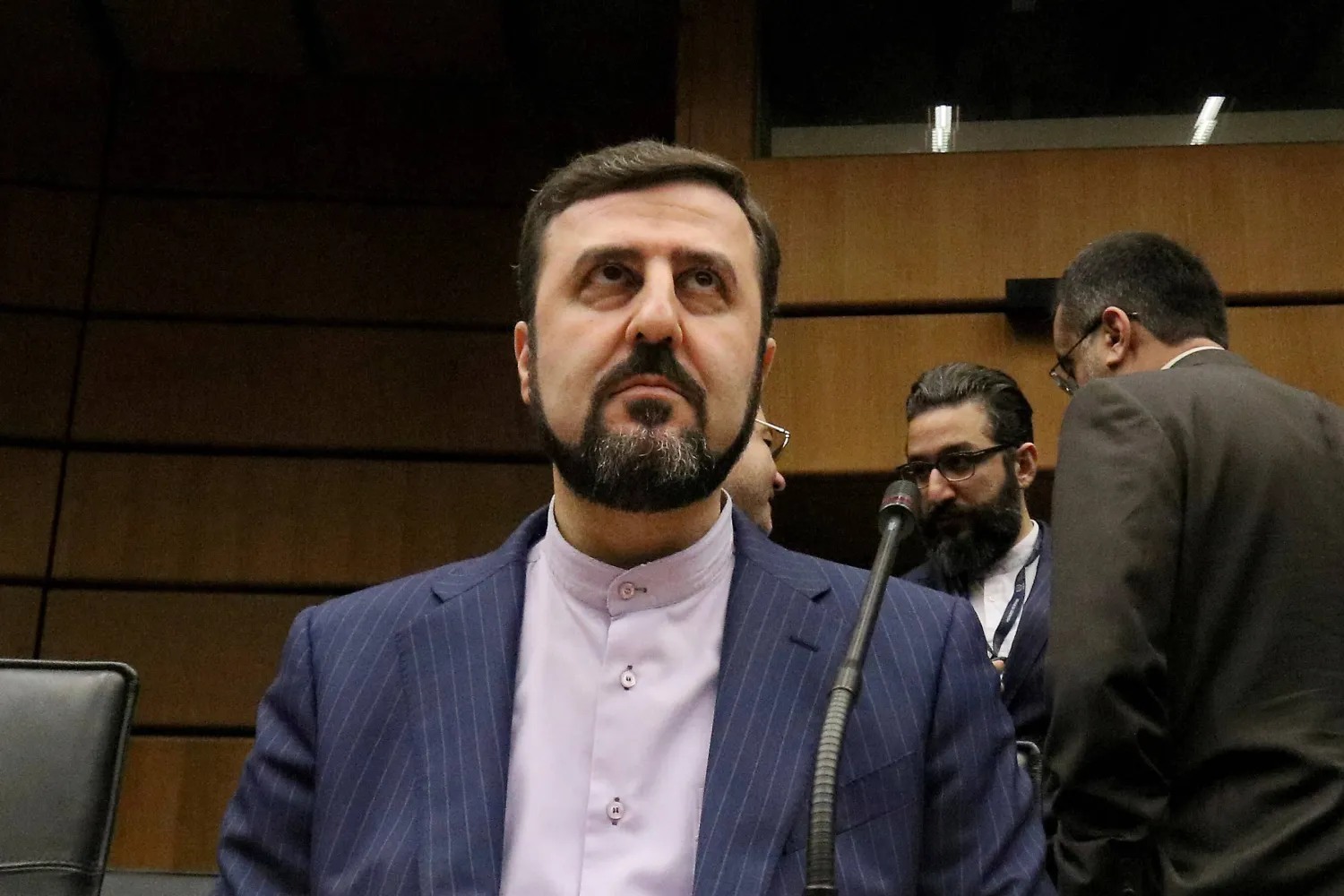
FILE - Iran's Ambassador to the International Atomic Energy Agency, IAEA, Kazem Gharibabadi, waits for the start of the IAEA board of governors meeting at the International Center in Vienna, Austria, Nov. 21, 2019. (AP Photo/Ronald Zak, file)
TT

Iran Dismisses US Threat of 'Economic D-day'

FILE - Iran's Ambassador to the International Atomic Energy Agency, IAEA, Kazem Gharibabadi, waits for the start of the IAEA board of governors meeting at the International Center in Vienna, Austria, Nov. 21, 2019. (AP Photo/Ronald Zak, file)

Iran on Monday dismissed Washington's declaration of a massive economic pressure campaign, saying it disproved US claims to have dismantled Tehran's military and nuclear capabilities.

"Your narrative doesn't add up: you say that Iran's military power has been 'dismantled', 100% of its military factories 'destroyed' and its nuclear program 'buried'," Kazem Gharibabadi, deputy foreign minister, said in a post on X.

Yet, he added, "there is a need for 'the largest financial invasion in history' and the mobilization of 'all institutions and powers' of the United States! Is this a victory or an admission of America's defeat?"

Earlier, US Treasury Secretary Scott Bessent wrote in the Financial Times that Washington was launching the "single greatest financial offensive marshalled against an adversary" -- calling it an "economic D-Day".

Bessent posted on X that the measure came after the United States "dismantled Iran's military capabilities, destroyed nearly 100 percent of its military factories, and buried its nuclear program."

He is scheduled to explain the new US sanctions on Iran on Monday.

Meanwhile, Iran's foreign ministry warned countries against joining the US economic campaign. Spokesman Esmaeil Baqaei said taking part would "definitely have its own consequences".

The United States and Israel triggered the Middle East war with a massive wave of strikes against Iran on February 28, triggering Iranian retaliation across the region.

An April 8 ceasefire ended nearly 40 days of intense bombardment, but control over the Strait of Hormuz soon emerged as a key flashpoint in the conflict.

Iran has controlled the vital energy conduit since the war began. Reopening the strait, vital for global oil and gas supplies, has become a US priority, but Tehran insists the waterway will remain closed until Washington lifts its naval blockade on Iranian ports, removes oil sanctions and unfreezes Iranian assets abroad.

Last week, US President Donald Trump announced that Washington would ramp up economic pressure on Iran "on an unprecedented scale."

Washington has urged other governments, including Beijing, to join efforts to further isolate Iran's economy.

In an article published on Monday in Iran's Ettela'at newspaper, Tehran's Foreign Minister Abbas Araghchi said relations with China "have taken on deeper, more structural, and more comprehensive dimensions."

Iran has faced US and international sanctions since the 1979 Iranian revolution.

Trump has repeatedly pursued a "maximum pressure" policy of economic sanctions against Iran, reinstating the approach after returning to office in January 2025 following a similar campaign during his first term.

Iran has repeatedly dismissed the sanctions policy as a failure, insisting that economic pressure and threats will not force it to change course.


US Cancels Joint Marine Drills with SKorea over Iran War

Apache choppers take off at Camp Humphreys in Pyeongtaek, South Korea, 04 March 2024, to join the Freedom Shield 2024 exercise on the first day of the 11-day annual South Korea-US joint drill against North Korean provocations.  EPA/YONHAP
Apache choppers take off at Camp Humphreys in Pyeongtaek, South Korea, 04 March 2024, to join the Freedom Shield 2024 exercise on the first day of the 11-day annual South Korea-US joint drill against North Korean provocations. EPA/YONHAP
TT

US Cancels Joint Marine Drills with SKorea over Iran War

Apache choppers take off at Camp Humphreys in Pyeongtaek, South Korea, 04 March 2024, to join the Freedom Shield 2024 exercise on the first day of the 11-day annual South Korea-US joint drill against North Korean provocations.  EPA/YONHAP
Apache choppers take off at Camp Humphreys in Pyeongtaek, South Korea, 04 March 2024, to join the Freedom Shield 2024 exercise on the first day of the 11-day annual South Korea-US joint drill against North Korean provocations. EPA/YONHAP

The United States cancelled a joint amphibious landing drill scheduled for next month with South Korea, Seoul's Marine Corps said on Monday, after Washington cited constraints on the availability of US forces due to the war in Iran.

The US Marine Corps formally notified its South Korean counterpart in June that force availability would be constrained for the division-level exercise, known as Ssangyong, a South Korean ⁠Marine Corps spokesperson ⁠told a press briefing.

The allies remain in close consultations on resuming the drills, Reuters quoted the spokesperson as saying. He did not specify what measures might be taken to prevent future cancellations or to make ⁠up for lost training opportunities.

US Forces Korea did not immediately respond to a request for comment.

The cancellation follows US President Donald Trump's surprise order to scale back a separate annual joint military exercise that ended last Friday, citing the cost and Seoul's refusal to take part in the Iran war.

Trump also wrote on his Truth Social ⁠platform ⁠that the Ulchi Freedom Shield drills sent "a signal that was totally inappropriate and hostile, to a Country that, as long as Donald J. Trump has been President, has been unthreatening and respectful."

Despite the reduction of the exercises, Pyongyang fired 10 short-range ballistic missiles last week and issued a statement denouncing the exercises.

North Korea has long condemned such joint exercises as rehearsals for invasion.