


US Strikes Expand into Northern Iran as it Disables Ship Trying to Run Blockade

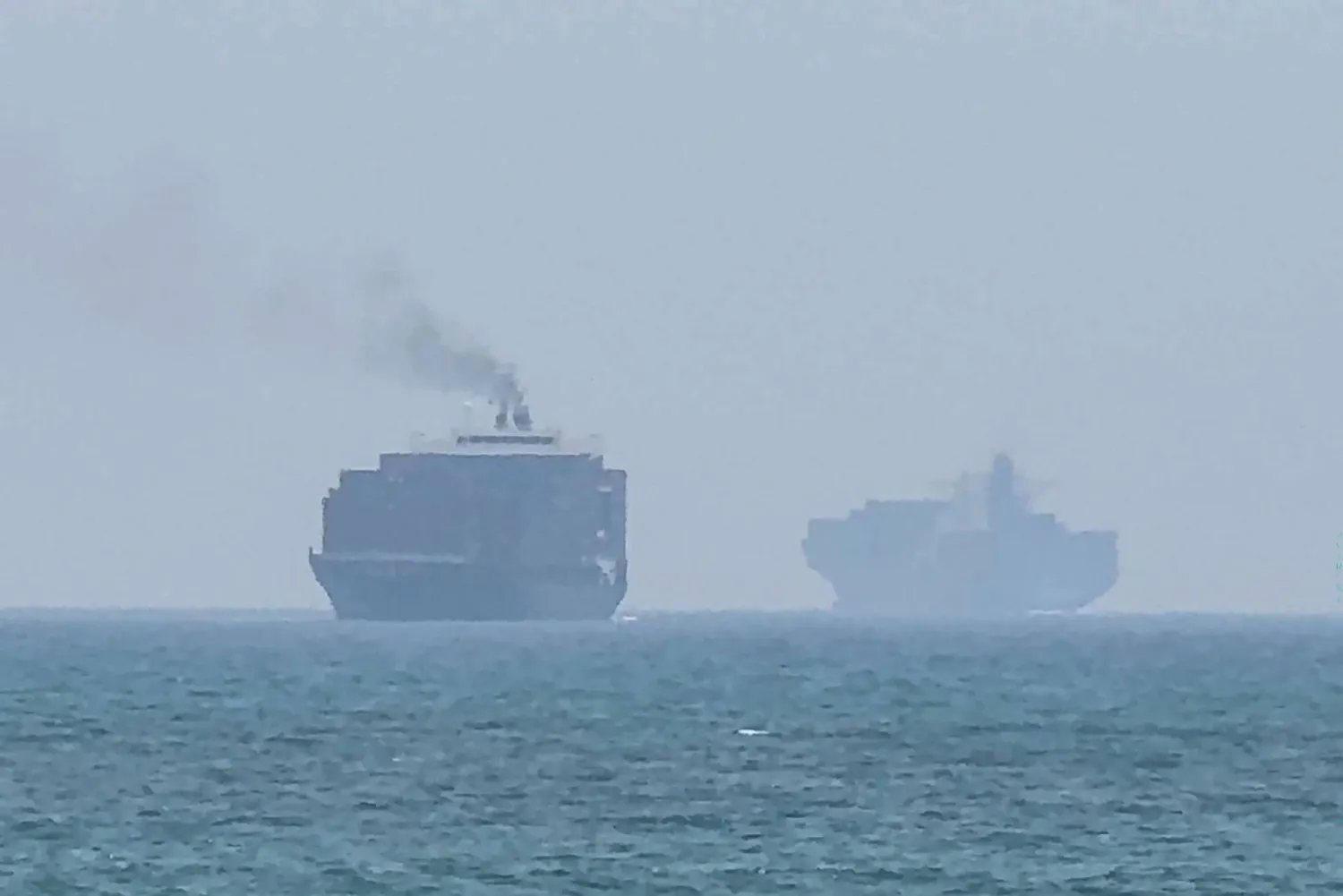
TOPSHOT - This frame grab taken from AFPTV video footage on July 12, 2026 shows cargo ships anchoring near the Strait of Hormuz off the eastern coast of the United Arab Emirates at Khor Fakkan. (Photo by AFPTV / AFP)
TT

US Strikes Expand into Northern Iran as it Disables Ship Trying to Run Blockade

TOPSHOT - This frame grab taken from AFPTV video footage on July 12, 2026 shows cargo ships anchoring near the Strait of Hormuz off the eastern coast of the United Arab Emirates at Khor Fakkan. (Photo by AFPTV / AFP)

The United States intensified its strikes targeting Iran early Thursday, hitting targets further north as American forces also fired into a ship it accused of trying to break its naval blockade on Iran.

Iran retaliated with missile and drone fire targeting Bahrain, Jordan and Kuwait before dawn.

Days of back-and-forth strikes by the US and Iran across the Middle East — and renewed threats to the Strait of Hormuz — have shredded the interim deal to end the Iran war and could tip the region back into all-out war. Already, Iranian officials say US strikes have killed more than 35 people and wounded over 300 others. Strikes also reached into areas around Iran’s capital, Tehran, for the first time of this latest round of violence, The Associated Press said.

When the US and Israel launched the war on Iran on Feb. 28, Tehran effectively closed the strait to shipping traffic, a move that sent the price of oil, fertilizer and many other goods soaring far beyond the region and gave Iran major leverage in negotiations.

US and Iran trade threats as attacks intensify

Those rising prices pose a particular challenge to US President Donald Trump and his Republican Party, which hopes to retain control of Congress in elections in November. But Washington has struggled to successfully reopen the waterway, leading to Trump reimposing the naval blockade Wednesday.

Iran’s parliament speaker and lead negotiator, Mohammad Bagher Qalibaf, said Iran was prepared for a fuller military confrontation if the US does not live up to the terms of the interim deal, and Iran’s paramilitary Revolutionary Guard threatened to halt all energy exports from the Middle East over the blockade.

“The export of oil and gas from the region will be either for everyone or for no one,” the Guard said.

Trump again insisted Iran was ready to strike a peace deal, but he did not elaborate.

“They don’t like what we’re doing, and they do want to settle. We’ll find out whether or not we settle with them, or we just finish it off,” he said Wednesday at the US Army War College in Pennsylvania.

Trump separately said on social media that Tehran made a goodwill gesture by releasing an American citizen wrongly detained in Iran since 2024. He didn’t release further details. Human rights lawyer Jared Genser released a statement identifying the detainee as his client Dena Karari, a US-Iranian citizen who runs a nonprofit and was charged with espionage.

Iran did not immediately acknowledge the release and her case was not publicly known, as is sometimes the case with detentions in Iran.

Both the US and Iran launch attacks as blockade is reimposed

The US strikes early Thursday hit around Tehran, state media reported. It also reported that American attacks targeted Semnan province, home to Iran’s ballistic missile production and space program.

On Wednesday, the US resumed striking Iran during daylight, further showing the increasing tempo of the attacks. An attack on Greater Tunb Island, a strategic point in the Strait of Hormuz, targeted Iranian defense and missile sites, Central Command said.

Meanwhile, the US military said it opened fire on the Curacao-flagged oil tanker Belma sailing toward Kharg Island, Iran’s main oil export terminal in the Arabian Gulf. After the ship “ignored multiple warnings,” a US aircraft disabled the merchant vessel by firing a missile into the ship’s smokestack.

Another American strike Wednesday targeted a barracks for Iran’s 388th Mechanized Infantry Brigade, which operates tanks and armored vehicles, in Sistan and Baluchestan province, Iranian state television reported. The report said Americans fired at least 13 missiles in the attack and the seven dead included conscripts and career soldiers. A number of troops were wounded.

Iran retaliated Thursday with missile and drone attacks on Bahrain, Jordan and Kuwait, authorities in those countries home to US forces said. There was no immediate acknowledgment of damage or casualties from the attacks.

The Strait of Hormuz remains at the heart of the fighting

The latest round of fighting is focused on the Strait of Hormuz. How to reopen the strait has bedeviled the US since Iran choked it off in the early days of the war.

During the interim deal, some ships began moving through the passage using a route near Oman overseen by the US military that is outside Tehran’s control.

In recent days, Iran attacked ships using that route — and back-and-forth attacks ensued. The US has threatened to reopen the strait by force — but experts say that would require a much bigger armada if not tens of thousands of ground troops. Imposing the blockade is another way to put pressure on Iran.

But in the meantime, oil prices are rising. The price for Brent crude oil, the international standard, traded above $85 a barrel on Thursday — more than 15% higher than the price before the war, but still well below the nearly $120 reached at the height of the conflict.



Iraq’s Top Judge in Damascus to Discuss ISIS Detainees, Judicial Cooperation

Iraq’s Supreme Judicial Council President Judge Faiq Zidan and his accompanying delegation at Tishreen Palace in Damascus, with Syrian Justice Minister Mazhar al-Wais in attendance. (SANA/Justice Ministry)
TT

Iraq’s Top Judge in Damascus to Discuss ISIS Detainees, Judicial Cooperation

Iraq’s Supreme Judicial Council President Judge Faiq Zidan and his accompanying delegation at Tishreen Palace in Damascus, with Syrian Justice Minister Mazhar al-Wais in attendance. (SANA/Justice Ministry)

Syrian Justice Minister Mazhar al-Wais met Faiq Zidan, head of Iraq’s Supreme Judicial Council, in Damascus on Thursday for talks aimed at deepening judicial cooperation, and the fate of Syrian detainees transferred to Iraq high on the agenda.

The Iraqi News Agency (INA) said Zidan arrived in the Syrian capital to discuss several issues of mutual concern, foremost among them ISIS detainees transferred to Iraqi prisons.

Al-Wais and Mohammad Taha al-Ahmad, adviser for Arab affairs at Syria’s Ministry of Foreign Affairs and Expatriates, received Zidan.

Judge Laith Jabr, head of Iraq’s Judicial Supervision Authority, said the visit opened broad prospects for judicial and legal cooperation between the two countries and included talks on detainees transferred from al-Hol camp.

Jabr told INA the Iraqi delegation, headed by Zidan, visited Damascus at the Syrian justice minister’s invitation to discuss a range of shared judicial issues.

He said the talks focused on Syrian detainees handed over to Iraq from al-Hol and their legal status, adding that Iraqi authorities had carried out judicial investigations and provided the detainees with all legal guarantees required under Iraqi law.

The two sides agreed to form joint judicial committees that would meet regularly to resolve issues linked to the detainees’ trials, Jabr said.

The meetings also covered stronger judicial coordination, expanded exchanges of information and expertise, and preparations for future memorandums of understanding between the two countries.

Sources following the visit said Zidan was expected to meet Syrian President Ahmed al-Sharaa and hold separate talks with the justice and foreign ministers and other Syrian officials.

The discussions were expected to cover ISIS members detained in Iraq, transitional justice, anti-corruption efforts and greater transparency.

Informed sources also said Iraq and Syria were close to signing a joint agreement to regulate the transfer and prosecution of Syrian detainees held by Iraqi authorities.

Al-Wais said Syria hoped the progress already made in economic and security relations would help drive closer judicial and legal coordination and strengthen ties between the two countries’ justice institutions.

Syria’s state news agency SANA quoted him as saying Damascus was committed to balanced and positive relations with its neighbors based on mutual respect and shared interests.

He said Syria’s historical ties and mutual interests with Iraq gave both countries stronger reason to expand bilateral cooperation.

Al-Wais said Syria was entering a new phase focused on building a state based on the rule of law and institutions, while strengthening national unity and justice.

He said the Justice Ministry was pursuing a broad judicial reform program to bolster judicial independence and integrity, improve judges’ efficiency, speed up the delivery of justice and simplify procedures for citizens.

Zidan, in turn, pointed to the historic and fraternal ties between Iraq and Syria and said Iraq’s judiciary was seeking new avenues of cooperation to improve judicial work and reinforce the rule of law in both countries.

He called for stronger coordination between justice institutions and greater exchanges of expertise, saying regional stability and justice required close judicial cooperation and partnership.

Iraqi and Syrian sources also said preparations were under way for a possible visit by Iraqi Prime Minister Ali al-Zaidi to Damascus for talks with Syrian President Ahmed al-Sharaa.

Asharq Al-Awsat reported on Sunday, citing sources in Baghdad, that Kurdistan Region President Nechirvan Barzani’s recent visit to Damascus had helped ease mutual concerns in Baghdad and Damascus over bilateral relations and several unresolved political and security issues.

The sources said Barzani carried messages between al-Zaidi and al-Sharaa and helped pave the way for a possible visit by the Iraqi prime minister to Damascus.


Iran Rejects Trump Claims of US Control over Hormuz as 'Lies'

An Iranian woman walks next to an anti-US billboard at the Enghelab square in central Tehran, Iran, 13 August 2026. Tensions between Iran and the US remain high as opposing claims persist over shipping control in the Strait of Hormuz.  EPA/ABEDIN TAHERKENAREH
An Iranian woman walks next to an anti-US billboard at the Enghelab square in central Tehran, Iran, 13 August 2026. Tensions between Iran and the US remain high as opposing claims persist over shipping control in the Strait of Hormuz. EPA/ABEDIN TAHERKENAREH
TT

Iran Rejects Trump Claims of US Control over Hormuz as 'Lies'

An Iranian woman walks next to an anti-US billboard at the Enghelab square in central Tehran, Iran, 13 August 2026. Tensions between Iran and the US remain high as opposing claims persist over shipping control in the Strait of Hormuz.  EPA/ABEDIN TAHERKENAREH
An Iranian woman walks next to an anti-US billboard at the Enghelab square in central Tehran, Iran, 13 August 2026. Tensions between Iran and the US remain high as opposing claims persist over shipping control in the Strait of Hormuz. EPA/ABEDIN TAHERKENAREH

Iran's military on Thursday rejected as "lies" remarks by US President Donald Trump claiming control of the Strait of Hormuz, saying the strategic waterway was fully under Iranian control.

"The false claims of the United States that ships are passing through the Strait of Hormuz normally ... are nothing more than lies and fabrications," said Ebrahim Zolfaghari, the spokesperson for Iran's central military command, Khatam-al Anbiya.

"The Strait of Hormuz is, as in the past, under the complete management and control of the Islamic Republic of Iran, and no commercial ship or tanker without the permission and supervision of the powerful Iranian armed forces has had and will have the possibility of safe passage through this strait," he said in a video carried by state television.

Iran has kept control of Hormuz, a vital energy conduit, since the outbreak of the war in the Middle East on February 28, requiring vessels to obtain permission and pay transit fees before using the waterway.

In a Wednesday Truth Social post, Trump claimed that the US "has total control over the Strait of Hormuz. I THINK WE WILL KEEP IT!"

"Our Naval Blockade is being called, by everyone, 'A WALL OF STEEL,' and there is nothing Iran can do about it," he added.

On Thursday, the head of Iran's Basij forces under the Revolutionary Guards also said that the strait was under Iranian control.

"Today, you see that the Strait of Hormuz is under the management and control of the Islamic republic, and our country continues on its path in complete security," said Hossein Taeb according to state television.

Iran's top diplomat Abbas Araghchi on Thursday said the US makes miscalculations in regard to the waterway.

"The US has long miscalculated due to intelligence failures. Case in point: The war on Iran. Now, an even bigger miscalculation on the Strait of Hormuz," he said on X.

Iranian parliamentarian and member of the national security commission Behnam Saeedi said the strait is closed to US and Israeli ships.

"Ships belonging to the Zionist regime will not have the right to pass through the Strait of Hormuz under any circumstances, whether in war or peacetime," he told state TV, adding that "US military ships will also be barred from passing through the Strait".

Iran and Oman have been in talks to establish a new route through the strait, but negotiations have not yet been finalized.

Tehran, however, says even if the talks produce a new route, that would not on its own open the waterway unless the US meets Iran's demands.


White House Press Secretary Karoline Leavitt Will Leave at the Month’s End

FILE - White House press secretary Karoline Leavitt watches as President Donald Trump speak to reporters while in flight on Air Force One to Joint Base Andrews, Md., Jan. 11, 2026. (AP Photo/Julia Demaree Nikhinson, File)
TT

White House Press Secretary Karoline Leavitt Will Leave at the Month’s End

FILE - White House press secretary Karoline Leavitt watches as President Donald Trump speak to reporters while in flight on Air Force One to Joint Base Andrews, Md., Jan. 11, 2026. (AP Photo/Julia Demaree Nikhinson, File)

White House press secretary Karoline Leavitt will leave the administration at the end of the month to spend more time with her family, President Donald Trump announced Wednesday.

Leavitt, 28, is the youngest person to hold the role. She was a press aide during Trump's first term and has been one of the most visible advocates of his “Make America Great Again” movement. Trump did not outline any plans for who might replace her, The Associated Press said.

Meanwhile, Trump said he slipped away from Air Force One after a trip last month in Türkiye because the Secret Service and military wanted him on a “different plane” due to a threat he insisted did not scare him.

He downplayed the extraordinary nature of the subterfuge involved in his flight, which saw him stow away in an airport catering container to sneak onto another plane while Air Force One was sent into the sky, essentially as a decoy.