

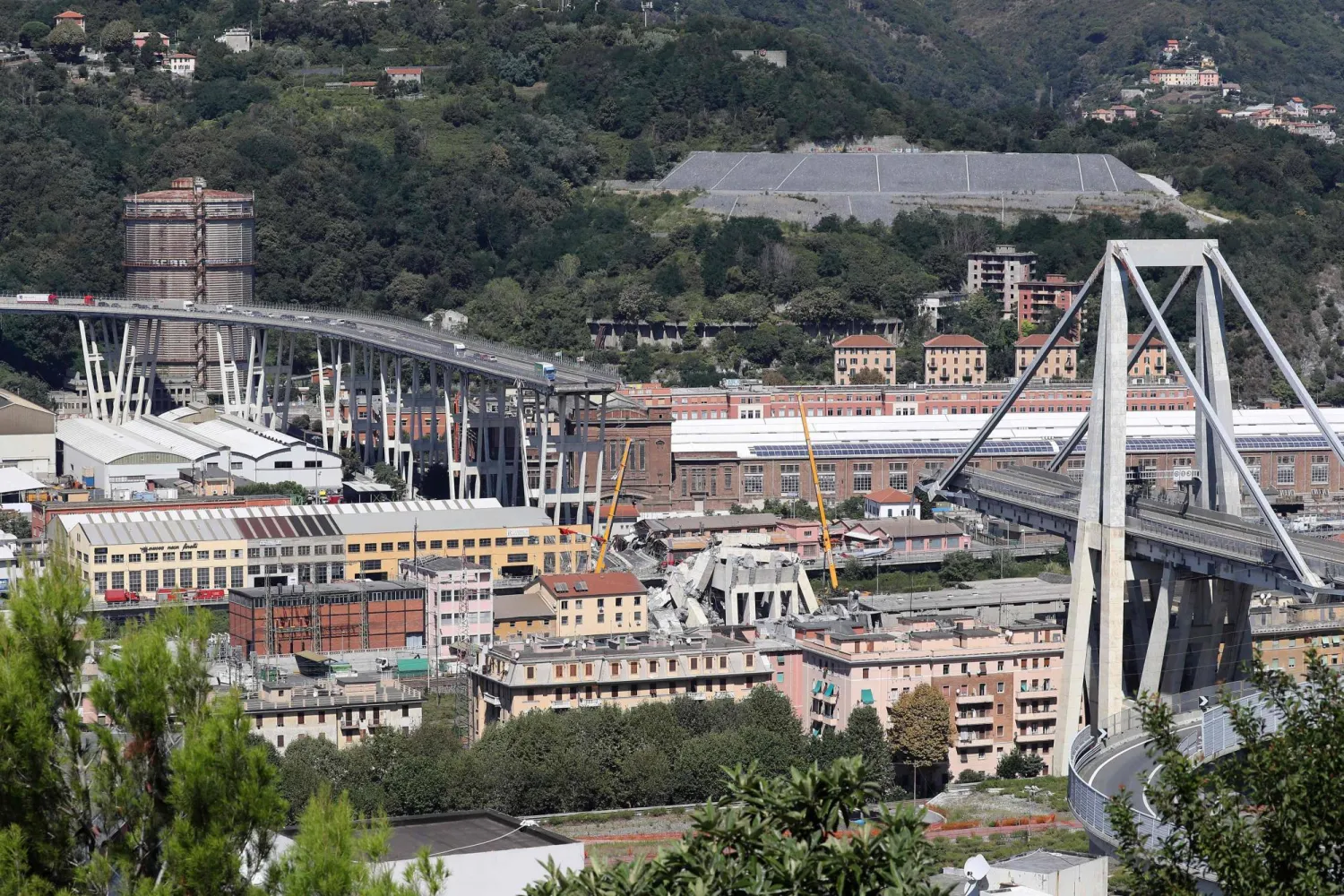

Italy Court Finds 32 People Guilty Over Deadly Genoa Bridge Collapse

(FILES) This general view taken on August 15, 2018, shows abandoned vehicles on the Morandi motorway bridge the day after a section collapsed in the north-western Italian city of Genoa. (Photo by Valery HACHE / AFP)
TT

Italy Court Finds 32 People Guilty Over Deadly Genoa Bridge Collapse

(FILES) This general view taken on August 15, 2018, shows abandoned vehicles on the Morandi motorway bridge the day after a section collapsed in the north-western Italian city of Genoa. (Photo by Valery HACHE / AFP)

An Italian court sentenced 32 defendants on Thursday, including the former head of motorway operator Autostrade, for their role in a deadly bridge disaster eight years ago that killed 43 people.

Autostrade's former chief executive, Giovanni Castellucci, was found guilty of vehicular homicide and negligence related to the collapse of the bridge in Genoa -- one of the country's worst infrastructure disasters.

The crowded courtroom was packed with relatives of those who plunged to their deaths when the Morandi Bridge -- part of a key highway connecting France and Italy -- gave way in torrential rain on August 14, 2018.

Castellucci, who was accused of postponing key maintenance work, was sentenced to 12 years behind bars.

The former executive is already serving time for his responsibility in a 2013 accident in which a bus crashed through the barriers of a viaduct, killing 40 people.

"Today we can say there are those guilty of the murder of our relatives," said Michele Matti Altadonna, whose brother was one of the victims.

"We are here for our loved ones, in their memory," he told AFP.

Legal teams for some of the defendants, including Castellucci, said they would appeal the ruling.

But Altadonna said "for the four children my brother left behind... we will not give up, we will not give up until the Supreme Court".

Under Italian law, judges will have to publish the reasoning for their decision within six months.

The findings of the investigation were damning: "Between the inauguration in 1967 and the collapse, i.e. 51 years later, not even minimal maintenance work was carried out to reinforce the stays of pillar number nine".

Work had been carried out on two other pillars, numbers 10 and 11, and was planned for number nine, which came crashing down in morning traffic.

Raffaele Caruso, a lawyer for the victims, said the Morandi bridge had not collapsed "by chance."

"This collapse, as we have always said and as the prosecutor's office, above all, has always said, could have been avoided."

Most of the defendants were executives and technicians from Autostrade per l'Italia (ASPI), which runs almost half of the country's motorway network, and engineering company Spea, in charge of maintenance.

Besides Castellucci, they included the former head of Spea, Antonino Galata, as well as officials from the infrastructure ministry.

ASPI's executive in charge of maintenance, Michele Mitelli, was sentenced to 11 years, while the group's number two, Paolo Berti, received five years and six months.

Italy's deputy transport secretary, Edoardo Rixi, wrote that Thursday's ruling marked an "important step on the path of truth and justice".

"The collapse was not a stroke of fate, but the result of serious errors and omissions by those who had a duty to ensure safety. It is right that responsibility has finally been established," wrote Rixi on social media.

The defence's main argument was that the bridge had a hidden construction defect, namely corrosion of its cables, and it was this that caused its collapse, not a lack of maintenance.

Lawyers for Castellucci wrote in a note following the verdict that the court had erroneously relied on a theory that "equates liability with hierarchical position", noting that the ex-CEO had taken "every initiative deemed necessary for the safety of the infrastructure".

"Today it is considered appropriate to assign personal criminal liability to the CEO of a company who did nothing other than rely on the best engineering specialists in the field," they wrote.

Autostrade and Spea reached an out-of-court settlement with the public prosecutor's office, which provides for a payment of 29 million euros ($30 million) to the state.

At the time of the tragedy, Autostrade belonged to the Atlantia group, controlled by the wealthy Benetton family, but faced with popular indignation the family subsequently gave up its stake to the state.



Mystery Shrouds Leadership of Iran’s Intelligence Agencies

Questions mount over the identity of Iran’s deputy intelligence minister months after Esmail Khatib’s death (Iranian Presidency)
TT

Mystery Shrouds Leadership of Iran’s Intelligence Agencies

Questions mount over the identity of Iran’s deputy intelligence minister months after Esmail Khatib’s death (Iranian Presidency)

Six months into Supreme Leader Mojtaba Khamenei’s rule, Iran has reshuffled its military and security leadership after a war that killed two cabinet ministers and a string of senior Revolutionary Guards commanders.

Yet two of the country’s most sensitive posts remain shrouded in secrecy: who is running the Intelligence Ministry, and who now commands the Guards’ powerful intelligence arm.

Defense Minister Aziz Nasirzadeh was killed on Feb. 28 in the opening strikes targeting the leadership, including the office of former Supreme Leader Ali Khamenei in Tehran’s heavily fortified Pasteur district.

On March 2, Iranian President Masoud Pezeshkian appointed Majid Ben Reza as deputy defense minister. He is expected to be formally nominated to parliament to take over the ministry.

Pezeshkian announced the death of Intelligence Minister Esmail Khatib on March 18. Since then, Iranian authorities have not disclosed who is serving as acting minister.

The government-affiliated news outlet reported last week that the deputy intelligence minister had sent separate congratulatory messages to Supreme National Security Council Secretary Mohsen Rezaei and newly appointed military commanders, pledging the ministry’s cooperation with the new leadership on priorities set by the supreme leader for the armed forces.

Deadline to name two ministers

Pezeshkian is under pressure from close reformist allies over the delay in naming a new intelligence minister, one of five cabinet posts that require the supreme leader’s approval.

In practice, the intelligence minister is usually chosen with the supreme leader’s direct involvement.

The minister also sits on the 12-member Supreme National Security Council, giving the officeholder a direct role in Iran’s main security decision-making body.

Abbas Goudarzi, a lawmaker and spokesman for parliament’s presiding board, said this week that Mojtaba Khamenei had given the government a deadline to submit nominees for the intelligence and defense ministries.

“Under the authorization obtained from the supreme leader, the government has one and a half months from Aug. 20 to submit its proposed ministers for intelligence and defense to the Iranian parliament,” Goudarzi said.

But naming a new intelligence minister may first require a change in the law.

Current legislation requires the minister to have attained the religious rank of ijtihad, a senior scholarly qualification that sharply narrows the pool of candidates to clerics who meet the requirement.

“The idea was raised that ijtihad should not be a requirement for the intelligence minister,” Goudarzi said. “Since the current law conflicts with this proposal, the law must be amended. It was therefore decided that the government would submit a bill to parliament on the matter.”

Legacy of security breaches

Khatib served as intelligence minister under former President Ebrahim Raisi and kept the job when Pezeshkian formed his government two years ago, despite mounting criticism of the security services over a series of breaches attributed to Israel’s Mossad.

Those criticisms intensified after Israeli intelligence reached military commanders and officials involved in the nuclear program who were killed during the war.

The next minister will inherit an agency battered by a string of security breaches and assassinations targeting military, nuclear and security officials, as well as the legacy left by successive ministers who ran the institution.

Fresh questions over the security surrounding senior intelligence officials were raised by Khatib’s son.

In an interview published by the state-run IRNA news agency on Aug. 10, he said his father had faced four assassination attempts before he was killed, including two during the June 2025 war.

He said Khatib was later killed at the home of his second wife despite tight security surrounding his movements.

Cultural Heritage Minister Reza Salehi Amiri is among the names being considered for the intelligence portfolio.

Salehi Amiri, previously known as Reza Fallah, worked at the Intelligence Ministry during the 1980s and 1990s and was one of the agency’s leading interrogators before gradually moving into political and government posts.

He later held positions at strategic research centers affiliated with the Iranian presidency and the Expediency Council.

Under President Hassan Rouhani, he served for a year as deputy minister of sports and youth before becoming a presidential adviser and head of the National Library and Archives.

He also served for a year as culture minister at the start of Rouhani’s second term before returning to government after Pezeshkian became president.

Vacuum in Revolutionary Guards intelligence

The picture is even murkier inside the Revolutionary Guards’ intelligence organization and its protection unit after several senior commanders were killed in the war.

On April 6, the Revolutionary Guards confirmed that Brigadier General Majid Khademi, head of its intelligence organization, had been killed in an Israeli-US attack, hours after Israeli Defense Minister Israel Katz first announced his death.

Khademi had previously headed the Guards’ protection organization before becoming intelligence chief on June 19, 2025, succeeding Mohammad Kazemi.

Before that, he oversaw the unit responsible for protecting political figures and sensitive sites, including key state institutions and nuclear facilities.

Kazemi was killed in Israeli strikes on June 15, 2025, three days after dozens of Revolutionary Guards commanders were killed in the opening strikes of the 12-day war.

That attack also killed Mohammad Reza Nasir Bagban, known by the alias Mohsen Bagheri, head of the Quds Force intelligence unit, and Brigadier General Hassan Mohaghegh, one of the Guards’ most prominent intelligence commanders and a figure with close ties to current Supreme Leader Mojtaba Khamenei.

Tehran has yet to disclose who now leads the Revolutionary Guards’ intelligence organization, its deputy command, or the Quds Force intelligence unit.

Hossein Taeb, however, who spent 13 years at the helm of Guards intelligence, has returned to a senior security role as commander of the Basij, tasked with expanding the “popular intelligence network.”


Colombia Estimates Quake Damage at $9.6 Billion

A view of the damage to the Carrasquilla Industrial Educational Institution, as seen during a visit by singer Shakira, in Quibdo, Colombia, 17 August 2026. (EPA)
TT

Colombia Estimates Quake Damage at $9.6 Billion

A view of the damage to the Carrasquilla Industrial Educational Institution, as seen during a visit by singer Shakira, in Quibdo, Colombia, 17 August 2026. (EPA)

The powerful earthquake that killed hundreds of people in western Colombia caused $9.57 billion in economic losses, President Abelardo de la Espriella said on Tuesday, issuing a preliminary estimate.

The 7.4-magnitude tremor, which struck on August 10, was the most powerful in Colombia in nearly half a century.

The death toll stands at 289, with a further 4,187 injured and 143 missing.

Nearly 27,000 homes were destroyed, leaving many people sleeping in the streets or in public parks.

Dozens of hospitals and schools also collapsed or were damaged.

"Imagine the scale of the disaster," said De la Espriella, a political novice who took office just three days before the disaster.

The crisis has been a baptism of fire for De la Espriella, a right-wing lawyer and business magnate who was elected on a promise to flush out the drug-trafficking rebels that control part of Colombia.

He said Tuesday he had tasked his housing minister with launching a "miracle" reconstruction plan, with the backing of the private sector.

But the minister, Jaime Andres Beltran, has been under fire for taking a Caribbean holiday in the immediate aftermath of the quake.


Trump Says No Talks Planned with Iran, Tehran Says Strait of Hormuz Still Shut

Vessels near the Strait of Hormuz, as seen from Musandam, Oman, August 17, 2026. (Reuters)
TT

Trump Says No Talks Planned with Iran, Tehran Says Strait of Hormuz Still Shut

Vessels near the Strait of Hormuz, as seen from Musandam, Oman, August 17, 2026. (Reuters)

US President Donald Trump said on Tuesday no talks were taking place with Iran and none were scheduled, and he insisted that the Strait of Hormuz was open, contradicting an earlier Iranian assertion that the critical waterway remained shut to shipping. 

The receding prospects of a deal to end the nearly six-month conflict drove up oil prices again on Tuesday, while stock markets sagged and borrowing costs for major economies including the US hit multi-decade highs, amid concerns about the long-term inflationary and fiscal impact of the crisis. 

A temporary ceasefire agreement expired on Monday and a senior Iranian official told Reuters that his country was moving to a "fully offensive" military posture due to the diplomatic stalemate, though there were no reports of fresh strikes by either side on Tuesday. 

"There are no talks or conversations going on, or scheduled, with Iran," Trump said ‌in a post on Truth Social on Tuesday. 

"The Naval Blockade remains in full force and ‌effect. ⁠The Hormuz Strait is ⁠open and operating. All water mines have been removed or detonated," he added. 

On Monday, Jared Kushner, Trump's son-in-law and special envoy, had sounded an optimistic note, saying talks with Iran were still under way and were "probably more robust" than they had ever been. 

SHIPPING DISRUPTED 

Despite Trump's typically ebullient remarks about the situation in the Gulf, preliminary shipping data on Tuesday showed ship crossings via the Strait of Hormuz were still in single digits on Monday. 

The United Kingdom Maritime Trade Operations said it received a report on Tuesday that a vessel was struck by an unknown projectile while transiting outbound in the Strait of Hormuz, causing engine room damage and a crew casualty. 

The ⁠remaining crew were being assisted by the Omani Coast Guard, according to the report. 

Top Iranian ‌negotiator Mohammad Baqer Qalibaf said in comments published by state media that the ‌strait would remain shut until the US met the conditions of an interim deal signed with Iran in June. 

These conditions include the US ‌lifting its blockade of Iranian ports, lifting oil sanctions, releasing Tehran's frozen assets, and ending threats and military operations on ‌all fronts, Qalibaf told parliament. 

A memorandum of understanding signed on June 17 had set a 60-day time frame for a broader deal on Iran's nuclear program and US sanctions. That period elapsed on Monday and Trump said he had no plans to extend it. 

The agreement, which declared the "immediate and permanent termination of military operations on all fronts," had quickly unraveled over a dispute about control of the Strait of Hormuz, the ‌narrow waterway through which a fifth of global oil and liquefied natural gas flowed before the war. 

IRAN SAYS IT STILL OPEN TO TALKS 

Both Trump and Tehran have frequently ⁠switched between threats and more emollient ⁠rhetoric as they seek a way out of the crisis, which erupted when the US and Israel launched strikes against Iran on February 28. 

Iran remains open to dialogue with the US but does not confuse negotiations with surrender, Mohammad Mokhber, an adviser to Iran's supreme leader, said on Tuesday, according to the semi-official Fars news agency. 

Mokhber said military pressure and sanctions would not break Iran's resolve and that the country would defend its security, dignity and allies while not seeking war. 

Even as Iran projects resilience in the war, its leaders are worried that a threat of more economic punishment could increase hardships, reignite unrest and further erode the regime’s legitimacy, according to three Iranian officials. 

Thousands of people have been killed in the conflict, mainly in Iran and Lebanon. Iran has bombed countries including Oman, Jordan, Kuwait, Israel, the United Arab Emirates and Saudi Arabia. 

Benchmark Brent crude oil futures have surged during the conflict, hitting a peak of $126 a barrel, roughly 75% above pre-war levels. Brent crude futures settled up 20 cents on Tuesday at just over $91 a barrel. 

For Americans who will vote in November congressional elections, gasoline prices have risen above $4 per gallon, up from less than $3 before the war, according to the automotive group AAA.