

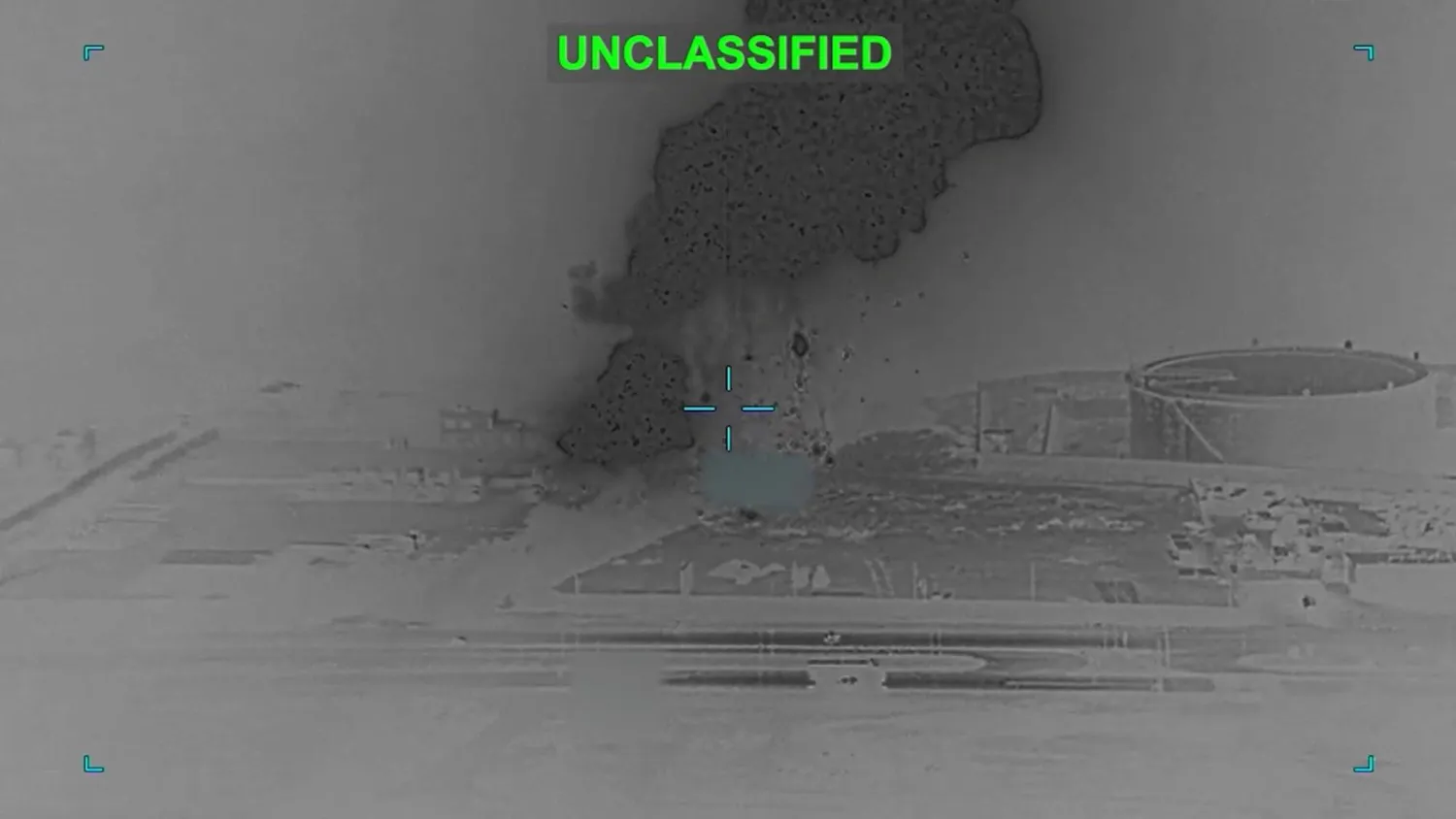

US, Iran Trade Attacks in Return to Full-Blown War

Smoke rises following a strike at an unknown location during what the US military says is its latest wave of strikes on Iran. US Central Command/Handout via REUTERS
TT

US, Iran Trade Attacks in Return to Full-Blown War

Smoke rises following a strike at an unknown location during what the US military says is its latest wave of strikes on Iran. US Central Command/Handout via REUTERS

The United States and Iran traded drone and missile strikes on Friday, as Tehran announced it had targeted American assets across the region, in the biggest escalation since the two foes returned to outright war. 

A month after the two sides agreed a memorandum of understanding aimed at ending their conflict, Iran accused US forces of hitting civilian infrastructure, including an airport, a railway station and two bridges. 

Iranian state media reported at least eight people dead and 20 wounded. 

It signaled an apparent expansion of American strikes with a focus on Iranian infrastructure, which US President Donald Trump has previously threatened to hit, but there was no immediate comment from US officials. 

The war began on February 28 with deadly US-Israeli strikes on Iran, which retaliated by effectively closing the Strait of Hormuz and launching attacks on Israel and American interests across the Gulf. 

Iranian Revolutionary Guards aerospace force commander Majid Mousavi said "effective and targeted strikes from across Iran against the enemy will continue" until the US ends its operation against Iran's coastal facilities in the south and around the strait. 

Iran's energy ministry urged citizens to reduce their electricity use and switch off air conditioners in peak hours -- even as temperatures in some areas soared -- after the power grid came under strain from what it said were US strikes on energy facilities. 

Iran's military had threatened infrastructure across the region in the event of any attacks on its own, and on Friday launched widespread strikes in what appeared to be the largest exchange of fire since the deal was signed last month. 

- 'Punish the aggressor' - 

In Kuwait, where Tehran said it had targeted US military sites on Friday, the electricity ministry said an Iranian attack damaged a power and water plant and urged users to ration electricity consumption. 

The Kuwaiti military said several troops had been wounded when Iranian drones targeted a number of its bases and camps. 

Meanwhile, Qatar said it had intercepted a missile attack. 

Abu Baker, a Sudanese resident of Qatar, said he had been about to go to sleep when he heard the air alerts, hoping the interception would be out at sea. 

"Then it hit and it shook my house," he added. "I am worried that this war will drag on... but thank God we're in a country that protects us." 

Iran's Guards also said they had attacked sites in Oman, as well as the Al-Tanf military base in Syria. A Syrian military source denied there had been such an attack and US forces said they had withdrawn from the base earlier this year. 

Jordan's military said it shot down three Iranian missiles, while Kurdish forces in Iraq said the US-led coalition there shot down several drones over Erbil. 

Strikes in Iraq's Kurdistan region also killed nine members of an Iranian Kurdish armed opposition group, the exiled party said, blaming the attack on Iran. 

The region's presidency condemned the attacks as "a serious escalation and a blatant violation of Iraq's sovereignty". 

In Bahrain, authorities urged citizens to take shelter from Iranian attacks. 

- Calls to resume talks - 

The battle over the strategic Strait of Hormuz has rekindled the war, with Tehran and Washington trading fire for six days running. 

Iran's health ministry said at least 38 people had been killed and more than 400 injured in the country since fighting resumed. 

Tehran claims control over Hormuz, a key shipping route for the global oil and gas trade that was open for free passage before the war. 

Mediators have attempted to bring both sides back to the negotiating table and China and Pakistan's foreign ministers called for the US and Iran to stop fighting and resume talks. 

As part of the wider escalation, the US has also reimposed its blockade of Iran's ports. 

Attacks on ships in the waterway have continued, with the UK Maritime Trade Operations agency on Friday saying a tanker was struck by a projectile off the coast of Oman overnight. 

Hamidreza Azizi, a visiting fellow at the German Institute for International and Security Affairs, said that in the latest round of fighting, Washington's "apparent objective is more specific: to weaken and ultimately remove Iran's control over the Strait of Hormuz". 


US House Passes Bill to Crack Down on University Boycotts of Israel

Police stand between counter-protesters and a protest encampment in support of Palestinians, during the conflict between Israel and the Palestinian group Hamas, at McGill University’s campus in Montreal, Quebec, Canada May 2, 2024. (Reuters)
TT

US House Passes Bill to Crack Down on University Boycotts of Israel

Police stand between counter-protesters and a protest encampment in support of Palestinians, during the conflict between Israel and the Palestinian group Hamas, at McGill University’s campus in Montreal, Quebec, Canada May 2, 2024. (Reuters)

The ‌US House of Representatives passed legislation on Thursday to block federal aid for universities that boycott Israel, the latest Republican-backed pro-Israel measure amid growing Democratic criticism of the Israeli government over the war in Gaza.

The Republican-majority chamber voted 237-169 in favor of the "Protect Economic and Academic Freedom Act," which would have to pass the Senate in order to become law.

The war in Gaza has devastated much of the Palestinian enclave since Hamas-led fighters killed 1,200 people ‌during an attack on ‌October 7, 2023, according to Israeli ‌tallies. ⁠Israeli attacks since then ⁠have killed more than 73,000 Palestinians, according to the Gaza health ministry.

The conflict sparked protests and calls for boycotts at many US campuses. In response, Republican President Donald Trump targeted colleges and universities with probes and federal funding suspension threats. The administration and many Republicans in Congress ⁠allege that the protesters were antisemitic and ‌supported extremism.

Protesters deny this, saying ‌advocacy for Palestinian rights and objections to the devastation in ‌Gaza should not be equated with antisemitism or support ‌for extremism.

Thursday's House vote was mostly along party lines, with just two Republicans voting nay and 33 Democrats voting in favor.

US Representative Jerrold Nadler, a New York Democrat, said in a statement ‌before the vote that he opposed the global Boycott, Divestment and Sanctions (BDS) movement but ⁠would vote no ⁠because he supported Americans' right to free expression.

"It is the only way to ensure speech I do agree with is equally protected," Nadler said.

The BDS movement seeks to isolate Israel over its treatment of Palestinians.

The bill's sponsors said it was not intended to hinder academic speech or debate, but to prevent the targeting of Israel and Judaism.

"It simply says that if your university takes federal taxpayer dollars, it can't discriminate against academic partnerships or investments with one country," US Representative Josh Gottheimer, a New Jersey Democrat, said in a speech urging support.


Netanyahu Says Toppling Iran’s Regime ‘within Reach’

 Men drive past a banner showing a portrait of the Iranian Supreme Leader Mojtaba Khamenei, in downtown Tehran, Iran, Monday, Aug. 31, 2026. (AP)
Men drive past a banner showing a portrait of the Iranian Supreme Leader Mojtaba Khamenei, in downtown Tehran, Iran, Monday, Aug. 31, 2026. (AP)
TT

Netanyahu Says Toppling Iran’s Regime ‘within Reach’

 Men drive past a banner showing a portrait of the Iranian Supreme Leader Mojtaba Khamenei, in downtown Tehran, Iran, Monday, Aug. 31, 2026. (AP)
Men drive past a banner showing a portrait of the Iranian Supreme Leader Mojtaba Khamenei, in downtown Tehran, Iran, Monday, Aug. 31, 2026. (AP)

Israeli Prime Minister Benjamin Netanyahu on Thursday voiced confidence that Iran's regime could soon fall, saying it was weaker than ever as the United States resumed attacks.

"This regime is currently teetering. It is weaker than ever. It is fighting for its survival," Netanyahu said at an event with Israeli military leaders.

"I am convinced that we can remove this threat once and for all -- that is, to overthrow this regime. That is the central task that still lies ahead of us, but it is close. It is not impossible. It is within reach," he said.

Netanyahu, after decades of describing Iran's cleric-run state as an existential threat, in late February launched a joint attack on Iran with the United States, although President Donald Trump abruptly called a ceasefire in April.

The United States has imposed more economic pressure and resumed strikes this week, leading Iran to fire back at the Gulf, Jordan and in Iraq's autonomous Kurdistan region -- but not Israel.

"If they're not attacking us, it is not by chance. They attack everyone, but not us," Netanyahu said.

"They know our power -- the strength of our arms -- and our determination."

Netanyahu's remarks come ahead of October 27 general elections in which some polls show him trailing and as opposition leaders accuse him of failing on Iran.


War Criminal Mladic’s Body Returns to Serbia with Military Honors

A convoy of vehicles, escorted by police, carrying the coffin of deceased Bosnian Serb General Ratko Mladic leaves Belgrade Airport, in Belgrade, Serbia, 03 September 2026. (EPA)
TT

War Criminal Mladic’s Body Returns to Serbia with Military Honors

A convoy of vehicles, escorted by police, carrying the coffin of deceased Bosnian Serb General Ratko Mladic leaves Belgrade Airport, in Belgrade, Serbia, 03 September 2026. (EPA)

Bosnian Serb war criminal Ratko Mladic's body arrived in Serbia Thursday, where it was received with military honors.

The casket, draped in the Serbian flag, was carried from the plane by six soldiers after arriving from The Hague, accompanied by Mladic's son Darko and Serbia's Justice Minister Nenad Vujic.

The body was then driven from the airport under police escort, reportedly to a Belgrade military hospital.

Mladic died last week while serving a life sentence for genocide, war crimes and crimes against humanity during the 1992-1995 Bosnian war.

Pro-government media broadcast images of dozens of people, mostly young men, gathered on footbridges over the motorway, displaying banners honoring Mladic and lighting flares as the convoy passed.

The same outlets reported details of the funeral, including a public service at a church scheduled for Monday, but no details have been officially confirmed.

Serbian President Aleksandar Vucic said earlier Thursday that the state would provide "every kind of logistical and transport support" and he expected tens of thousands to gather for the funeral.

The court ordered a full inquiry into the circumstances surrounding Mladic's death, which had to be completed before his family could take possession of the body.

- EU concern -

EU Enlargement Commissioner Marta Kos on Monday criticized plans to bury Mladic with state honors.

"Regarding Ratko Mladic, the glorification of war criminals is contrary to fundamental European values and has no place in the European Union or in countries that aspire to become members," Kos said in Slovenia.

Mladic, who had suffered several strokes in recent months, was convicted of atrocities committed during Bosnia's war, which killed around 100,000 people and forced 2.2 million from their homes.

His role in the killings earned him the nickname the "Butcher of Bosnia", particularly for his role in the Srebrenica massacre, Europe's worst atrocity since World War II.

Mladic was the military face of a brutal leadership alongside former Bosnian Serb political leader Radovan Karadzic and ex-Yugoslav president Slobodan Milosevic.

After receiving the body, the military hospital said it would carry out a post-mortem examination "at the request of Mladic's family and the justice minister".

Dr. Ivan Lekovic, deputy head of the hospital, said: "All findings, including the post-mortem results and those of all analyses and examinations, will be provided to the family and the relevant institutions as soon as possible."

Serbia's Justice Minister Nenad Vujic said last week that Mladic "will receive all the military and state honors to which he is entitled".

Vucic said only that the funeral would be "dignified and in accordance with the family's wishes".
