


US House Republicans Push Forward on Trump Funding Plan for Iran War, Election Overhaul

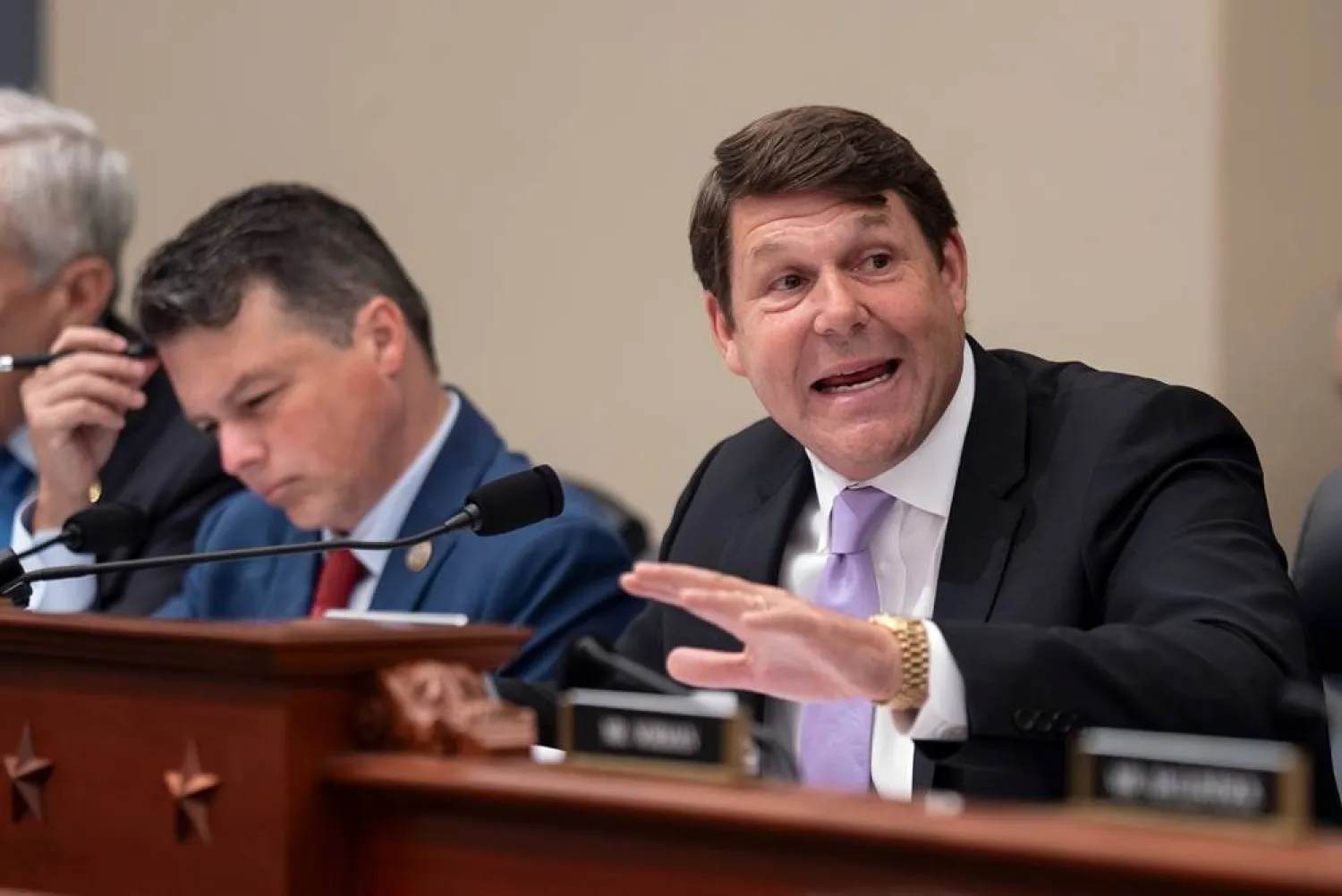
 House Budget Committee Chairman Jodey Arrington, R-Texas, right, joined at left by Rep. Brendan Boyle, D-Pa., the ranking member, speaks during a markup on the Fiscal Year 2027 spending plan, at the Capitol in Washington, Thursday, July 16, 2026. (AP)
House Budget Committee Chairman Jodey Arrington, R-Texas, right, joined at left by Rep. Brendan Boyle, D-Pa., the ranking member, speaks during a markup on the Fiscal Year 2027 spending plan, at the Capitol in Washington, Thursday, July 16, 2026. (AP)
TT

US House Republicans Push Forward on Trump Funding Plan for Iran War, Election Overhaul

 House Budget Committee Chairman Jodey Arrington, R-Texas, right, joined at left by Rep. Brendan Boyle, D-Pa., the ranking member, speaks during a markup on the Fiscal Year 2027 spending plan, at the Capitol in Washington, Thursday, July 16, 2026. (AP)
House Budget Committee Chairman Jodey Arrington, R-Texas, right, joined at left by Rep. Brendan Boyle, D-Pa., the ranking member, speaks during a markup on the Fiscal Year 2027 spending plan, at the Capitol in Washington, Thursday, July 16, 2026. (AP)

Republicans in the US Congress forged ahead on Thursday with a $95 billion budget plan to meet President Donald Trump's demands for new defense funding for the Iran war, farm assistance and a sweeping overhaul of voting requirements ahead of the November midterm elections.

A Republican-controlled budget panel in the US House of Representatives approved the resolution on Thursday, clearing it for a full House vote as early as next week.

If passed, it would pave the way for a special budget reconciliation bill intended to clear the Senate with a simple majority rather than the 60 votes needed for most legislation in that chamber.

That could enable Republicans, who hold 53 of ‌the Senate's 100 seats, ‌to bypass Democratic opposition and advance legislation directing $60 billion for defense, $13 billion for ‌intelligence, $12 ⁠billion for agriculture, ⁠and $10 billion to enact Trump’s signature voter ID bill, the SAVE America Act, over the next decade.

But it was too early to say whether a House reconciliation bill would qualify under strict Senate rules or even garner a simple majority.

"We're not going to get any help from our Democrat colleagues to do what I believe are ... critical things," budget committee chair Jodey Arrington, a Texas Republican, told his fellow panel members, who approved the resolution for full House consideration in a 20-14 party-line vote.

Democrats criticized the measure for not addressing soaring prices for gasoline, food and other products ⁠that voters say is their top issue.

"The American people know that this is ‌a failed presidency, and this has been a failed Republican majority," said ‌Representative Brendan Boyle, the committee's top Democrat.

House Republican leaders hope to pass the blueprint as early as next week. But it ‌was not clear that the chamber's narrow Republican majority could advance the measure.

Earlier on Thursday, the House ‌was unable to pass a veterans benefits bill because of opposition from Republican hardliners.

In the Senate, the blueprint faces likely opposition from defense hawks who want more Pentagon spending, deficit hawks who want spending cuts to pay for the outlays and others who fear that Trump's partisan voter ID bill could hamper efforts to win the November midterm elections.

The SAVE America Act, ‌which Trump calls his No. 1 legislative priority, lacks the votes to pass the Senate as a standalone bill, given vehement opposition from Democrats who say it ⁠would disenfranchise millions of ⁠Americans.

Republicans intend to use reconciliation to offer states grant money as an incentive to require voters to show photo ID at polling places and proof of citizenship to register to vote, and to turn over state voter rolls to the Department of Homeland Security.

Republicans defeated 14 Democratic amendments to advance party priorities including reinstating healthcare, food assistance, educational funding cut by previous bills, curbing Trump's immigration crackdown, revoking Trump tariffs and eliminating spending on the Iran war.

The defense segment is intended to help fund the Iran war, replenish US military weapons stockpiles depleted by the Middle East conflict and boost military readiness, according to Republican lawmakers.

"This budget resolution is a poorly planned, poorly drafted backdoor deal to pay for President Trump's decision to start a war with Iran. It's irresponsible ... and we see it played out every single day on the news," said Democratic Representative Becca Balint of Vermont.

The resolution contains no offsets for the new $95 billion in spending. But Republican committee staff said it would reduce overall spending by capping discretionary spending. The resolution would authorize spending legislation to help US farmers facing higher fuel and fertilizer costs from the war.




Landslide in Southwest China Traps People, Rescue Efforts Underway

 In this photo released by Xinhua News Agency, rescuers conduct search and rescue operation on the site of the landslide in Pengshui County in southwestern China's Chongqing on Friday, July 17, 2026. (Xinhua via AP)
In this photo released by Xinhua News Agency, rescuers conduct search and rescue operation on the site of the landslide in Pengshui County in southwestern China's Chongqing on Friday, July 17, 2026. (Xinhua via AP)
TT

Landslide in Southwest China Traps People, Rescue Efforts Underway

 In this photo released by Xinhua News Agency, rescuers conduct search and rescue operation on the site of the landslide in Pengshui County in southwestern China's Chongqing on Friday, July 17, 2026. (Xinhua via AP)
In this photo released by Xinhua News Agency, rescuers conduct search and rescue operation on the site of the landslide in Pengshui County in southwestern China's Chongqing on Friday, July 17, 2026. (Xinhua via AP)

A landslide Friday in the southwestern Chinese city of Chongqing buried some residential buildings, trapping an undetermined number of people, state media reported.

State broadcaster CCTV said at least nine people were rescued from the debris, and that search and rescue operations were ongoing.

CCTV said the landslide occurred at around 9:08 a.m. in Chongqing’s Pengshui County. Massive amounts of rocks and soil washed downslope, burying more than 10 residential buildings, and rescuers were using more than 50 sets of detection, search and rescue equipment, according to the official Xinhua News Agency.

Images by CCTV showed part of a mountainside collapsing onto a residential area. Several buildings were located next to the collapse site, while rescue crews were seen searching through the debris.

Photos showed large slabs of rock sliding beside buildings several stories high into a waterway below. Two buildings that looked about five and 15 stories high were damaged but still standing.

The rain-triggered landslide occurred near a section of the Wujiang River, which cuts through karst mountains peppered with small towns and terraces.

Authorities sent more than 8,000 disaster-relief items to Chongqing, including tents, folding beds and family emergency kits.

Pengshui County is located in the southeast part of Chongqing, bordering the provinces of Hubei and Guizhou.


UK Police Charge Man Over Iran-Linked Spying Offenses

A Metropolitan Police officer stands on duty in Westminster, London, Britain, October 1, 2021. (Reuters)
TT

UK Police Charge Man Over Iran-Linked Spying Offenses

A Metropolitan Police officer stands on duty in Westminster, London, Britain, October 1, 2021. (Reuters)

British police said on Friday they had charged a 39-year-old man on suspicion of assisting Iran's intelligence service, the latest in a series of incidents involving Tehran and offences covered under UK National Security laws.

Police said the suspect, Vahid Aberi, from Liverpool, northern England, was taken to a police station in central England and searches had been carried out at addresses ‌in nearby Birmingham and ‌Liverpool.

UK security officials have repeatedly ‌warned ⁠that Iran has sought ⁠to use criminal proxies to carry out hostile activity in the country. Since the beginning of the US-Iran war there have been a number of antisemitic attacks in Britain linked to Iran.

Seeking to use new powers designed ⁠to stop the use of state-sponsored proxies, ‌Britain banned support ‌for Iran's Revolutionary Guard Corps earlier this week.

On ‌the Aberi investigation, police said they had ‌not identified any direct threat to any community or individual, but said they were having to intervene more frequently to disrupt suspected activity by foreign intelligence services.

"We ‌have seen a significant and sustained increase in the tempo of our ⁠work ⁠in national security investigations in recent years," Helen Flanagan, head of counter terrorism policing in London, said in a statement.

Last week, Britain summoned Iran's most senior diplomat over the stabbing of an Iranian journalist in London, for which two Romanians were convicted.

In response to being called a threat to Britain, Iran's embassy in London has previously said it rejected the "unfounded, politically motivated and hostile allegations".

Aberi will appear in court in London later on Friday.


Israel’s Parliament Dissolves Ahead of Oct. 27 Elections

 Members of the Knesset attend a session of the Israeli Parliament in Jerusalem on July 16, 2026, before the start of the election recess ahead of the October 27 general election. (AFP)
Members of the Knesset attend a session of the Israeli Parliament in Jerusalem on July 16, 2026, before the start of the election recess ahead of the October 27 general election. (AFP)
TT

Israel’s Parliament Dissolves Ahead of Oct. 27 Elections

 Members of the Knesset attend a session of the Israeli Parliament in Jerusalem on July 16, 2026, before the start of the election recess ahead of the October 27 general election. (AFP)
Members of the Knesset attend a session of the Israeli Parliament in Jerusalem on July 16, 2026, before the start of the election recess ahead of the October 27 general election. (AFP)

Israel’s parliament dissolved early Friday after passing a marathon of bills in the last moments of Prime Minister Benjamin Netanyahu’s governing coalition.

The Knesset, which was scheduled to break for its summer recess on Friday, will not reconvene before the elections scheduled on Oct. 27.

The expected dissolution comes as Netanyahu is struggling to hold onto power ahead of the next elections as Israel grinds toward the third anniversary of the Oct. 7 attack that sparked nearly three years of war.

Israeli polls are showing a groundswell of support for opposition parties, led by former Prime Minister Naftali Bennett and a popular centrist former military chief.

Over the past week, the Knesset passed several controversial laws in marathon sessions as Netanyahu attempted to ram through several of his pet projects.

Earlier this week, the Knesset passed two bills that effectively halt the enlistment of ultra-Orthodox men in the military in an attempt to ensure ultra-Orthodox parties join Netanyahu’s coalition in the next government.

The Knesset also recently passed several bills connected with Netanyahu’s attempts to overhaul the judiciary, including increasing government control over broadcast media and weakening the role of the attorney general.

Attorney General Gali Baharav-Miara has opposed the overhaul, and been a frequent target of Netanyahu and the Israeli right.

“We are completing a four-year term, we passed nine budgets and hundreds of bills, I thank you for the trust you placed in me, through which together we succeeded in maintaining a four-year term,” Knesset Speaker Amir Ohana said as he announced the dissolution.

Completing a full, four-year term is a rare occurrence throughout Israeli history.

The last time Israel’s government fulfilled a full term without breaking for early elections was in 1988. Israel has no term limits, and Netanyahu has served more terms than any other prime minister in Israel’s history, but it is rare even for him to finish a full, four-year term.

Between 2019 and 2022, Israelis went to the polls five times. Israel holds elections on average every 2.4 years, making it second-lowest ranked country in the OECD for periods between elections, a marker of political instability, according to the Israel Democracy Institute.