
China Warns of Reciprocal Countermeasures after US Shortens Foreign Journalist Visas

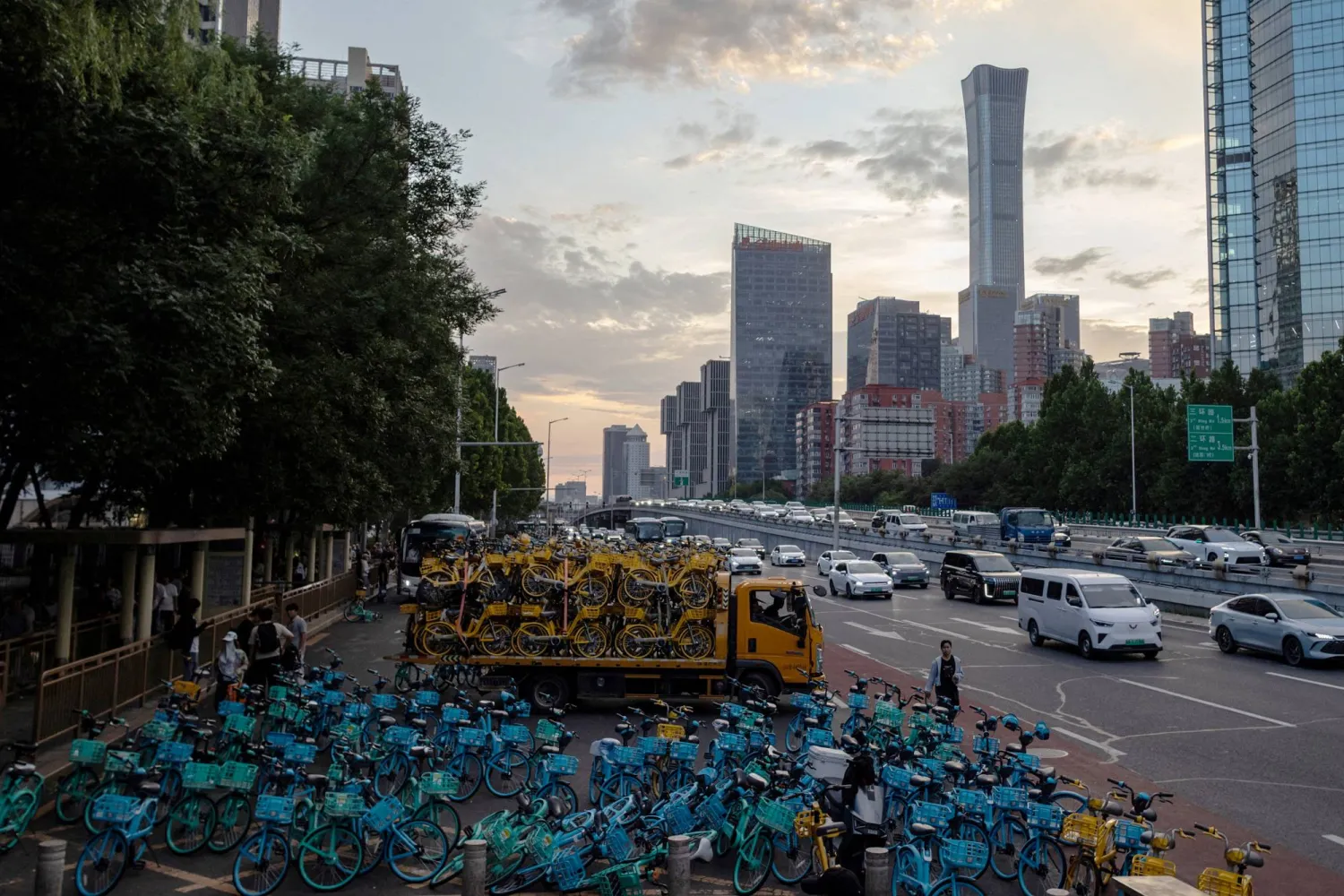
FILE PHOTO: A truck loaded with bicycles drives out of a collection area for shared bicycles near Beijing's Central Business District (CBD), China, July 6, 2026. REUTERS/Maxim Shemetov/File Photo/File Photo
TT

China Warns of Reciprocal Countermeasures after US Shortens Foreign Journalist Visas

FILE PHOTO: A truck loaded with bicycles drives out of a collection area for shared bicycles near Beijing's Central Business District (CBD), China, July 6, 2026. REUTERS/Maxim Shemetov/File Photo/File Photo

The Trump administration announced Thursday it will drastically shorten visas for foreign journalists in the US to 240 days, down from years, and cut those for Chinese journalists to only 90 days, raising concerns over press freedom in the United States and prompting China to warn of possible reciprocal countermeasures.

The rule announced by the Department of Homeland Security will do away with the “duration of status” system, which allows foreign journalists to stay and work in the United States as long as they meet eligibility requirements.

That will be replaced with a fixed period of time, though the visas may be extended.

The agency says it's necessary to better vet the visa holders. But advocates for foreign journalists oppose the change, saying the drastically shorter stay would severely restrict their ability to live and work in the States.

The even shorter visa rule for Chinese journalists, which does not include those from the “special administrative regions” of Hong Kong or Macao, is particularly harsh and could add tensions to the already fraught relations between Washington and Beijing, despite both leaders stating they intend to stabilize ties.

The decision comes at a time when President Donald Trump is targeting news organizations with multiple threats and legal actions at home and his administration is tightening immigration policies, though foreign journalists are not considered immigrants.

The rule will take effect 60 days after it’s published in the Federal Register. Congress can reject a rule, but it's extremely rare.

“We are outraged that the Trump administration has cruelly limited the duration of visas for foreign journalists from a period of up to five years to a fixed eight months,” the advocacy group Reporters with Borders said in a statement. “This change destroys international journalists’ ability to report from the US and makes it extremely difficult for international outlets to operate here at all.”

“The relentless cycle of visa renewals restricts press freedom, as journalists will feel compelled to avoid drawing the administration’s ire, lest their applications be rejected,” The Associated Press quoted it as saying.

The Committee to Protect Journalists released a statement calling the new visa policy “the behavior of a backsliding democracy, not the international vanguard of free speech.”

In proposing the change in August 2025, the federal agency said the rising number of foreign journalists in the US “poses a challenge” to its ability “to monitor and oversee these nonimmigrants while they are in the United States.”

It added that students and foreign visitors also will see their previous rule of “duration of status” replaced with fixed periods by the same decision.

By admitting them into the country for a fixed period, the Department of Homeland Security said it could better vet the visa holders to ensure their activities are permissible. The visas can be extended.

The first Trump administration sought to change the visa rules in 2020, but the proposal was withdrawn in 2021 when President Joe Biden took office.

But the White House then tightened visas for Chinese journalists to only 90 days, in response to the treatment of US journalists in China, including the expulsion of three Wall Street Journal reporters, as tensions flared up during the COVID-19 pandemic between the two countries.

The Biden administration later relaxed the rule, allowing stays to increase to up to a year.

When the Trump administration proposed to revive the 90-day rule last year, the Chinese Foreign Ministry said it opposed “the US’s discriminatory move targeting a specific country.”

China warns of reciprocal measures China's Foreign Ministry called the decision “discriminatory” and said it would affect the work of Chinese media in the US.

“China urges the US to immediately revoke its discriminatory policies targeting Chinese journalists and effectively safeguard their lawful rights and interests in the US,” said Foreign Ministry spokesperson Lin Jian at a daily briefing in Beijing.

He added that “China reserves the right to take reciprocal countermeasures.”


Cape Verde in Mourning after Children Killed in Bus Crash

An aerial view of residents and relatives of the victims killed in a bus crash gathering during their funeral at Sao Lourenco Church in the town of Sao Lourenco, on the island of Fogo, on September 6, 2026. (Photo by Herculano da Luz / AFP)
TT

Cape Verde in Mourning after Children Killed in Bus Crash

An aerial view of residents and relatives of the victims killed in a bus crash gathering during their funeral at Sao Lourenco Church in the town of Sao Lourenco, on the island of Fogo, on September 6, 2026. (Photo by Herculano da Luz / AFP)

Cape Verde's government announced two days of mourning on Sunday after 25 people, mostly children and teenagers, were killed in a bus crash.

The west African country's leaders joined a Mass on Sunday at a local church on the island of Fogo, where 18 coffins were on display.

Such accidents are rare in the Atlantic archipelago, where roads are generally in good condition.

Officials said the bus veered off the road and plunged into a deep ravine late on Saturday, following an excursion to a village inside a volcanic crater.

The dead included the bus driver, who organized the excursion every year as a present for the pupils he drove to school during term time.

Prime Minister Francisco Carvalho told public television station TCV he had ordered two days of mourning and promised further measures would be taken.

President Jose Maria Neves, meanwhile, said he would order an inquiry into the circumstances of the accident.

"Right now the priority is to show solidarity with the families of the victims," AFP quoted him as saying.

Emergency personnel worked through the night to rescue victims trapped in the wreckage, in a remote, rocky valley.

Seven victims were buried early on Sunday. The rest were set to be buried later in the day, according to public radio network RCV.

Dionisio Semedo, a doctor at the regional hospital on Fogo, told public TV that 12 people were still receiving treatment, two of whom were in serious condition.

He said bodies and injured people began arriving at the hospital on Saturday night, between 11:00 pm and midnight.


Iran's Top Negotiator Threatens 'Faster, More Intense' Response to US Attacks

People walk past a large anti-US banner with reference to the dropping of the atomic bomb on the Japanese city of Hiroshima, in Tehran on September 2, 2026. (Photo by Atta KENARE / AFP) /
TT

Iran's Top Negotiator Threatens 'Faster, More Intense' Response to US Attacks

People walk past a large anti-US banner with reference to the dropping of the atomic bomb on the Japanese city of Hiroshima, in Tehran on September 2, 2026. (Photo by Atta KENARE / AFP) /

Iran's top negotiator Mohammad Bagher Ghalibaf threatened on Sunday to launch swifter and more forceful responses to US attacks, after Tehran targeted American warships in retaliation for US attacks on tankers.

"The Americans must have understood that the era of proportionate responses has come to an end," said Ghalibaf in a speech carried by state media, adding that "any aggression against Iran's interests and security will receive a faster, more intense and more painful response.”

Iran said Sunday that it struck an unmanned US military boat in the Strait of Hormuz.

US Central Command, which oversees the US military operations in the Middle East, did not confirm the claim or respond to request for comment. It comes one day after the US said it struck Iranian oil tankers in retaliation for Iran launching ballistic missiles at Navy warships.


A Fuel Tanker Explosion in West Iran Kills 11 and Injures 7

A fuel tanker exploded in western Iran, killing 11 people and injuring seven others, according to the state media.(AP)
TT

A Fuel Tanker Explosion in West Iran Kills 11 and Injures 7

A fuel tanker exploded in western Iran, killing 11 people and injuring seven others, according to the state media.(AP)

A fuel tanker exploded in western Iran, killing 11 people and injuring seven others, state media said.

IRNA reported late Saturday that the tanker hit other cars before bursting into flames near a traffic police station close to the Kurdish city of Sanandaj, some 400 kilometers (248 miles) west of the capital, Tehran. The report cited a faulty brake system, The Associated Press said.

The injured were transferred to hospitals.

In 2018, a similar road accident between a fuel tanker and an intercity passenger bus near Sanandaj killed 15 people and injured four.

Road and traffic accidents annually leave more than 17,000 dead in Iran. Experts blame the high fatality rate on unsafe vehicles, disregard for traffic rules, and inadequate emergency services.