


Netanyahu Pushes Off Washington Visit After US ‘Anger’ Over PM’s Behavior

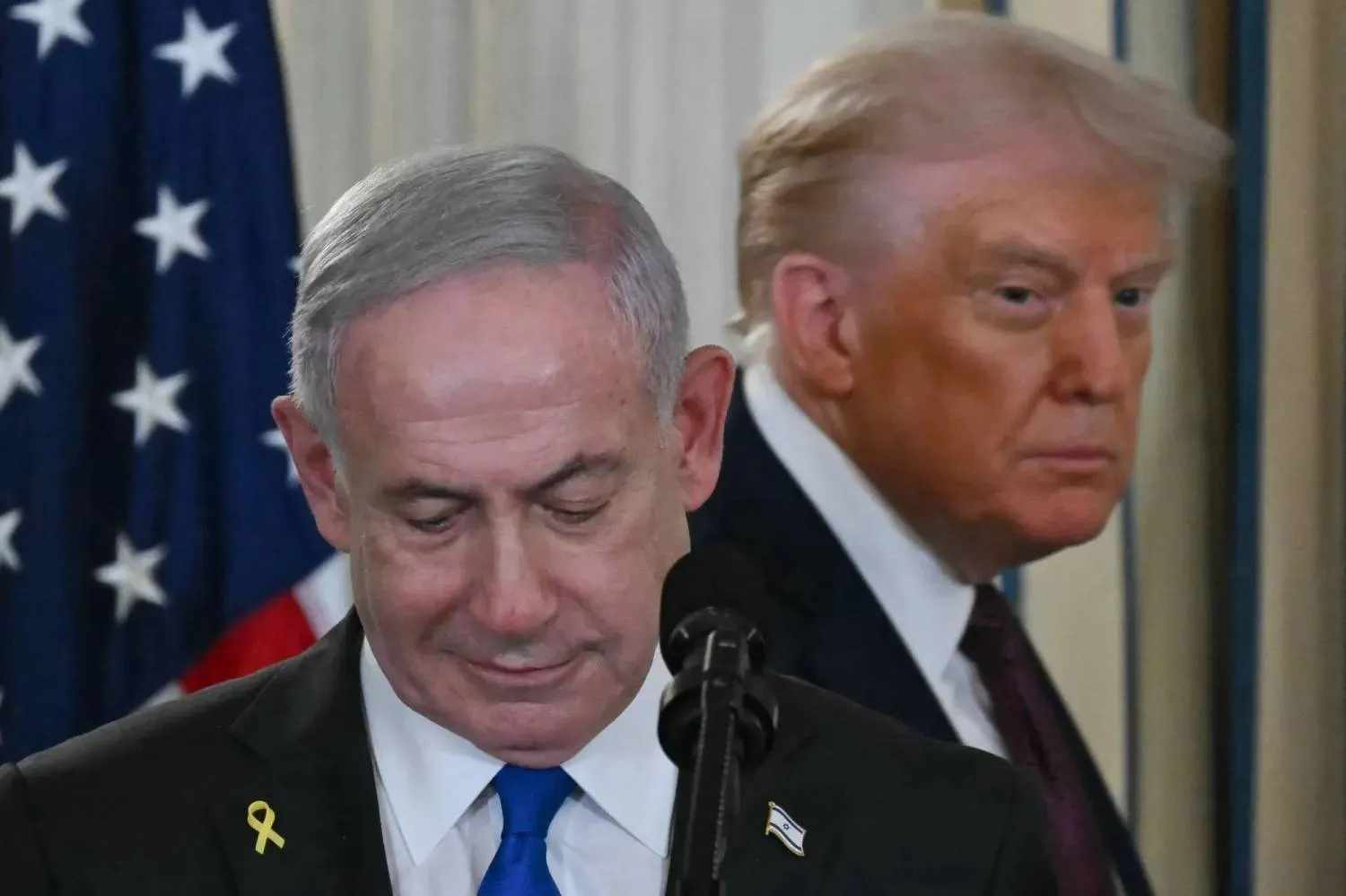
US President Donald Trump and Israeli Prime Minister Benjamin Netanyahu (L) arrive for a press conference in the State Dining Room of the White House in Washington, DC on 29 September 2025. (AFP)
TT

Netanyahu Pushes Off Washington Visit After US ‘Anger’ Over PM’s Behavior

US President Donald Trump and Israeli Prime Minister Benjamin Netanyahu (L) arrive for a press conference in the State Dining Room of the White House in Washington, DC on 29 September 2025. (AFP)

Israeli Prime Minister Netanyahu has canceled his planned trip to the United States next week as both the US and Israeli sides do not want US President Donald Trump to meet with the PM in the White House.

On Friday, Netanyahu’s Office said the postponement was due to changes surrounding the funeral of Senator Lindsey Graham. However, sources in Tel Aviv affirmed that the scheduling issue was only part of the reason behind the decision.

The sources said efforts to schedule a meeting between Netanyahu and Trump during the visit have failed.

According to the same sources, the Israeli PM knows the US administration is rigged against him. He also knows why.

“The Americans are closely monitoring Netanyahu and his cabinet members, tracking their public and private statements,” they said.

In return, intelligence assessments detail an escalation of Israeli surveillance targeting US decision-makers.

Several reports in Israel said Netanyahu fears such a trip could end in humiliation in front of the cameras, similar to what Trump did with Ukrainian President Volodymyr Zelensky in early 2025.

Meanwhile, US officials believe that Netanyahu is obstructing Trump's policies and plans to reach a ceasefire in the Middle East.

The US-Israeli tension was highlighted by US Vice President JD Vance who accused some members of the Israeli government of trying to influence Americans' opinions to prolong the Iran war.

In an interview, Vance told podcaster Joe Rogan that while he trusts some people within the Israeli government, there are others “who are manipulating and trying to change American public opinion to keep the war going on indefinitely.”

Vance said that people within the Israeli government have been trying to shift the US away from its efforts to negotiate with Iran.

“I definitely think you have seen this very discreet, extremely well-funded campaign to try to derail the negotiation and try to derail the deal,” he said, adding there is “exact evidence” that some Israeli leaders “hate the deal.”

The Vice President also referenced a Time magazine article suggesting Israel had used funds to pay online influencers, some of whom Vance said had attacked him.

Political sources confirm that Trump has been delaying meeting with Netanyahu since the US-Iranian agreement on June 16. The President has expressed frustration over Israeli criticisms of the deal, which paves the way for a window to curb Iran’s nuclear program.

Israeli officials have strongly criticized the peace agreement, describing it as “terrible” and a disaster for Israel.

Their statements have reflected on Israeli public opinion toward the US.

Polling in Israel shows a remarkable drop in Trump's popularity, falling from 74% support to roughly 32% following his administration's negotiations and ceasefire agreements regarding Iran while 62% of Israelis believe Trump does not care about Israeli interests.

Many in Washington view these numbers as “ingratitude” and a “stab in the back.” US officials suspect Israel is escalating conflicts to evade specific promises previously made to Trump.

In several telephone conversations, Trump advised Netanyahu to “drive people behind him” as a “strong leader,” to pull Israeli troops from south Syria, Lebanon and to implement the peace deal in Gaza.

But sources noted that Netanyahu was said to have pushed back, citing Israel’s security needs. Washington came to the conclusion that Netanyahu was not willing to meet the necessary terms, including pulling troops out of Syria.

Currently, Netanyahu is relying on Strategic Affairs Minister Ron Dermer to soothe rising tensions with the US President, striving to realign Trump's support ahead of the upcoming Israeli elections.

The Israeli PM fears the US administration may pivot to support his rivals, following a five-day trip by Naftali Bennett to the US last week and reports of indirect US contacts with Gadi Eisenkot.



Trump Calls Iran Conflict ‘Small Potatoes’ and Defends Vance’s Position That It’s Not a ‘War’

 US President Donald Trump attends an event to sign executive orders related to beef, in the Oval Office of the White House, in Washington, DC, US, September 4, 2026. (Reuters)
US President Donald Trump attends an event to sign executive orders related to beef, in the Oval Office of the White House, in Washington, DC, US, September 4, 2026. (Reuters)
TT

Trump Calls Iran Conflict ‘Small Potatoes’ and Defends Vance’s Position That It’s Not a ‘War’

 US President Donald Trump attends an event to sign executive orders related to beef, in the Oval Office of the White House, in Washington, DC, US, September 4, 2026. (Reuters)
US President Donald Trump attends an event to sign executive orders related to beef, in the Oval Office of the White House, in Washington, DC, US, September 4, 2026. (Reuters)

President Donald Trump on Friday said the conflict in Iran is “small potatoes” as he defended Vice President JD Vance for asserting that months of on-and-off attacks in the Middle East are not a “war.”

Asked during an Oval Office exchange about Vance’s comments made a day earlier, Trump said US strikes on Iran are now “intermittent” and “a lot of people don’t call it a war." The conflict has cost US taxpayers more than $37.5 billion and left 18 US service members dead.

“I can understand what he’s saying,” said Trump. He added: “I call it a military conflict because it’s small potatoes for us. It's not a big thing."

Vance, during a White House press briefing Thursday, rejected the use of the word “war” to describe the US fighting with Iran and steered clear of predicting that the six-month-old conflict would be over by November’s midterm elections, in which Republicans are trying to hang on to their narrow majorities in Congress.

“I wouldn’t call it a war,” Vance said after being asked about whether the fighting could end before voters cast their ballots in the Nov. 3 elections. “Right now, there is no active shooting.”

Vance’s assertion came even as Iran fired at Kuwait on Thursday in retaliation for rounds of US strikes on Iran earlier in the week.

Trump in Friday's exchange with reporters added that the US death toll in the Iran conflict is relatively lower than some other recent US wars. The US and Israel have only carried out air strikes in the Iran war, which began Feb. 28, and have not deployed troops into the country.

“We did Venezuela and we did this. In Venezuela, we lost nobody,” said Trump, referring to the January US military operation to seize former Venezuelan President Nicolás Maduro and spirit him to New York City to face federal drug trafficking charges. “And this, we lost 18 people. And, in Vietnam we lost 100,000 people. And in other conflicts, we lost tens of thousands of people.”

A total of 58,220 members of the US armed forces died during the Vietnam War, according to records from the US National Archives.

Pressed by a reporter on describing the conflict as “small potatoes" when 18 US service members have been killed, Trump responded by reiterating his argument that the conflict — one that he said at the outset of the war would last a matter of weeks — has led to the defanging of Iran's nuclear program.

“Iran will not have a nuclear weapon because if they did you probably wouldn’t be standing here,” Trump said.


UN Approves Resolution in Support of Map that Shows Africa's True Size

FILE PHOTO: A vendor sells a map of Africa along the streets of Bujumbura, Burundi April 24, 2015. REUTERS/Thomas Mukoya/File Photo
TT

UN Approves Resolution in Support of Map that Shows Africa's True Size

FILE PHOTO: A vendor sells a map of Africa along the streets of Bujumbura, Burundi April 24, 2015. REUTERS/Thomas Mukoya/File Photo

The United Nations on Friday voted for a shift away from the 16th-century Mercator global map towards one more accurately reflecting countries' true size, a resolution sponsored by African states to counter perceptions that the continent is peripheral.

Togo led the initiative to further the African Union campaign to limit use of the Mercator map, which distorts the relative size of land masses by expanding those nearer the poles. It makes Greenland appear roughly the same size ⁠as Africa, though Africa ⁠is about 14 times larger.

"A fair world begins with a fair map," Togo's Foreign Minister Robert Dussey told Reuters ahead of Friday's vote.

The resolution promotes the Equal Earth projection, which more accurately portrays the size of the continents.

It is not legally binding and it "in no way challenges the use of the Mercator projection for maritime and aerial navigation, for which it remains fully suited," the Togolese ministry ⁠said in a statement.

The resolution passed in the UN General Assembly by a vote of 164 to 1 with 6 abstentions.

The United States, the only country to vote against the resolution, said it promoted an "ideological agenda" and was a distraction from the "genuine problems of international peace, prosperity or good relations".

The Mercator map remains widely used in classrooms, but Togo hopes to change its school geography materials by the end of the year, Dussey told Reuters.

"Togo will be the first country to change our own geography books," Dussey said.

"In the classroom, we need to change it ⁠to give an ⁠example to all the countries in the world."

Togo will press other governments, schools, international organizations and technology companies to move away from the centuries-old Mercator projection, Dussey said, adding that Equal Earth offers "the best perception" of the world.

Togo plans to meet African Union member states and supporters from other regions within the next six months to agree on how to promote wider adoption, Dussey said.

Dussey said the discussion about next steps would need to include companies operating mapping, GPS and other location-based technologies.

Dussey linked the campaign to adopt the map to wider African efforts to confront colonial-era legacies, while saying it was not an attack on Europe or any other civilization.

The Mercator map's widespread use is a consequence of colonization, he said.

"The world is changing. Africa also is changing."


Philippine VP is Ordered Arrested for Threats Against the President

FILE -Philippine Vice President Sara Duterte gestures as she speaks during a press conference in Manila, Philippines on Friday, Feb. 7, 2025. (AP Photo/Basilio Sepe, File)
TT

Philippine VP is Ordered Arrested for Threats Against the President

FILE -Philippine Vice President Sara Duterte gestures as she speaks during a press conference in Manila, Philippines on Friday, Feb. 7, 2025. (AP Photo/Basilio Sepe, File)

A Philippine court ordered the arrest of Vice President Sara Duterte on Friday over charges that she publicly threatened to have the president and two other people assassinated.

Duterte was already impeached by the House of Representatives in May on the same charges as well as alleged financial anomalies, The Associated Press reported. Her troubles are part of a high-stakes political showdown pitting her against her rival, President Ferdinand Marcos Jr. A conviction could derail her plans to seek the presidency in 2028, when Marcos' six-year term ends.

A lawyer of the vice president, who has denied the charges, suggested she will post bail to avoid detention while facing trial by the Quezon City Regional Trial Court.

“She has no intention of evading the law and will continue to exercise all her legal remedies,” Paul Lawrence Lim said in a statement, without elaborating.

The charges stem from a threat made by Duterte in a 2024 online news conference to have Marcos, his wife and then-House of Representatives Speaker Martin Romualdez killed by an assassin if she herself was killed, as their political disputes escalated. The vice president then warned that her threat wasn’t a joke.

She later said she wasn’t threatening Marcos but was expressing concern for her own safety. Her remarks set off a criminal investigation and national security concerns.

Marcos and Duterte were running mates in the 2022 elections in a whirlwind alliance that combined the vote-getting power of two of the country’s most formidable political dynasties, but the union rapidly fell apart.

The vice president is the daughter of former President Rodrigo Duterte, Marcos’ predecessor. Rodrigo Duterte was arrested last year on orders of the International Criminal Court and detained in The Hague, where he is scheduled to face trial over alleged crimes against humanity on Nov. 30.

The charges are in connection with brutal anti-drugs crackdowns that left thousands of mostly poor suspects dead while Duterte was in power. He has denied authorizing extrajudicial killings but repeatedly threatened suspects with death while in office.

Last May, the House of Representatives, which is dominated by Marcos’ allies, voted overwhelmingly to impeach the vice president over alleged unexplained wealth, misuse of confidential state funds and her threats against Marcos, his wife and Romualdez.

The Philippine Senate, acting as an impeachment court, opened her televised trial in July.

If convicted of the charges, Duterte may be permanently disqualified from holding public office and will prohibit her from seeking the presidency in 2028.

Marcos and the Dutertes have contrasting geopolitical leanings. Marcos has expanded defense engagements with the United States, his country’s treaty ally, as his administration stood up to China’s increasingly aggressive actions in the disputed South China Sea.

Rodrigo Duterte had nurtured cozy ties with Chinese President Xi Jinping and Russian leader Vladimir Putin while threatening to sever ties with Washington. The vice president has come under fire for not condemning China’s assaults, including with the use of powerful water cannons, against Filipino forces and fishermen in the disputed waters.