


China, Philippines Trade Accusations over South China Sea Encounter

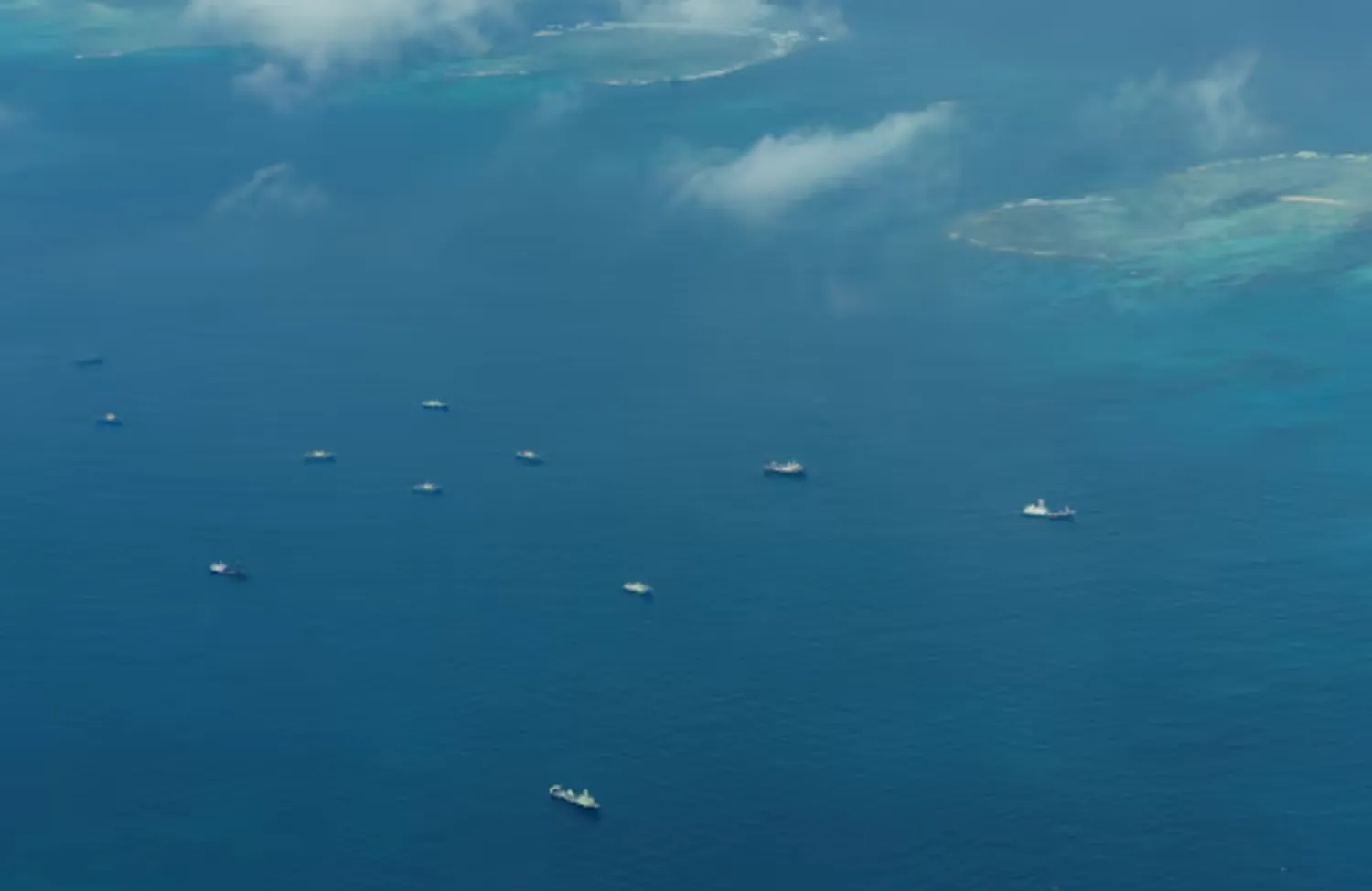
File photo: An aerial view of what Philippine Coast Guard alleges were Chinese vessels in the disputed South China Sea, March 9, 2023.
TT

China, Philippines Trade Accusations over South China Sea Encounter

File photo: An aerial view of what Philippine Coast Guard alleges were Chinese vessels in the disputed South China Sea, March 9, 2023.

China and the Philippines on Monday traded accusations after an encounter between vessels in contested South China Sea waters, with Manila saying one of its navy personnel was struck on the head and Beijing saying Manila provoked the incident. The Philippines said Chinese Coast Guard personnel aggressively struck one of its navy staff on the head with a wooden baton during an encounter in the Second Thomas Shoal on Monday in which a navy rubber boat was damaged. Southeast Asian foreign ministers will gather in Manila for high-level meetings this week, with Chinese Foreign Minister Wang Yi also in attendance. Tensions in the South China Sea are expected to feature in the discussions. The Armed Forces of the Philippines (AFP) said a Chinese Coast Guard rigid-hull inflatable boat with eight personnel approached to within close range of its grounded warship on the Second Thomas Shoal and took photos and videos, Reuters reported.

When two Philippine navy boats moved to drive the Chinese vessel away, its personnel "reacted violently and aggressively by striking Philippine navy personnel with a wooden baton."

In a 25-second video clip released by the Philippine armed forces, one of the eight could be seen hitting a navy crew member in a rubber boat that was close to the Chinese vessel.

"We call on the People's Liberation Army and the China Coast Guard, including their maritime militia, to put a stop to their illegal, coercive, aggressive and deceptive actions within the West Philippine Sea and adhere to the 2016 Arbitral Award that affirms the Philippines' lawful maritime rights under international law," the Philippine military said.

In response, China's Coast Guard accused the Philippine vessels of ignoring repeated warnings, approaching and ramming a Chinese patrol boat in a dangerous manner and said the Philippine personnel were the first to attack, a statement showed.

"Philippine personnel first used paddles, wooden poles and other implements to aggressively attack Chinese law enforcement officers," the statement read, noting the Chinese forces exercised the utmost restraint in the handling by issuing warnings, making maneuvering operations around the boats and taking proportionate countermeasures. China's Coast Guard also accused the Philippines of distorting facts and levelling false accusations against China on the incident, demanding "immediate cessation of infringement, provocation and false hype."

In a 49-second video clip released late on Monday by China's state-backed tabloid Global Times, Chinese officers can be heard shouting "This is China Coast Guard, please leave immediately" as personnel from both sides wielded paddles and batons during a confrontation.

Southeast Asian ministers are gathering in Manila this week for high-level meetings, with Chinese Foreign Minister Wang Yi also in attendance. Tensions in the South China Sea are expected to be discussed.

Manila's foreign ministry said the "act of violence" against its navy personnel was "unacceptable" and warranted diplomatic action. The shoal is within the Philippines' 200-nautical-mile exclusive economic zone and is 1,300 km (808 miles) from mainland China, which refers to it as the Renai Reef.

The Philippines has accused China of disrupting resupply missions to troops on the grounded vessel. A June 2024 incident also turned violent, with one Filipino sailor losing a thumb. The 2024 confrontation later led to a provisional understanding with China to allow resupply missions to the grounded ship.

China has denied allegations of aggressive conduct during encounters in the South China Sea and has accused the Philippines of trespassing in its waters.



Countries Open Path Towards 'Killer Robots' Pact

The European headquarters of the United Nations (UN) in Geneva, Switzerland, November 17, 2026. REUTERS/Denis Balibouse
TT

Countries Open Path Towards 'Killer Robots' Pact

The European headquarters of the United Nations (UN) in Geneva, Switzerland, November 17, 2026. REUTERS/Denis Balibouse

Countries opened a path Saturday towards finding an international agreement on regulating lethal autonomous weapons systems -- though campaigners seeking to stop so-called killer robots were disappointed by the "weakened" outcome.

After five grueling days of talks at the United Nations, which dragged on into overtime, states agreed on building some form of pact over the next two years.

However, with warfare being radically transformed by artificial intelligence, non-governmental organizations wanted far swifter, legally binding rules on handing power over human life and death to autonomous machines.

With full consensus required for any decision, talks at the UN's Review Conference of the Convention on Conventional Weapons in Geneva finally concluded at nearly 4:45 am (0345 GMT) on Saturday.

The 128 countries party to the convention "agreed to launch the elaboration of an international instrument on lethal autonomous weapons systems, which should be conducted over the next two years", conference president Julien Thoni told reporters afterwards.

While a majority of states want a legally binding agreement, countries that have the technology, including the United States and Russia, are reluctant to have their hands tied.

- Two-year timeline -

The process ahead should flesh out "which weapons can be forbidden according to international humanitarian law, and which is not forbidden but can be regulated", Thoni told AFP.

The Swiss diplomat said the parties would work on the instrument, and then decide on whether it should be a treaty, along with the extent to which its provisions should be binding.

He stressed that having the world's major military powers agreeing to work towards an instrument on lethal autonomous weapons systems (LAWS) was a big step forward.

Brazilian ambassador Frederico Meyer described a balancing act as "some countries have the power, some countries have the majority".

Before midnight, during a break in talks, delegates spent a long period huddled tightly around Russia's representative.
Later, a group of 15 delegates broke out for hushed talks on a staircase.

Diplomats inside could be seen pointing at amended text on the screens and refuelling on packets of crisps.

- 'Watered down' -

Campaign groups said the outcome fell well short of expectations.

Once activated, LAWS are capable of selecting and attacking targets without any human intervention.

According to Stop Killer Robots, a global coalition of more than 300 organisations, such systems have already been tested or deployed, including during the war in Ukraine.

"States adopted a watered-down mandate that fails to chart a clear path towards a legally binding instrument," said the group.

"Over 95 states expressed their support for a treaty. In the final hours, a small number of states weakened the mandate introducing uncertainty about the legal status of the final document."

- Diplomacy lagging behind technology -

Verity Coyle, the deputy director for arms at Human Rights Watch, said the outcome "does not provide the urgent action needed to agree new rules -- but the technology is racing ahead", she said.

Rain Liivoja, a director of the Asia-Pacific Institute for Law and Security, said the decision was one "nobody wanted but everyone could grudgingly live with", adding that consensus merely "makes everyone equally unhappy".

"It remains possible -- likely, even -- that there will be no treaty by the end of 2028," he added.

UN disarmament chief Izumi Nakamitsu said getting an instrument completed in two years was a "very compressed timeframe" which would require "a lot of negotiations".

She said countries should start thinking as soon as Monday about how to get as strong an instrument as possible to ban and regulate LAWS.

"The consequences of not having a strong instrument are very clear," she told reporters.

She said a group of governmental experts from the countries would make recommendations on the legal nature and specific form of the instrument, including whether it should be a binding protocol.

"The path to, or possibility to, have a legally binding instrument is still open," she insisted.


Tanker Catches Fire After Projectile Strike Near Strait of Hormuz, UKMTO Says

Vessels at the Strait of Hormuz, as seen from Musandam, Oman, November 17, 2026. (Reuters)
TT

Tanker Catches Fire After Projectile Strike Near Strait of Hormuz, UKMTO Says

Vessels at the Strait of Hormuz, as seen from Musandam, Oman, November 17, 2026. (Reuters)

A tanker caught fire after being struck by an unknown projectile while sailing outbound through the Strait of Hormuz, the United Kingdom Maritime Trade Operations (UKMTO) agency said on Friday.

The British navy-affiliated agency ‌UKMTO said ‌that the incident occurred ‌8 ⁠nautical miles north ⁠of the Omani town of Khasab, adding that no casualties or environmental impact were reported.

Iran's Revolutionary Guards said shortly afterwards that ⁠an oil tanker had caught ‌fire ‌after hitting a mine while ‌attempting to transit the Strait ‌of Hormuz near Khasab, Iranian state media reported.

Khasab lies on Oman's Musandam Peninsula at the ‌entrance to the Strait of Hormuz, a strategic waterway ⁠that ⁠carried nearly one-fifth of global crude oil supplies before the US-Israeli conflict with Iran.

Shipping through the Strait of Hormuz has been disrupted since Iran moved to close the waterway following the eruption of the conflict on February 28.


Myanmar Genocide Judgment May Bolster Gaza Case Against Israel

19 November 2026, Palestinian Territories, Deir al-Balah: Palestinians inspect widespread destruction of homes and displacement shelters following demolition operations carried out by the Israeli army in the early morning hours east of al-Maghazi refugee camp, central Gaza Strip. (dpa)
TT

Myanmar Genocide Judgment May Bolster Gaza Case Against Israel

19 November 2026, Palestinian Territories, Deir al-Balah: Palestinians inspect widespread destruction of homes and displacement shelters following demolition operations carried out by the Israeli army in the early morning hours east of al-Maghazi refugee camp, central Gaza Strip. (dpa)

The International Court of Justice's landmark ruling that Myanmar committed genocide against the Rohingya will strengthen South Africa's genocide case against Israel over the war in Gaza, legal experts said, establishing a precedent that genocidal intent can coexist with a military objective.

While the conflicts in Gaza and Myanmar are legally distinct, both cases before the World Court are based on allegations that states breached their obligations under the 1948 Genocide Convention.

On Thursday, the court found that Myanmar had violated the convention on multiple grounds stemming from mistreatment of the Muslim Rohingya minority by the armed forces.

South Africa, which has brought a genocide case against Israel over its conduct in Gaza, welcomed the judgment. Foreign Minister Ronald Lamola said it set an important precedent by establishing for the first time that a state had committed genocide.

He said it was of "great significance" to the case against Israel, which is not expected to be argued until 2029.

Both Myanmar and Israel have defended the actions of their armed forces as legitimate responses to insurgencies. But a majority of nine judges on the 15-member ‌bench found that ‌around 10,000 killings, including of children, the razing of homes, widespread sexual violence and the forced exodus of ‌more ⁠than 700,000 people in ⁠2017 amounted to state-sponsored genocide.

The ruling also handed other major legal victories to Gambia, which brought the case seven years ago on behalf of Muslim-majority countries.

The judges found that Myanmar had failed in its obligation to prevent genocide and said it must facilitate the return of Rohingya refugees and pay unspecified reparations.

The court also adopted conclusions from UN fact-finding reports, including one stating that mass deaths and rapes showed genocidal intent.

IMPORTANT PRECEDENT

Israeli legal scholar Yuval Shany said the ruling could broaden the arguments available to South Africa in its case against Israel.

He said the court maintained a requirement that genocidal intent be the “only reasonable inference,” but expanded the contextual factors it can consider beyond a pattern of conduct, to include the scale and systematic nature of acts and ⁠the history of persecution.

The approach “gives South Africa more avenues to argue for genocide” in Gaza, Shany said.

Proving genocide ‌is notoriously difficult because it requires establishing an "intent to destroy, in whole or in part, a ‌national, ethnical, racial or religious group, as such."

Five criminal acts can constitute genocide: killing members of a group, causing them serious bodily or mental harm, ‌creating conditions calculated to destroy them, preventing births, or forcibly transferring children to other groups.

Lamola said South Africa would study the judgment carefully with ‌a view to demonstrating, as the court had in the Rohingya case, that a state's actions, including ethnic cleansing, the killing of children, sexual violence and destruction of civilian infrastructure, can fall within the definition of genocide.

TARGETING OF CHILDREN, WOMEN

Another aspect of the ruling that could resonate in the Israel case was the court's emphasis on the systematic nature and scale of the crimes committed in Myanmar, said Marieke de Hoon, professor of international criminal law at the University of Amsterdam.

South ‌Africa alleges that Israel's military operations created conditions intended to prevent births and disproportionately affected women and children in Gaza. In its filing to the ICJ, it said an estimated 70% of those killed ⁠were non-combatants.

Israel rejects those allegations ⁠and says its operations have been conducted in accordance with international law.

"Arguments that a military intent or military objective would erase the idea that there could be a genocide intent are now rejected by the court," said De Hoon.

She said the judges found that some acts, including attacks on children and women and sexual violence, could not be explained by military objectives alone, leaving genocide as the only reasonable inference.

The Hague Initiative for International Cooperation (Thinc), a think tank funded by pro-Israeli groups, said the judgment would fundamentally alter how courts assess allegations of genocide by imposing a "lower threshold for proving genocidal intent, with serious consequences for Western militaries engaged in confronting terror," such as after Hamas' October 7, 2023 attack on Israel.

It is "not only a verdict in a particular case but a template," Thinc's director, Andrew Tucker, wrote in a reaction.

"Its propositions will be used in future cases: that genocidal intent may coexist with legitimate military objectives...that UN reports compiled without access can carry decisive weight; and that a state can breach the duty to prevent genocide without any finding that genocide occurred."

While the World Court judgment unequivocally found Myanmar responsible for genocide, proving the crime in court remains difficult, said Richard Horsey, senior adviser for Asia at the International Crisis Group.

"The ICJ has never before found that a state committed genocide. The legal bar is extremely high, but what this case shows is that it is surmountable,” he said.