

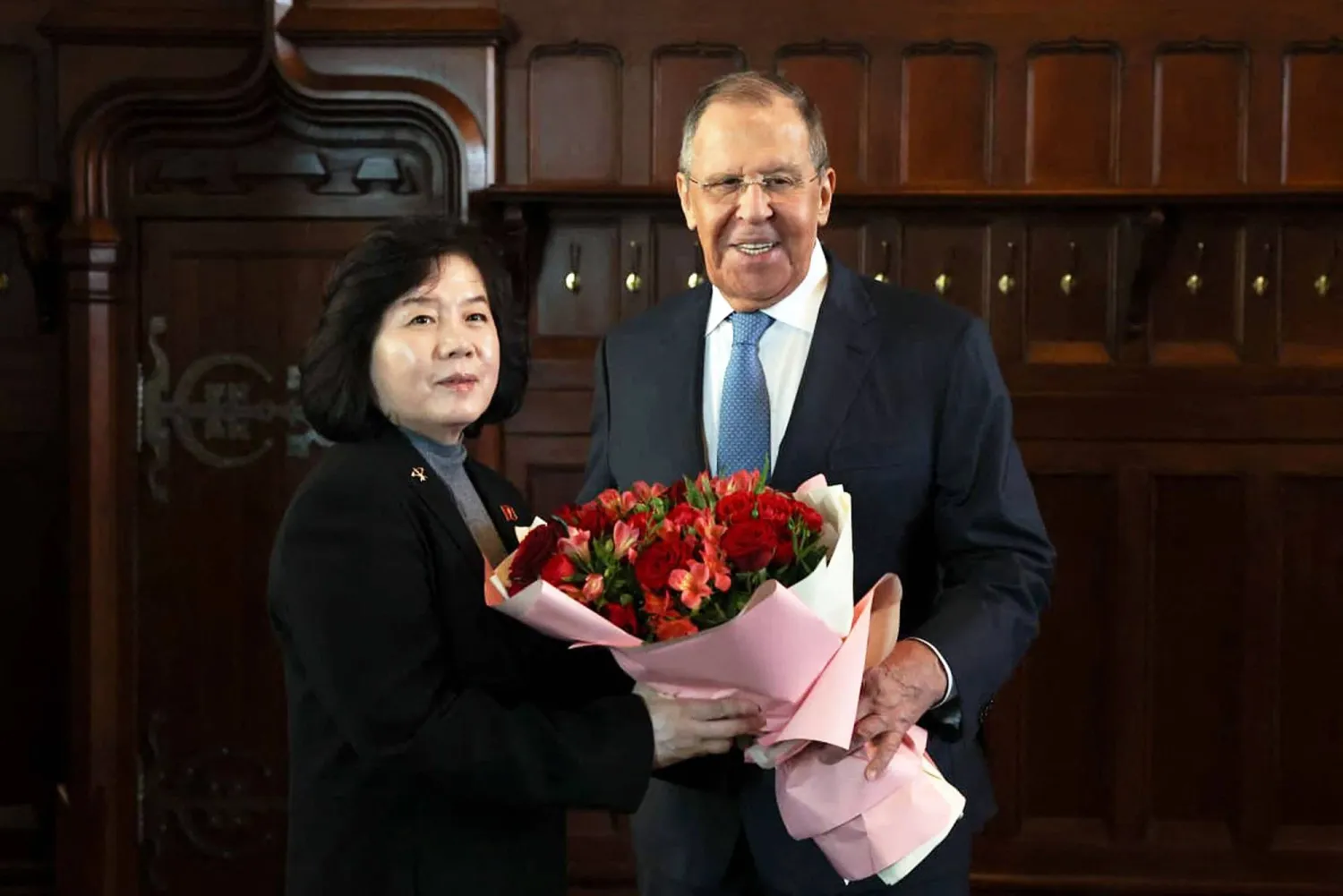

North Korea Reaffirms Support for Moscow Over Ukraine

In this photograph released by the Russian Foreign Ministry, Russia's Foreign Minister Sergei Lavrov (R) welcomes North Korea's Foreign Minister Choe Son-hui ahead of a meeting in Moscow on July 20, 2026. (Handout /Russian Foreign Ministry / AFP)
TT

North Korea Reaffirms Support for Moscow Over Ukraine

In this photograph released by the Russian Foreign Ministry, Russia's Foreign Minister Sergei Lavrov (R) welcomes North Korea's Foreign Minister Choe Son-hui ahead of a meeting in Moscow on July 20, 2026. (Handout /Russian Foreign Ministry / AFP)

North Korea reaffirmed its support for Russia's war on Ukraine as the nations' foreign ministers met in Moscow, Pyongyang's state media reported Tuesday, increasing speculation Kim Jong Un may soon visit the Kremlin.

Diplomatically isolated North Korea and Russia have rapidly expanded cooperation since Russia launched its full-scale invasion of Ukraine in early 2022.

Pyongyang has sent troops to Russia's embattled Kursk region and supplied Moscow with weapons systems, in return securing financial assistance, food, energy supplies and military technology, analysts say.

Following a Moscow meeting between North Korean Foreign Minister Choe Son Hui and her Russian counterpart Sergei Lavrov, Pyongyang's state media said the nations had "reaffirmed their steadfast political will to accelerate the long-term multi-faceted development of the bilateral relations".

"The DPRK side expressed invariable support for all the internal and external policies of the Russian Federation to eliminate the root cause of the Ukrainian dispute and defend its national sovereignty, territorial integrity and international justice," state news agency KCNA said.

The agency reported that Russia, meanwhile, expressed full support for North Korea's efforts to defend its sovereignty and security.

"I would like once again to express my gratitude for the support provided to the special military operation we are conducting," Putin said in a video released by the Kremlin on Sunday.

Choe laid a wreath at the Tomb of the Unknown Soldiers by the wall of the Kremlin on her visit, KCNA said Tuesday.

Kim Jong Un last travelled to Russia in September 2023, and Putin made a rare visit to Pyongyang in June 2024.

Choe's visit to Moscow could have been aimed at discussing a trip to Russia by Kim later this year, according to South Korean media reports.

"Putin has repeatedly invited Kim to visit Russia since his trip to Pyongyang in 2024," Park Won-gon, a professor of North Korean studies at Ewha Womans University, told AFP.

Chinese President Xi Jinping made a rare trip to Pyongyang last month, where he and Kim pledged to bolster ties.

While Pyongyang has drawn closer to Moscow, China remains North Korea's largest economic partner, accounting for nearly 98 percent of the country's foreign trade in 2024, according to official figures.

"After hosting Chinese President Xi Jinping this year, Kim would have a strong incentive to visit Russia as well," Park said.

"It would showcase North Korea breaking out of diplomatic isolation while highlighting support from both China and Russia, reinforcing the image of a North Korea-China-Russia alignment."



Qatar Delivers US Response to Iran on Seven-Day Proposal

This handout picture released by the Qatari Ministry of Foreign Affairs shows Qatar's Prime Minister and Foreign Minister Sheikh Mohammed bin Abdulrahman Al Thani, (L) meeting with Iran's Foreign Minister Abbas Araghchi (R) in Tehran on August 27, 2026. (Qatari Ministry of Foreign Affairs / AFP)
TT

Qatar Delivers US Response to Iran on Seven-Day Proposal

This handout picture released by the Qatari Ministry of Foreign Affairs shows Qatar's Prime Minister and Foreign Minister Sheikh Mohammed bin Abdulrahman Al Thani, (L) meeting with Iran's Foreign Minister Abbas Araghchi (R) in Tehran on August 27, 2026. (Qatari Ministry of Foreign Affairs / AFP)

Iranian Foreign Minister Abbas Araghchi met Qatari mediators in Doha on Tuesday night and received US feedback ‌on ‌a proposed ‌seven-day ⁠trust-building plan, which he ⁠will discuss in Tehran on Wednesday, an official briefed ⁠on the talks ‌told ‌Reuters.

The main ‌disagreement is ‌over the sequencing of the plan, which aims ‌to build trust and return ⁠to ⁠an enhanced version of a US-Iran memorandum of understanding signed in June, the official said.

President Donald Trump said on Tuesday he does not know if Iran is going to "give up yet" but cast the country as doing "very poorly" in its war with the US.

"I don't know if they are going to give up ‌yet but ‌they'll give up," Trump told reporters.

"They ‌are ⁠doing very poorly," ⁠he added.

A US blockade has cut Iran's financial lifeline - oil exports, and economic costs of the war have made life tougher for Iranians.

Iran's president told the UN General Assembly last ⁠week that Tehran would never surrender to ‌US pressure.

The rise in oil prices due to the ‌war has also become a major issue ‌for Trump's Republican Party heading into the November US midterm elections.

The war has led to the blockade of the Strait of ‌Hormuz, which carried a fifth of global supplies of crude oil ⁠and ⁠LNG before the conflict.

Trump has offered shifting goals and timelines for the Iran war that began on February 28 when the US and Israel attacked Iran and Tehran responded with its own strikes on Israel and Gulf states.

US-Israeli strikes on Iran and Israeli attacks on Lebanon have killed thousands and displaced millions.


US Supreme Court Lifts Limits on Third-country Deportations

The United States has deported thousands of migrants to so-called third-countries, including Liberia, as part of US President Donald Trump's immigration crackdown. Matthew Jacobs / AFP
TT

US Supreme Court Lifts Limits on Third-country Deportations

The United States has deported thousands of migrants to so-called third-countries, including Liberia, as part of US President Donald Trump's immigration crackdown. Matthew Jacobs / AFP

The US Supreme Court on Tuesday lifted restrictions on the deportations of immigrants to countries that are not their own, while agreeing to hear the issue on its merits in December.

The conservative-dominated high court granted an emergency request by the Trump administration to suspend a lower court ruling that restricted, but did not outright ban, so-called "third-country removals."

The lower court had said people targeted with deportation must be given effective notice ahead of time about where they are being sent to allow them to raise concerns about potential persecution, said AFP.

The three liberal justices on the nine-member bench said they would not have granted the administration's request.

President Donald Trump campaigned on promises to expel millions of undocumented migrants from the United States and has taken several actions aimed at speeding up deportations since returning to the White House in 2025.

The Trump administration has defended third-country deportations as necessary since the home nations of some of those who are targeted for removal sometimes refuse to accept them.

In a brief to the Supreme Court, opponents of lifting the restrictions argued that the lower court ruling did not fully block all third-country deportations, "it simply requires them to do so lawfully."

Trump's solicitor general, John Sauer, meanwhile told the court that the rapid deportation to third countries was "an essential tool to remove certain aliens, including some of the worst criminal aliens."

The lower court ruling "created substantial logistical problems" with removals, he said.

- 'Indefensible' -

An AFP investigation found that the US has offered multimillion-dollar deals and threatened visa restrictions in a bid to get "third countries," especially in Africa, to take such deportees.

Once in these countries -- and outside US jurisdiction -- deportees have been subject to abuse by local guards, indefinite detention, or quickly re-deported to their home countries.

According to an investigation published last week, the United States has deported more than 25,000 people under secretive agreements with 35 countries to take migrants with no ties to those nations.

The investigation by Forbidden Stories found the administration has earmarked $410 million to be paid directly to the receiving countries, or to United Nations agencies to facilitate the returns.

The vast majority of the deportees -- around 20,000 -- were sent to Mexico, but the rest were dispersed to 27 other countries across Latin America, Africa, and the Pacific, and agreements have been finalized with seven more.

Congress has made it US policy not to deport people to countries where their lives would be in danger or they could be subject to torture.

After the high court's ruling, some Democratic lawmakers were calling for more formalized steps to prevent such deportations and uphold due process.

"Congress must step in. No one should be shipped off to a country that is not their own without basic due process and a meaningful opportunity to raise legitimate fears for their safety," House Democrat Lois Frankel said on X.

Rob Menendez, another congressional Democrat, called the Supreme Court's decision "indefensible."

"Taxpayers shouldn't fund tearing people from the only home they've ever known, nor should our legal system fast-track these unilateral deportations."


US Withdraws from European Anti-Corruption Panel

FILE PHOTO: A general view of a US State Department sign outside the US State Department building in Washington, DC, US, July 11, 2025. REUTERS/Annabelle Gordon/File Photo
TT

US Withdraws from European Anti-Corruption Panel

FILE PHOTO: A general view of a US State Department sign outside the US State Department building in Washington, DC, US, July 11, 2025. REUTERS/Annabelle Gordon/File Photo

The Trump administration has withdrawn the United States from a top European anti-corruption watchdog as it forges ahead with plans to disengage from international and multilateral organizations that it accuses of exceeding their mandates, being inefficient or not adapting to US policies.

The Council of Europe said Tuesday that the US formally notified it a day earlier that it would leave the Group of States against Corruption, or GRECO. Only two other countries have left GRECO before — Russia and Belarus.

The State Department confirmed the move, saying that US participation, which requires an annual monetary contribution, “does not provide tangible benefits to US national security.”

“The era of writing blank checks to international bureaucracies is over,” it said. “The department is instead prioritizing higher-impact tools to combat corruption, such as visa restrictions, sanctions, and targeted foreign assistance to strengthen foreign criminal investigations into corruption directly threatening US security and prosperity.”

The Strasbourg-based Council of Europe said the US had been “a valuable contributor” to GRECO "and to the exchange of experience and good practice in preventing and combating corruption.”

“GRECO remains open to resuming cooperation with the United States in the future in support of shared efforts to prevent corruption, strengthen integrity and uphold the rule of law,” it said in a statement.

The decision was announced a week after the Organization for Security and Cooperation in Europe said the US had declined to invite its members to observe November’s congressional midterm elections, a sharp break from past practice.

The US has already withdrawn from a number of European-based UN and multilateral agencies, including the World Health Organization and the UN Human Rights Council, and is weighing further such steps.

The US withdrew in January from another Council of Europe panel — the Venice Commission, which is an advisory body on constitutional law.

GRECO was created in 1999 by the Council of Europe to monitor compliance with the organization’s anti-corruption standards. Membership is not limited to European Union members, and the United States joined a year after its founding.