


Afghans Search for Dozens Missing After Devastating Flood

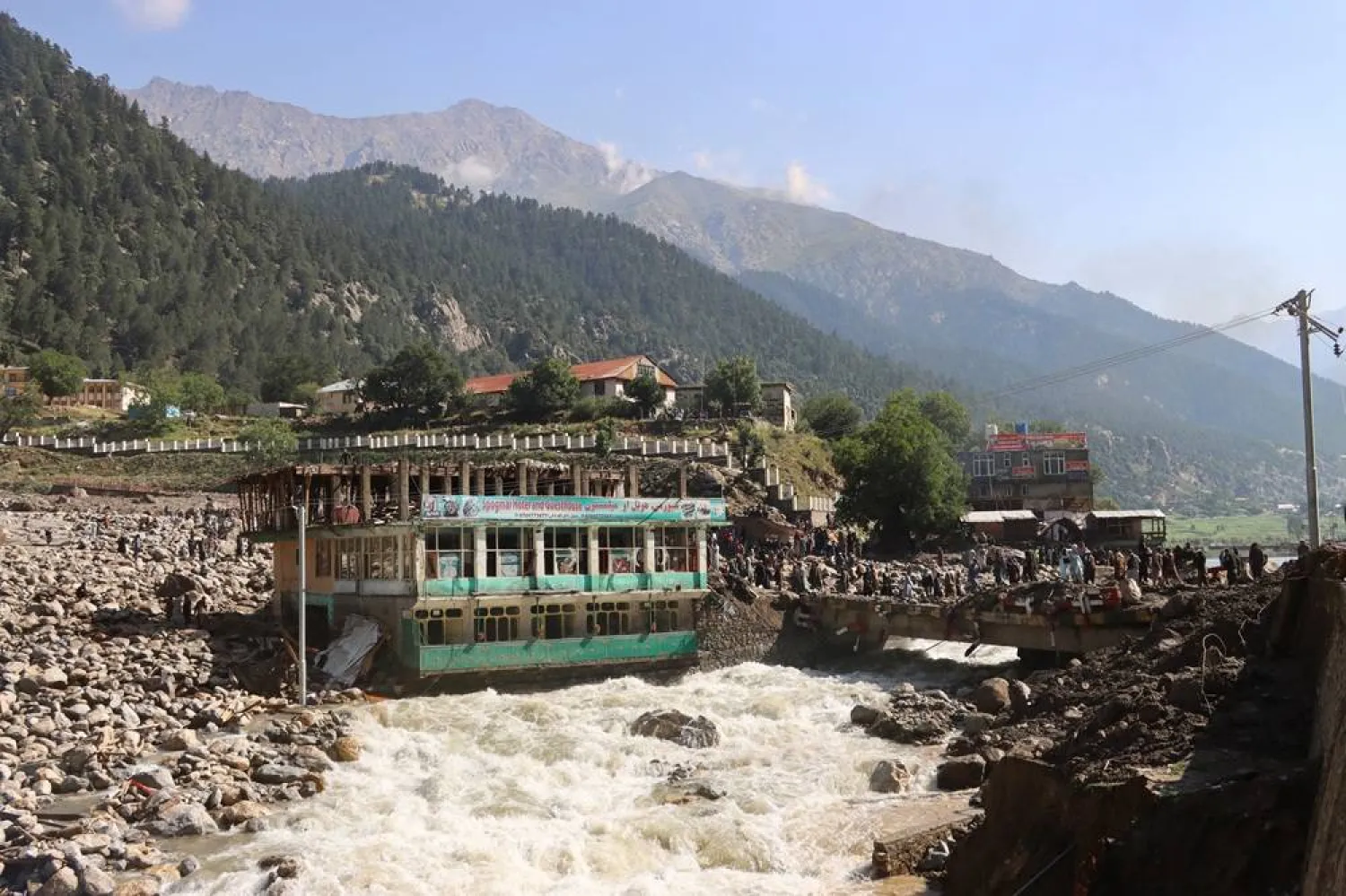
Floodwaters near a hotel and guest house building in Parun, the capital of Nuristan province, Afghanistan, July 21, 2026. (Reuters)
TT

Afghans Search for Dozens Missing After Devastating Flood

Floodwaters near a hotel and guest house building in Parun, the capital of Nuristan province, Afghanistan, July 21, 2026. (Reuters)

Rescuers were struggling to reach residents trapped under mud and boulders in eastern Afghanistan on Tuesday, after a major flood smashed through one province killing at least 23 people.

Around 100 people are unaccounted for, the national disaster agency and the provincial governor's office said, also updating the death toll from Monday's deluge.

An AFP journalist saw dozens of people gathered in remote Parun, the capital of Nuristan province, using wooden poles and their bare hands to search for the missing.

Farid Gul Zaheer, a 34-year-old pharmacist, said he had "never witnessed such a dangerous flood".

"It felt like there was an earthquake, and I heard children and people screaming," he told AFP, after getting injured while trying to flee up the mountain.

On Tuesday, a bulldozer was of limited use in clearing some debris in Parun, where the flood had buried multiple shops and brought huge boulders that smashed into buildings.

Parun's mayor and other government employees were among the missing, the governor's office said on Monday.

Zakirullah Zaki, manager of the Spogmai Hotel, said it felt like "an act of God struck us".

"The rest of the hotels, markets, and shops were completely destroyed," the 29-year-old told AFP.

The Spogmai was still standing, surrounded by destruction, and the manager's missing younger brother was found.

- 'Traumatized' -

Juma Khan Nayel, communications chief for the Afghan Red Crescent Society, described a "devastating situation" with water rising to unprecedented levels.

They have deployed dozens of volunteers who are working by hand, using shovels.

"Right now, urgently, we are supplying some food," water and tents for those whose homes have been destroyed, he told AFP.

Afghanistan's defense ministry said the military had been deployed to the area to support the relief effort, while the United Nations said it was assessing the disaster.

Zaheer, the pharmacist, said he had "lost everything".

"Everyone is traumatized, they didn't sleep all night," he said.

The flooding and rain have also affected neighboring Pakistan, where 12 people were killed according to Khyber Pakhtunkhwa's provincial disaster agency.

More than 200 people were killed in flooding and rain that hit Afghanistan and Pakistan between March and April.

Afghanistan is particularly vulnerable to climate change and flooding has increased, according to the head of the country's environmental protection agency.

Environmental problems "have severely affected the Afghan people and have contributed to a humanitarian crisis in the country", Mawlavi Mati-ul-Haq Khalis said this month.



Ukraine Urges US to Sanction Entities Supporting Russia's Starlink Rival

Plastic letters arranged to read "Sanctions" are placed in front of Ukraine's and Russia's flag colors in this illustration taken February 25, 2022. REUTERS/Dado Ruvic/Illustration/ File Photo
TT

Ukraine Urges US to Sanction Entities Supporting Russia's Starlink Rival

Plastic letters arranged to read "Sanctions" are placed in front of Ukraine's and Russia's flag colors in this illustration taken February 25, 2022. REUTERS/Dado Ruvic/Illustration/ File Photo

Ukraine is urging the United States to impose sanctions on several Russian entities that it says are helping develop Moscow's Rassvet satellite network as a domestic alternative to SpaceX's Starlink, its acting ambassador said on Wednesday.

Denys Sienik, deputy chief of mission at the Ukrainian embassy in Washington, told reporters Russia was rapidly expanding the Rassvet satellite network, saying its goal to start operations in 2027 would pose grave risks to Ukraine.

"If they launch Rassvet by the end of 2026, they will be able to target to hit Ukrainian targets real time on our territory," Sienik said, adding that he would share details with the US government and Congress about ‌the firms and ‌individuals that Kyiv accuses of aiding Rassvet.

"If these entities are not sanctioned, ‌it ⁠will actually make this ⁠program possible for Russia and that will be a game-changer," Sienik said. He also stressed Ukraine's urgent need for some 300 additional Patriot interceptors by winter, saying that Russia was producing more than 100 ballistic missiles per month.

The US Treasury Department had no immediate comment on Ukraine's push for new sanctions, Reuters said.

Russia plans to start operating Rassvet, a smaller version of Elon Musk's Starlink system, in 2027, Alexei Shelobkov, CEO of Iks Holding, the company developing the service, said in June. The company launched its first 16 low-orbit satellites in March ⁠and plans to reach 900 over several years.

SpaceX currently has more ‌than 10,000 satellites in orbit. Starlink is banned in Russia, ‌and the use of its equipment is subject to fines.

Western nations have targeted the infrastructure behind Russia's space-based communications ‌efforts, but gaps remain. Kyiv has been pressing Washington to expand sanctions against a broader group of ‌Russian companies and individuals.

Ukraine has been pressing for access to expanded Starlink satellite internet coverage so it can strike Russian ballistic missile launchers located inside Russian territory, a position backed by Finnish President Alexander Stubb last week.

SHORTAGE OF AIR DEFENSE

With winter looming, Ukraine has an acute shortage of air defenses to repel Russian ballistic missiles, ‌and Kyiv officials believe that turning on Starlink over Russian territory would help it target the Russian launchers that fire the missiles.

Sienik also questioned ⁠the lack of US ⁠response when Russian strikes hit American firms in Ukraine, saying US complaints about Ukrainian strikes that hit US assets in the Caspian Sea had resulted in closer cooperation and more precise targeting.

But Washington remained silent in terms of messaging to Moscow when US firms in Ukraine were struck, and officials were even reluctant to name the companies affected, he said.

Sienik last week posted details of US firms being hit by Russia missiles in Ukraine, including offices of Boeing, Flex and Bunge. A Coca-Cola facility in the Kyiv region was also hit in September, along with a logistics facility serving McDonald’s, he said in his message on X.

"It is not a coincidence, Russia knows what it is doing by attacking regular businesses operating in Ukraine, supported by American investment and serving civilian needs," he wrote.

"While Russia must be deprived of the possibility to cause more deaths and destruction by strong sanctions, Ukraine must have enough air defense capabilities to protect itself but also to ensure the security of the American businesses operating and investing in Ukraine."


South Korea's Lee Urges North Korea to Restore Dialogue, Pledges Military Buildup

South Korean President Lee Jae Myung delivers a speech during the Armed Forces Day at a military base in Gyeyong, South Korea, Thursday, Oct.  1, 2026. (Jeon Heon-kyun/Pool Photo via AP)
South Korean President Lee Jae Myung delivers a speech during the Armed Forces Day at a military base in Gyeyong, South Korea, Thursday, Oct. 1, 2026. (Jeon Heon-kyun/Pool Photo via AP)
TT

South Korea's Lee Urges North Korea to Restore Dialogue, Pledges Military Buildup

South Korean President Lee Jae Myung delivers a speech during the Armed Forces Day at a military base in Gyeyong, South Korea, Thursday, Oct.  1, 2026. (Jeon Heon-kyun/Pool Photo via AP)
South Korean President Lee Jae Myung delivers a speech during the Armed Forces Day at a military base in Gyeyong, South Korea, Thursday, Oct. 1, 2026. (Jeon Heon-kyun/Pool Photo via AP)

South Korean President Lee Jae Myung on Thursday called on North Korea to help restore trust and resume dialogue, a day after Seoul and Pyongyang traded barbs over a landmine incident that South Korea's military and the UN Command said amounted to an armistice violation.

"I hope that the North joins us now on the path of restoring trust and resuming dialogue, ‌following a ‌long interruption," Lee said in an address ‌marking ⁠the country's Armed ⁠Forces Day, adding that his administration would "consistently pursue practical measures to reduce military tensions between the two Koreas."

The comments came after Seoul's military and the UN Command said North Korea violated the Korean War armistice following a landmine blast last week that wounded ⁠three South Korean soldiers in the Demilitarized ‌Zone (DMZ).

Kim Yo Jong, the ‌influential sister of North Korean leader Kim Jong Un, rejected ‌the findings in a statement on Wednesday, accused ‌Seoul of fabricating the results and warned of retaliation.

Lee reaffirmed his goal of securing the transfer of wartime operational control from the United States to South Korea, calling it ‌part of a long-standing push for self-reliant national defense.

In a wide-ranging defense reform ⁠agenda, Lee ⁠also said in his speech that South Korea would build nuclear-powered submarines by the mid-2030s and upgrade missile defense capabilities, including AI-based command-and-control systems and high-energy laser interceptors.

He said the modernization drive would also involve expanding AI capabilities, restructuring the military for future warfare and strengthening the country's three-axis defense system for detecting and intercepting missile threats.

Lee's government has sought to reopen dialogue with North Korea, but Pyongyang has largely rejected Seoul's overtures while pressing ahead with border fortification work along the DMZ.


Pakistani Airstrikes in Afghanistan Kill 9 People, Kabul Says

People stand on the rubble of a house that was damaged in what the Taliban said was a Pakistani airstrike in Garmsir district in Helmand province, Afghanistan, October 1, 2026. Picture taken with a mobile phone. REUTERS/Stringer
TT

Pakistani Airstrikes in Afghanistan Kill 9 People, Kabul Says

People stand on the rubble of a house that was damaged in what the Taliban said was a Pakistani airstrike in Garmsir district in Helmand province, Afghanistan, October 1, 2026. Picture taken with a mobile phone. REUTERS/Stringer

Pakistan carried out airstrikes in two Afghan provinces overnight, both countries said Thursday, with Afghanistan saying 9 women and children were killed and another 11 civilians were wounded in the bombings.

Pakistan’s Ministry of Information said its strikes were against militant hideouts in two locations and that “initial reports suggest” that 22 militants had been killed. The casualty claims from either side could not be independently verified.

The strikes come amid repeated cross-border clashes between the two countries, while Pakistan has repeatedly carried out airstrikes inside Afghanistan since tensions between the two countries spiraled dramatically earlier this year. The two neighbors have longstanding disputes over militant activity along their border.

The United Nations Mission in Afghanistan said last week that it had documented over 1,100 civilian deaths and injuries in Afghanistan from cross-border violence so far this year. Pakistan denies striking civilians, and says it targets militants who carry out attacks inside Pakistan. Afghanistan denies harboring militants.

The spokesman for Afghanistan's Taliban government, Zabihullah Mujahid, said the airstrikes hit civilian homes in southern Helmand province and the eastern province of Kunar, destroying three houses, killing nine women and children and wounding 11 other civilians.

“We condemn this act, and consider this an act of aggression and a crime that violates all universally accepted principles,” The Associated Press quoted him as saying.

Pakistan's Ministry of Information said the airstrikes were “well planned and calibrated” against militant hideouts and camps, and had “been carried out in Afghanistan with precision and accuracy.”

It added that large quantities of weapons and ammunition were located in the hideouts and were destroyed.

Pakistan accuses Afghanistan’s Taliban government of allowing militants, particularly the Pakistani Taliban — formally known as Tehrik-e-Taliban Pakistan, or TTP — to operate from Afghan territory and carry out attacks inside Pakistan. The TTP is separate from but allied with the Afghan Taliban, who have ruled Afghanistan since seizing power in 2021.

Kabul denies providing the group a safe haven and has rejected Pakistan’s accusations.

“The threat to Pakistan emanates from Afghanistan," Pakistan's ministry said. "Our action precisely targeted the terrorist hubs.”

“Maximum precautions were taken and it was ensured that no collateral damage occurs,” the statement said and added that its campaign “will continue at full pace to wipe out" the threat of militants from the country.