Rubio Meets China’s Wang at Regional Gathering Where Iran War Looms Large

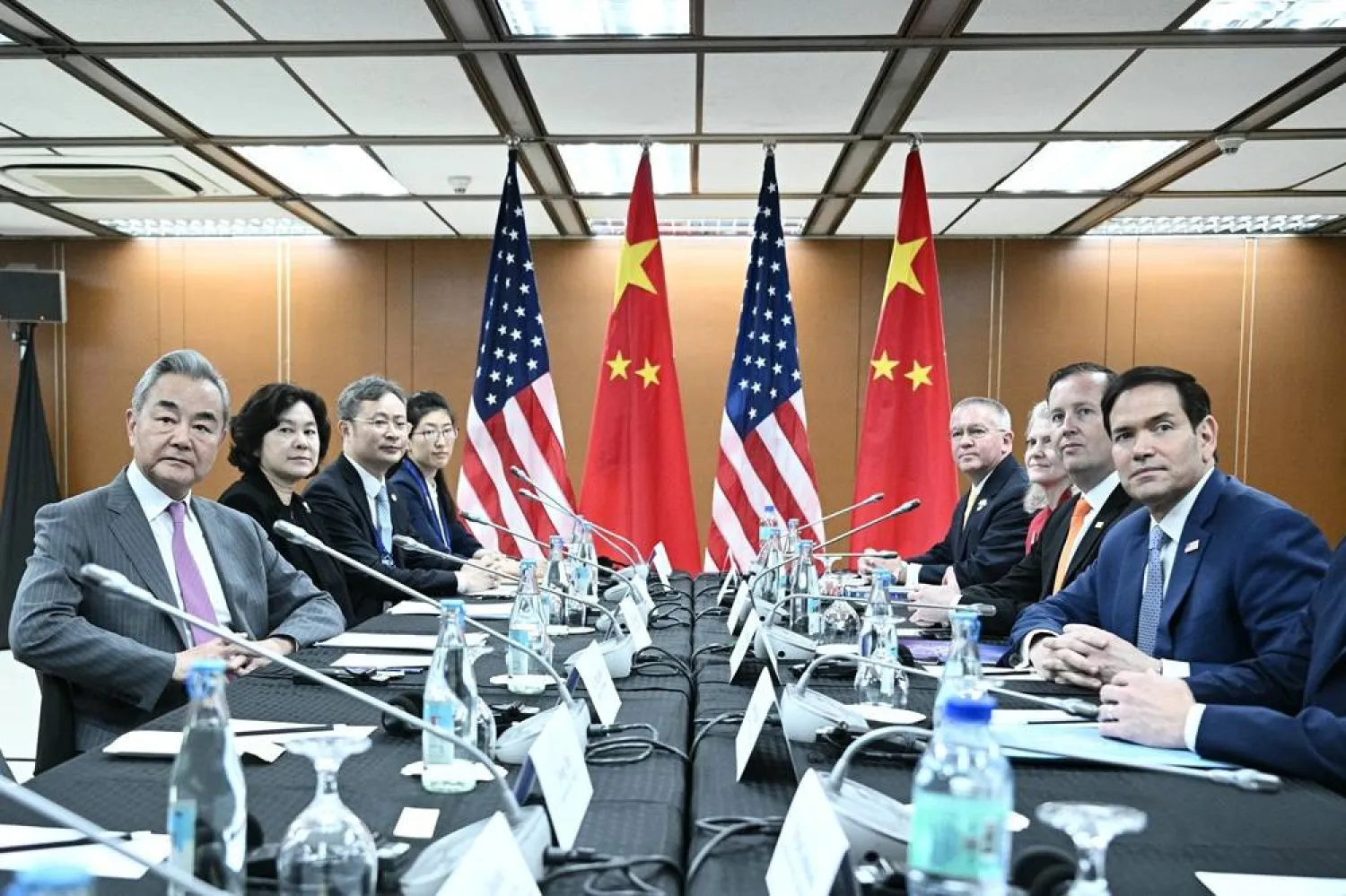
 Secretary of State Marco Rubio, right, takes part in a bilateral meeting with China's Foreign Minister Wang Yi, left, on the sidelines of the Association of Southeast Asian Nations (ASEAN) Foreign Ministers' Meeting in Pasay, Metro Manila, Philippines Wednesday, July 22, 2026. (Brendan Smialowski/Pool Photo via AP)
Secretary of State Marco Rubio, right, takes part in a bilateral meeting with China's Foreign Minister Wang Yi, left, on the sidelines of the Association of Southeast Asian Nations (ASEAN) Foreign Ministers' Meeting in Pasay, Metro Manila, Philippines Wednesday, July 22, 2026. (Brendan Smialowski/Pool Photo via AP)
TT

Rubio Meets China’s Wang at Regional Gathering Where Iran War Looms Large

 Secretary of State Marco Rubio, right, takes part in a bilateral meeting with China's Foreign Minister Wang Yi, left, on the sidelines of the Association of Southeast Asian Nations (ASEAN) Foreign Ministers' Meeting in Pasay, Metro Manila, Philippines Wednesday, July 22, 2026. (Brendan Smialowski/Pool Photo via AP)
Secretary of State Marco Rubio, right, takes part in a bilateral meeting with China's Foreign Minister Wang Yi, left, on the sidelines of the Association of Southeast Asian Nations (ASEAN) Foreign Ministers' Meeting in Pasay, Metro Manila, Philippines Wednesday, July 22, 2026. (Brendan Smialowski/Pool Photo via AP)

US Secretary of State Marco Rubio and Chinese counterpart Wang Yi on Wednesday discussed a visit to the US in September by Chinese President Xi Jinping during an Asian gathering where ministers voiced concern about the Iran war and South China Sea tensions.

Rubio said he and Wang discussed at length the need to lay the groundwork for a "very positive visit" by Xi, and it was their job to manage the big differences between the two countries and ensure they did not get out of control.

Wang on his part demanded that the US "respect China's core interests ... effectively manage differences and disagreements, and address China's legitimate concerns," according to an official Chinese summary, which called the meeting "pragmatic, positive, and constructive."

Wang and Rubio agreed to "make sound preparations for the next stage of high-level exchanges," Wang's ministry said in a statement.

The broader ASEAN meeting in Manila comes amid a flare-up in the conflict between the US and Iran, and while tension simmers between Beijing and close ‌US ally the Philippines ‌over an incident in the South China Sea on Monday that led each to summon the other's ‌ambassador.

Meeting ⁠with foreign ministers ⁠of the Association of Southeast Asian Nations, who expressed serious concern about the Middle East war, Rubio put the blame squarely on Iran.

"The problem we're having right now is that they're not serious about talks," he said.

"If they're serious, we're serious. If they're not, then we will do what's necessary to protect our interests, and also the interests of our allies."

He stressed that Iran could not be allowed to control the Strait of Hormuz, as it could set a dangerous precedent for other parts of the world.

'COMMERCE AS A GEOPOLITICAL WEAPON'

His remarks follow his opinion piece in Philippine media on Tuesday that took aim at Beijing's conduct in the South China Sea, warning of "dire new threats" if those waters were to "fall under the control of ⁠a power willing to use commerce as a geopolitical weapon".

Beijing claims sovereignty over almost the entire ‌South China Sea via a line on its maps that cuts into the exclusive economic zones ‌of Brunei, Indonesia, Malaysia, the Philippines, and Vietnam, and is at the center of long-running disputes over a multitude of islands and features.

Australia's Foreign Minister ‌Penny Wong said Monday's altercation between China's coast guard and Philippine navy personnel in the South China Sea was risky and destabilizing.

"The countries ‌of the region have a choice to make about how we all respond to that," Wong told reporters.

China's foreign ministry spokesperson Lin Jian hit back at Wong, saying Australia had no right to intervene in the South China Sea and that Beijing "urges relevant countries to stop stirring up tension and inciting confrontation".

Canada's top diplomat Anita Anand called the maritime tension "troubling" and in an interview with Reuters said a negotiated settlement in the Middle East was crucial, as ‌was freedom of passage through key waterways such as the Strait of Hormuz.

Disputes between the Philippines and China have increased in recent years as Manila takes a bolder stance on the South ⁠China Sea, while pursuing closer defense ties ⁠with treaty ally the United States, plus Australia and Japan.

RUBIO DUE TO MEET LAVROV

China's Foreign Minister Wang had said on Tuesday some elements of the Philippines' security apparatus had engaged in deliberate provocations that served interests of "external forces", and Beijing could work with ASEAN to "eliminate interfering factors".

He met ASEAN counterparts on Wednesday and told them their mutual trust and respect was essential, and together they could get things done and "be the anchor for regional and global peace and development".

Russian Foreign Minister Sergei Lavrov confirmed he would meet in Manila on Thursday with Rubio, who said he would discuss the Ukraine war, adding that Washington was looking to play a constructive role to end it.

Rubio also joined counterparts from India, Australia and Japan for a meeting of the Quad grouping that Beijing has criticized as being Cold War-like.

Rubio's meeting with Wang, which lasted about 90 minutes, came amid a fragile truce between the world's biggest economies that could be complicated by President Donald Trump's accusations of Chinese interference, which Beijing has rejected.

Rubio said those allegations were not discussed and the two talked about trade, Taiwan and areas for potential cooperation ahead of Xi's Washington trip.

Wang "stated China's solemn position on a series of recent negative remarks and actions by the US side" and demanded the US abide by the "One China" principle, the Chinese foreign ministry said.


Erdogan Takes Russia, Ukraine to Task Over Black Sea Attacks

Turkish President Recep Tayyip Erdogan and Ukrainian President Volodymyr Zelensky shake hands during a press conference in Istanbul, Türkiye, October 31, 2026. (Reuters)
TT

Erdogan Takes Russia, Ukraine to Task Over Black Sea Attacks

Turkish President Recep Tayyip Erdogan and Ukrainian President Volodymyr Zelensky shake hands during a press conference in Istanbul, Türkiye, October 31, 2026. (Reuters)

Türkiye’s President Recep Tayyip Erdogan said on Saturday attacks aimed at civilian vessels in the Black Sea were unacceptable, urging Russia and Ukraine to "act responsibly".

Despite its ties with both Russia and Ukraine, Türkiye has been infuriated by the attacks on commercial vessels in the Black Sea.

"It is clear that attacks against civilian vessels and actions that further escalate tensions in the Black Sea serve no one's interests," Erdogan told a news conference with Ukraine's President Volodymyr Zelensky in Istanbul.

"We cannot accept these attacks under any circumstances, regardless of who carries them out or what justification is offered. We call on all parties to act responsibly on this matter," he said.

Ankara has sent a proposal to Russia and Ukraine to end strikes on civilian ships, but says the two foes have failed to act on it.

"We will continue our talks with the parties concerned with a view to restoring the safety of navigation in the Black Sea," the Turkish leader said.

"I believe that reaching an agreement on this issue would also give fresh impetus to efforts to secure lasting peace in Ukraine."

Türkiye has also hosted several rounds of talks between Russia and Ukraine aiming for a lasting ceasefire and peace deal.

In a phone call with US President Donald Trump on Wednesday, Erdogan said Türkiye was ready to support efforts to revive the diplomatic process between Ukraine and Russia and bring the war to an end through negotiations, according to the Turkish leader's office.


Rubio Says US Yet to Decide on New Iran Strikes

Iranian people walk past a mural depicting late Iranian supreme leader Ali Khamenei, in a street of Tehran, Iran, 31 October 2026. (EPA)
TT

Rubio Says US Yet to Decide on New Iran Strikes

Iranian people walk past a mural depicting late Iranian supreme leader Ali Khamenei, in a street of Tehran, Iran, 31 October 2026. (EPA)

US President Donald Trump has not made a decision about fresh strikes on Iran amid stalled peace talks, US Secretary of State Marco Rubio said Saturday.

"We can achieve military objectives if we seek to," Rubio told a press conference in Atlanta, Georgia, where he was hosting G20 foreign ministers for a two-day meeting.

But Rubio added that Trump "hasn't made a decision" on further military action, amid reports that the US leader could attack after key midterm elections on Tuesday.

"I have no announcement in that regard with you today, and nor do we take any of it lightly," Rubio said.

While he slammed Tehran for "actively and openly" targeting commercial vessels for attack, Rubio also expressed Trump's preference for a diplomatic solution to end war with Iran.

But he did not commit to a timeline for talks.

"I'm not going to characterize neither the progress on those talks nor any timeframe on it, other than to tell you that if there is a diplomatic solution, we would be open to it," Rubio said.

Iran's supreme leader on Saturday warned the United States and Israel against launching new attacks, following threats to resume strikes after crucial elections.

Trump earlier warned of the potential for fresh military action after US midterms, saying previously that he was weighing up whether to "finish them off."

But any further attack would spark concern among US allies.

On Thursday, EU foreign policy chief Kaja Kallas told AFP: "We are calling for a diplomatic solution, and really, escalation does not benefit anyone."


Iranian Envoys Meet Qatari Mediators as Threat Looms of US Strikes After Midterms

A man holds Iran's national flag in a street of Tehran, Iran, 31 October 2026. (EPA)
TT

Iranian Envoys Meet Qatari Mediators as Threat Looms of US Strikes After Midterms

A man holds Iran's national flag in a street of Tehran, Iran, 31 October 2026. (EPA)

Iranian negotiators held talks in Doha with Qatari mediators on Saturday to discuss paths out of war in the region, a source told Reuters, as diplomats try to avert a new outbreak of fighting after the US midterm elections this week.

Saturday's talks in the Qatari capital followed more than 12 hours of discussions on Friday between Iranian and Qatari envoys in Tehran, said the source, who was briefed on the negotiations and spoke on condition of anonymity. The source said the talks were being coordinated in regular contacts with Washington.

Countries in the region have been anticipating that US President Donald Trump, who has held off on strikes on Iran during the weeks leading ‌up to Tuesday's ‌midterm elections, could restart attacks once the voting is over. Iran has repeatedly ‌said ⁠it would respond ⁠to new attacks by striking at US and Israeli targets in neighboring countries.

Iran's Supreme Leader Mojtaba Khamenei issued a statement on Saturday ordering the armed forces to be prepared to respond to any attacks. The Iranian military later announced it was taking steps to improve its readiness.

"Any level or type of threat must be met with an immediate, impactful, and geographically unrestricted response," Khamenei, who has not appeared in public since replacing his father slain at the war's outset, said on Saturday in the statement posted on his official Telegram account.

He said ⁠that senior commanders had reported high readiness along the Gulf coast, in ‌and around the Strait of Hormuz and Gulf of Oman, and ‌on Iran's northwestern and southeastern borders.

DIPLOMACY CONTINUES DESPITE GAPS

Trump, who launched the war alongside Israel in February, has repeatedly hinted ‌at plans to restart strikes on Iran. Last week he called on Israelis ahead of their ‌own election to keep his wartime ally Prime Minister Benjamin Netanyahu in power so the two leaders can "finish the job".

But Washington has also lately taken steps to indicate it is open to diplomacy. Earlier this week, Vice President JD Vance, who led the US delegation at previous rounds of talks with Iran, wrote a letter to a hardline senior ‌Iranian security official, which the New York Times and Wall Street Journal described as an initiative to see if it was possible to restart talks.

Trump ⁠played the letter down, ⁠saying he approved it only to discuss the possibility of letting more medical supplies into Iran: "I said if you want to do that, that's ok. Basically, it's getting supplies in to help people that are not well."

In the latest Qatari-mediated discussions, the Qataris brought a proposal to Tehran a week ago for a seven-day plan, under which the US and Iran would take daily steps to build trust ahead of broader peace talks, the source briefed on the negotiations said. A senior Iranian official told Reuters on Friday that this proposal was not deemed satisfactory by Tehran.

Iran has been proposing its own seven-day plan since September, so far rejected by Trump. That calls for Washington to lift a blockade of Iranian ports, unfreeze assets and approve an Iranian-backed route through the Strait of Hormuz, after which the contested strait would be reopened.

Foreign Minister Abbas Araghchi said in remarks reported by Al Jazeera on Saturday that Iran was studying Vance's letter. He said the Iranian plan was the only proposal on the table to reopen the strait.