


Iran Ramps up Executions Under Shadow of War

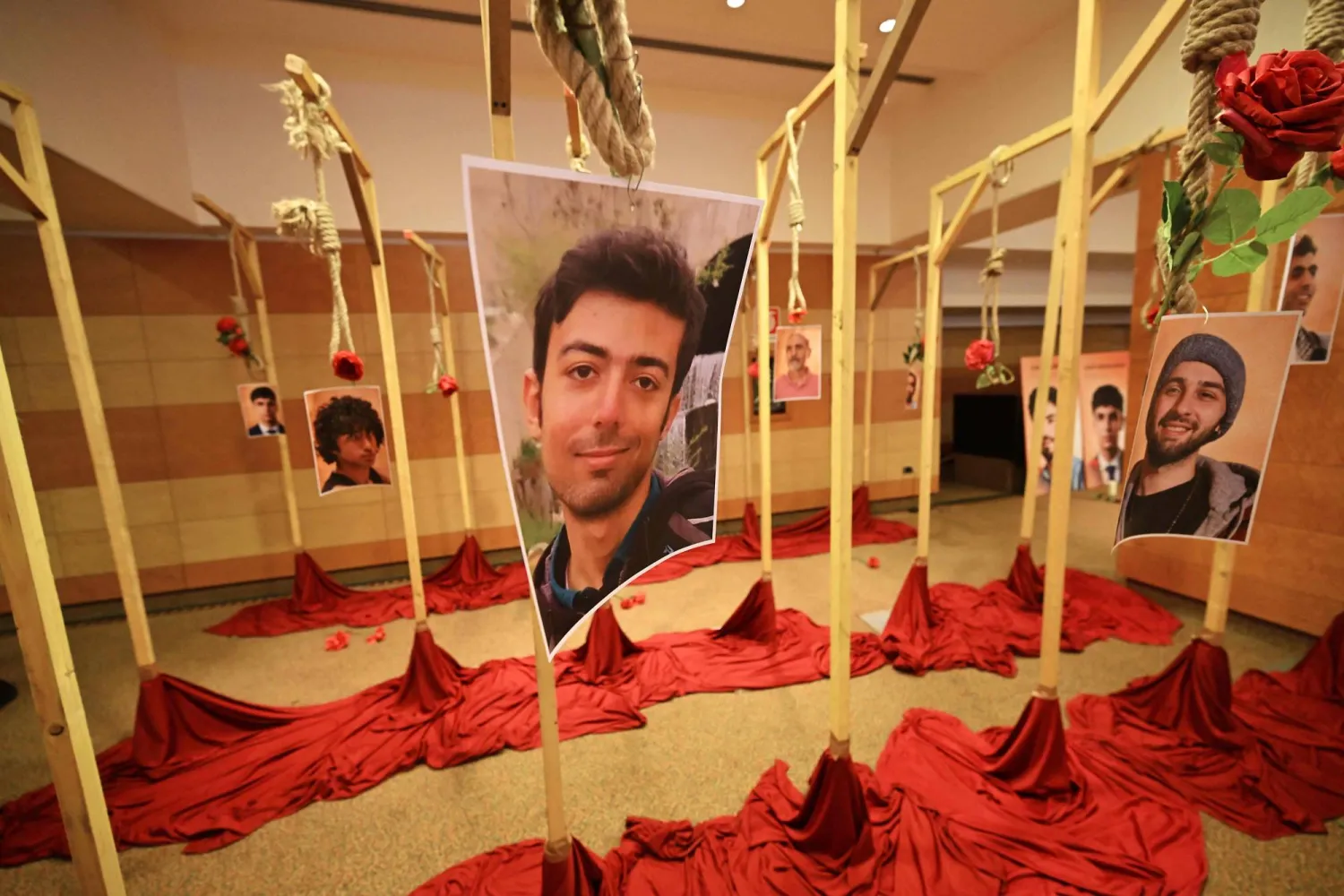
This photograph shows portraits of Iranian protesters allegedly executed by the Iranian regime during protests in Iran are displayed during a demonstration at the Ergife Palace Hotel to condemn the silence of Western governments in the face of the growing wave of Iranian political executions, in Rome on July 16, 2026. (AFP)
TT

Iran Ramps up Executions Under Shadow of War

This photograph shows portraits of Iranian protesters allegedly executed by the Iranian regime during protests in Iran are displayed during a demonstration at the Ergife Palace Hotel to condemn the silence of Western governments in the face of the growing wave of Iranian political executions, in Rome on July 16, 2026. (AFP)

Vahid Baniamerian's family only found out he was going to be executed when Iranian state media reports flashed on their phones, saying the supreme court would review his death sentence.

"They did not give any warning. Even the lawyer didn't know," a close relative of Baniamerian, based outside of Iran, told AFP, asking not to be identified.

"It was completely illegal, even based on their own oppressive laws."

Baniamerian, a 34-year-old academic who taught physics, was sentenced to death along with five other defendants on charges of membership of the outlawed People's Mujahedin (MEK) organization. All six men have now been hanged.

He is one of dozens of people that rights groups say are political prisoners Iran has executed since the war with the United States and Israel started, from protesters to alleged members of banned groups and people convicted of spying.

Iran has pressed ahead with executions since the earliest phase of the war finished in March, in what activists see as an attempt to instill fear in society and prevent a repeat of the protests that shook the leadership earlier this year.

The political situation is now all the more febrile after the killing of longstanding supreme leader Ali Khamenei on the first day of the war and his replacement by his son Mojtaba, who has yet to appear in public.

- 'Where else in the world?' -

Now that a shaky ceasefire has ruptured, rights groups fear Iran will further ramp up executions to intimidate people into silence.

"With the breakdown of the ceasefire and the resumption of the war, we are deeply concerned that the authorities will exploit the situation to intensify the execution of political prisoners," said Mahmood Amiry-Moghaddam, the director of the Iran Human Rights (IHR) NGO, which tracks executions.

IHR warns "hundreds of political prisoners and protesters are currently facing capital charges" with around 100 already sentenced to death.

This includes over 70 people awaiting the gallows in a single prison -- Dastgerd in the central city of Isfahan.

IHR has repeatedly called for what it terms Iran's "killing machine" to be a central part of any dialogue with the Iranian regime.

"The international community -- and the European Union in particular -- must make an immediate moratorium on executions a central issue" in any negotiations, said Amiry-Moghaddam.

According to IHR, since the start of the war, 24 people have been hanged over the January protests and another two over a previous protest movement that shook Iran between 2022 and 2023.

Authorities say those convicted carried out deadly attacks against security forces or targeted public buildings, but rights groups say they were tortured and convicted after grossly unfair fast-track trials.

Another 13 men have been executed for alleged links to the MEK and other banned groups, while 10 people have been hanged on accusations of espionage.

But with over 400 people executed so far in this year alone, according to IHR, such high-profile cases do not form the bulk of capital punishment in the country.

Most people are hanged on drugs-related charges or for murder.

To protest the high levels of hangings at their prison, inmates at Ghezel Hesar prison in Karaj outside Tehran have staged a sit-in protest since July 13 after fellow prisoners were taken to solitary confinement ahead of hanging on drugs charges.

Footage shared by rights groups on social media showed inmates sitting outside their cells chanting "no to execution".

"These are prisoners who committed errors simply to afford the basic necessities of life, and they deeply regret their actions. Where else in the world is a human life taken for a first mistake?" the prisoners said in a statement seen by AFP.

- 'Do not cry' -

Last year, Iran put to death over 2,150 people, according to Amnesty International, making it again by a wide margin the world's most prolific executioner after China.

Baniamerian was from childhood "a kind and humble person", his relative said.

"He had a sense of responsibility. He always wanted to help," they added.

"Even in his darkest moments, he chose to encourage others instead of giving in to fear," the relative said.

In his last days in prison he tried to keep up the spirits of his fellow inmates and managed to have smuggled out an audio message to his mother.

"I said goodbye to you and did not know what lay ahead," he said referring to their final meeting.

A video also smuggled out of prison showed him singing a patriotic song in the prison yard ahead of execution.

"The day they took them to solitary, Vahid told them 'do not cry in front of the enemy. We are proud of what we are doing'," his relative said.



Pentagon Inks Tomahawk Deal Amid Reports of Missile Shortfall

A visitor walks past Raytheon stand at the 53rd International Paris Air Show at Le Bourget Airport near Paris, France June 21, 2019. (Reuters)
TT

Pentagon Inks Tomahawk Deal Amid Reports of Missile Shortfall

A visitor walks past Raytheon stand at the 53rd International Paris Air Show at Le Bourget Airport near Paris, France June 21, 2019. (Reuters)

The Pentagon announced a $22.9 billion contract with Raytheon on Monday for Tomahawk missiles amid reports of a shortfall due to the war with Iran.

Acting US Navy Secretary Hung Cao said the contract will "accelerate Tomahawk missile delivery to our warfighters at unprecedented speed."

"Guaranteeing our naval and joint forces have the lethal firepower they need to deter aggression and protect the homeland is paramount," Cao said in a statement. "The Department is utilizing every available tool to meet the demands of our current operations."

An analysis by the Center for Strategic and International Studies (CSIS) think tank released last month found that US stocks of Patriot and THAAD air defense missiles have been slashed by the conflict with Iran.

Before it began in late February, the United States had more than 2,300 Patriot and more than 450 THAAD interceptors -- figures that CSIS estimated have been roughly halved or more in the subsequent months of war.

The Washington Post reported this month that President Donald Trump had demanded answers from Pentagon chief Pete Hegseth about munitions shortages at a recent cabinet meeting.

Trump and Hegseth both later denied that the United States was faced with dwindling missile stocks.

Tomahawk missiles are mainly launched from submarines and warships and can travel more than 1,600 kilometers (1,000 miles).


UN Laments ‘Unacceptable’ Toll of 350 Aid Workers Killed in 2025

UN Under-Secretary-General for Humanitarian Affairs and Emergency Relief Coordinator Tom Fletcher briefs the media about the humanitarian crisis in the Gaza Strip during a press conference at the European headquarters of the United Nations (UNOG), Geneva, Switzerland, Aug. 22, 2025. (EPA)
TT

UN Laments ‘Unacceptable’ Toll of 350 Aid Workers Killed in 2025

UN Under-Secretary-General for Humanitarian Affairs and Emergency Relief Coordinator Tom Fletcher briefs the media about the humanitarian crisis in the Gaza Strip during a press conference at the European headquarters of the United Nations (UNOG), Geneva, Switzerland, Aug. 22, 2025. (EPA)

The number of aid workers killed worldwide in 2025 reached 350, with the most fatalities in Gaza and Sudan, the United Nations said Monday, calling attacks on humanitarians "unacceptable."

The death toll, however, was slightly lower than that of 2024, when 377 aid workers were killed.

The UN Office for the Coordination of Humanitarian Affairs (OCHA) cited the figures from the research and advisory group Humanitarian Outcomes in a statement marking World Humanitarian Day.

Some 186 humanitarians were killed in Gaza -- the deadliest place for aid workers for the third year running -- followed by Sudan with 71 killed.

"More than 1,000 aid workers have been killed in just three years and that is utterly unacceptable," Tom Fletcher, under-secretary-general for humanitarian affairs, said in the statement.

"But just calling it out will not protect the next aid worker. States must uphold international humanitarian law and use every tool to protect civilians and our colleagues," he said. "And for those who break the rules, there must be real consequences."

Since the start of 2026, 82 more aid workers have been killed, 97 injured and 39 abducted worldwide.

OCHA voiced particular concern over the proliferation of armed drones "that are putting lethal power into ever more hands and sending more explosive weapons into towns and cities."

In Sudan, armed drones caused 80 percent of civilian deaths in the first four months of 2026, hitting markets and health facilities, the statement said, also noting casualties from drone attacks in the Russia-Ukraine war.

"Weaponized drones have become the new face of an old danger: the deliberate or reckless destruction of civilian life," Fletcher said.


Reports: UK PM Exchanged Messages with Trump Aide Imposter

Prime Minister Andy Burnham speaks with apprentices and staff at the met office during a visit on August 14, 2026 in Exeter, United Kingdom. (Reuters)
TT

Reports: UK PM Exchanged Messages with Trump Aide Imposter

Prime Minister Andy Burnham speaks with apprentices and staff at the met office during a visit on August 14, 2026 in Exeter, United Kingdom. (Reuters)

New British Prime Minister Andy Burnham exchanged messages with someone posing as Susie Wiles, the White House chief of staff, several media outlets reported on Monday.

According to Politico, which broke the story quoting anonymous sources, the British leader sent a "few messages" via an unspecified communication channel to a person he believed to be Wiles before becoming suspicious.

The incident was deemed serious enough for the British embassy in Washington to raise the matter with the White House, according to two sources cited by Politico.

Neither the date nor the content of the exchanges is known.

Burnham succeeded former Labour Party leader Keir Starmer as prime minister on July 20.

"We do not comment on national security matters," a spokesperson for Burnham's Downing Street office said, without denying the exchanges.

Burnham is not the first prominent British politician to fall victim to this type of hoax.

In 2024, the British government released a video of a phone call in which the then foreign minister David Cameron was duped by someone posing as former Ukrainian president Petro Poroshenko.

The Foreign Office explained at the time that it had disclosed the incident to preempt any attempt by the perpetrators to manipulate the footage.