


Israeli Generals Accuse Netanyahu of Seeking to Ignite a ‘Third Intifada’

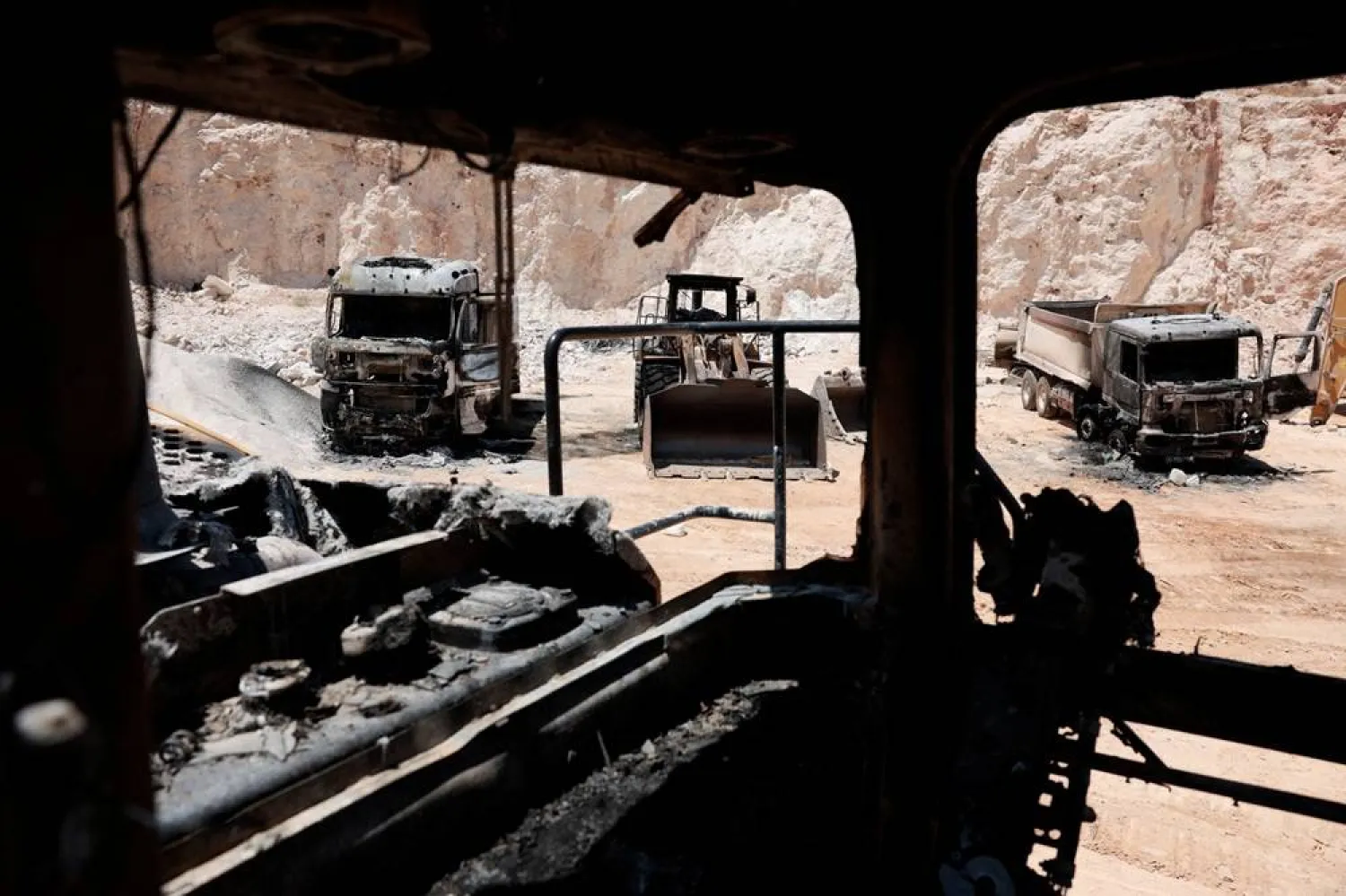
Heavy machinery that was burned inside a Palestinian quarry after Palestinians say Israeli settlers attacked yesterday, near Ramallah, in the Israeli-occupied West Bank, July 27, 2026. (Reuters)
TT

Israeli Generals Accuse Netanyahu of Seeking to Ignite a ‘Third Intifada’

Heavy machinery that was burned inside a Palestinian quarry after Palestinians say Israeli settlers attacked yesterday, near Ramallah, in the Israeli-occupied West Bank, July 27, 2026. (Reuters)

Several generals close to the Israeli military leadership have launched a broad campaign against Prime Minister Benjamin Netanyahu's policies, accusing him of seeking to "ignite a third intifada in the West Bank" as his "only way out to remain in power."

Six hundred former generals and senior officials sent a letter to US President Donald Trump, urging him to "halt the deterioration in the West Bank and exploit his meeting with Netanyahu to rein in his comrades and allies in the far-right who are drowning the country in blood."

Netanyahu departed for the US for a meeting with Trump on Monday.

In their letter, the generals argued that "faced with US pressure to end the war, remaining aside on the Iranian front, and withdrawing from vast areas in Lebanon, Syria, and the Gaza Strip, Netanyahu has nothing left but the West Bank. He needs a conflict to maintain the state of emergency, which he requires either to unite the right around him or to postpone the elections that appear poised to cost him power."

Several opinion polls regarding the upcoming general elections in October indicate that Netanyahu's chances of forming a government appear to be declining, contrasted with the growing chances of his main rival, former Chief of Staff Gadi Eisenkot, making significant gains.

The generals, who are making media statements, writing articles, or organizing protest petitions, have noted the bloody attacks carried out by Israeli settlers against Palestinians with overt government backing.

These attacks reached a new peak last week when hundreds of settlers torched Palestinian homes, cars, and shops, resulting in the deaths of two Israeli soldiers and four Palestinian citizens in the village of Tal, near Nablus.

Although the Israeli military is decisively fueling the situation under the pretext of protecting settlers, its generals directly accused the government of planning the current unrest, driven in part by certain ministers with far-right ideological motives aimed at preventing the establishment of a Palestinian state, and in part by others for partisan and personal electoral purposes.
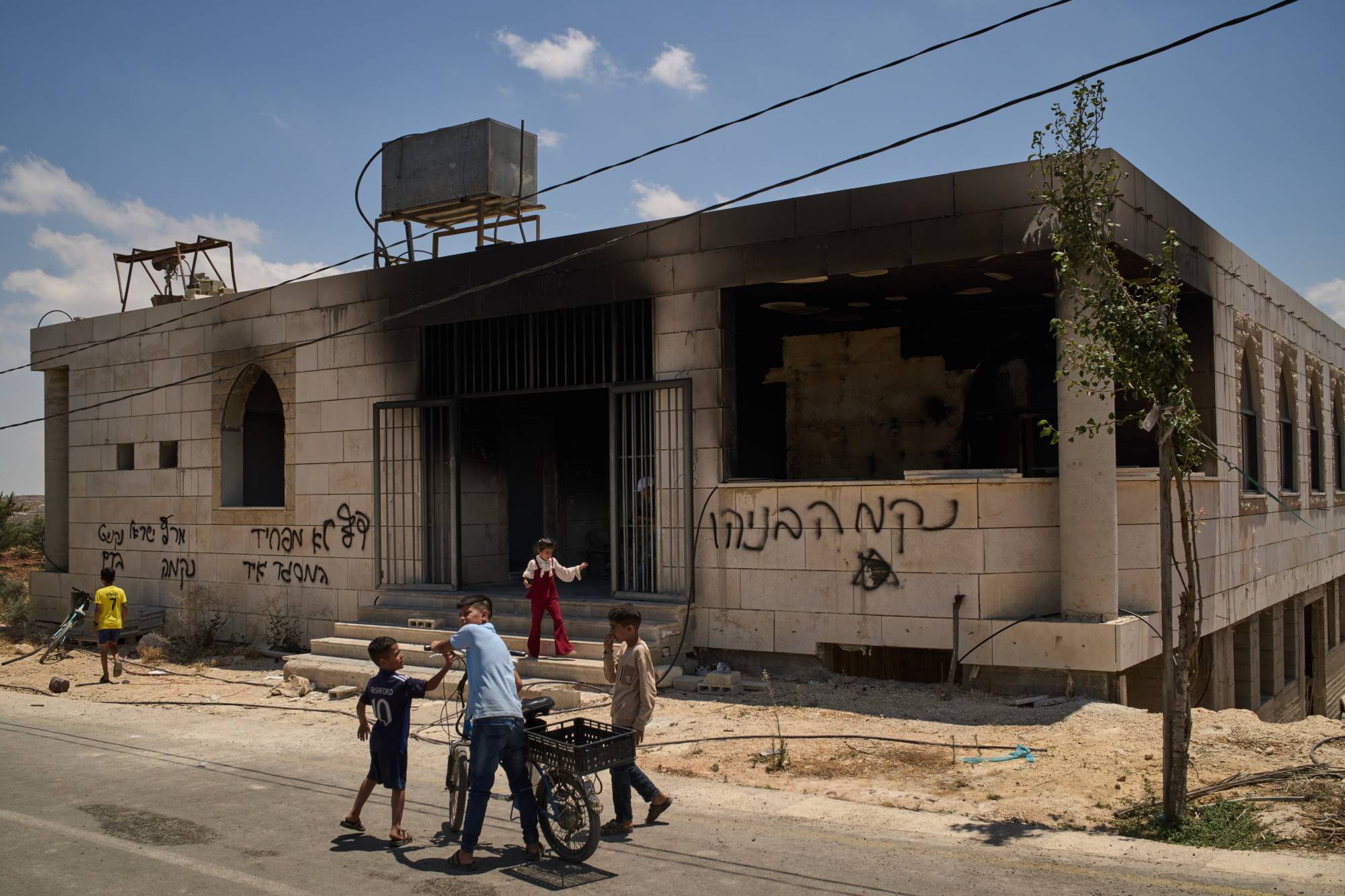
Children stand outside a mosque that was burned during an attack by Israeli settlers early in the morning in the West Bank village of Qusra, Sunday, July 26, 2026, as on its wall a Hebrew graffiti reads "Revenge Benayahu", referring to an Israeli settler killed during clashes with Palestinians in the village of Tell, last Friday. (AP)

‘Playing with fire’

Yedioth Ahronoth published an editorial on Monday written by military correspondent Yossi Yehoshua under the headline "Playing with Fire," in which he stated that the military feels caught in an ambush: settlers attack, Palestinians respond, the military defends, Palestinians express their anger, settlers react, and so on, until the cycle of violence expands and can no longer be stopped.

He added that "in an attempt to calm the situation, the Israeli military requires a massive force, deploying 26 battalions to the West Bank alone while maintaining long, open war fronts in Gaza, Lebanon, Syria, and the West Bank, leaving almost no room to breathe."

Yehoshua expressed his belief that "the root of the scourge lies in the settlement map of the West Bank, which is undergoing the largest shift in its history; plans for 80 settlements have been approved, 34 of which have already been built. Alongside this, more than 100 pastoral farms and a similar number of outposts have been established, some of which are currently undergoing regularization procedures."

He stated: "It is important to understand that every new settlement is not just a point on the map, but requires protection; it creates transit routes, friction points, security missions, and a defensive routine. As Israeli territory expands, the area that the Israeli military must protect also widens."

The author pointed to a grim equation emerging: Palestinians are initiating almost no resistance activities, yet the more they reduce these acts, the more settlers increase their attacks against them.

According to data from the security establishment and the police, 660 Israeli attacks against Palestinians were recorded in the first half of 2026, representing a 63 percent increase compared to the second half of 2025, which saw 405 recorded incidents.

On the verge of a third intifada

Also in Yedioth Ahronoth, Nahum Barnea wrote that "the third intifada is on the brink of erupting, and if it happens, it will be different from its two predecessors; it will be the first to break out according to the vision of the Israeli government. There are those who sow the wind in hopes of reaping a whirlwind. Netanyahu sowed the wind, and he is pursuing and pushing for a third intifada."

However, Barnea held the army responsible, stating: "If the weekend's round of violence turns into a third intifada, the Israeli military will not be exempt from responsibility for the bloodshed. The commander's mission is to protect Israelis residing in Area C, but he has a prior mission rooted in the country's laws and international law: to be the sovereign, enforce his rule over the area, and ensure the security of all residents. This is his military, leadership, and legal duty."
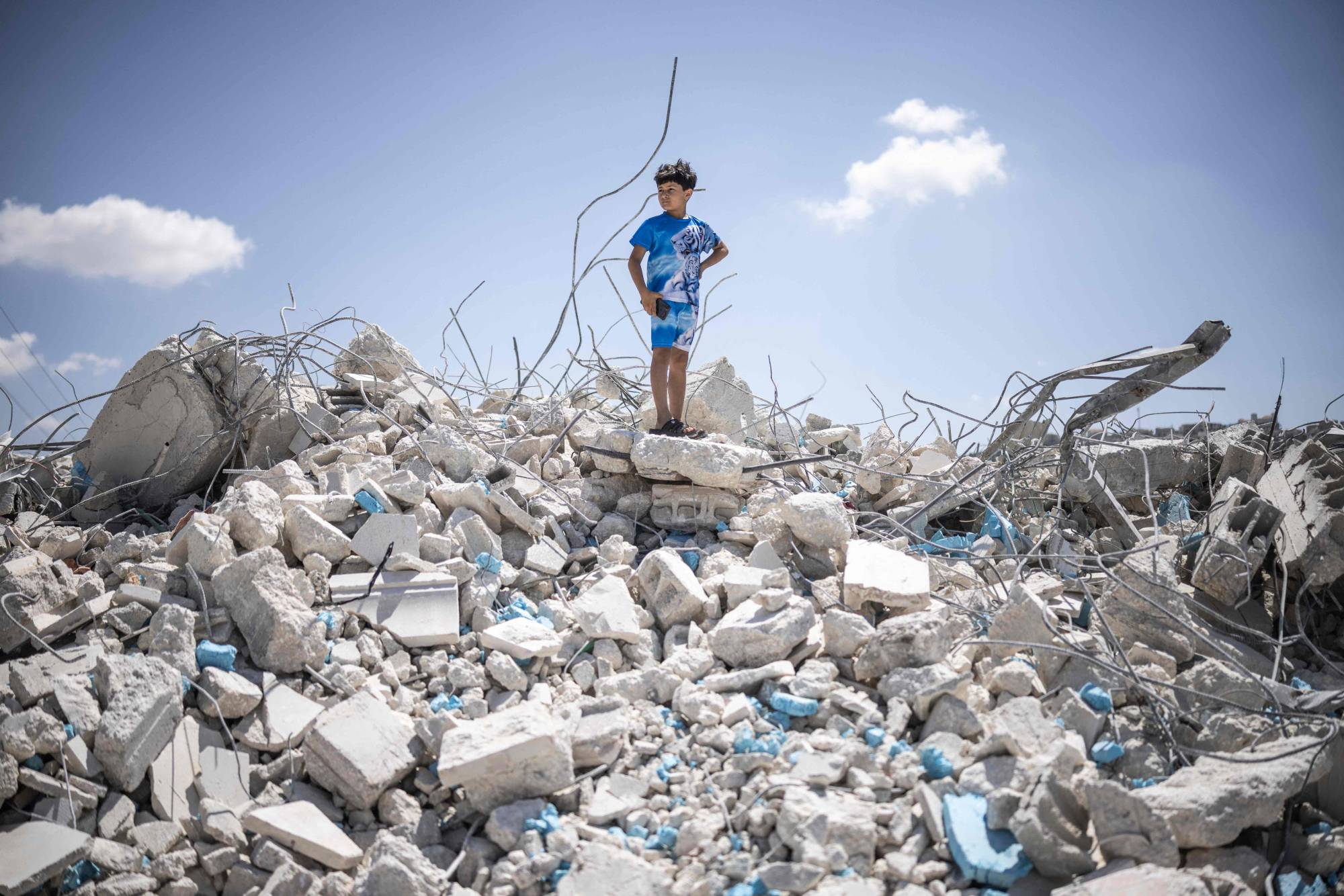
A Palestinian boy stands on top of a pile of rubble from a building containing shops and flats that were demolished by Israeli forces, citing the lack of a building permit, in Arraba, south of the Palestinian city of Jenin in the northern Israeli-occupied West Bank, on July 27, 2026. (AFP)

Effective international intervention

In Haaretz, historians Dr. Assaf Bondy and Dr. Adam Raz wrote that "what Israel is doing against the Palestinians requires effective international intervention."

They noted that "even under the darkest regimes that adopted killing as a method of governance, these regimes often sought to prosecute those who committed crimes of murder and looting in violation of their own 'regulations' and 'laws' - not out of integrity, but because even a murderous regime seeks to monopolize crime to ensure that killing is carried out by order, or according to specific goals and plans, rather than individual initiative."

The two historians noted that "Israel in 2026, after nearly three years of genocide in the Gaza Strip, has abandoned even this appearance; crime is no longer merely remote from justice, but is now openly celebrated."

They cited Finance Minister Bezalel Smotrich smiling proudly while holding the Peace Now movement's report on massacres in the Palestinian territories and the accelerated pace of annexation.

They warned that while "many of the state's citizens pin their hopes on the judicial system, a realistic view reveals that the judicial system in Israel is nothing but another cog in the crime machine called the State of Israel."

The historians concluded that "foreign intervention is necessary, otherwise the number of Palestinian victims will increase dramatically."



IRGC Signals Shift Toward Wider, More Offensive War

An Iranian woman walks past an anti-US billboard in Enghelab Square in central Tehran (EPA) 
TT

IRGC Signals Shift Toward Wider, More Offensive War

An Iranian woman walks past an anti-US billboard in Enghelab Square in central Tehran (EPA) 

A senior Iranian Revolutionary Guard Corps official has warned that Iran could shift from defensive to offensive military operations, as Tehran and allied armed groups in Iraq, Yemen and Lebanon reportedly prepare plans to broaden the conflict and raise the cost for the United States and its allies.

Yadollah Javani, the IRGC’s deputy for political affairs, told Iranian state television that Iran’s military actions had so far been defensive because its adversaries had started the war, but could become offensive in the future.

He said the armed forces would adopt new approaches following recent appointments and directives from Supreme Leader Mojtaba Khamenei and warned Iran’s adversaries to expect what he described as strategic surprises.

The warning came as a senior Iranian official told Reuters on Monday that Tehran would escalate tensions in the Strait of Hormuz and the wider region if diplomacy with Washington failed.

The official said Iran had decided to shift from a defensive posture to a “fully offensive” one and had given the United States “a few weeks” to fully implement the memorandum of understanding. The official noted that relying on pressure or mediators to secure a lasting agreement was no longer considered realistic.

Javani reiterated Iran’s position that ending the war and reopening the Strait of Hormuz depended on Washington fulfilling its commitments under the Islamabad memorandum. He said the waterway and the arrangements governing it would not return to their prewar status, adding that Iran’s talks with Oman over a shipping corridor concerned the period after hostilities had definitively ended.

He described Khamenei’s recent military appointments as a restructuring aimed at adapting Iran’s defense doctrine to current conditions. Mohammad Reza Naqdi, an adviser to the IRGC commander, has also spoken of moving from a defensive military doctrine toward a more offensive approach.

IRGC Deputy Commander Maj. Gen. Mostafa Izadi, meanwhile, claimed Iran had endured the war, sanctions and blockade while spending only a fraction of what its adversaries had spent. He also claimed Iranian forces had shot down more than 200 aircraft during the conflict.

At the same time, intercepted communications and intelligence indicate that the IRGC has been working with allies in Iraq, Yemen and Lebanon on plans to expand the battlefield, The Wall Street Journal reported, citing regional officials.

According to the newspaper, Tehran used the relative lull following the June 17 memorandum with Washington to reorganize its military and security structure, rebuild capabilities and prepare for a broader confrontation, based on an assessment that war remained the most likely scenario and negotiations might amount only to a temporary pause.

Preparations reportedly included giving the IRGC greater influence over the regular military, reorganizing the chain of command, expanding counterintelligence efforts and accelerating missile and drone production while improving accuracy.

Iran also dispatched advisers and commanders to allied armed groups to discuss a possible expansion of the fighting. Plans included positioning missiles, naval weapons and drone launchers near the Red Sea, supplying allies with intelligence, target lists and operational advice, and threatening regional energy facilities if the United States struck similar infrastructure inside Iran.

Other options reportedly under consideration include preemptive strikes, operations on adversaries’ territory, possible sabotage of undersea internet cables, and greater use of the Strait of Hormuz and Red Sea to exert military and economic pressure.

The military restructuring has also placed veteran security figures in key positions, including Mohsen Rezaei, Hossein Taeb, Ali Abdollahi and Ahmad Vahidi, as Tehran prepares for the possibility of a broader confrontation.


Russia Downs 180 Drones in Moscow Region Overnight

Pedestrians walk past a destroyed DIY and construction materials mall "Galaktika" following an overnight attack, which local Russian-installed officials called Ukrainian drone strikes, in Donetsk, Russian-controlled Ukraine, on August 16, 2026, amid the ongoing Russian-Ukrainian conflict. (Photo by AFP)
TT

Russia Downs 180 Drones in Moscow Region Overnight

Pedestrians walk past a destroyed DIY and construction materials mall "Galaktika" following an overnight attack, which local Russian-installed officials called Ukrainian drone strikes, in Donetsk, Russian-controlled Ukraine, on August 16, 2026, amid the ongoing Russian-Ukrainian conflict. (Photo by AFP)

Russia downed 180 drones in the Moscow region overnight, the capital's mayor, Sergei Sobyanin, said on the Telegram messaging app early on Tuesday, in one of the biggest Ukrainian air ‌attacks on ‌the Russian capital.

Drones ‌hit ⁠a warehouse of ⁠Russian e-commerce company Wildberries and other facilities near Moscow, regional governor Andrei Vorobyov said separately, adding that at least three ⁠people, including a 10-year-old ‌girl, were ‌injured in the region, reported Reuters.

Wildberries, a ‌frequent target of ‌Kyiv's attacks following Russia's full-scale invasion of Ukraine in 2022, said in a statement that the ‌warehouse experienced minor damage after drone debris hit ⁠one ⁠of its walls.

Overall, 620 drones were heading for the region surrounding the Russian capital between Monday evening and 5 a.m. (0200 GMT), according to Sobyanin, and Moscow was temporarily restricting flights at its airports.


UKMTO: Vessel Struck by Unknown Projectile in Strait of Hormuz, Crew Casualty Reported

Archive photo of ships crossing the Strait of Hormuz (AFP)
TT

UKMTO: Vessel Struck by Unknown Projectile in Strait of Hormuz, Crew Casualty Reported

Archive photo of ships crossing the Strait of Hormuz (AFP)

The United Kingdom Maritime Trade Operations (UKMTO) received a report on Tuesday that a vessel was struck ‌by an ‌unknown projectile ‌while ⁠transiting outbound in the ⁠Strait of Hormuz, causing engine room damage and a crew casualty, with the ⁠remaining crew being ‌assisted ‌by the Omani Coast ‌Guard, Reuters said.

No environmental impact ‌has been reported and authorities are investigating, UKMTO said.

The incident ‌comes as shipping through the Strait of ⁠Hormuz remains ⁠severely disrupted, with vessel crossings still in the single digits, down from more than 130 a day before the war.
