


Taiwan Drills to Test Relocating Arms Production Under Chinese Attack

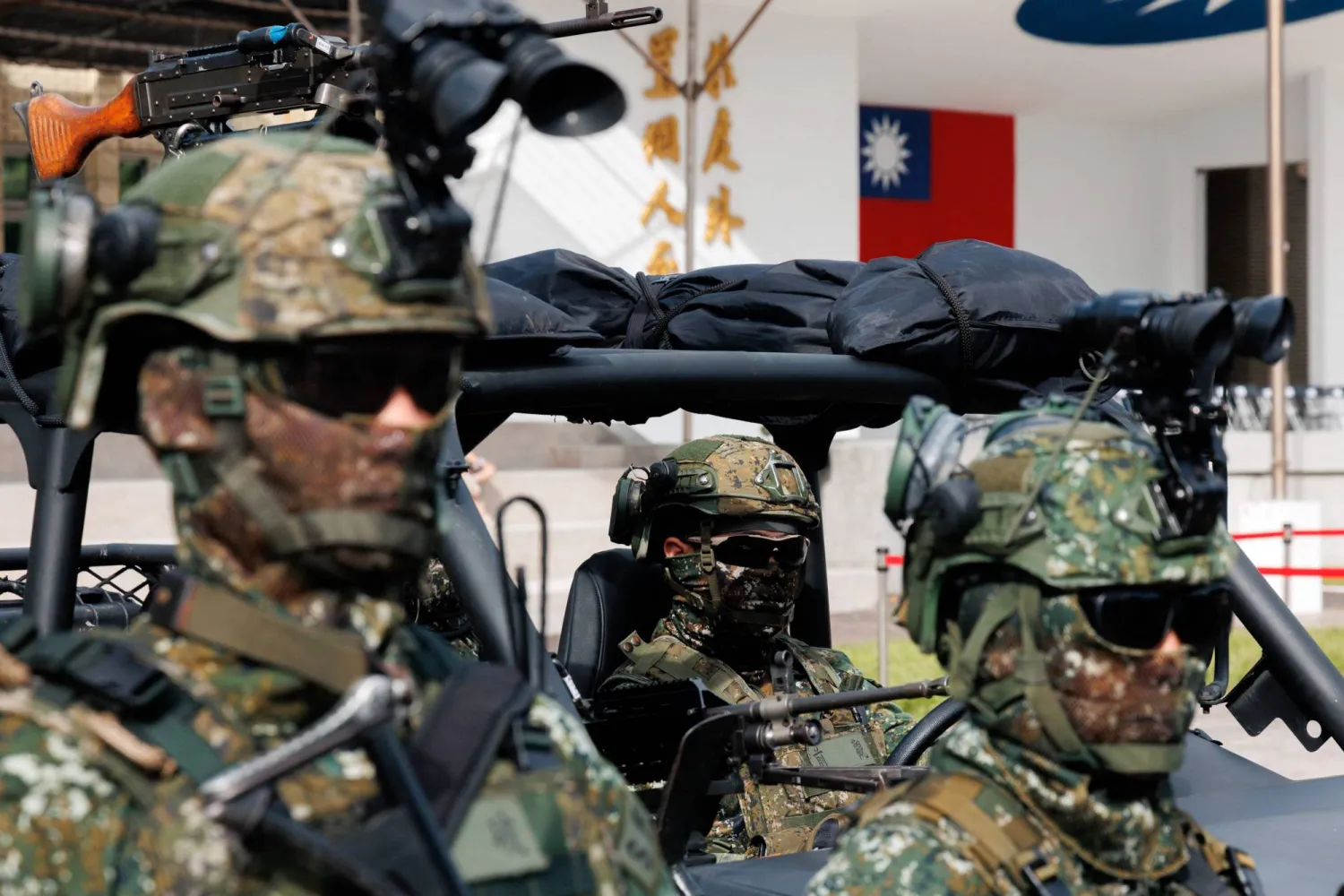
 Taiwanese soldiers instruct visitors on the use of military equipment during an open day at the National Defense University's Fuxinggang campus in Taipei on July 25, 2026. (AFP)
Taiwanese soldiers instruct visitors on the use of military equipment during an open day at the National Defense University's Fuxinggang campus in Taipei on July 25, 2026. (AFP)
TT

Taiwan Drills to Test Relocating Arms Production Under Chinese Attack

 Taiwanese soldiers instruct visitors on the use of military equipment during an open day at the National Defense University's Fuxinggang campus in Taipei on July 25, 2026. (AFP)
Taiwanese soldiers instruct visitors on the use of military equipment during an open day at the National Defense University's Fuxinggang campus in Taipei on July 25, 2026. (AFP)

Taiwan will test relocating weapons production lines and converting civilian factories for military use in annual drills next month, the defense ministry said on Tuesday, aiming to sustain combat operations if Chinese attacks hit supply hubs.

The exercise, part of the annual Han Kuang war games from August 5 to 14, will simulate China using routine military drills to conceal preparations for a full ‌invasion of Taiwan, prompting ‌the island's armed forces to immediately raise ‌combat readiness ⁠and conduct rapid-response ⁠drills.

The drill will test whether Taiwan can disperse industrial production while maintaining output needed to support its armed forces in a conflict, according to the ministry's planning outline.

The focus reflects one of Taiwan's central wartime concerns: that China, which claims the democratically governed island as its own, would seek to paralyze command centers, ports, logistics sites and defense ⁠industry facilities early in any attack. Taiwan's government rejects ‌Beijing's sovereignty claims, saying it is ‌already an independent country.

The drills assume "Chinese forces use routine annual joint military exercises ‌as cover for large-scale landing training, concealing plans to attack ‌Taiwan while completing final assault preparations," Major General Lu Wen-yuan, head of the Joint Operations Division, told a press briefing.

Lu said the drill will simulate the wartime relocation of the Armaments Bureau's 202nd Arsenal in the capital Taipei ‌and mobilize civilian factories responsible for "whole-system assembly" after an emergency order is issued.

The drills will also test ⁠Taiwan's ability ⁠to keep sea lanes open and protect shipments of critical supplies, Lu said, adding the navy and coast guard will conduct joint drills using live troops, equipment and ammunition for coast guard vessel refits, coastal strikes, maritime law enforcement and escorts for critical supplies.

The drills come as Taiwan reports a sharp rise in Chinese coast guard activity around the island, heightening concern in Taipei that Beijing could escalate pressure off Taiwan's Pacific coast and threaten vital supply routes.

For the first time, Taiwan will also deliberately slow mobile internet speeds during the 10-day drill, testing how citizens would communicate if bandwidth became scarce in emergencies ranging from disasters to a Chinese invasion.

Vigil Held in Pakistan for 14 Newborns as Investigators Probe Cause of Fatal Hospital Fire

A medical staff member walks past a damaged corridor at the site, a day after a fire at the Mother and Child Health ward of the Pakistan Institute of Medical Sciences (PIMS) Hospital in Islamabad on August 27, 2026. (AFP)
TT

Vigil Held in Pakistan for 14 Newborns as Investigators Probe Cause of Fatal Hospital Fire

A medical staff member walks past a damaged corridor at the site, a day after a fire at the Mother and Child Health ward of the Pakistan Institute of Medical Sciences (PIMS) Hospital in Islamabad on August 27, 2026. (AFP)

A candlelight vigil was held on Thursday at the scene of a devastating hospital fire in Pakistan which killed 14 newborn babies, as investigators appointed by the prime minister arrived at the site to determine the cause of the blaze.

The government is facing pressure from grieving families and the public who are seeking answers about the cause of the fire and the safety measures at a major health facility.

The scene at the Pakistan Institute of Medical Sciences in Islamabad was somber as doctors, staff, patients and relatives gathered to mourn the newborns. Access was restricted to the third-floor area where the fire occurred.

During the vigil, members of civil society groups sat on the hospital floor beside rows of flickering candles, their grief and anger reflected in brightly colored, handwritten placards. “Investigators, no more graves for our babies,” one read.

A woman fought back tears as some participants chanted, “We want justice,” and demanded accountability. The police did not intervene, and the demonstrators later dispersed peacefully.

The fire early on Wednesday at the hospital was confined to a third-floor nursery and did not affect the rest of the building. Hospital officials said the blaze spread so quickly that two doctors, two nurses and other staff present were able to rescue only one baby from among the 15 in the nursery.

Witnesses, including relatives of other patients, said they saw the family of the only baby to survive the fire leave the hospital with him after the blaze broke out.

Prime Minister Shehbaz Sharif has appointed an investigating committee, led by retired federal secretary Shahid Khan. It is expected to take statements from hospital staff, witnesses and families. The committee is also expected to make urgent recommendations to Sharif within 48 hours and deliver a comprehensive report within five days.

Hospital and district officials initially said an exploding air-conditioning unit caused the fire. In its preliminary report, however, the hospital said a blast involving a nebulizer sparked the blaze, which spread within minutes because of the high concentration of oxygen in the nursery. The committee has not reached its own conclusion and will independently determine the cause, the city administration said.

Officials said authorities handed over the bodies of all 14 newborns to their families for burial Wednesday night. Witnesses saw the families leaving the hospital with them in ambulances which were arranged by the government.

The Pakistani Taliban, a militant group also known as Tehrik-e-Taliban Pakistan, or TTP, expressed grief over the newborns’ deaths and offered condolences to their families. The group has been behind numerous deadly attacks on security forces and civilians across the country in recent years.

The deaths prompted authorities to order broader reviews of fire-safety measures and firefighting equipment at hospitals. In Punjab, Pakistan’s most populous province, the government instructed the Health Department to immediately review fire-safety systems and emergency-response facilities, according to a government statement.

Sharif dismissed Health Secretary Aslam Ghauri, the Health Ministry’s highest-ranking civil servant, after the fire. Grieving parents and members of civil society have demanded answers about how the fire began and whether the nursery had adequate firefighting equipment.

The UN children’s agency, UNICEF, said it was saddened by the deaths and called for an urgent review and strengthening of fire-prevention and safety standards at health facilities.

The fire was among Pakistan’s deadliest recent tragedies involving children. In June, 14 schoolchildren were killed when the roof of a tutoring center under construction collapsed in the eastern city of Lahore.


White House Says No Negotiations with Iran, All Options on Table

US and Iran flags are seen in this illustration taken June 18, 2025. REUTERS/Dado Ruvic/Illustration/File Photo
TT

White House Says No Negotiations with Iran, All Options on Table

US and Iran flags are seen in this illustration taken June 18, 2025. REUTERS/Dado Ruvic/Illustration/File Photo

The United States and Iran are not currently in talks to end the war as Washington focuses on pressuring Tehran economically, but all options remain "on the table," White House press secretary Karoline Leavitt said in an interview with Fox News on Thursday.

"What President Trump's number one goal has been and will always be is to ensure that Iran can never obtain a nuclear weapon. Period. And so we've had Operation Epic Fury to destroy their military. Now we have Operation Economic Outcast to destroy their economy," Leavitt told the "Fox & Friends" program.

"No negotiations are happening right now, and this will continue until the president feels that maybe they come to the table in a meaningful way. We have not seen that yet," she said.

"He of course continues to retain all options on the table, and the naval blockade continues to be in effect as well."

US Treasury Secretary Scott Bessent had warned countries on Monday to cut their financial ties with Iran or face secondary sanctions as part of what had been billed as "economic D-Day," but the Treasury Department stopped short of actually imposing penalties.


Chinese Foreign Minister Calls for US and China to 'Overcome Obstacles' Ahead of Presidential Summit

US and Chinese flags are seen in this illustration created on March 20, 2025. REUTERS/Dado Ruvic/Illustration/File Photo
TT

Chinese Foreign Minister Calls for US and China to 'Overcome Obstacles' Ahead of Presidential Summit

US and Chinese flags are seen in this illustration created on March 20, 2025. REUTERS/Dado Ruvic/Illustration/File Photo

China's foreign minister said his country and the United States should overcome obstacles between the nations ahead of an expected summit next month between US President Donald Trump and Chinese President Xi Jinping.

Wang Yi met with US ambassador to China David Perdue on Wednesday and called on both sides to “focus on the positive agenda, properly manage differences, remove interference and overcome obstacles to high-level exchanges between the two countries,” Chinese state broadcaster CCTV reported Thursday.

China-US relations “still face various risks and challenges,” he acknowledged in a statement released by CCTV.

Trump and Xi met in May in Beijing and pledged to keep the relationship stable and maintain the fragile trade truce. Trump invited Xi to meet Sept. 24 in the US, but the exact date of the Chinese leader's visit has not been confirmed, The Associated Press said.

Since then, however, the US and China have continued to take targeted economic action against each other, including the US banning imports of new Chinese-made humanoid robots and China banning American entities engaging in trade and other activities in China.

Also on Thursday, China's Ministry of Foreign Affairs spokesperson Lin Jian said at a regular press conference that China and the US were maintaining communication about the two leaders' upcoming meeting “within the year.”

China-US tensions had been elevated since Trump's return to the White House last year, with the US at one point saying tariffs on China would be up to 145%, although the tariff levels came down substantially later. Tensions have eased in recent months and several agreements were made during the leaders' May meeting, including the setting up of boards of trade and investment between the two countries.

However, the Trump administration has recently been deliberating new tariffs of 7.5% on China as a result of an ongoing US probe against 16 economies on excess industrial capacity and production. An official decision has not yet been finalized or made public. The US also said last month that it was imposing a 12.5% tariff on China as a result of a US probe on forced labor against 60 economies.

In response to the potential 7.5% new tariffs by the US, China's Ministry of Commerce on Thursday told reporters that China “firmly opposes” the US probe on excess capacity, adding that the US was “politicizing economic and trade issues.”

Beijing will continue to closely monitor developments and “reserves the right to take all necessary measures” if needed, the Commerce Ministry added.

Last month, China also hit back against Western criticism of overcapacity in a report titled “China’s Position on the So-called Excess Capacity Issue,” saying China never sought a large trade surplus.
