


US Looks to Boost Anti-China Spending Worldwide by Hundreds of Millions

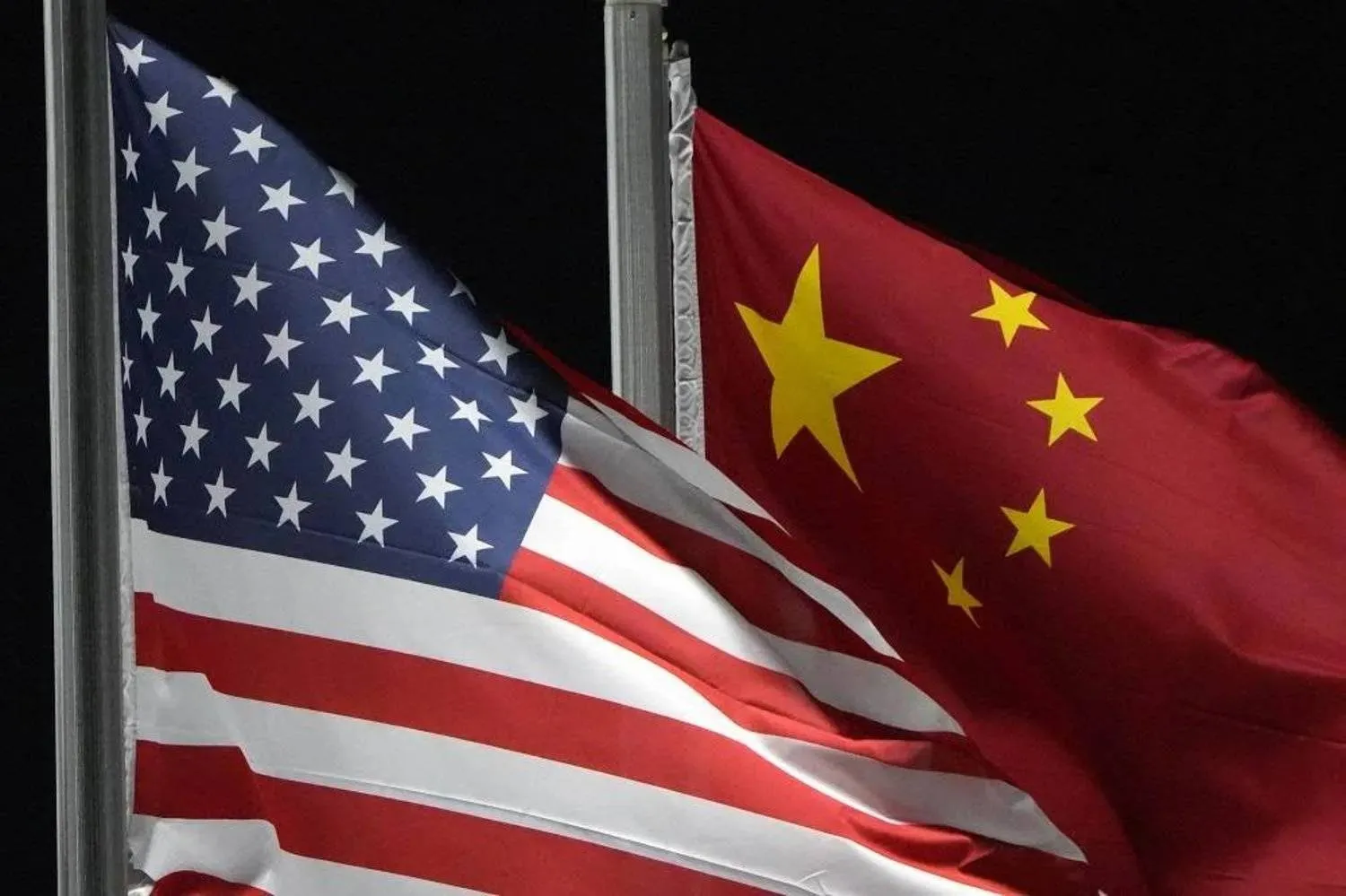
File photo: The American and Chinese flags wave at Genting Snow Park ahead of the 2022 Winter Olympics, in Zhangjiakou, China, on Feb. 2, 2022. (AP)
TT

US Looks to Boost Anti-China Spending Worldwide by Hundreds of Millions

File photo: The American and Chinese flags wave at Genting Snow Park ahead of the 2022 Winter Olympics, in Zhangjiakou, China, on Feb. 2, 2022. (AP)

The Trump administration is preparing to ramp up funding by hundreds of millions of dollars for programs designed to counter China’s growing influence around the world, after it had put a halt to many of those initiatives last year during a flurry of budget and personnel cuts.

The administration notified Congress late last week that it intends to spend $175.8 million to replace outdated and aging undersea telecommunications cables in the Caribbean and Central America to prevent China from moving in. The Associated Press obtained a copy of the notification on Monday.

The administration has expressed deep concern about China's activities in the Americas, pushing back on Chinese ownership of ports at either end of the Panama Canal, infrastructure projects funded by China's Belt and Road initiative in the region, and Chinese investment in the telecommunications sector.

A State Department official said China’s economic activities in the Western Hemisphere pose risks to US national security and prosperity. The official, who was not authorized to speak publicly to the subject and spoke on condition of anonymity, said China's offerings may seem cheaper but in the end wind up being more expensive due to cost overruns, hidden maintenance fees and poor performance.

The underseas cable funding appears to be part of a broader push to restore support for initiatives aimed at blunting Chinese influence globally that would cost many hundreds of millions of dollars more. That is even as President Donald Trump and Chinese leader Xi Jinping put on a show of cooperation and Xi prepares to visit the US this fall.

US weighs wider spending to counter China globally

The State Department is considering spending nearly half a billion dollars more on programs aimed at China throughout the Western Hemisphere, Africa and Asia, according to an internal State Department document obtained by AP.

“The United States must respond to the CCP’s growing economic, technological, and diplomatic leverage around the world which undermines our national interests,” the document says, using the acronym for the Chinese Communist Party.

Many of those proposed programs are designed to “reclaim diplomatic leverage” through investments in areas where the US had previously been spending money but stopped as the Elon Musk-led Department of Government Efficiency, or DOGE, carried out deep government budget and personnel cuts last year.

Those cuts, which dismantled the US Agency for International Development and eliminated several hundred diplomatic posts worldwide, also affected previously approved projects, including some aimed at countering China.

A senior US official, who spoke on condition of anonymity to discuss future administration plans, confirmed the Trump administration’s intent to boost funding on countering China but could not speak to specifics. The official acknowledged discussions of large-scale projects but said many were still in the discussion phase.

Congress told about undersea cable project to keep China away

The program described to Congress on Friday is called the “Countering CCP Control of Caribbean and Central America Undersea Cables project.”

It will “fund the installation of strategically-selected undersea cable infrastructure” and support foreign governments in partnering with private sector undersea cable installers, according to the notification. The money will “support replacement of outdated undersea telecommunications cables in the Caribbean and Central America region with secure, US and trusted alternatives,” it said.

Even as it pursues the war with Iran and peace efforts in Gaza and Lebanon, the Trump administration has put a focus on the Western Hemisphere, capturing Venezuelan leader Nicolás Maduro earlier this year, ramping up pressure on Cuba’s socialist government in the months since and imposing severe sanctions on the government in Nicaragua.

Under the new program, funding is anticipated to be given to or in support of undersea cable projects benefiting El Salvador, Guatemala, Honduras, Nicaragua and Haiti, the document said. The US has tenuous ties with Nicaragua and would not be working with the government there.

China's embassy in Washington did not immediately respond to requests for comment.

Other anti-China efforts could focus on cyber and critical minerals

At the same time, the administration has drawn up plans to spend more than $340 million for over 50 specific anti-China projects around the world, including many in the Western Hemisphere, according to the internal State Department document outlining various proposals.

The administration notified Congress in May that it had spent several hundred million dollars in counter-China funding from the 2024 budget that was approved by the Biden administration. However, many other projects funded for 2024 and 2025 had been put on hold.

Among the plans to be resurrected are the creation of security operations centers in Argentina and Belize to monitor Chinese threats to critical infrastructure and cyber platforms throughout the region. Also coming back would be initiatives to protect Ecuador, Jamaica, Mexico, Paraguay, Peru and Uruguay from alleged Chinese attempts to infiltrate port operations and illegally exploit offshore fishing and critical minerals extraction.

More broadly, the proposal, which is still under consideration, would work against Chinese influence in the selection of a successor to the Dalai Lama “by developing proprietary technology to ensure secure communications and information collection.” It also would go after international support for China’s space program and push back against Chinese firms seeking to export surveillance and censorship technology.

The document did not describe the initiatives in detail.

Trump is expected to meet with Xi in September around the time of the annual UN General Assembly gathering of world leaders in New York. To prepare for that meeting, Secretary of State Marco Rubio met with Chinese Foreign Minister Wang Yi last week at a regional security conference in the Philippines.

Trump has oscillated between anger and elation with Xi, whom the US leader has sought to cultivate as an ally even while China pursues goals antithetical to many of his administration's. The ultimate impact of the proposed new programs won't be known for many months or years.



US, Allies Want IAEA Board to Report Iran to UN Security Council

The logo of the International Atomic Energy Agency (IAEA) at the organization's headquarters in Vienna, Austria, March 6, 2023 (Reuters)
TT

US, Allies Want IAEA Board to Report Iran to UN Security Council

The logo of the International Atomic Energy Agency (IAEA) at the organization's headquarters in Vienna, Austria, March 6, 2023 (Reuters)

The US and its allies Britain, France and Germany are pushing other countries on the UN nuclear watchdog's board to pass a resolution next week reporting Iran to the UN Security Council for the first time in 20 years, diplomats said on Friday.

If passed, the resolution would follow up on one adopted on June 12 of last year declaring Iran in breach of its non-proliferation obligations for not fully cooperating with an investigation into uranium traces found at undeclared sites, Reuters reported.

Israel started bombing Iran's nuclear facilities the next day, soon joined by the United States, destroying or badly damaging Iran's uranium-enrichment plants.

Iran has not let International Atomic Energy Agency (IAEA) inspectors return to the bombed sites since then or verify what remains of its stocks of enriched uranium, some of which was enriched to up to 60% purity, a short step from weapons grade.

A resolution by the IAEA's 35-nation board reporting Iran to the Security Council would also be the culmination of a standoff over IAEA access to those sites, since the board has passed two resolutions in the past year demanding Iran declare its enriched uranium stocks and grant the IAEA full access to verify them.

A draft text for the resolution has yet to be formally submitted to the board and negotiations between countries over the exact wording are ongoing, diplomats said. A draft is usually formally submitted early in the week of a board meeting.

As a party to the nuclear Non-Proliferation Treaty (NPT), Iran has the right to develop nuclear technology, including enrichment, for peaceful purposes. Iran says it would never produce nuclear weapons.

It is, however, the only country to enrich to 60% without making a bomb. The amount it has enriched to that level is "a matter of serious concern" to the IAEA.

The IAEA believes well over 200 kg of that highly enriched uranium has survived the bombardments and is held in a tunnel complex at Isfahan and at the Natanz facility.


Vance Says Iran Conflict Is Not a War, Declines to Offer Timeline for End

Vice President JD Vance speaks with reporters in the James Brady Press Briefing Room at the White House, Thursday, Sept. 3, 2026, in Washington. (AP)
TT

Vance Says Iran Conflict Is Not a War, Declines to Offer Timeline for End

Vice President JD Vance speaks with reporters in the James Brady Press Briefing Room at the White House, Thursday, Sept. 3, 2026, in Washington. (AP)

US Vice President JD Vance on Thursday said the fighting between the United States and Iran was not a war and declined to provide a timeline for when the conflict would be over, underscoring the challenge the Trump administration faces as the hostilities enter their seventh month and midterm elections loom.

His comments come as Washington and Tehran exchanged back-and-forth attacks this week after a period of relative calm, with no diplomatic talks with the Iranians underway to end the ‌conflict.

The war ‌has dragged down President Donald Trump's approval ratings and ‌driven ⁠up gas prices, ⁠raising the stakes for Republican candidates fighting to preserve their party's narrow congressional majorities in November.

In a briefing at the White House, Vance touted US efforts to facilitate oil shipping through the Strait of Hormuz, where Iranians have disrupted maritime traffic since the war started, crediting Washington's actions with helping to avert a broader global energy crisis.

He pushed back on describing the conflict as a "war," saying the US ⁠has ended major combat operations with Iran, despite renewed ‌fighting this week. He said Washington's focus ‌now was to ensure Tehran cannot keep disrupting commercial oil shipping.

"I wouldn't call it ‌a war," Vance said. "Right now there's no active shooting. I recognize there's ‌been places where this has flared up."

The US maintains more than 50,000 troops in the Middle East. The Trump administration has surged assets into the region, including nearly 20 warships focused on a blockade. In some instances, troops have been deployed for longer ‌than expected and have been pulled from Europe and the Indo-Pacific.

Asked repeatedly about the timeline on the war, ⁠Vance said an end ⁠would require a halt in Iranians shooting at commercial shipping.

"When will the Iranians stop shooting at ships? I think the reality is I don't know the answer to that question," he said.

He also ruled out any negotiations as long as Tehran continued to target commercial shipping.

While the most intense fighting has subsided, the recurring exchange of fire and the lack of a definitive end to the war have kept global oil prices elevated.

On Tuesday, the United States launched airstrikes on Iran, hitting what it said were military targets along the coast in retaliation for Iranian attacks on shipping in the Strait of Hormuz. The sudden escalation of the war has caused a surge in oil prices to levels unseen since July.


Russian Attacks Kill at Least 3 in Ukraine as US Talks on the War Are Expected

Firefighters walk among debris at a destroyed pharmaceutical warehouse after Russian drone attacks on the outskirts of Kyiv, Ukraine, Thursday, Sept. 3, 2026. (AP)
TT

Russian Attacks Kill at Least 3 in Ukraine as US Talks on the War Are Expected

Firefighters walk among debris at a destroyed pharmaceutical warehouse after Russian drone attacks on the outskirts of Kyiv, Ukraine, Thursday, Sept. 3, 2026. (AP)

Russian attacks overnight killed at least three people in Ukraine, local officials said Friday, after President Volodymyr Zelenskyy said US envoys are expected to visit Kyiv within the coming days as part of renewed diplomatic efforts to end the war.

The air war between Russia and Ukraine has intensified as the conflict stretches into its fifth year following Moscow’s invasion of its neighbor. Russian forces have relentlessly struck civilian areas.

Previously, these attacks occurred mostly at night — but now they are happening during the day as well. The front line in eastern and southern Ukraine remains largely deadlocked.

US envoys expected in Kyiv

Though US efforts to negotiate a settlement have yet to produce a path to peace, in his nightly address Thursday, Zelenskyy said that preliminary dates have been set for meetings in both Moscow and Kyiv. Ukraine’s negotiating team is in near-constant contact with the US side and preparing for talks, he said.

“They confirmed they will have a meeting in Moscow and another one in Kyiv. We expect the latter to take place in the coming days. This is very important. It is important that America remain actively engaged,” he said, adding that Ukraine is ready for substantive, high-level negotiations.

Russian state news agency TASS reported Friday that American negotiators Steve Witkoff and Jared Kushner would visit Moscow first, then Kyiv on Sept. 5-6, though this could not be independently verified.

Speaking with journalists Friday, presidential spokesperson Dmitry Peskov refused to confirm reports that Kushner and Witkoff would visit Moscow, only saying that the media would be informed if such a meeting took place.

US officials did not immediately confirm the visit.

Kushner and Witkoff last visited Moscow in January 2026, where they met with Russian President Vladimir Putin. This would be their first visit to Kyiv.

After that meeting, Russian presidential aide Yury Ushakov described talks as constructive, but said “that reaching a long-term settlement can’t be expected without solving the territorial issue.”

However, further talks have lost momentum with the White House’s attention focused on its conflict with Iran.

In a news conference on Wednesday, Putin described negotiations as “frozen.”

Deadly strikes in Ukraine

The latest diplomatic developments came as a “massive” overnight Russian attack on the Odesa region killed one person and injured at least five others, including a child, regional head Oleh Kiper said in a post on Telegram. The attacks damaged multiple residential buildings, including two multi-story blocks.

Overnight strikes elsewhere in Ukraine killed two police officers in Dnipro, officials said, while a drone attack in Kyiv injured three people after hitting a residential building.

In Russia, a large-scale Ukrainian drone strike hit the Black Sea resort city of Sochi and the nearby district of Sirius, regional officials said Friday. They said the attack sparked a blaze at an oil depot but gave no further details. Russian media outlets reported two depots were hit, with one fire in Sochi and another in Sirius.

Ukraine has repeatedly targeted oil facilities that form the backbone of Russia’s economy, one of the world’s largest energy producers. Growing economic pressure and public frustration have mounted in Russia after months of escalating Ukrainian strikes on refineries and e-commerce hubs that have caused nationwide disruptions.

The barrages prompted Putin last month to decree that the state can temporarily seize control of critical infrastructure facilities if private owners fail to protect them from Ukrainian drone attacks or don’t rebuild them after strikes. Analysts said the move was aimed at forcing companies to pay for their own security and bring damaged assets back into service, despite the cost.

Drone washes up in Finland

Finnish authorities said Friday they were investigating how a Russian-made drone ended up on a rocky shoreline in the Pellinge archipelago east of Helsinki.

Finland’s Border Guard said what appears to be a Geoscan 701 drone, manufactured by a Russian company, was found on the shore. “The device model in question is used by both state and civilian operators, and it is not possible at this stage to determine its intended use or identify the country or entity operating it,” the Border Guard said in a statement.

State broadcaster Yle reported the drone was discovered Tuesday by a fisherman, Peter Kellgren, who said it “was out there in the open sea” and appeared to have drifted ashore from elsewhere.

Geoscan describes itself as one of Russia’s leading drone manufacturers and says the 701 model is designed for large-scale aerial surveying.