


6 Refugees Speak Out as UN-backed Treaty to Help People Fleeing War and Persecution Marks 75 Years

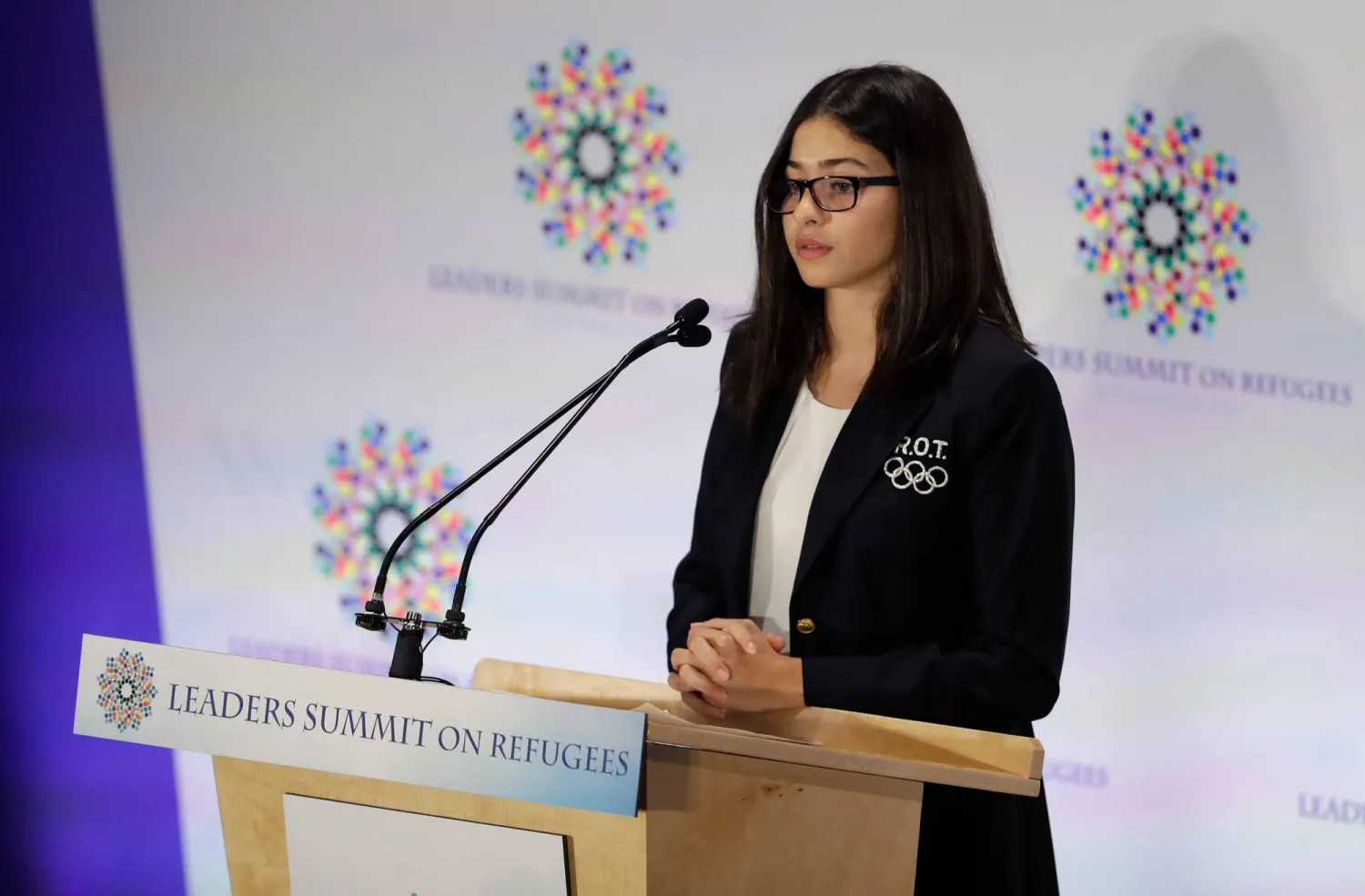
FILE - Yusra Mardini, a swimming for the Refugee Olympic Team, speaks during the Leaders Summit on Refugees during the 71st session of the United Nations General Assembly at UN headquarters, Tuesday, Sept. 20, 2016. (AP Photo/Carolyn Kaster, File)
TT

6 Refugees Speak Out as UN-backed Treaty to Help People Fleeing War and Persecution Marks 75 Years

FILE - Yusra Mardini, a swimming for the Refugee Olympic Team, speaks during the Leaders Summit on Refugees during the 71st session of the United Nations General Assembly at UN headquarters, Tuesday, Sept. 20, 2016. (AP Photo/Carolyn Kaster, File)

Tuesday marks the 75th anniversary of the 1951 Refugee Convention, which was born after the ravages of World War II to help people fleeing war, violence and persecution. Proponents say the treaty has saved millions of lives.

Respect for it, though, has come under strain: Some countries have denied entry to asylum seekers. Under US President Donald Trump, the United States has led a policy of sending asylum seekers to third countries — upending years of US policy, The Associated Press said.

More than 41 million refugees remain forcibly displaced: Nearly 70% are hosted by low- and middle-income countries. The ranks could grow: The International Committee of the Red Cross counts more than 130 armed conflicts around the globe.

The convention took key steps toward defining what a refugee is, laying out their rights, and establishing standards of treatment. Nearly 150 countries are parties to the convention.

“It codified a simple but powerful principle that people forced to flee persecution, conflict or violence must be able to find safety and protection,” said Elizabeth Tan, UN High Commissioner for Refugees' director of international protection and solutions.

Its core principle is “non-refoulement,” prohibiting the return of people to a place where they would face persecution, torture or other serious harm. It all rests on the idea that no society is immune to war, persecution or sudden upheaval.

Here’s what six refugees say about their experiences and the importance of the convention.

Rohingya fleeing Myanmar Sayed Alom, a humanitarian aid worker and one of the 700,000 Rohingya who fled Myanmar into neighboring Bangladesh in 2017, has been languishing in refugee camps there ever since.

Myanmar's military forces “raped our mothers and sisters, burned down our homes, threw our children into the river and set them on fire,” he recalled in an interview in refugee camps outside Cox’s Bazar, Bangladesh. “We were persecuted until we could no longer live there.”

Alom, who expected to return home quickly, says the limbo situation has become “imaginably worse,” with kidnapping for ransom, as well as threats from nature, including extreme heat, flooding and landslides destroying the camps.

Escaping Nicaragua's deadly crackdown Human rights lawyer Juan Carlos Arce considers himself among millions of people whose lives have been saved by the convention: He fled Nicaragua by foot in 2018 after a bloody government crackdown against protesters killed hundreds.

The Nicaraguan Center for Human Rights, for which Arce worked, had documented the violence and was deemed a “terrorist organization” by President Daniel Ortega’s government. He fled to Costa Rica where he was granted asylum.

In Costa Rica, rights defenders and Nicaraguan opposition leaders were attacked and even assassinated, so he moved to Barcelona, Spain, last year under a resettlement program organized by UNHCR and the UN’s International Organization for Migration.

“Feeling safe and protected, that is priceless,” he said under Barcelona’s Arc de Triomf, as tourists and residents walked by.

A Palestinian living for decades in Lebanon

More than seven decades after fleeing her village, 88-year-old Hussniyah Ahmad Ghozlan still remembers the journey that brought her family to Lebanon.

Ghozlan was a child when they fled during the 1948 war after their village — Yajur, southeast of Haifa, Israel — was depopulated.

“We got by because we worked, raised our children and built our lives,” she said in an alley near her home in Shatila camp for Palestinian refugees in Beirut.

Asked whether she knew of the 1951 Refugee Convention, Ghozlan laughed and said she had not, explaining that she never learned to read or write.

The US was once welcoming

Hershel Greenblat was born during World War II, in 1941, inside a cave in Ukraine as his Jewish family hid from the Nazis.

After the war, his family sneaked into Austria, where they lived in US Army camps for displaced persons. After initially considering moving to Israel, they opted for the US after receiving approval in 1949 to immigrate there.

He recalled how his father woke him in the middle of the night as the Army transport ship approached the Statue of Liberty. The kids received welcome boxes packed by American middle-schoolers.

In Atlanta, where his family has lived for decades, Greenblat said refugees today often get a different welcome. He said he wasn't previously familiar with the convention — but said refugees deserve protections and opportunities for work and education.

“Refugees in the ’50s worked their butts off to get what they wanted, what they needed,” said Greenblat, now 85.

From refugee to Olympic basketball player Wenyen Gabriel said his parents worked hard too. He was born in the Sudanese capital, Khartoum, in 1997 after his parents fled civil war in southern Sudan. They later moved to Egypt as refugees, before being resettled in New Hampshire.

Little Wenyen was 2 at the time. Big Wenyen — he's 2.08 meters (nearly 6 feet, 10 inches) tall — earned a basketball scholarship at the University of Kentucky and played in the NBA. In 2024, he played for the young country of South Sudan at the Olympic Games in Paris.

While he at times felt “a little bit different from the people in the community” in New Hampshire, there were other refugee families around.

“We had to struggle and figure out how to become something inside of the United States,” he said at the headquarters of the refugee agency UNHCR, for which he became its newest goodwill ambassador on Monday. “It’s not easy to make something of yourself in a foreign country.”

Swimming to refuge in Germany Swimmers Yusra and Sarah Mardini fled war-torn Syria in 2015, joining the wave of refugees from their home country that year, in a saga that has been turned into a highly-regarded movie.

They went first to Lebanon, then Türkiye, where they paid smugglers to take them by sea to Greece: They jumped out of an overloaded boat to keep it from sinking. After an arduous trek across southeast Europe, they received refuge in Germany. She was named a UNHCR goodwill ambassador in 2017.

Now that Syria's war is over, Mardini is hopeful: Some 1.3 million Syrians have returned. But after such an ordeal, change doesn't just happen overnight. “You can’t just snap your fingers,” she said.

“I do believe that my country and its people are very strong and that I’m going to contribute in the best way possible.”



US Launches ‘Economic Onslaught’ Against Iran’s Financial Connections

WASHINGTON, DC - AUGUST 24: US Treasury Secretary Scott Bessent announces a new set of sanctions against Iran in the Cash Room at the Treasury Department on August 24, 2026 in Washington, DC. Chip Somodevilla/Getty Images/AFP
TT

US Launches ‘Economic Onslaught’ Against Iran’s Financial Connections

WASHINGTON, DC - AUGUST 24: US Treasury Secretary Scott Bessent announces a new set of sanctions against Iran in the Cash Room at the Treasury Department on August 24, 2026 in Washington, DC. Chip Somodevilla/Getty Images/AFP

US Treasury Secretary Scott Bessent unveiled Monday what he described as an "economic D-Day" that aims to give a final warning to countries to sever their business ties with Iran or risk having key companies and entities cut off from the dollar-based financial system.

"We are launching an economic onslaught against Iran’s financial connections around ⁠the globe. Our ⁠objective is to sever every economic lifeline that sustains this tyrannical regime until Tehran stands alone," Bessent said.

He added that it’s “no longer acceptable to operate in the gray spaces” of the conflict.

He did not name what countries could face potential secondary sanctions from the United States.

“Let there be no ambiguity as to the position of the United States,” Bessent told a news conference. “An economic engagement of any kind with this murderous regime will expose those responsible to the full reach of American power.”

The US Treasury Department has mapped the networks, facilitators, and financial channels that Iran uses to smuggle oil and evade sanctions and said that Washington would be working with US partners to target any source of Iran's "illicit revenue."

The department said it has issued determinations against five sectors -- digital assets, technology, gold, ⁠aviation and shipping -- that the Iranian government is using to prop up its economy. The Treasury has also imposed sanctions on nearly 60 entities, individuals and vessels.

US President Donald Trump's war with Iran, which has pushed energy prices higher worldwide, is about to hit its six-month mark. While heavy fighting has ‌subsided, diplomatic efforts to end the war have stalled and oil and raw material shipping through the Strait of Hormuz ⁠remains blocked, ⁠keeping energy prices elevated.


Trump Says Iran 'Collapsing' Ahead of Sanctions Announcement

Motorcyclists pass a billboard depicting US President Donald Trump with hands around his neck beneath the words "Revenge is inevitable" in Tehran, Iran, Monday, Aug. 24, 2026. (AP Photo/Vahid Salemi)
TT

Trump Says Iran 'Collapsing' Ahead of Sanctions Announcement

Motorcyclists pass a billboard depicting US President Donald Trump with hands around his neck beneath the words "Revenge is inevitable" in Tehran, Iran, Monday, Aug. 24, 2026. (AP Photo/Vahid Salemi)

President Donald Trump said Monday that Iran is "collapsing" hours before the US government was set to announce details of what it says will be crushing sanctions against Tehran.

"IRAN IS COMPLETELY COLLAPSING!!!" Trump posted in his trademark all-caps style on his social media platform Truth Social.

“President Trump decimated Iran’s economy to a point where the rial has never been weaker and inflation has rarely been higher,” US Treasury Secretary Scott Bessent wrote Sunday in an opinion piece in the Financial Times.

“The regime’s final refuge now lies in the self-deception of fearful nations that still believe accommodating aggression can secure a durable peace.”


Health of Norway's King Deteriorated but he is Stable Now

(FILES) Norway's King Harald gives a speech at the gala dinner at the Castle in Oslo on April 8, 2025 during the state visit of Iceland's President Halla Tomasdottir and her husband Bjorn Skulason. (Photo by Fredrik Varfjell / NTB / AFP)
TT

Health of Norway's King Deteriorated but he is Stable Now

(FILES) Norway's King Harald gives a speech at the gala dinner at the Castle in Oslo on April 8, 2025 during the state visit of Iceland's President Halla Tomasdottir and her husband Bjorn Skulason. (Photo by Fredrik Varfjell / NTB / AFP)

Crown Prince Haakon visited his father King Harald of Norway on Monday at the hospital, after the king's health deteriorated over the weekend, public broadcaster NRK reported.

The 89-year-old monarch, who has been on sick leave for several weeks, was admitted to the National Hospital a week ago. He is now receiving antibiotics for a bacterial blood infection and has responded to treatment, the royal palace said late Sunday, adding that his condition is stable.

Haakon, has been serving as regent during that time, The Associated Press quoted the palace as saying.

The king has hemolytic anemia and was being treated with cortisone, leading to fluid accumulation in the body that required hospital treatment, the palace said last week.

Norway's prime minister sent his wishes for the king and said that “all of Norway is following and thinking about the king,” NRK reported.

“My strong wish is that he continues to receive good treatment from the good healthcare system we have,” Prime Minister Jonas Gahr Støre said.

Harald, who has been monarch since 1991, has been in and out of the hospital several times in recent years.

In February, he was admitted to a hospital in Spain’s Canary Islands during a winter vacation for treatment for a skin infection.

Two years ago, the king fell ill during a private vacation with the queen in Malaysia and received a temporary pacemaker there. Harald returned aboard a medical airplane to Norway, where he was fitted with a permanent pacemaker.