


Iran Reportedly to Get Chinese Shoulder-launched Missile Systems in Weeks

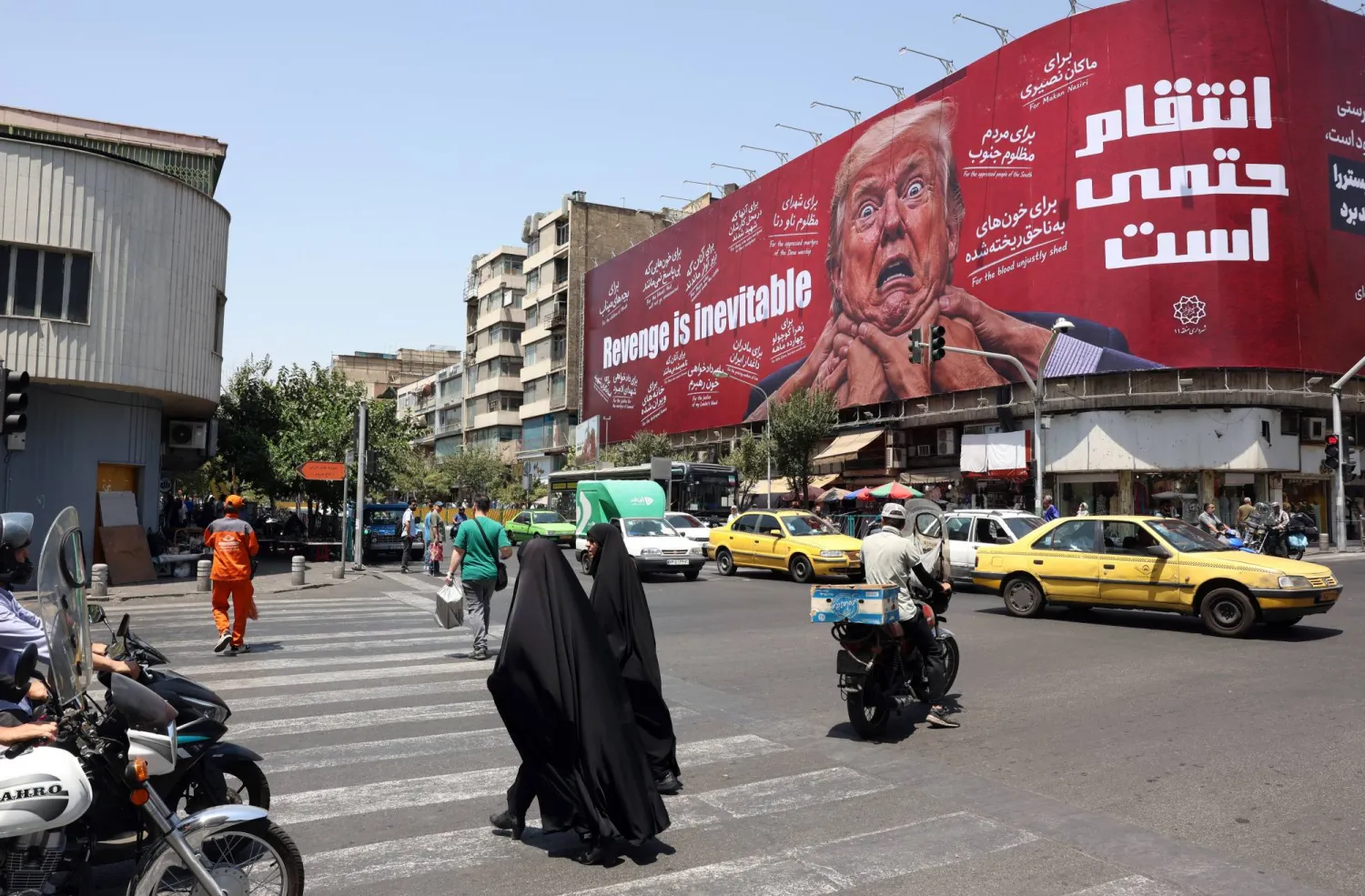
Women walk past an anti-US and Trump billboard in a street in Tehran, Iran, 27 July 2026. EPA/ABEDIN TAHERKENAREH
TT

Iran Reportedly to Get Chinese Shoulder-launched Missile Systems in Weeks

Women walk past an anti-US and Trump billboard in a street in Tehran, Iran, 27 July 2026. EPA/ABEDIN TAHERKENAREH

Iran is expected to receive within weeks a first shipment out of up to 400 Chinese-made shoulder-fired air-defense missile launchers, three sources familiar with the deal told Reuters, as it rebuilds its defenses amid war with the United States.

The purchase, valued at $60-70 million, is one of Tehran's largest-known efforts to strengthen its short-range air defenses since the outbreak of its war with the US and Israel, which exposed gaps in Iran's ability to protect military sites and strategic infrastructure.

The contract covers the purchase of between 300 and 400 man-portable air defense systems (MANPADS), including Chinese-made QW-12 and FN-16 missiles, the sources said.

The deal was signed with Zhongqing Baoshang International Investment, a Hong Kong-based company that the sources said was acting as an intermediary between the Iranian side and the Chinese supplier.

The sources spoke on condition of anonymity because of the sensitivity of the matter. Iran's foreign ministry did not immediately reply to a request for comment.

China's Foreign Ministry said: "The relevant reports are completely groundless. China has consistently played a role in promoting peace and ⁠ending the conflict."

Beijing-based ⁠Zhong Qing Bao Shang Group, the parent company of Zhongqing Baoshang International Investment, did not immediately respond to an email request for comment on Tuesday.

Iran needs to rearm after months of fighting in which the US and Israel have struck facilities linked to its missile, drone and air-defense programs, and Tehran responded with barrages of ballistic missiles and drones.

The conflict has highlighted the challenge of defending fixed military and strategic sites against advanced aircraft and precision-guided weapons.

Washington abruptly suspended two weeks of bombardment on Saturday, but President Donald Trump said strikes would resume if negotiations failed to end the five-month-old conflict, which has in theory been in a state of ceasefire since April.

The delivery of ⁠hundreds of MANPADS would significantly expand Iran's inventory of short-range air-defense weapons and underscore how military ties with China are deepening.

The sources cautioned that, although the agreement had been signed, delivery schedules, quantities and other implementation details could still change.

Under a plan agreed by the parties, deliveries will initially be by air from Urumqi in western China, then transiting through Pakistan to Iran, according to the sources, who did not clarify whether the transfers would take place by air or by road.

Pakistan’s military public relations wing ISPR said: “Speculations of Pakistan being involved in supply of Air Defense weapons to Iran from China are absolutely concocted and false."

A spokesperson for the Pakistani Foreign Ministry did not respond to requests for comment.

While Iran has invested heavily in the past two decades in missiles, drones and radar, military experts say portable air-defense systems are important because they can be dispersed quickly, operated by small teams and relocated frequently, making them less vulnerable than fixed air-defense batteries.

A European ⁠security source said authorities in ⁠his country were aware of several contracts under discussion involving the possible sale of QW-series MANPADS to Iran, including QW-12, QW-18 and QW-19 systems.

A second security source, in the Middle East, said Iran had been seeking to purchase QW-12 and QW-18 missiles, but they were unaware that a deal had already been concluded.

The QW-12 and FN-16 are shoulder-fired, infrared-guided surface-to-air missile systems designed to engage low-flying aircraft, helicopters and drones. Their mobility allows them to be deployed rapidly around military installations, energy infrastructure and other sensitive sites.

Defense analysts regard the QW-12 as less capable than newer QW variants, including the QW-18 and QW-19, but say the systems can still provide an effective layer of short-range protection against drones and low-flying targets.

Two Western intelligence sources and an Iranian official said Tehran had also explored the use of overland routes to move Chinese military supplies and dual-use components more discreetly and reduce the risk of disruption.

The procurement highlights Tehran's continuing reliance on a combination of domestic weapons production and foreign suppliers despite years of sanctions and restrictions on defense-related imports.

Reuters previously reported that Iran was close to securing a separate agreement with China to acquire anti-ship cruise missiles, according to people familiar with those negotiations.

Reuters could not determine whether the agreement went through.


US, Iran Separately Talk with Mediators in Latest Bid to End War

 An Iranian missile is displayed under the country's national flag in a military exhibition commemorating the anniversary of the start of the 1980-88 Iraq-Iran war at Baharestan Square, in Tehran, Monday, Sept. 28, 2026. (AP)
An Iranian missile is displayed under the country's national flag in a military exhibition commemorating the anniversary of the start of the 1980-88 Iraq-Iran war at Baharestan Square, in Tehran, Monday, Sept. 28, 2026. (AP)
TT

US, Iran Separately Talk with Mediators in Latest Bid to End War

 An Iranian missile is displayed under the country's national flag in a military exhibition commemorating the anniversary of the start of the 1980-88 Iraq-Iran war at Baharestan Square, in Tehran, Monday, Sept. 28, 2026. (AP)
An Iranian missile is displayed under the country's national flag in a military exhibition commemorating the anniversary of the start of the 1980-88 Iraq-Iran war at Baharestan Square, in Tehran, Monday, Sept. 28, 2026. (AP)

US and Iranian officials spoke separately with mediators on Monday as part of a renewed effort to end seven months of war, according to officials of both countries.

Any further talks are expected to focus on an amended version of a seven-day proposal that Iran presented last week on the sidelines of the United Nations General Assembly, an official briefed on the negotiations told Reuters.

The war began in late February with US and Israeli attacks on ‌Iran, killing ‌thousands of people over seven months and shocking global markets ‌as ⁠vital waterways for ⁠oil remained choked. The US and Iran have twice previously agreed to ceasefires in mediated peace talks, in April and June. Those agreements quickly unraveled.

Iranian Foreign Minister Abbas Araghchi, who remained in New York after attending the General Assembly, said Iran expected to receive the US response to its latest ceasefire proposals and its conditions for restoring passage of maritime traffic in the Strait of Hormuz, according to state ⁠news agency IRNA.

"If the Americans claim they are seeking ‌an agreement or a peaceful solution, we ‌have presented that solution," Araqchi said.

US officials separately spoke with mediators on Monday, US President Donald ‌Trump told reporters at the White House, without giving further details.

TRUMP HAS ‌FLAGGED FURTHER TALKS THIS WEEK

Iran's seven-day plan envisages an end to all hostilities in Iran and Lebanon, the unfreezing of billions of dollars' worth of Iranian assets, an end to sanctions on Iranian oil and the lifting of the US blockade on Iranian ‌ports.

Iran would then allow the reopening of the Strait of Hormuz, a vital conduit for oil tankers, and the ⁠two sides would ⁠also resume talks on Iran's nuclear program and Trump's wish to seize or eliminate its highly enriched uranium.

Trump said on Saturday he had rejected Iran's proposal, saying Iran wanted a swift agreement because of the crippling economic pressure it is under. However, he also told Axios on Sunday that he expected US negotiators to engage in further talks this week.

Araghchi said on Sunday that mediators had not formally conveyed a US rejection, and that Iran was awaiting Washington's definitive position before deciding its next steps.

"Our conditions are clear, and any move toward reopening the Strait of Hormuz is contingent on these conditions being met," he said on Sunday, adding that only a negotiated solution could resolve the impasse.


Ukraine’s Zelenskiy Says North Korea Prepares to Deploy Another 10,000 Troops to Russia

Ukraine's President Volodymyr Zelenskiy addresses the 81st United Nations General Assembly (UNGA) at UN headquarters in New York City, US, September 23, 2026. (Reuters)
TT

Ukraine’s Zelenskiy Says North Korea Prepares to Deploy Another 10,000 Troops to Russia

Ukraine's President Volodymyr Zelenskiy addresses the 81st United Nations General Assembly (UNGA) at UN headquarters in New York City, US, September 23, 2026. (Reuters)

Ukrainian President Volodymyr Zelenskiy said on Monday there are more than 8,000 North Korean troops on Russian territory and preparations are underway to deploy another 10,000 troops.

Citing "new data" on the deployment of North Korean troops to Russia, Zelenskiy said they were "being selected for training and subsequent deployment to Russia."

The Ukrainian president ‌said in ‌August that up to ‌50,000 North ⁠Korean soldiers could be ⁠sent to fight for Russia, and called on South Korea to provide support for Ukraine's air defense.

South Korea announced in July a $100 million aid package for Ukraine, although it excluded lethal weapons.

Zelenskiy's comments on Monday ⁠came after Seoul and Kyiv were ‌at odds over ‌his announcement last week that Ukraine had transferred ‌two captured North Korean soldiers to ‌South Korea.

Seoul expressed regret over his announcement, citing an agreement to keep the transfer confidential. South Korea also protested against what it called a ‌false statement from the Ukrainian presidential office denying that such a confidentiality ⁠agreement ⁠existed.

North Korea has sent an estimated 14,000 to 15,000 troops to support Russia's war in Ukraine since 2024, according to Ukrainian and South Korean estimates, with most deployed in the Kursk region to help repel a Ukrainian incursion.

Pyongyang has also supplied Russia with millions of artillery and mortar rounds, as well as ballistic missiles, long-range artillery systems and multiple-launch rocket systems, according to Ukrainian and independent assessments.


Iran Says Filed Complaint to UN Aviation Watchdog over US Flight Restrictions

The Iranian flag waves in front of the International Atomic Energy Agency (IAEA) headquarters, before the beginning of a board of governors meeting, amid the coronavirus disease (COVID-19) outbreak in Vienna, Austria, March 1, 2021. (Reuters)
TT

Iran Says Filed Complaint to UN Aviation Watchdog over US Flight Restrictions

The Iranian flag waves in front of the International Atomic Energy Agency (IAEA) headquarters, before the beginning of a board of governors meeting, amid the coronavirus disease (COVID-19) outbreak in Vienna, Austria, March 1, 2021. (Reuters)

Iran has lodged a complaint with the United Nations over US sanctions against its aviation sector that have forced the cancellation of flights, state media reported Monday. 

This month the United States imposed restrictions on the entire aviation industry in Iran and vowed to take a hard line against companies that assist it, said AFP. 

As the sanctions took effect last Wednesday, major airlines were forced to cancel international flights after several countries implemented bans. 

"To defend the legitimate rights of the aviation industry and counter illegal restrictions imposed by America, Iran has drafted and submitted a formal protest to the International Civil Aviation Organization (ICAO)," said civil aviation chief Abouzar Shiroudi, according to Iran's official IRNA news agency. 

The ICAO is a UN agency based in Montreal, Canada that sets and regulates standards for civil aviation. 

"In cooperation with the foreign ministry, we have also filed a complaint with the International Court of Justice at The Hague," Shiroudi added. 

For Iranians wishing to enter or exit their country, destinations in neighboring Türkiye are now the primary options for flights. 

Routes also remain available to Afghanistan, Pakistan, China, Russia, Malaysia and Thailand, with flights to the United Arab Emirates suspended. 

An official from Tehran's Imam Khomeini International Airport said Sunday that around 30 international destinations were still being served by Iranian airlines.
