

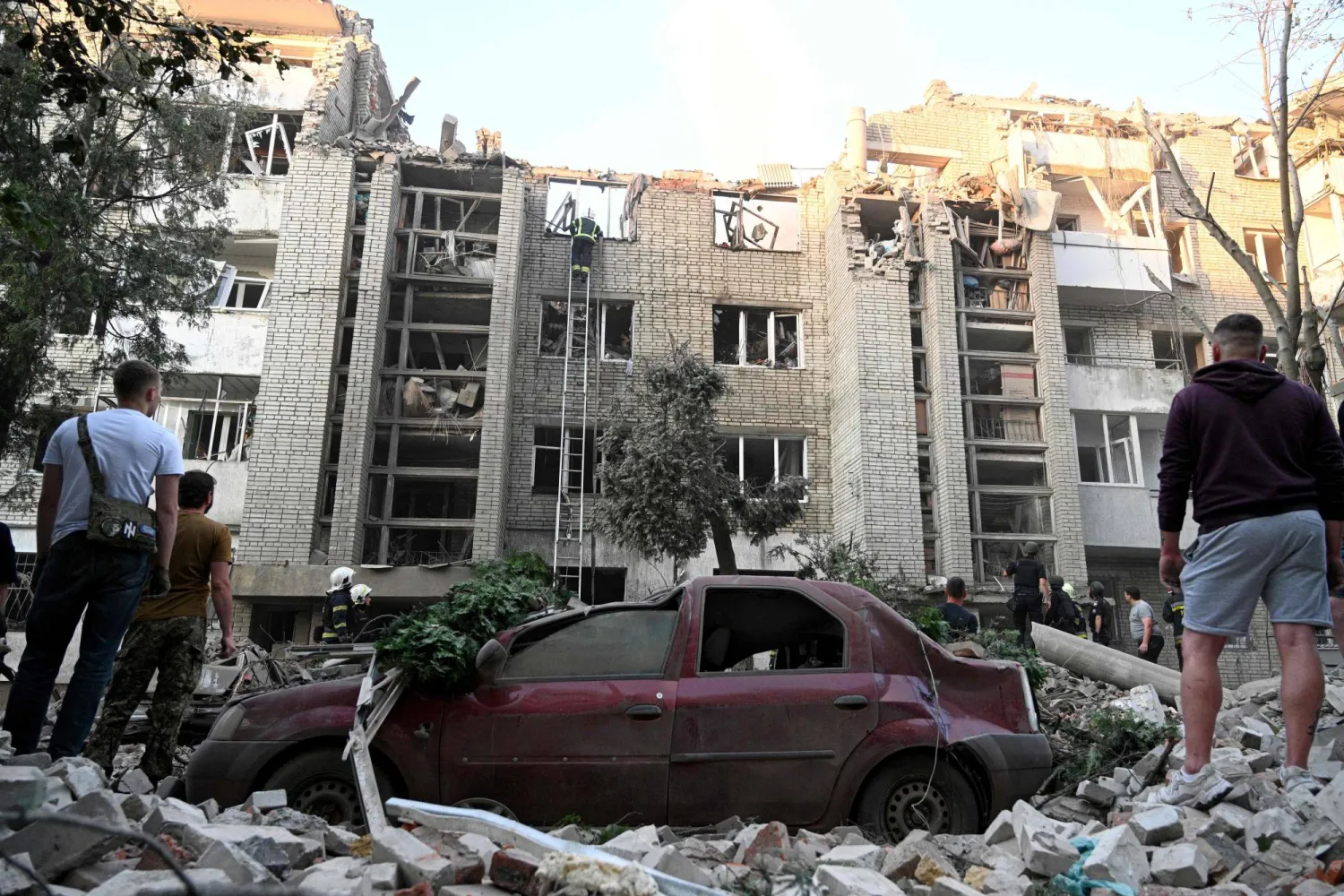

Russian Missile Strike Destroys Family Home, 10 Feared Dead

Local residents watch as first responders operate at a residential building partially destroyed as a result of Russian missile strikes in the western Ukrainian city of Lviv on July 30, 2026, amid the Russian invasion in Ukraine. (AFP)
TT

Russian Missile Strike Destroys Family Home, 10 Feared Dead

Local residents watch as first responders operate at a residential building partially destroyed as a result of Russian missile strikes in the western Ukrainian city of Lviv on July 30, 2026, amid the Russian invasion in Ukraine. (AFP)

A Russian missile slammed into a family home in eastern Ukraine early Thursday, obliterating it and leaving 10 members of the same family presumed dead, an official told AFP. 

An official with Ukraine's emergency services told AFP that six people had been confirmed killed so far, with another four presumed dead but still to be formally identified. 

Russia fired a total of 74 missiles and 284 drones in the overnight barrage, according to Ukraine's air force -- the latest deadly attack in the four-and-a-half-year war, which is seeing a spike in civilian deaths. 

In the capital Kyiv, tens of thousands hunkered in packed-out metro stations through the night after blasts started ringing out shortly after midnight. 

The western city of Lviv was also badly hit, and neighboring NATO member Poland said a 10-meter crater punctured in a field 80 kilometers (50 miles) from the Ukraine border was likely from a Russian missile. 

"The Russians used their ballistic missile to destroy an ordinary house belonging to an ordinary family," Ukrainian President Volodymyr Zelensky said on social media. 

"It was an ordinary home, blown into smithereens," he added. 

"The Voronov family: mother Olena, father Artem, seven children," and a grandchild, he said. 

The strike hit their house outside the eastern city of Kryvyi Rig -- Zelensky's hometown. 

The youngest presumed victim was one-and-a-half-years old, he added. 

The emergency services official said that such was the devastation at the scene, 17 "body fragments" had been found, and forensic examinations were ongoing. 

"It can be preliminarily stated that all 10 people who were in the house have died," Sergiy Kovtoniuk, press officer of the State Emergency Service in the Dnipropetrovsk region, told AFP. 

The regional governor published photos of rescuers sifting through the rubble of a destroyed house, wooden beams and concrete debris strewn across the yard. 

- 'I want to live' - 

Three people were also killed across Kyiv, Poltava and Lviv, local officials there said. 

Russia's defense ministry said it had hit Ukrainian military-industrial complex, military communications and logistics centers. 

Zelensky had late on Wednesday warned of a likely missile attack, prompting tens of thousands in Kyiv to preemptively seek shelter. 

More than 56,000 people packed the stations of the Kyiv subway, which have doubled as shelters during the war. 

They set up tents, rolled-out yoga mats and unfolded sleeping bags in what is now a well-organized routine. 

Galyna Doschuk, 27, said she came to the subway station every time she read reports of a forthcoming attack. 

"I want to live... sometimes our neighbor gets in the way," said the young photojournalist, wrapped in a black sweater, referring to Russia. "But we're fighting on." 

Explosions starting ringing out in the capital at around 01:00 am, an AFP journalist heard. 

The attack also destroyed a popular flea market in Kyiv. 

Its burnt and mangled metal structure was still smoldering in the morning as sellers tried to salvage belongings. 

In the western city of Lviv, rescuers said they had pulled a 93-year-old-woman out alive from the rubble of a five-storey building. She had been alone on the top floor when Russia attacked. 

An AFP reporter in the city saw apartment blocks ripped open, rubble all around, as locals looked on, crying and covering their faces. 

- Poland crater - 

Ukraine's air force said it had managed to intercept 55 missiles and 265 drones launched by Moscow -- but it has struggled to intercept the advanced ballistic missiles that Russia is increasingly deploying. 

In neighboring Poland, police said they had discovered a 10-meter-wide crater in a field after an unidentified object was detected on radar screens during the Russian attack -- triggering anger in Warsaw and across Europe. 

"From the analysis of most of the traces, the recovered fragments point to a Russian Kh-101 missile," Prime Minister Donald Tusk told journalists near the crater. 

Zelensky renewed his call for more supplies of air-defense equipment to protect Ukraine against the ballistic missiles. 

"Given the critical shortage of air-defense missiles from our partners, our warriors are accomplishing truly incredible things," he said. 

The Ukrainian leader had on Tuesday discussed anti-ballistic defense with US President Donald Trump at the White House. 

Trump had previously said he would give Ukraine a license to start producing anti-ballistic Patriot interceptors, but neither Kyiv nor Washington has revealed details of the plan. 

Last month was the deadliest for civilians in Ukraine since April 2022 as Russia ramped up its attacks. 


Landfill Collapse Kills 30 in Guinea

Residents and rescuers use an excavator to search for bodies after a landslide struck the Dar es Salaam dumpsite overnight in Conakry on August 23, 2026. (Photo by AFP)
TT

Landfill Collapse Kills 30 in Guinea

Residents and rescuers use an excavator to search for bodies after a landslide struck the Dar es Salaam dumpsite overnight in Conakry on August 23, 2026. (Photo by AFP)

Thirty people died in Guinea's capital Conakry on Sunday when a mound of rubbish in a landfill collapsed before dawn onto neighboring homes following heavy rains, the government said.

Six others were seriously injured in the 2:00 am (0200 GMT) incident in the Bbessia district's Dar-es-salam neighborhood on the capital's outskirts, a government statement said.

Neighborhood leader Lancine Sylla had previously told AFP that he feared a heavy toll.

"We have pulled out 18 bodies that were taken to the morgue," he told AFP.

Guinea's minister for territorial administration Djenabou Toure went to the scene of the accident, where AFP photographers saw excavators take part in a search-and-rescue operation through the collapsed landfill under the gaze of a crowd of onlookers.

In recent days, the government had ordered the expulsion of people and safety measures around the site because of fears of a collapse.


French Ambassador to Asharq Al-Awsat: Mohammed bin Salman’s Visit Paves Way for New Phase of Strategic Partnership

Patrick Maisonnave, French Ambassador to Saudi Arabia (Asharq Al-Awsat).
TT

French Ambassador to Asharq Al-Awsat: Mohammed bin Salman’s Visit Paves Way for New Phase of Strategic Partnership

Patrick Maisonnave, French Ambassador to Saudi Arabia (Asharq Al-Awsat).

A senior French official stressed that Saudi Crown Prince Mohammed bin Salman’s visit to France on Sunday means, in short, that Riyadh and Paris are entering a new phase of a genuine strategic partnership. He said the visit will address diplomacy, security, defense, investment, energy, culture, technology, and education.

Patrick Maisonnave, the French ambassador to Saudi Arabia, told Asharq Al-Awsat that the momentum is now being further strengthened through the visit of Crown Prince and Prime Minister Mohammed bin Salman to France and the first meeting of the French-Saudi Strategic Partnership Council.

According to Maisonnave, the council is particularly important because it provides a permanent institutional framework for this political ambition, allowing both countries to set priorities, measure progress, and develop long-term cooperation across the main pillars of the relationship.

He added that as the two countries seek to keep pace with profound geopolitical, economic, and technological changes, Mohammed bin Salman’s visit demonstrates a shared determination to move from a very strong bilateral partnership to a comprehensive strategic partnership.

He continued by saying that the readiness of the two leaderships to work together is not limited to bilateral issues, but also extends to regional stability, global challenges, and the major transformations shaping their societies, as the partnership enters a new phase with this visit.

He explained that the transformation Saudi Arabia is undergoing under Vision 2030, together with France’s strengths in sectors such as energy, infrastructure, culture, innovation, artificial intelligence, education, and creative industries, is creating new areas for convergence.

He stressed that the strategic dimension of the partnership lies precisely in this development, moving from a relationship based on strong cooperation to one increasingly grounded in shared objectives, long-term planning, and joint initiatives.

A Convergence Resilient to Challenges

Maisonnave affirmed that Riyadh and Paris have a well-established partnership and mutual trust that enable them to overcome the geopolitical challenges facing the region. He noted that the bilateral convergence translates into close coordination on the region’s most prominent crises.

He added that Paris and Riyadh are working together to support a two-state solution for Israelis and Palestinians and create the necessary political conditions for lasting peace. The two countries also share an interest in Yemen’s stability and in protecting freedom of navigation and the security of strategic maritime routes.

According to Maisonnave, the two countries support efforts to end the devastating war in Sudan and preserve the country’s unity and institutions. They also support Syria’s sovereignty, unity, and recovery, as well as the establishment of a stronger Lebanese state capable of exercising its authority, while reducing external interference and the influence of non-state armed groups.

He continued by saying that France and Saudi Arabia naturally have their own interests and perspectives, but have developed the ability to engage in frank dialogue, particularly during periods of regional tension and profound international changes. This has enabled the relationship not only to endure, but also to continually reinvent itself.

Ambassador Maisonnave said the distinctive nature of the Saudi-French relationship lies in its rare combination of historical depth, political trust, and a shared ability to look to the future. Over the past century, he explained, the two countries have built a relationship based on mutual respect, continuous dialogue, and, most importantly, strategic autonomy.

He added that the relationship is no longer defined solely by its history or traditional areas of cooperation. Instead, it is increasingly focused on what the two countries can build together over the coming decades. French President Emmanuel Macron’s visit to Saudi Arabia in December 2024 was a landmark moment that gave new political momentum to bilateral relations.

He attributed the resilience of bilateral relations since their establishment in 1926 to the fact that their strength lies in a century of accumulated trust, sustained political engagement at the highest levels, and a determination to adapt the partnership to each new historical period, despite some turning points along the way.

Maisonnave added that since diplomatic relations were established in 1926, France and Saudi Arabia have steadily expanded the scope of their cooperation. The relationship has accompanied the transformation of the Kingdom itself while responding at the same time to successive regional and international challenges. After 100 years, he said, the relationship is broader and deeper than at any previous stage in its history.

He continued by saying that this continuity is particularly evident today in diplomatic cooperation. At a time when the Middle East is going through one of its most significant periods of transformation, France and Saudi Arabia share a fundamental objective: preventing instability from becoming permanent and restoring the priority of diplomacy, state sovereignty, and international law.

Of particular importance, according to Maisonnave, is that this diplomatic coordination is developing alongside an equally deep economic and societal partnership. France is accompanying the transformation taking place in Saudi Arabia under Vision 2030 in areas ranging from investment and energy to culture, tourism, technology, education, and human capital development.

In his view, this gives the relationship an unprecedented scope, noting that strategic dialogue at the highest political levels is reinforced by growing ties between the two countries’ economies, institutions, and societies.

He also noted that the centenary of the establishment of diplomatic relations represents more than a commemoration of the past. It symbolizes the transition from one chapter to another in the history of the relationship.

Maisonnave explained that the first 100 years established and laid the foundations for a relationship based on trust. He stressed that the next 100 years must build on this legacy, making France and Saudi Arabia not merely partners in a changing world, but partners in shaping the future.


Zelensky Rejects Wartime Elections, Says Would 'Split' Ukraine

(FILES) Ukraine's President Volodymyr Zelensky arrives to attend a meeting with Serbian President at the Palace of Serbia, in Belgrade on August 8, 2026. (Photo by Andrej ISAKOVIC / AFP)
TT

Zelensky Rejects Wartime Elections, Says Would 'Split' Ukraine

(FILES) Ukraine's President Volodymyr Zelensky arrives to attend a meeting with Serbian President at the Palace of Serbia, in Belgrade on August 8, 2026. (Photo by Andrej ISAKOVIC / AFP)

President Volodymyr Zelensky said in remarks made public Sunday that it would be too dangerous for Ukraine to hold an election while it fights Russia's invasion, after a call by his former defense minister to organize a vote.

"I believe that in a war like this, elections as such are a huge risk. Elections right now are a tsunami for the country that will split Ukraine," Zelensky said in the comments.

Ukraine has suspended elections under martial law, a measure still widely supported by the population as the country focuses on fighting off Russian forces.

"If we want to destroy the country, then we can move in the direction of elections during these times of war," the 48-year-old leader added.

He held a briefing with a group of journalists including AFP on Saturday, the first in months amid several political crises.

The latest upheaval saw thousands take to the streets after Zelensky fired his defense minister, Mykhailo Fedorov.

The ousted Fedorov this week made a surprise call to find a way to organize a vote - but without offering a roadmap, and prompting even some of his supporters to distance themselves from him.

Experts have cited a flurry of obstacles, including how soldiers, millions of Ukrainian refugees and people from occupied territories would vote, as well as disinformation threats from Russia.

Only 15 percent of Ukrainians believe elections should be held before the end of hostilities, according to a poll by the Kyiv Institute of Sociology.

Zelensky made numerous jab at his opponent during the briefing.

"I believe he is going himself -- or is being pushed - toward wrong things," Zelensky said of Fedorov.

The former minister had pushed for reforms but clashed with the military's command and their traditionally stiff approach.

The public initially took his side and pushed for the dismissal of commander-in-chief Oleksandr Syrsky.

Zelensky said people had the right to protest but warned against "disrespectful" attitudes to military people.

"Since when has marketing started to outweigh the people who are giving their lives?" he said.

After a political crisis that had weakened him, Zelensky was able to cast himself as a rampart against division.

"I believe that society and soldiers must not be divided," he said, "We must acknowledge that there is this risk -- that there may be movement in that direction, toward dangerous developments."
