

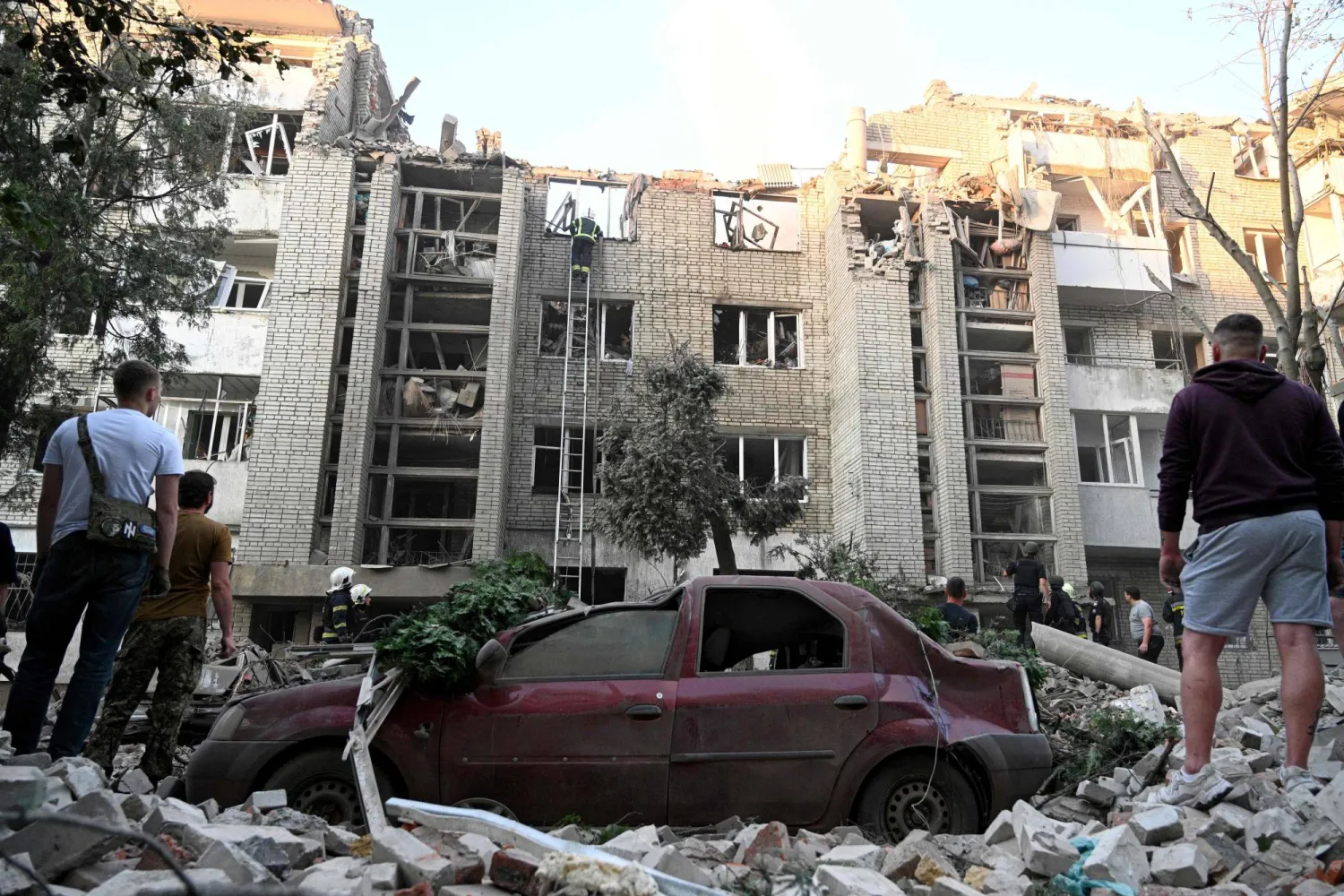

Russian Missile Strike Destroys Family Home, 10 Feared Dead

Local residents watch as first responders operate at a residential building partially destroyed as a result of Russian missile strikes in the western Ukrainian city of Lviv on July 30, 2026, amid the Russian invasion in Ukraine. (AFP)
TT

Russian Missile Strike Destroys Family Home, 10 Feared Dead

Local residents watch as first responders operate at a residential building partially destroyed as a result of Russian missile strikes in the western Ukrainian city of Lviv on July 30, 2026, amid the Russian invasion in Ukraine. (AFP)

A Russian missile slammed into a family home in eastern Ukraine early Thursday, obliterating it and leaving 10 members of the same family presumed dead, an official told AFP. 

An official with Ukraine's emergency services told AFP that six people had been confirmed killed so far, with another four presumed dead but still to be formally identified. 

Russia fired a total of 74 missiles and 284 drones in the overnight barrage, according to Ukraine's air force -- the latest deadly attack in the four-and-a-half-year war, which is seeing a spike in civilian deaths. 

In the capital Kyiv, tens of thousands hunkered in packed-out metro stations through the night after blasts started ringing out shortly after midnight. 

The western city of Lviv was also badly hit, and neighboring NATO member Poland said a 10-meter crater punctured in a field 80 kilometers (50 miles) from the Ukraine border was likely from a Russian missile. 

"The Russians used their ballistic missile to destroy an ordinary house belonging to an ordinary family," Ukrainian President Volodymyr Zelensky said on social media. 

"It was an ordinary home, blown into smithereens," he added. 

"The Voronov family: mother Olena, father Artem, seven children," and a grandchild, he said. 

The strike hit their house outside the eastern city of Kryvyi Rig -- Zelensky's hometown. 

The youngest presumed victim was one-and-a-half-years old, he added. 

The emergency services official said that such was the devastation at the scene, 17 "body fragments" had been found, and forensic examinations were ongoing. 

"It can be preliminarily stated that all 10 people who were in the house have died," Sergiy Kovtoniuk, press officer of the State Emergency Service in the Dnipropetrovsk region, told AFP. 

The regional governor published photos of rescuers sifting through the rubble of a destroyed house, wooden beams and concrete debris strewn across the yard. 

- 'I want to live' - 

Three people were also killed across Kyiv, Poltava and Lviv, local officials there said. 

Russia's defense ministry said it had hit Ukrainian military-industrial complex, military communications and logistics centers. 

Zelensky had late on Wednesday warned of a likely missile attack, prompting tens of thousands in Kyiv to preemptively seek shelter. 

More than 56,000 people packed the stations of the Kyiv subway, which have doubled as shelters during the war. 

They set up tents, rolled-out yoga mats and unfolded sleeping bags in what is now a well-organized routine. 

Galyna Doschuk, 27, said she came to the subway station every time she read reports of a forthcoming attack. 

"I want to live... sometimes our neighbor gets in the way," said the young photojournalist, wrapped in a black sweater, referring to Russia. "But we're fighting on." 

Explosions starting ringing out in the capital at around 01:00 am, an AFP journalist heard. 

The attack also destroyed a popular flea market in Kyiv. 

Its burnt and mangled metal structure was still smoldering in the morning as sellers tried to salvage belongings. 

In the western city of Lviv, rescuers said they had pulled a 93-year-old-woman out alive from the rubble of a five-storey building. She had been alone on the top floor when Russia attacked. 

An AFP reporter in the city saw apartment blocks ripped open, rubble all around, as locals looked on, crying and covering their faces. 

- Poland crater - 

Ukraine's air force said it had managed to intercept 55 missiles and 265 drones launched by Moscow -- but it has struggled to intercept the advanced ballistic missiles that Russia is increasingly deploying. 

In neighboring Poland, police said they had discovered a 10-meter-wide crater in a field after an unidentified object was detected on radar screens during the Russian attack -- triggering anger in Warsaw and across Europe. 

"From the analysis of most of the traces, the recovered fragments point to a Russian Kh-101 missile," Prime Minister Donald Tusk told journalists near the crater. 

Zelensky renewed his call for more supplies of air-defense equipment to protect Ukraine against the ballistic missiles. 

"Given the critical shortage of air-defense missiles from our partners, our warriors are accomplishing truly incredible things," he said. 

The Ukrainian leader had on Tuesday discussed anti-ballistic defense with US President Donald Trump at the White House. 

Trump had previously said he would give Ukraine a license to start producing anti-ballistic Patriot interceptors, but neither Kyiv nor Washington has revealed details of the plan. 

Last month was the deadliest for civilians in Ukraine since April 2022 as Russia ramped up its attacks. 


Far-Right Triumph in Eastern Germany Leaves Migrants Questioning Their Future

A general view taken on September 7, 2026 in Magdeburg, eastern Germany, shows Saxony-Anhalt's State Parliament, the day after the state election. (AFP)
TT

Far-Right Triumph in Eastern Germany Leaves Migrants Questioning Their Future

A general view taken on September 7, 2026 in Magdeburg, eastern Germany, shows Saxony-Anhalt's State Parliament, the day after the state election. (AFP)

Mamad Mohamad watched with mixed emotions as the far-right Alternative for Germany (AfD) swept to a historic victory on Sunday evening in the eastern state of Saxony-Anhalt.

A member of the Greens, the 46-year-old is set to become one of the first lawmakers with an immigrant background to enter the state parliament, alongside Mustafa Groener of the Left (Die Linke) party.

For Mohamad, who arrived in Germany from Syria as a 16-year-old Yazidi Kurd in 1996, it was a milestone that should have been a moment of celebration. Instead, he described it as a "poisoned victory".

"My heart was split," Mohamad said, recalling the first projections that showed the AfD outperforming expectations ‌while Chancellor Friedrich Merz's ‌governing conservatives slumped to a historic low.

'CULTURALLY ALIEN'

The AfD has long ‌campaigned ⁠for tighter immigration ⁠and asylum policies, arguing that Germany has lost control of its borders and that migration is putting heavy pressure on public services, security and social cohesion.

According to its election manifesto, an AfD-led Saxony-Anhalt would launch a state-level campaign to deport rejected asylum seekers.

The party also proposes encouraging businesses to adopt artificial intelligence and automation rather than rely on skilled migration from what it describes as "culturally alien" backgrounds.

The AfD rejects accusations that its rhetoric contributes to a hostile climate for migrants, insisting it opposes only illegal and uncontrolled ⁠migration.

"Everyone is warmly welcome who contributes positively to our society, who ‌wants to work here, who is qualified, who pays taxes, ‌and who abides by the law," AfD co-leader Alice Weidel said on Monday.

PACKED BAGS

The mood in Mohamad's ‌family was somber on Monday.

His daughter, he said, was reluctant to attend school, one of ‌several criticized by the AfD over projects that examine threats to democracy.

Though anxiety is running high in many immigrant communities, the result has prompted unease rather than surprise, said Undra Dressler, managing director of the State Network of Migrant Organizations in Saxony-Anhalt.

People with migrant backgrounds have long faced discrimination and structural barriers in access ‌to work, education, healthcare and public services, Dressler said.

"All of this is our reality," she told Reuters.

Sunday's result nevertheless marks a turning ⁠point, she said. "There are ⁠many people in our communities who say: 'We've already packed our bags and have concrete plans, and we'll be leaving soon,' or, in some cases, have already left."

Pascal Begrich, managing director of democracy advocacy group Miteinander, said he did not expect a large-scale exodus, partly because of economic realities, but agreed that many migrants but also employers were reassessing their future in Saxony-Anhalt.

"There are companies asking themselves whether they really want to locate here and whether they can ensure their workers will be safe," Begrich told Reuters.

CONSTITUTIONAL LIMITS

Mohamad said he feared the political shift could make it harder to attract newcomers to a state already grappling with demographic decline.

"Skilled workers and families will look elsewhere," he said.

Despite concerns about the state's political direction, both Dressler and Begrich stressed that any future government would remain bound by Germany's constitutional order and protections for minorities.

"Every government is bound by this," Dressler said. "And the 15 other federal states have a duty to monitor this and, if necessary, to intervene."


Russia Announces the Closure of the German Consulate in St. Petersburg

A person walks past the German Consulate General in Saint Petersburg, Russia September 2, 2026. Picture taken with a mobile phone. REUTERS/Dmitry Vasilyev
TT

Russia Announces the Closure of the German Consulate in St. Petersburg

A person walks past the German Consulate General in Saint Petersburg, Russia September 2, 2026. Picture taken with a mobile phone. REUTERS/Dmitry Vasilyev

Russia’s Foreign Ministry said Monday that the German consulate in St. Petersburg will have to close, a tit-for-tat move that reflected the simmering tensions between the two countries.

Russia’s Foreign Ministry said the German consulate must stop operations by Sept. 18, following an earlier move by Moscow to close German cultural centers on its territory.

The ministry said the closure was in retaliation for Germany’s decision Wednesday to close both the Russian consulate in Bonn and the Russian House cultural center in the German capital, Berlin.

Germany blamed Russia for an attempted drone attack at Leipzig/Halle Airport on Aug. 4, when an explosives-laden drone was found near a Ukrainian plane.

The airport is a major international freight hub used for providing support to Ukraine. The drone was later defused.

Moscow has denied involvement.


North Korea, Russia Open their First Road Bridge, a Symbol of Expanding Ties 

The first road bridge between Russia and North Korea across the Tumen River, locally known as Tumannaya, on the border with North Korea in the Primorsky region, Russia, in this still image from a video released September 7, 2026. Russian Government/Handout via REUTERS
TT

North Korea, Russia Open their First Road Bridge, a Symbol of Expanding Ties 

The first road bridge between Russia and North Korea across the Tumen River, locally known as Tumannaya, on the border with North Korea in the Primorsky region, Russia, in this still image from a video released September 7, 2026. Russian Government/Handout via REUTERS

North Korea and Russia opened their first road bridge on Monday in a carefully choreographed display of friendship, a structure which spans the Tumen river and which both sides cast as an important milestone in their deepening strategic partnership.

The first flag-adorned trucks trundled across the 1 km (0.6 mile) long two-lane bridge as Russian Prime Minister Mikhail Mishustin and North Korea's Premier Pak Thae Song tuned in by video link to address workers and government officials from both countries.

Construction of the new bridge, which had been under discussion for years, began in April last year after the project was agreed during a visit by President Vladimir Putin to North Korea in 2024. There are already direct air and rail links between Moscow and Pyongyang, but until Monday there had not been a proper road link. Instead, since 1959 and by special arrangement, planks had been placed on the nearby rail bridge - for decades the sole border crossing point - in order to move vehicles across the border between the two countries.

"I am convinced that the expansion of cross-border transport infrastructure will provide a powerful impetus for the further development of trade, economic, scientific, technological and cultural cooperation," said Mishustin, who said ties between Moscow and Pyongyang were "at an unprecedented high level" and called the opening of the bridge "a genuinely historic event."

The construction of the bridge was not merely an engineering project, he said, but "a new symbol of friendship".

Mishustin said up to 300 vehicles would be able to cross every day and that the bridge would be linked to Russia's federal road network and have easy access to the transport corridor which runs from the far eastern city of Vladivostok to St Petersburg. Trucks would begin to use the bridge immediately to transport cargo, the Russian government said. At the end of this year, the bridge would be fully operational and could be used for passenger traffic too.

The bridge was built near an existing "Friendship Bridge", a rail bridge which was commissioned in 1959 after the Korean war. Symbolically, the new bridge is named after Yakov Novichenko, a Red Army soldier who Pyongyang credits with protecting the life of North Korea's first leader Kim Il Sung in 1946 by intercepting a grenade thrown at him and others.

Ties between the two countries have grown stronger since the start of the war in Ukraine in 2022, with Pyongyang sending thousands of troops to Russia's Kursk region to help repel a 2024 Ukrainian incursion there.

Mishustin made a reference to that in his speech on Monday, referring to "the Korean heroes who, only recently, fought shoulder to shoulder with our soldiers and defended Russian soil".
