



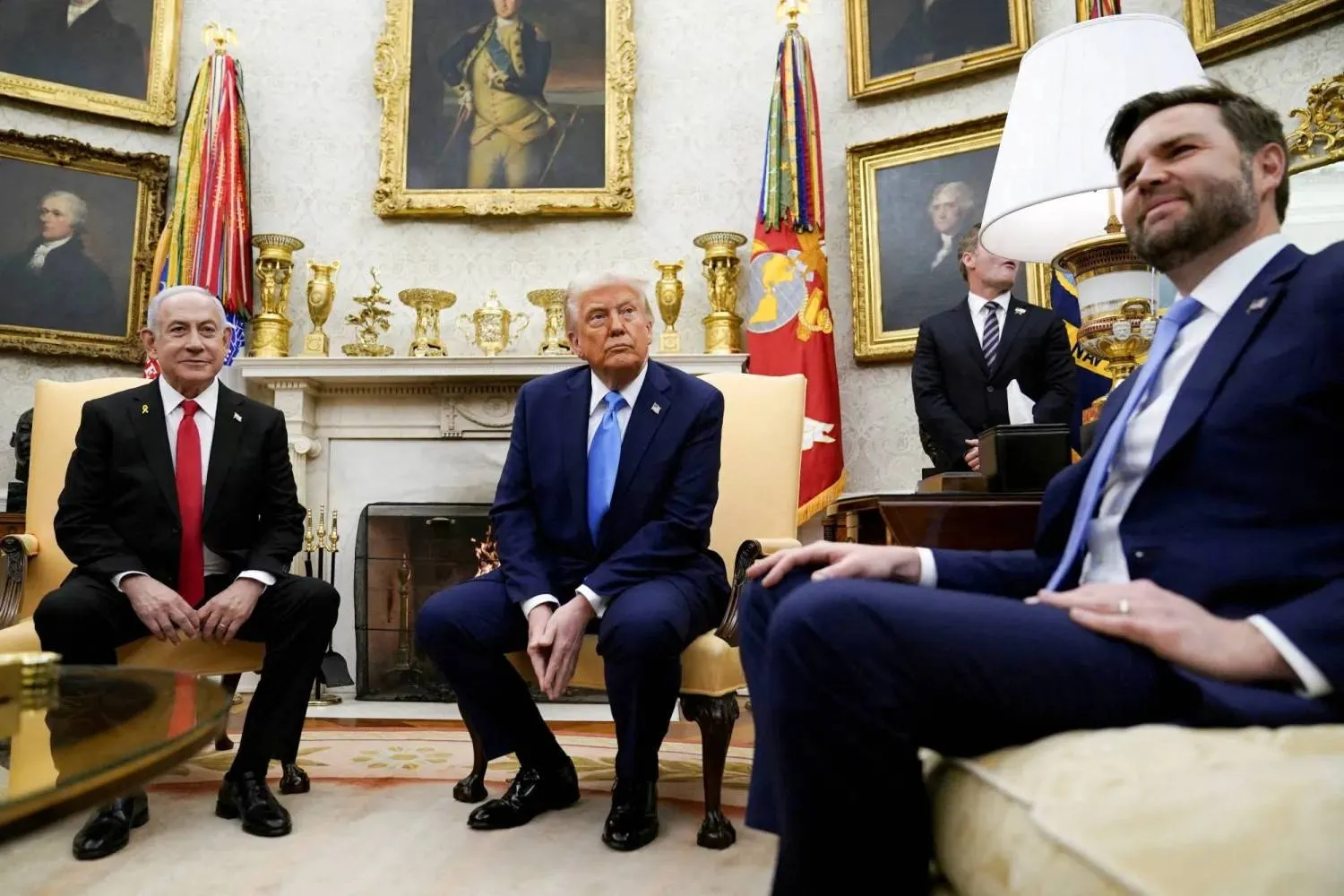

US Vice President JD Vance and Israeli Prime Minister Benjamin Netanyahu held on Thursday direct talks to address differences over continued military pressure and Washington's efforts to reach a diplomatic settlement that would prevent the US-Iran conflict from turning into an open war.
The meeting at Blair House was described by a US official as a “cordial and productive conversation about Middle East issues that are important to both countries,” according to CBS News.
The Vice President and the PM agreed to continue pursuing opportunities for Israel and the United States to cooperate in areas of mutual interest and shared goals, the official said, adding that the meeting was not confrontational and that Vance and Netanyahu have a productive working relationship.
A senior Israeli official told Axios that Netanyahu spoke to Vance about his recent criticism of the Israeli government and Israel's standing among Republicans.
“It was a frank and candid conversation,” the Israeli official said.
A US official then confirmed that characterization: “The conversation was direct.”
In a July interview on Joe Rogan's podcast, Vance accused some members of the Israeli government of running an influence campaign to push the US away from diplomacy and keep the war going.
Later, in an interview with ABC News, Netanyahu denied his government was trying to derail peace talks or pressure Trump to resume attacks on Iran.
“He's the senior partner. It's the United States of America, let's not forget. And I'm a junior partner,” the Israeli PM added.
Trump’s Choices
Talks between Vance and Netanyahu came following a meeting between the Israeli PM and Trump in the White House, where the two men explored all possible paths to curb Iran's nuclear program, including diplomacy, economic pressure and force, a senior Israeli official told Reuters on Wednesday.
The US president has three options and all were discussed at length, said the official, listing them as “a (negotiated) deal, continuing the blockade and economic pressures, and a massive strike.” Netanyahu also added unspecified new ideas to the mix, the official added.
Trump had voiced irritation with Netanyahu ahead of their meeting, complaining that details had surfaced publicly about the Israeli leader's plans to talk about new intelligence on Pickaxe Mountain, a deep-underground, nuclear-linked facility that Trump has threatened to bomb.
Pushing back against any notion of tensions over the issue, the official said the two allies readily share intelligence, denied that Netanyahu had pushed Trump to escalate militarily against Iran and left open the possibility of a diplomatic solution.
Vance Defends US-Iran Talks
Vance has become the administration's most outspoken defender of diplomacy with Iran, repeatedly arguing that Trump's objective should be to prevent Iran from obtaining a nuclear weapon without becoming mired in an open-ended military campaign, according to Axios.
Vance took on a larger role in war policy and Iran negotiations as the conflict progressed. That culminated in the US-Iran memorandum of understanding, which Vance took a lead role in defending.
Netanyahu opposed the agreement but didn't come out against it publicly, hoping it would collapse on its own. It did several weeks later.
Tensions between the two have been simmering behind the scenes. Netanyahu was unhappy about Vance's public criticism of him.
In March, Vance and Netanyahu had a tense phone call during which Vance pointed out that several of Netanyahu's predictions about the war had proved far too optimistic, particularly the prospect of a popular uprising toppling the regime.
In June, Vance issued a blunt public warning to members of the Israeli government who were attacking the deal with Iran. “If I was in the cabinet of the Israeli government, I might not be attacking the only powerful ally that I have anywhere left in the entire world,” Vance said.
In his interview with ABC New, Netanyahu remained skeptical that a diplomatic solution with the Iranian regime is possible.


