



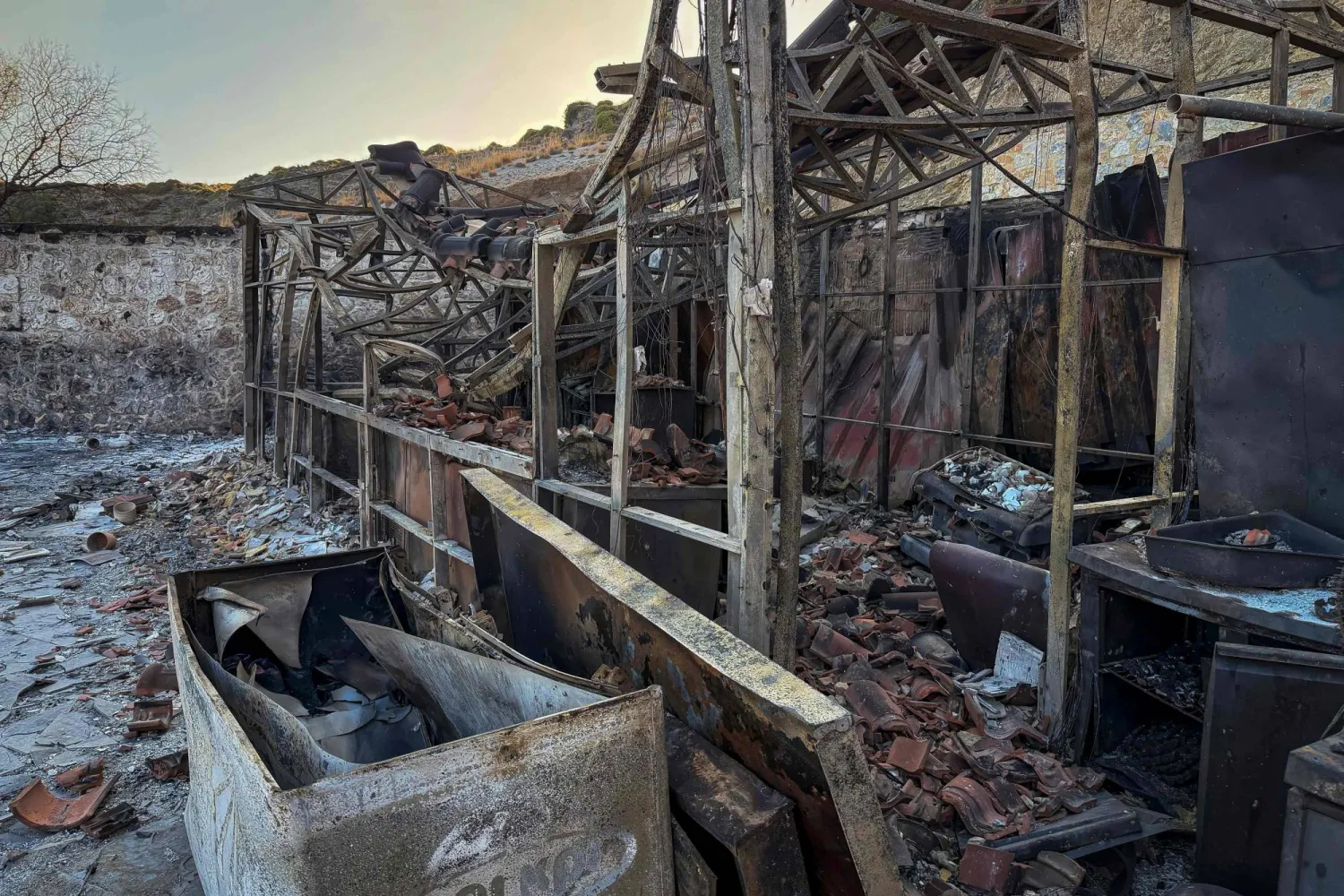

Greek firefighters continued on Friday to battle a wildfire ravaging parts of the tourist island of Crete, although conditions had improved, authorities said.
"The situation around Rethymno is better," a fire department spokesperson told AFP.
But the blaze "has not yet been contained, there are still many hotspots," he added.
About 4,500 hectares (11,120 acres) had been scorched on Wednesday and Thursday south of the tourist town of Rethymno, according to meteo.gr, the weather service of the National Observatory of Athens, citing an analysis of satellite imagery from the European Union's Copernicus program.
Strong winds and rugged terrain continued to hamper firefighting efforts, authorities said.
Extensive damage was reported around the seaside resort of Agia Galini, where about 8,000 people were evacuated on Wednesday evening.
"My entire cafe was destroyed. This place supported two families, mine and my son's," Thrasyvoulos Paterakis, 69, the owner of a local cafe, told AFP.
"We're now out on the street," he said.
- 'Very high' risk-
A separate wildfire was burning on the Peloponnese peninsula near the port city of Patras, raising concerns among authorities.
Four water-bombing aircraft and three helicopters were deployed near the village of Floka, south of Patras, the fire service said.
Wildfires were also burning on the Aegean islands of Paros, Kalymnos and Andros, although "the situation is better", according to the fire service.
Across Greece, firefighters and civil protection services have been placed on general alert, fire brigade spokesman Vassilis Vathrakogiannis said at a briefing on Thursday.
Many parts of the country, including the Athens region, Crete, numerous Aegean islands and parts of the Peloponnese, faced a "very high" wildfire risk on Friday, the second-highest level on Greece's five-point scale, according to Greek civil protection.
Winds of up to 88 kph (55 mph) were forecast for Friday, disrupting ferry services to islands popular with tourists.
"The gusts are literally carrying the fire and spreading it in all directions," Theodore Giannaros, a senior researcher at the National Observatory of Athens, told public broadcaster ERT.
"The strong winds are lifting embers that can spark new outbreaks, sometimes far from the main fire front," he added.
Greece's geography, made up of hundreds of islands, complicates the rapid deployment of emergency responders, Vathrakogiannis said.
Additional firefighting resources have been dispatched to Crete.
"Strong winds and dense smoke are creating conditions of near-zero visibility and severe turbulence, making aerial water drops extremely difficult, if not impossible," he said, particularly in Crete.
Greek authorities on Wednesday ordered the evacuation of around 8,000 residents and tourists from the coastal resort of Agia Galini.
Most evacuees have since returned to their homes and hotels as Crete's peak tourist season continues.
Prime Minister Kyriakos Mitsotakis warned on Thursday that Greece, which had largely avoided the severe heatwaves and major wildfires seen earlier this summer in countries such as France and Spain, was entering a challenging period.
"August ... is traditionally a difficult month," he said.
Three firefighters have died this week while battling wildfires in Crete and the Peloponnese, according to Greek authorities.


