


Prime Minister Visits Quake-Hit Southern Japan as Cleanup Begins in Intense Heat

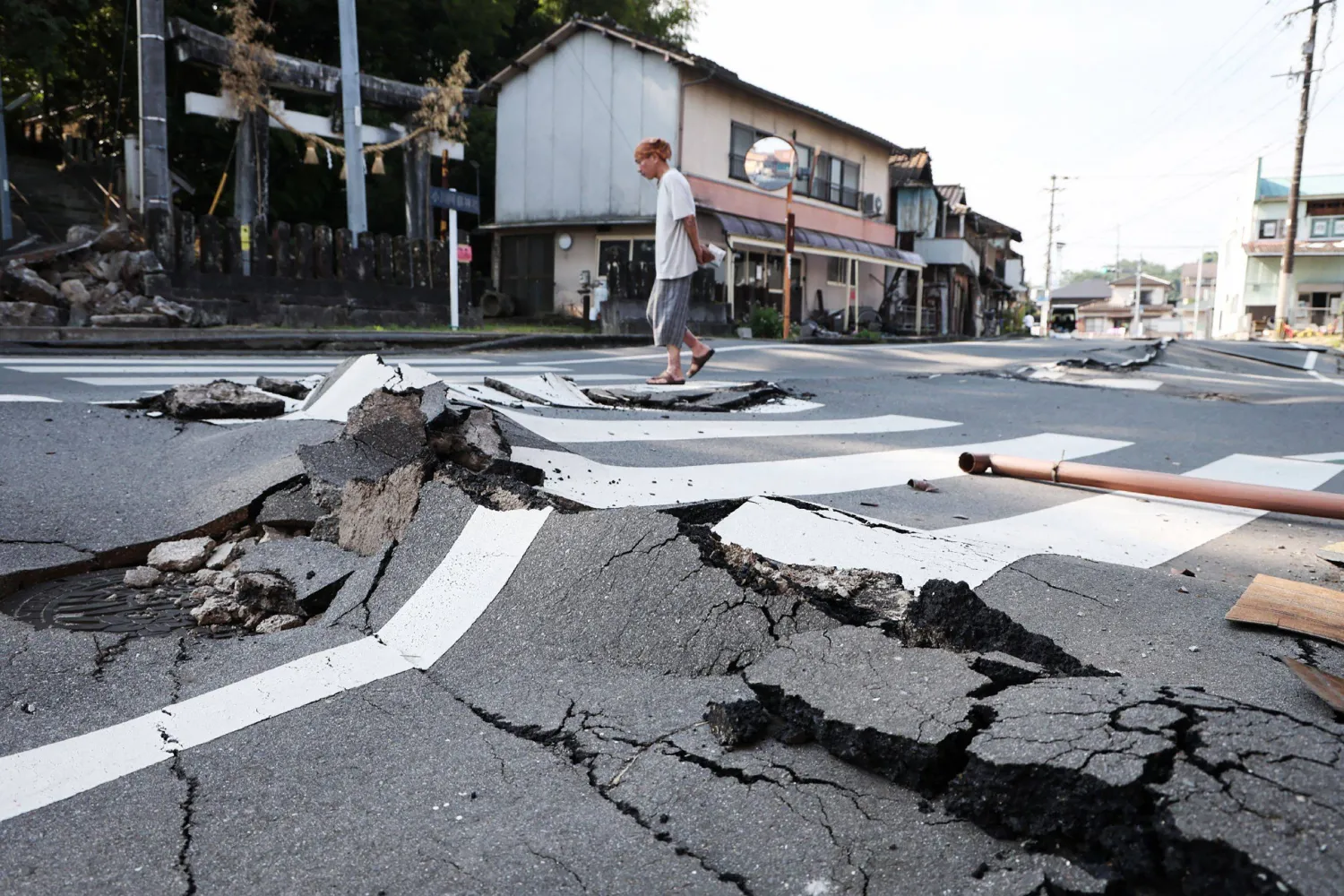
 A man walks along a destroyed road in Uki, Kumamoto prefecture on August 3, 2026, following the July 28 earthquake. (Jiji Press/AFP)
A man walks along a destroyed road in Uki, Kumamoto prefecture on August 3, 2026, following the July 28 earthquake. (Jiji Press/AFP)
TT

Prime Minister Visits Quake-Hit Southern Japan as Cleanup Begins in Intense Heat

 A man walks along a destroyed road in Uki, Kumamoto prefecture on August 3, 2026, following the July 28 earthquake. (Jiji Press/AFP)
A man walks along a destroyed road in Uki, Kumamoto prefecture on August 3, 2026, following the July 28 earthquake. (Jiji Press/AFP)

Residents in Japan's quake-hit southwestern prefecture of Kumamoto put out heaps of debris for collection and the prime minister visited as the region baked under intense heat.

The heat and a lack of water supplies have added to the challenges in the severely damaged areas where Prime Minister Sanae Takaichi briefly visited for the first time since a magnitude 7.1 quake hit Kumamoto Prefecture on Japan’s southern main island of Kyushu last Tuesday.

Thirty-eight people died during the quake, including one who died of apparent heat stroke while taking shelter in a car in hot weather and one others whose cause of death is still being investigated, prefectural officials said Monday.

Residents put out heaps of debris, broken furniture and damaged appliances for collection, while in the towns of Uki and Hikawa, construction of temporary housing began.

More than 46,000 households remained without water and many also faced fuel shortages as the region suffers sweltering heat, stoking fears of heat-related illness. Japan Meteorological Agency predicted that temperatures would rise close to 40 C (104 F) Monday.

More than 8,500 people remain at crowded emergency shelters, such as converted community centers, school gyms and classrooms, many of which lack air-conditioning. Others are sleeping in cars at town hall parking lots and parks, or outside of their homes.

Experts have long warned that inadequate shelter provision leads to crowded conditions and a lack of sanitation and privacy for people forced to leave their homes following disasters.

Takaichi on Monday visited one of the area's best-equipped shelters, with cardboard beds, partitions and air-conditioning, triggering criticisms on social media that her visit distorted reality.

Meanwhile, a company that owned a general store in a collapsed shopping mall acknowledged that it had instructed two employees who were killed in a later explosion to return to the building to put sales proceeds into a safe.

Two executives of Habita, a local general store operator that had a shop inside the collapsed Aeon Mall in the town of Kashima, attended the wake Sunday of one of the two victims, 22-year-old Kurumi Otake, and apologized to her parents for the death.

Company sales manager Goji Yuse acknowledged that the company instructed the two to put sales proceeds into the safe if it was possible.

“I wish someone had stopped her,” Otake's tearful mother told them. “My daughter is not coming back.”

The mall's operator said it believes the explosion was due to a gas leak and occurred after about 3,000 shoppers had been evacuated to a parking lot following the quake, but some employees remained inside. Rescuers recovered five people and the bodies of seven others from the mall.

The earthquake has left 114 people injured across Kumamoto, authorities said.

Some 700 homes were destroyed, and more than 11,300 buildings were damaged, according to Kumamoto prefecture.




Russia Wants AI, Digital Cooperation with China, Putin Tells Xi

FILE - Russian President Vladimir Putin, left, gestures while speaking to Chinese President Xi Jinping during the Shanghai Cooperation Organization (SCO) summit in Samarkand, Uzbekistan, Sept. 16, 2022. (Sergei Bobylev, Sputnik, Kremlin Pool Photo via AP, File)
TT

Russia Wants AI, Digital Cooperation with China, Putin Tells Xi

FILE - Russian President Vladimir Putin, left, gestures while speaking to Chinese President Xi Jinping during the Shanghai Cooperation Organization (SCO) summit in Samarkand, Uzbekistan, Sept. 16, 2022. (Sergei Bobylev, Sputnik, Kremlin Pool Photo via AP, File)

Moscow aims to cooperate with Beijing in the field of artificial intelligence and digital innovation, Russian President Vladimir Putin told China's Xi Jinping on Monday as the leaders met in Kyrgyzstan.

They arrived in the central Asian country for a two-day summit of the Shanghai Cooperation Organisation (SCO), a regional bloc that seeks to serve as a counter-balance to the West.

Russia, with its troops bogged down in Ukraine, has deepened ties with its main oil customer China, which has never condemned Moscow for its four-and-a-half-year invasion.

"Cooperation is successfully developing on all fronts," Putin told Xi ahead of their talks.

They last met in May in Beijing.

"Digital innovations, including in artificial intelligence technologies, are also opening up new opportunities for the economic development of our countries," Putin said.

The Kremlin has in the past months sought to tighten its control over the online sphere, imposing intermittent mass internet shutdowns and restrictions on popular messaging apps.

Moscow is pushing Russians to embrace the state-backed Max messenger platform -- an unencrypted super-app similar to China's WeChat that critics say raises privacy and snooping concerns.

It has repeatedly threatened foreign-owned sites with bans, part of what rights advocates say is a broader attempt by authorities to control and monitor internet use.


Pentagon Signs 7-year Deals to Increase Missile Production

FILE - The Pentagon is seen from the air, July 15, 2026, in Washington. (AP Photo/Alex Brandon, File)
TT

Pentagon Signs 7-year Deals to Increase Missile Production

FILE - The Pentagon is seen from the air, July 15, 2026, in Washington. (AP Photo/Alex Brandon, File)

The Pentagon said on Monday it secured seven-year agreements with General Dynamics Ordnance and Tactical Systems (GD-OTS) and Lockheed Martin to increase missile production.

The agreements are designed to "increase production quantities and accelerate delivery schedules for critical missile subcomponents supporting the Terminal High Altitude Area Defense (THAAD) and Patriot Advanced Capability-3 Missile Segment Enhancement (PAC-3 MSE) interceptor programs," the Pentagon said.


Israel Signs Three-billion-euro Arms Export Deal with Greece

Greece to buy a defense system from Israel (Reuters)
TT

Israel Signs Three-billion-euro Arms Export Deal with Greece

Greece to buy a defense system from Israel (Reuters)

Israel's defense ministry announced Monday it had signed a deal with Athens worth approximately three billion euros (almost $3.5 billion) to set up the "Achilles Shield" aerial defense system for Greece. 

"Under the deal, Israel will build Greece a comprehensive, multi-layered air defense array, drawing entirely on Israeli-made systems and on the extensive operational experience Israel's defense establishment has gained during the war," the ministry said in a statement. 

"This is the largest defense export deal in the history of Israel-Greece relations, and one of the largest in the history of the State of Israel," it added. 

The deal was signed by the Israeli defense ministry's director general, Major General (Res.) Amir Baram, and his Greek counterpart, Ioannis Bouras, in Tel Aviv. 

A Greek defense ministry source had told AFP in late July about an upcoming purchase of Israeli-made anti-missile, anti-aircraft and anti-drone systems, part of a broader defense investment for the Achilles Shield of 4.2 billion euro ($4.8 billion). 

In a statement, the Greek Defense Ministry said the multi-billion euro purchase was part of "the greatest reform of its armed forces in its history". 

Greek Defense Minister Nikos Dendias was quoted in the statement as saying that recent technological developments "have long rendered existing defense doctrines completely obsolete". 

"Greece is the first country in the European Union to adopt" a multi-layered air defense system such as the Israeli one, he added. 

According to the Israeli Defense Ministry, the export deal includes the David's Sling, Barak MX and SPYDER interception systems, air surveillance radars, and "a new national command and control system". 

All the equipment is manufactured by Israeli defense contractors Rafael and Israel Aerospace Industries and its subsidiary ELTA Systems. 

A supplementary 26 million euro deal was also signed to provide Greece with Rafael's defense systems against drones, the ministry said. 

"Israel and Greece share common strategic interests and face shared regional challenges," said Defense Minister Israel Katz, quoted in the statement. 

"At a time when actors with hegemonic ambitions are seeking to expand their influence and undermine stability in the region, Israel and Greece will continue to deepen their defense and strategic cooperation," he said, in a likely reference to Türkiye. 

Greece is now one of only four European NATO members to spend at least three percent of GDP on its military, amid decades of tensions with neighboring Türkiye. 

Israel has also increasingly locked horns with Türkiye, having struck a disused military base in northwest Syria, claiming it wanted to avert Turkish troops deploying to the facility. 

In 2023, Israel signed a deal with Germany to provide the Arrow 3 anti-ballistic missile defense system, which was expanded in December for a total value of $6.5 billion, the country's largest-ever military export contract.