

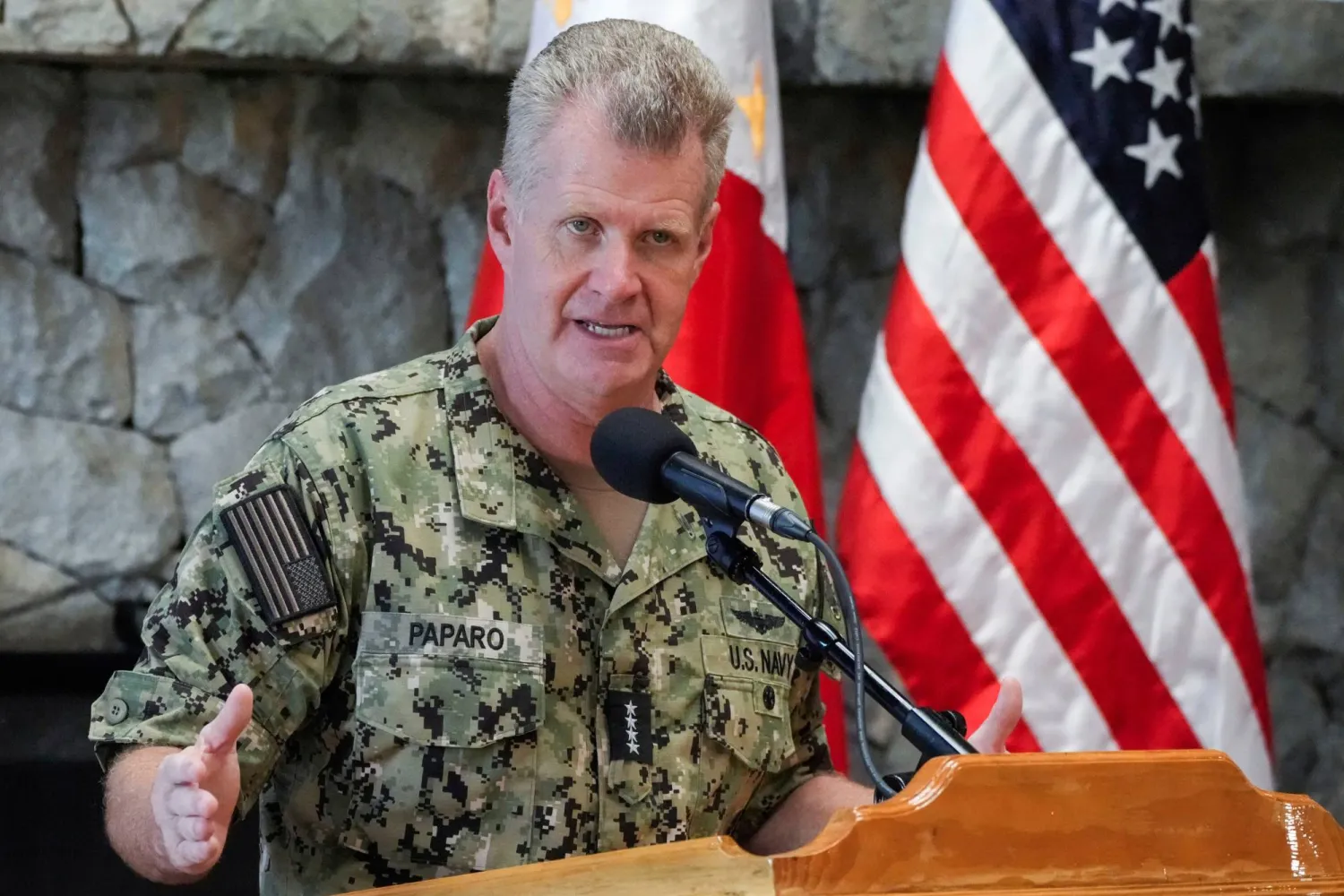

Top US Admiral Warns Against Coercion, Says No Nation Will Dominate Indo-Pacific

US Indo-Pacific Command Commander, Admiral Samuel Paparo, gestures during a press conference at the Philippine Military Academy in Baguio, northern Philippines, Aug. 29, 2024. (AP)
TT

Top US Admiral Warns Against Coercion, Says No Nation Will Dominate Indo-Pacific

US Indo-Pacific Command Commander, Admiral Samuel Paparo, gestures during a press conference at the Philippine Military Academy in Baguio, northern Philippines, Aug. 29, 2024. (AP)

The head of US Pacific Command said Monday that coercive actions by China and other actors are challenging regional stability, warning the United States will not allow any nation to dominate the Indo-Pacific.

Admiral Samuel Paparo said some actors were using “false claims of legitimacy” to justify intimidation and coercion.

“That’s not the rule of law. That’s the rule by law. That distinction between law as a tool of order versus law as a weapon of raw power, is the defining fault line of our time,” he said via video link at a regional security conference in Malaysia organized by the US Pacific Command.

Paparo’s remarks come as tensions remain high in the South China Sea, where China’s expansive maritime claims overlap with those of several Southeast Asian nations. The Philippines has been at the center of a series of confrontations with China, particularly around a disputed shoal, where Chinese and Philippine vessels have repeatedly faced off.

Manila has accused Beijing of dangerous maneuvers, water cannon attacks and attempts to block Philippine resupply missions. China has rejected those accusations and maintains its territorial claims in the disputed waterway.

The United States has said it does not take sides in competing sovereignty claims but supports freedom of navigation, international law and the ability of states to operate in accordance with their rights.

Paparo emphasized that freedom of the seas, maritime security and open commerce are key to regional stability, saying peaceful resolution of disputes and respect for the sovereignty of all nations are essential to preserving the Indo-Pacific order.

“The United States is clear-eyed about the complex security environment in this region. Our posture and our intent are well defined. The United States is deterring China through strength, not through confrontation,” Paparo said. “We will not let any nation dominate this region or sweep away the hard-fought sovereign rights of independent states."

The US Indo-Pacific commander said the region remains the world’s geopolitical and economic center of gravity, with growing instability and security challenges making cooperation among allies and partners increasingly important.

Earlier at the conference, Philippine Defense Secretary Gilberto Teodoro vowed his country will continue to resist and “push back” against the threat from China.

Teodoro told reporters later that the Philippines’ concerns extend beyond China’s activities in the South China Sea, pointing to Beijing’s actions in other areas, including a recent ballistic missile launch into the Pacific Ocean, as evidence of its expanding reach and growing military presence.

“China is everywhere ... this is a matter of concern,” he said.

Talks between the Association of Southeast Asian Nations and China for a code of conduct to govern behavior in the South China Sea and help ease tensions have progressed significantly, ASEAN Secretary-General Kao Kim Hourn said on the sidelines of the conference.

“The pace has picked up dramatically and I think we are much closer to finalizing the code of conduct,” Kao said. “I have full confidence that we will get it done within this year.”




Russia Wants AI, Digital Cooperation with China, Putin Tells Xi

FILE - Russian President Vladimir Putin, left, gestures while speaking to Chinese President Xi Jinping during the Shanghai Cooperation Organization (SCO) summit in Samarkand, Uzbekistan, Sept. 16, 2022. (Sergei Bobylev, Sputnik, Kremlin Pool Photo via AP, File)
TT

Russia Wants AI, Digital Cooperation with China, Putin Tells Xi

FILE - Russian President Vladimir Putin, left, gestures while speaking to Chinese President Xi Jinping during the Shanghai Cooperation Organization (SCO) summit in Samarkand, Uzbekistan, Sept. 16, 2022. (Sergei Bobylev, Sputnik, Kremlin Pool Photo via AP, File)

Moscow aims to cooperate with Beijing in the field of artificial intelligence and digital innovation, Russian President Vladimir Putin told China's Xi Jinping on Monday as the leaders met in Kyrgyzstan.

They arrived in the central Asian country for a two-day summit of the Shanghai Cooperation Organisation (SCO), a regional bloc that seeks to serve as a counter-balance to the West.

Russia, with its troops bogged down in Ukraine, has deepened ties with its main oil customer China, which has never condemned Moscow for its four-and-a-half-year invasion.

"Cooperation is successfully developing on all fronts," Putin told Xi ahead of their talks.

They last met in May in Beijing.

"Digital innovations, including in artificial intelligence technologies, are also opening up new opportunities for the economic development of our countries," Putin said.

The Kremlin has in the past months sought to tighten its control over the online sphere, imposing intermittent mass internet shutdowns and restrictions on popular messaging apps.

Moscow is pushing Russians to embrace the state-backed Max messenger platform -- an unencrypted super-app similar to China's WeChat that critics say raises privacy and snooping concerns.

It has repeatedly threatened foreign-owned sites with bans, part of what rights advocates say is a broader attempt by authorities to control and monitor internet use.


Pentagon Signs 7-year Deals to Increase Missile Production

FILE - The Pentagon is seen from the air, July 15, 2026, in Washington. (AP Photo/Alex Brandon, File)
TT

Pentagon Signs 7-year Deals to Increase Missile Production

FILE - The Pentagon is seen from the air, July 15, 2026, in Washington. (AP Photo/Alex Brandon, File)

The Pentagon said on Monday it secured seven-year agreements with General Dynamics Ordnance and Tactical Systems (GD-OTS) and Lockheed Martin to increase missile production.

The agreements are designed to "increase production quantities and accelerate delivery schedules for critical missile subcomponents supporting the Terminal High Altitude Area Defense (THAAD) and Patriot Advanced Capability-3 Missile Segment Enhancement (PAC-3 MSE) interceptor programs," the Pentagon said.


Israel Signs Three-billion-euro Arms Export Deal with Greece

Greece to buy a defense system from Israel (Reuters)
TT

Israel Signs Three-billion-euro Arms Export Deal with Greece

Greece to buy a defense system from Israel (Reuters)

Israel's defense ministry announced Monday it had signed a deal with Athens worth approximately three billion euros (almost $3.5 billion) to set up the "Achilles Shield" aerial defense system for Greece. 

"Under the deal, Israel will build Greece a comprehensive, multi-layered air defense array, drawing entirely on Israeli-made systems and on the extensive operational experience Israel's defense establishment has gained during the war," the ministry said in a statement. 

"This is the largest defense export deal in the history of Israel-Greece relations, and one of the largest in the history of the State of Israel," it added. 

The deal was signed by the Israeli defense ministry's director general, Major General (Res.) Amir Baram, and his Greek counterpart, Ioannis Bouras, in Tel Aviv. 

A Greek defense ministry source had told AFP in late July about an upcoming purchase of Israeli-made anti-missile, anti-aircraft and anti-drone systems, part of a broader defense investment for the Achilles Shield of 4.2 billion euro ($4.8 billion). 

In a statement, the Greek Defense Ministry said the multi-billion euro purchase was part of "the greatest reform of its armed forces in its history". 

Greek Defense Minister Nikos Dendias was quoted in the statement as saying that recent technological developments "have long rendered existing defense doctrines completely obsolete". 

"Greece is the first country in the European Union to adopt" a multi-layered air defense system such as the Israeli one, he added. 

According to the Israeli Defense Ministry, the export deal includes the David's Sling, Barak MX and SPYDER interception systems, air surveillance radars, and "a new national command and control system". 

All the equipment is manufactured by Israeli defense contractors Rafael and Israel Aerospace Industries and its subsidiary ELTA Systems. 

A supplementary 26 million euro deal was also signed to provide Greece with Rafael's defense systems against drones, the ministry said. 

"Israel and Greece share common strategic interests and face shared regional challenges," said Defense Minister Israel Katz, quoted in the statement. 

"At a time when actors with hegemonic ambitions are seeking to expand their influence and undermine stability in the region, Israel and Greece will continue to deepen their defense and strategic cooperation," he said, in a likely reference to Türkiye. 

Greece is now one of only four European NATO members to spend at least three percent of GDP on its military, amid decades of tensions with neighboring Türkiye. 

Israel has also increasingly locked horns with Türkiye, having struck a disused military base in northwest Syria, claiming it wanted to avert Turkish troops deploying to the facility. 

In 2023, Israel signed a deal with Germany to provide the Arrow 3 anti-ballistic missile defense system, which was expanded in December for a total value of $6.5 billion, the country's largest-ever military export contract.