


Greece Wildfire Expert Says Season ‘One of the Worst’ in a Decade

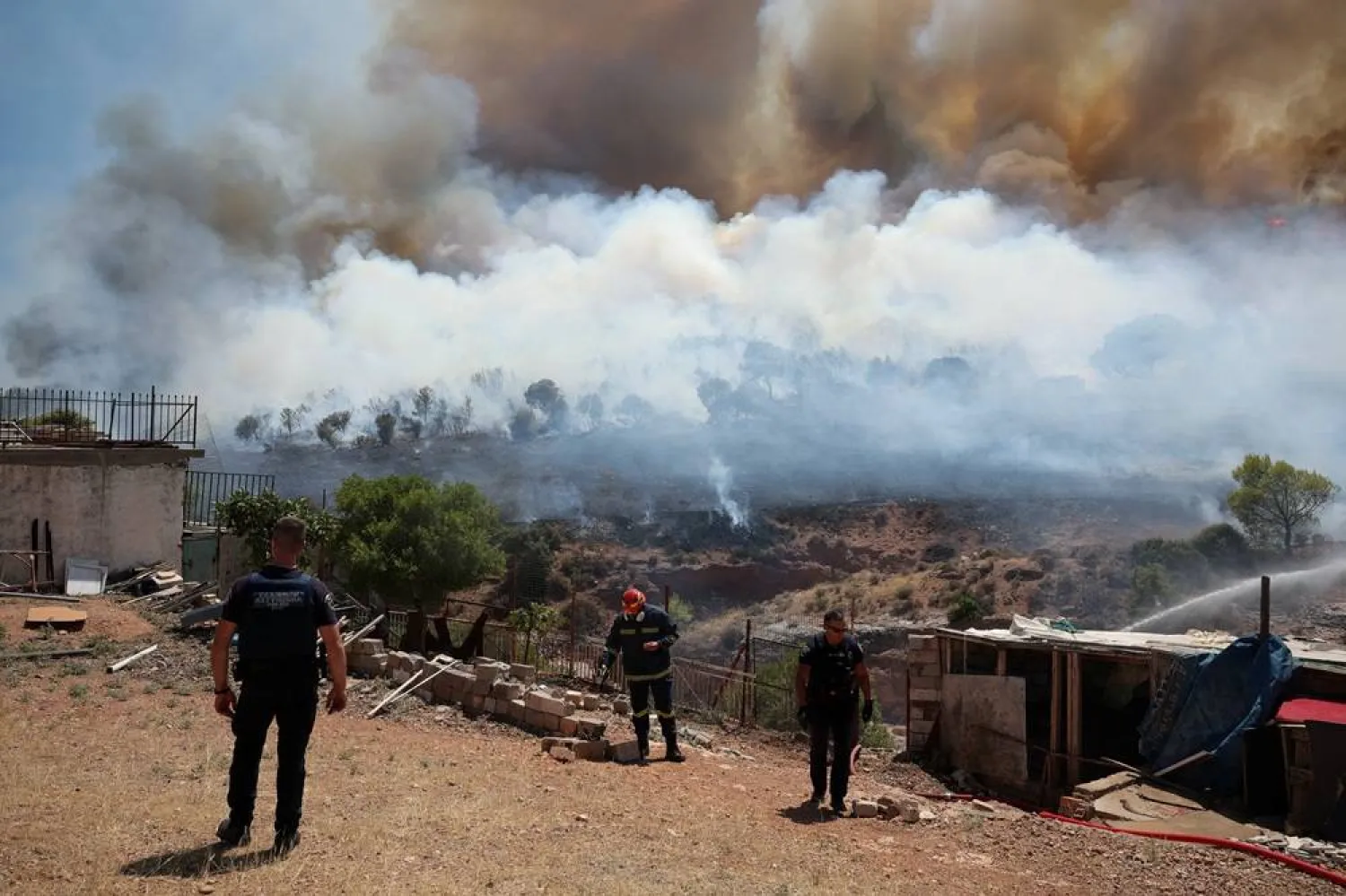
 A firefighter and police officers work beside a burning area near Nea Peramos, as wildfires hit West Attica, Greece, August 3, 2026. (Reuters)
A firefighter and police officers work beside a burning area near Nea Peramos, as wildfires hit West Attica, Greece, August 3, 2026. (Reuters)
TT

Greece Wildfire Expert Says Season ‘One of the Worst’ in a Decade

 A firefighter and police officers work beside a burning area near Nea Peramos, as wildfires hit West Attica, Greece, August 3, 2026. (Reuters)
A firefighter and police officers work beside a burning area near Nea Peramos, as wildfires hit West Attica, Greece, August 3, 2026. (Reuters)

As Greece grapples with a succession of massive wildfires, Theodore Giannaros, a senior wildfire meteorologist at the National Observatory told AFP on Monday the country faced "one of the worst fire crises" in recent memory.

Hundreds of firefighters have been battling multiple blazes across Greece, which have claimed five lives over the past two weeks.

"I would say that it is definitely one of the worst fire crises I've seen in the past, maybe eight to 10 years."

But he added they cannot make right now a direct comparison in terms of burnt areas or number of ignitions.

"We will have to wait until the end of the fire season to do such a quantitative comparison," he added.

More than 12,000 hectares of forest and agricultural land have burned over the past week, according to analyses by the European Union's Copernicus Earth observation program.

Explaining the drivers behind the fires, Giannaros said it would be easy to blame climate change and weather alone.

"Climate change is indeed creating conditions that are highly conducive to these kinds of fires, allowing them to spread very easily and become uncontrollable," he said.

But, he argued, the broader picture in Greece and across Europe also points to failures in land management.

- 'Human activity' -

"Climate change definitely sets the stage for fire, but climate change and weather do not ignite fires. Unfortunately, 95 percent, or even more, of ignitions are caused by human activity, either through arson, negligence or land management," he said.

Greece, he added, has long neglected many of its rural and forested areas.

"We have abandoned our rural areas. Our forests are not being managed efficiently," he said.

"The climate crisis is simply increasing the toll."

Over the weekend, Giannaros said the fires around Porto Germeno, about 70 kilometers (45 miles) by road northwest of Athens in the region of Viotia, were likely to be classified as a megafire.

Asked why, he said that while there was no universally accepted definition of a megafire, a commonly used US benchmark classifies a wildfire as such when it burns more than 10,000 hectares.

"Based on a preliminary assessment of satellite data, it appears that this particular fire in western Attica is going to exceed that threshold," he said.

"It is therefore highly probable that we will end up classifying it as a megafire."

From the deadly Mati wildfire in 2018 to the massive Evros blaze in 2023, Greece endured a succession of destructive fire disasters between 2018 and 2025, cementing the eastern Mediterranean's status as one of Europe's most vulnerable regions to wildfires.

The country was hit by an exceptional heatwave in 2021, enabling wildfires that ravaged large parts of northern Evia, an island close to Athens, and destroyed tens of thousands of hectares of forest. The blaze was later classified as a megafire.

- 'More remains to be done'-

Asked about Greece's fire-weather forecasting and early-warning systems, Giannaros said significant progress had been made in recent years.

"The most recent development that makes me somewhat optimistic is that Greece now has a new civil protection law," he said, referring to the Active Battle legislation approved by parliament this spring.

"Unfortunately, there was very little time between the law's adoption and the start of the fire season, so it has yet to be fully implemented."

Asked whether Greece is better prepared today than in previous years, the senior researcher replied: "I want to believe the answer is yes," though he stressed that much work remains to be done.

The new law, he said, provides another important tool by introducing a 10-year integrated fire-management plan.

"It establishes that our approach to wildfire management will not change if the government changes, and that is really important."



Germany Blames Russia for Airport Drone Incident, Hits Back with Sanctions

German Interior Minister Alexander Dobrindt R) and German Foreign Minister Johann Wadephul attend a press conference on the drone incident at Leipzig Airport in Berlin, Germany 01 September 2026. (EPA)
TT

Germany Blames Russia for Airport Drone Incident, Hits Back with Sanctions

German Interior Minister Alexander Dobrindt R) and German Foreign Minister Johann Wadephul attend a press conference on the drone incident at Leipzig Airport in Berlin, Germany 01 September 2026. (EPA)

Germany on Tuesday blamed Russia for an attempted "hybrid attack" involving an explosive-laden drone at a strategic airport last month and announced diplomatic counter-measures.

The European Union expressed "full solidarity" with Germany, NATO assured that it would defend its members and countries including Britain, Estonia and Poland offered strong backing.

Germany will close Russia's consulate in the former capital Bonn later this month, and cancel the contract for the Russian House, a cultural center in Berlin, said Foreign Minister Johann Wadephul.

"We are tightening entry controls for Russian nationals" and Germany would propose the listings of more Russian individuals for European Union sanctions, he added, as the Russian ambassador to Berlin was being summoned.

Germany's top diplomat also vowed that "we are increasing pressure on the Russian shadow fleet" -- a term for the old oil tankers and other cargo ships with opaque ownership Russia uses to get around Western sanctions.

Interior Minister Alexander Dobrindt said that after assessing the drone technology used and other intelligence, "the government concludes that Russia is responsible for the hybrid attack in Leipzig on August 4".

He blamed "low-level agents" for the operation and said "the drone configuration -- various components, explosives and ignition systems -- are known to us from other hybrid operations by Russia and its war against Ukraine".

"We do not view the Leipzig incident in isolation, but rather see it in the context of other hybrid actions," he said. "We assume that Germany is the target of further hybrid attacks by Russia."

"We are not at war, but we are a daily target of hybrid warfare."

European Union chief Ursula von der Leyen said the bloc stands in "full solidarity" with Germany, while NATO chief Mark Rutte said the alliance "will continue to strengthen our ability to deter and defend all Allies against any threat."

Germany, which supports Ukraine in its fight against Russia, has for months reported suspicious drone sightings over military and industrial sites, but the Leipzig incident raised the alarm as a drone found there carried explosives.

Police used a robot to defuse the device near a Ukrainian cargo plane. Another drone was reportedly found weeks later near the airport, also with traces of an explosive substance.

The airport in eastern Germany plays a key role in the transport of military goods, including by the German military and NATO allies, and also serves as a base for Ukraine's Antonov Airlines.

- 'Hub for espionage' -

Chancellor Friedrich Merz said last week that Germany has "found itself in the crosshairs of hybrid attackers" and warned that the perpetrators would "pay for them", without naming a target.

There had been much discussion of whether Germany should shut down Berlin's Russian House, which security services believe is both a center to spread propaganda and an intelligence hub.

The Russian House of Science and Culture, a seven-storey building opened in 1984 in what was then East Berlin, is located near the Russian embassy.

Conservative MP and security policy expert Roderich Kiesewetter recently told Welt TV that the facility is assumed to be a hub for espionage.

He said more than 100 people lived there "with no one knowing who they are" and that the building's power consumption is unusually high.

It was "presumably filled with technical surveillance equipment", he said, and used by "people who are not well-disposed toward Germany".

In recent weeks, the German government had explained it was so far keeping the Russian House open by pointing to its bilateral contractual link to the Goethe Institute in Moscow.

Kiesewetter had dismissed concerns about Russian countermeasures.

"Are we not closing it because we believe the Goethe Institutes in Russia would then be closed in retaliation?" he asked. "Then they'll just get closed."


Trump Warns of ‘Much Harder’ Action if Iran Retaliates to Strikes

A drone view shows vessels near the Strait of Hormuz, as seen from Musandam, Oman, August 28, 2026. (Reuters)
TT

Trump Warns of ‘Much Harder’ Action if Iran Retaliates to Strikes

A drone view shows vessels near the Strait of Hormuz, as seen from Musandam, Oman, August 28, 2026. (Reuters)

President Donald Trump warned Iran on Tuesday not to retaliate against the latest US strikes, saying Tehran faced "much harder and higher" attacks if it hits back. 

Trump said Tuesday's US attacks near the Strait of Hormuz were in response to Iran laying mines and shooting missiles at an American base in Jordan. 

"If the failed Nation of Iran retaliates for this very justified attack, they will be hit again at a much harder and higher level, but it will not be the biggest attack of them all, that is waiting in the wings and, when it is over, there will be very little left of the Islamic Republic of Iran!" Trump said on his Truth Social network. 

US forces launched strikes Tuesday against Iran's Revolutionary Guards in response to attempted attacks on commercial shipping and American forces, the US military said.

The strikes -- which began at 12:00 pm (1600 GMT) -- came after "recent attempted attacks by (the Guards) against commercial shipping in the Strait of Hormuz and against American service members deployed to the region," US Central Command said on X.

The Revolutionary Guards vowed to make the United States "regret" fresh attacks around the strait, despite Trump’s warning. 

"Severe punishment awaits the aggressors; the United States will regret its new attacks," said Guards spokesman Hossein Mohebi in a post on X, after explosions were heard in multiple areas along and east of Hormuz. 

After six months of war, the foes remain at an impasse, with Iran keeping the strategic Strait of Hormuz closed and the United States persisting with a counter-blockade of Iranian ports.

On Sunday, the United States carried out its first known strikes on Iran in several weeks, hitting an Iranian island in the Strait of Hormuz.

Tehran quickly retaliated by attacking US military targets in the Middle East.

Washington said its forces attacked Iranian rocket launchers on the island of Larak to prevent Tehran planting mines in the key shipping lane.

Iran responded with missile and drone attacks aimed at Jordan, saying they targeted US forces there.

Trump vowed at the time to "hit them hard," telling a Fox News reporter that "there will be a response."


Iran Parliament Speaker Urges Citizens to Cut Petrol Use

Drivers queue at a petrol station to refuel in Tehran, on August 25, 2026. (AFP)
TT

Iran Parliament Speaker Urges Citizens to Cut Petrol Use

Drivers queue at a petrol station to refuel in Tehran, on August 25, 2026. (AFP)

A top Iranian official called on citizens to curb their petrol consumption on Tuesday, as the country faces difficulty importing enough fuel to meet demand due to a US naval blockade.

"Of course, part of the responsibility for this high consumption does not lie with our people; it lies with our industry," parliament speaker and top negotiator Mohammad Bagher Qalibaf said in a televised address. "But in any case, what is clear is that we need to save gasoline in our consumption."